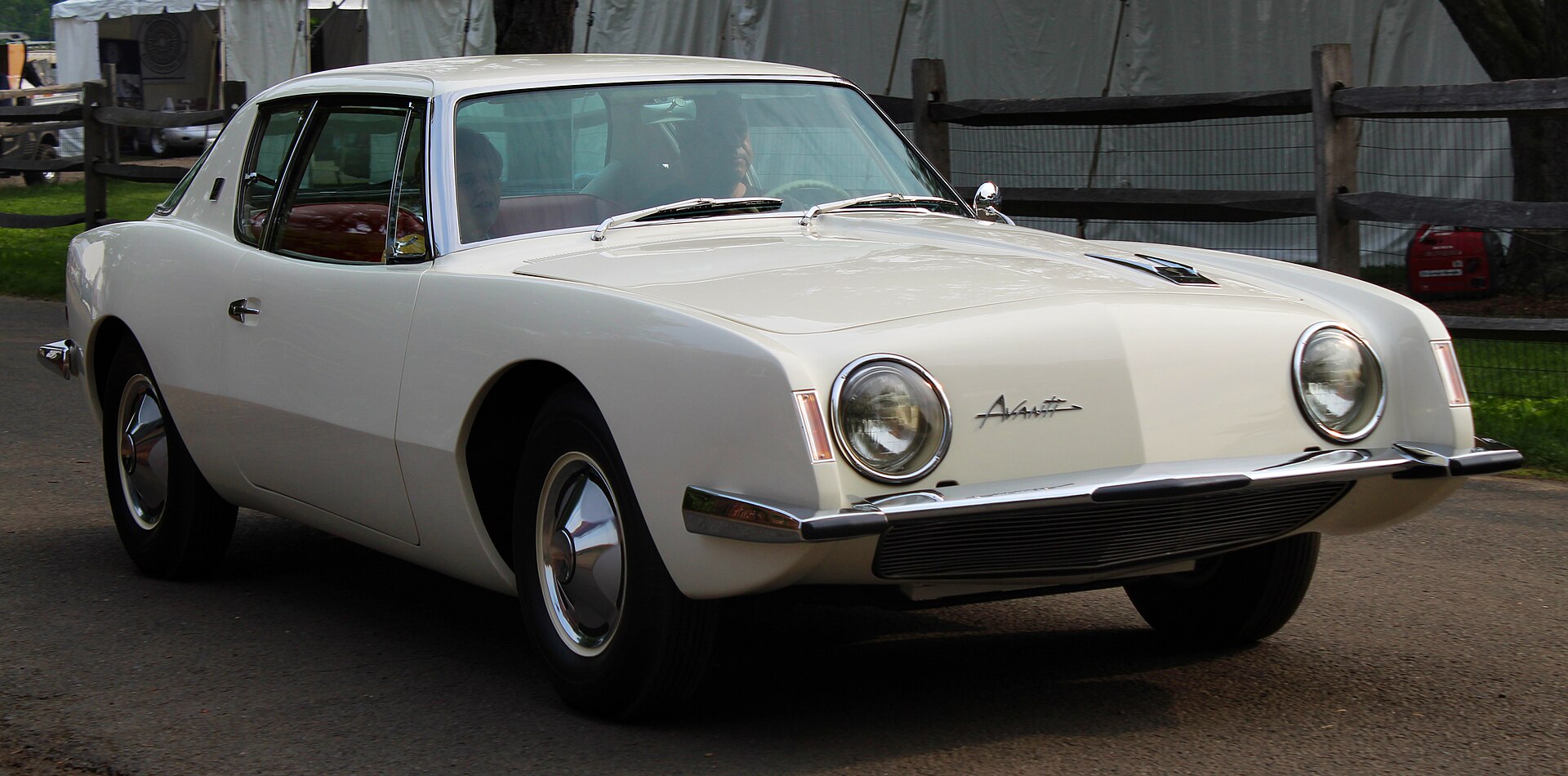
 Studebaker Avanti
Specs, engines and history
Published Sources (1) Report an error
By Sarah Whitmore, Senior Automotive Writer
- Built
- 1962–1963
- Top power
- 179 kW (243 PS)
Which Avanti to choose
Our verdict · Sarah Whitmore
- For the original: a 1962–1963 Studebaker-built car; the later Avanti II is a separate, hand-built car with Chevrolet power.
- For performance: an R2 with the Paxton supercharger and 216 kW (289 PS); R3 cars are very rare.
- For relaxed touring: an R1, without a supercharger, with the three-speed automatic.
- What to check: panel fit and finish, which were weak points from new, and the condition of the glass-fibre body.
More American cars of the decade are in the 1960s classics section and among the best classic cars of the 1960s.
Studebaker began as a blacksmith and foundry business that the brothers Henry and Clement Studebaker opened in South Bend, Indiana, in February 1852. It became a major builder of wagons and carriages and supplied the Union Army in the Civil War. Motor vehicles followed in the new century: electric cars from 1902 and petrol cars from 1904, at first with Garford. The 1939 Champion, the 1947 Starlight coupé and the Lark of 1959 were its big sellers. In 1954 it merged with Packard, and car production in South Bend ended on 20 December 1963; the last Studebaker left the plant in Hamilton, Ontario, on 17 March 1966.
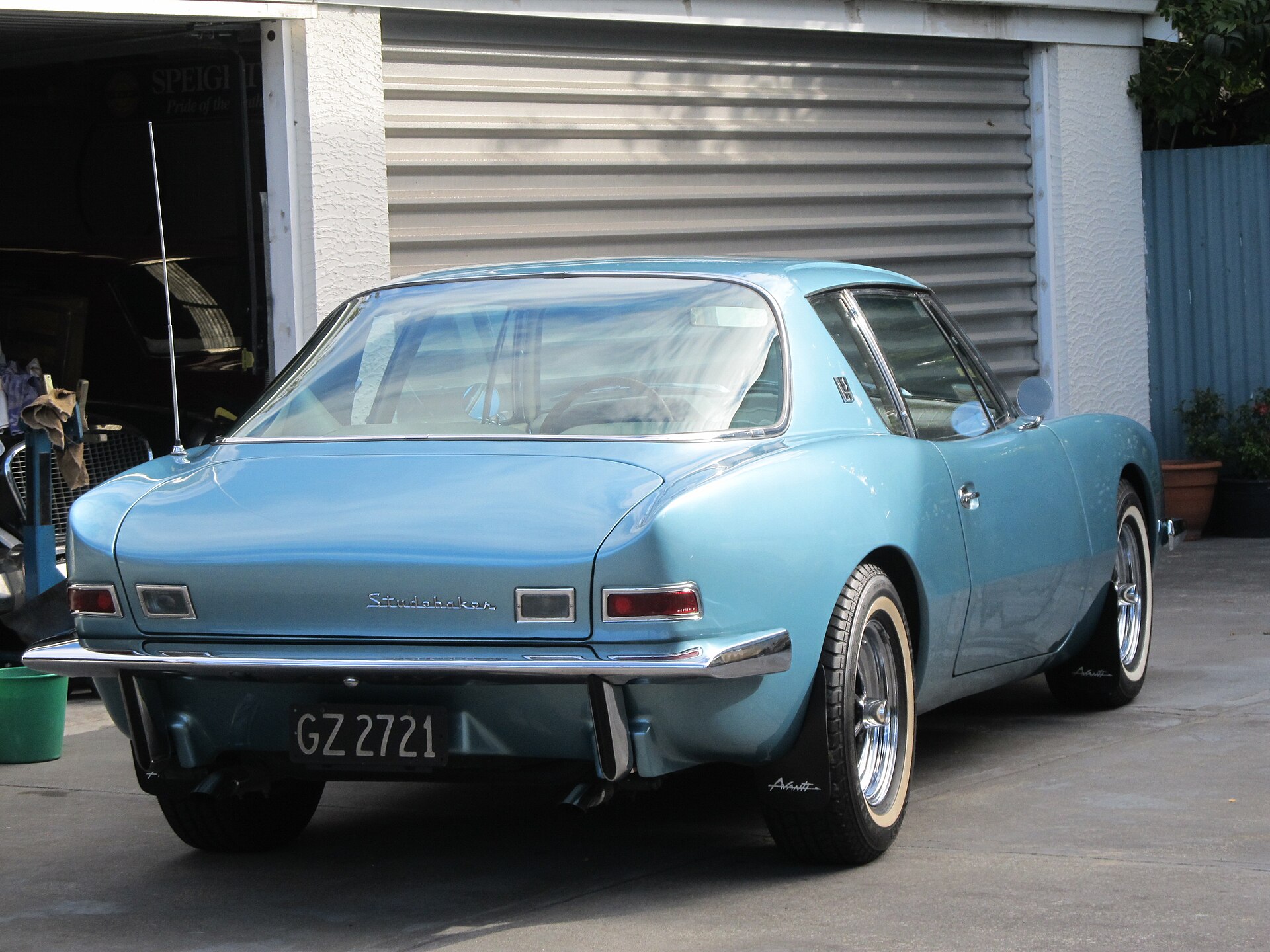
The Avanti is the car of those last South Bend years. It is a four-seat coupé with a glass-fibre body, styled in 40 days by Raymond Loewy's team and built from June 1962 to December 1963. It was the first American production car offered with front disc brakes, and a modified supercharged Avanti set 29 world speed records at Bonneville. Its name and tooling outlived Studebaker by more than 40 years.
Specs by version
| Version | Engine | Power | Drive | Production years |
|---|---|---|---|---|
| 4.7 V8 (289) | 8 cyl · Petrol | 179 kW 243 PS240 hp | Rear-wheel drive | 1963 |
Verified Manufacturer and type-approval data from our catalog · Sources and methodology
In short
- Built in South Bend, Indiana, from June 1962 to December 1963: 1,200 cars in 1962 and fewer than 4,600 in 1963 (German Wikipedia gives 4,643 in total).
- Studebaker 289 V8 of 4.7 litres with 179 kW (240 hp); the Paxton-supercharged R2 had 216 kW (289 PS).
- Front disc brakes of Dunlop design built by Bendix, a first on an American production model.
- Name, tooling and plant space were sold on, and Avanti derivatives were built until 2006.
Studebaker Avanti at a glance
| Parameter | Metric | Imperial |
|---|---|---|
| Maker | Studebaker Corporation, South Bend, Indiana | — |
| Production | June 1962 – December 1963 | — |
| Built | 1,200 (1962) + fewer than 4,600 (1963); 4,643 in total by German Wikipedia | — |
| Design | Raymond Loewy and Associates: Tom Kellogg, Bob Andrews, John Ebstein | — |
| Body | two-door, four-seat coupé in glass fibre | — |
| Chassis | modified Studebaker Lark frame | 109 in wheelbase |
| Engine | 289 V8, 4.7 litres (4,740 cm³) | 289 cu in |
| Power (R1) | 179 kW (240 hp) | — |
| Gearbox | three-speed manual, four-speed manual or three-speed automatic | — |
| Wheelbase | 2,769 mm | 109 in |
| Length × width × height | 4,887 × 1,786 × 1,367 mm | 192.4 × 70.3 × 53.8 in |
| Kerb weight | 1,404 kg | 3,095 lb |
Studebaker before the Avanti
The wagon business was incorporated in 1868 as the Studebaker Brothers Manufacturing Company. Cars took over in the 20th century: output reached 28,623 vehicles in 1912 and 136,205 in 1928. The company went into receivership on 18 March 1933 and was back in profit by December that year. The 1939 Champion, with styling credited to Raymond Loewy and Virgil Exner, doubled sales in its first year, and production peaked at 268,226 vehicles in 1950.
The 1950s were harder. The 1954 merger with Packard created Studebaker-Packard, which was close to bankruptcy by 1956. The compact Lark, built largely from existing parts, sold more than 130,000 in its first year, and output rose from 56,920 in 1958 to 153,844 in 1959. Sales fell once the big Detroit makers launched their own compacts in 1960, and a 38-day strike began on 1 January 1962. The Avanti was meant to change the company's image at exactly this point.
Sherwood Egbert's 40-day car
Sherwood Egbert became president of Studebaker in February 1961. The company was losing ground, and he wanted a car that would answer Ford's Thunderbird and give the brand a performance image it lacked. English Wikipedia says he sketched the basic theme himself during a flight.
Raymond Loewy's studio was given a crash programme of 40 days. Its stylists had a clay model ready in eight days, with a two-seat sports car on one side and a four-seat GT coupé on the other. Tom Kellogg preferred the four-seater, and that is the car that was built. The result was quite unlike the Thunderbird and the two-seat Corvette of the time, which the Corvette C1 and Thunderbird comparison sets side by side.
Design: glass fibre and no grille
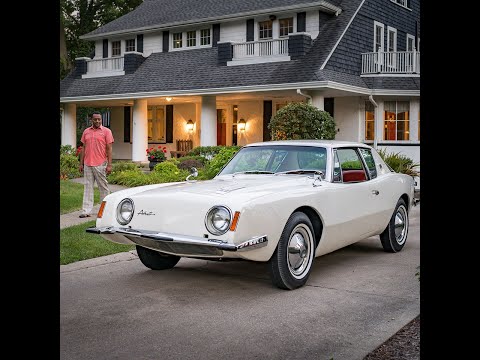
A steel body of this shape would have been costly and hard to make, so the Avanti was built in glass fibre. The panels came from Molded Fiberglass Body of Ashtabula, Ohio, the firm that had made the first Corvette bodies in 1953. The history of the Chevrolet Corvette covers that car.
The shape has no conventional grille. The Avanti was one of the first "bottom breather" designs, taking cooling air from below the front bumper. It sat on a modified 109-inch Lark chassis, and its front disc brakes, a Dunlop design made under licence by Bendix, were the first offered on an American production car.

Engines: R1, R2 and the Bonneville R3
All Studebaker-built Avantis use versions of the company's 289 cu in V8. German Wikipedia lists the following outputs:
| Engine | Displacement | Induction | Power |
|---|---|---|---|
| R-1 (standard) | 4.7 l | no supercharger | 179 kW (240 SAE hp) |
| R-2 (option) | 4.7 l | Paxton supercharger | 216 kW (289 PS) |
| R-3 | bored to 4.9 l, later 5.0 l | Paxton supercharger | 250 kW (335 PS) officially; about 295 kW measured on a dynamometer |
| R-5 (experimental) | — | one supercharger per bank | 429 kW (575 PS) |
The Avanti was called "the fastest production car in the world" when it appeared. A modified car with the supercharged R3 went past 170 mph (270 km/h) at the Bonneville Salt Flats and broke 29 world speed records there, according to English Wikipedia. German Wikipedia describes a standard R-3 reaching just under 275 km/h at Bonneville in 1963 and setting 34 US records. With 179 kW and 1,404 kg, the standard car has about 127 kW per tonne; the power-to-weight calculator compares it with later coupés.

Production problems and the end in South Bend
Egbert planned to sell 20,000 Avantis in 1962. Studebaker built only 1,200 that year. The outside body supplier could not keep up, panel fit and finish were poor, and delays led buyers to cancel orders. A Competition Press report quoted in English Wikipedia said that dealers held about 2,500 cars and had sold 1,600 since the launch. For comparison, Chevrolet built 23,631 Corvettes in 1963.
| Date | Event |
|---|---|
| February 1961 | Sherwood Egbert becomes Studebaker president |
| 1962 | Avanti launched; production from June, 1,200 built |
| 1963 | fewer than 4,600 built; Bonneville speed records |
| 20 December 1963 | South Bend plant closes; Avanti production ends |
| 1965 | Avanti II production starts under Nate Altman and Leo Newman |
| 1987 | production moves to Ohio |
| 2006 | last derivatives built, production moved to Cancún, Mexico |
Egbert was forced out, sales of the whole range were weak, and the South Bend factory shut on 20 December 1963. Studebaker carried on in Canada for little more than two years.
Avanti II and the later Avantis
The Avanti name, tooling and plant space were bought by two South Bend Studebaker dealers, Nate Altman and Leo Newman. They formed the Avanti Motor Corporation and hired former Studebaker workers to build the Avanti II by hand from 1965. It had no link to the Studebaker brand and used Chevrolet Corvette V8s, first of 5.4 litres, then 5.7, 6.6 and finally 5.0 litres. German Wikipedia puts output at roughly 150 to 250 cars a year until the early 1980s.
Five different ventures built Avanti derivatives through 2006. Stephen Blake took over after the founders died and went bankrupt in 1986. Michael Kelly then moved production to Ohio in 1987, on a Camaro and Firebird platform. A redesigned AVX followed from 2001, a Ford 4.6-litre V8 with 227 kW (304 PS) from 2004, and production moved to Cancún, Mexico, in 2006. It ended in 2006 or early 2007, and the company was dissolved in 2008.

Photo gallery


Studebaker Avanti in our rankings
- No. 530 of 859 · Most powerful cars (179 kW · top 62%)
- No. 59 of 94 · Most powerful cars of the 1960s (179 kW · top 63%)
- No. 117 of 154 · Most powerful American cars (179 kW · top 76%)
- No. 259 of 313 · Most powerful coupes (179 kW · top 83%)
- No. 139 of 154 · Most powerful V8 cars (179 kW · top 91%)
- No. 879 of 912 · Longest-running car nameplates (1 year)
More powerful than 38% of ranked cars in the 1CARS catalog (No. 530 of 859).
FAQ
How many Studebaker Avantis were built?
1,200 in 1962 and fewer than 4,600 in 1963, according to English Wikipedia; German Wikipedia gives 4,643 in total.
Who designed the Studebaker Avanti?
Raymond Loewy and Associates, with Tom Kellogg, Bob Andrews and John Ebstein, working from a theme sketched by Studebaker president Sherwood Egbert.
What engine does the Avanti have?
The Studebaker 289 V8 of 4.7 litres: 179 kW (240 hp) as the R1, 216 kW (289 PS) with the Paxton supercharger as the R2.
Was the Avanti the first American car with disc brakes?
It was the first American production model offered with front disc brakes, a Dunlop design built under licence by Bendix.
What is the difference between the Avanti and the Avanti II?
The Avanti was built by Studebaker in 1962–1963. The Avanti II was hand-built from 1965 by the Avanti Motor Corporation, with Chevrolet V8s and no link to the Studebaker brand.
Data sources
Data checked by an editor against the sources below.