Archive first published
Lada Vesta Sport: The 2018 Sports Saloon Explained
The Lada Vesta Sport is the sporting version of the Vesta saloon, shown in production form in August 2018 after a concept in 2016. It kept a naturally aspirated 1.8-litre engine but raised output to 107 kW (145 PS). A five-speed manual gearbox, wider tracks, bigger wheels and rear disc brakes completed the package. Lada quoted 0–100 km/h in 9.6 seconds.

Key takeaways
- Production version shown in August 2018; based on the Vesta saloon launched in 2015.
- 1.8-litre four-cylinder: 107 kW (145 PS) and 182–184 Nm, five-speed manual, front-wheel drive.
- 0–100 km/h in 9.6 s, top speed about 193 km/h.
- 17- or 18-inch wheels, five-stud hubs, rear disc brakes and a body kit with a diffuser.

Where the sports saloon came from
The Lada Vesta entered production in September 2015 on the Lada B/C platform developed with Renault. A sporting version was previewed as a concept in 2016. The production car was presented at a motor show in late August 2018, and it changed little from the concept. The Sport stayed a saloon. The estate and raised versions are covered on the Vesta SW Cross page.
Size at a glance
Hyundai Solaris RB
The Lada Vesta is 40 mm longer and 203 mm lower than the Hyundai Solaris RB.
| Dimensions | Lada Vesta | Hyundai Solaris RB | Difference |
|---|---|---|---|
| Length | 4,410 mm173.6 in | 4,370 mm172.0 in | +40 mm+1.6 in |
| Width | 1,764 mm69.4 in | - | - |
| Height | 1,497 mm58.9 in | 1,700 mm66.9 in | −203 mm−8.0 in |
| Wheelbase | 2,635 mm103.7 in | 2,570 mm101.2 in | +65 mm+2.6 in |
| Boot | 480 L17.0 cu ft | - | - |
Kia Rio UB
The Lada Vesta is 44 mm longer, 44 mm wider and 42 mm taller than the Kia Rio UB.
| Dimensions | Lada Vesta | Kia Rio UB | Difference |
|---|---|---|---|
| Length | 4,410 mm173.6 in | 4,366 mm171.9 in | +44 mm+1.7 in |
| Width | 1,764 mm69.4 in | 1,720 mm67.7 in | +44 mm+1.7 in |
| Height | 1,497 mm58.9 in | 1,455 mm57.3 in | +42 mm+1.7 in |
| Wheelbase | 2,635 mm103.7 in | 2,570 mm101.2 in | +65 mm+2.6 in |
| Boot | 480 L17.0 cu ft | 500 L17.7 cu ft | −20 L−0.7 cu ft |

Lada Vesta Sport specifications

| Figure | Vesta Sport |
|---|---|
| Engine | 1.8-litre 16-valve four-cylinder, no turbo |
| Power | 107 kW (145 PS) at 6,000 rpm |
| Torque | 182–184 Nm |
| Gearbox | 5-speed manual |
| Drive | front-wheel drive |
| 0–100 km/h | 9.6 s |
| Maximum speed | 193 km/h (approx.) |
| Length / width | 4,420 mm / 1,774 mm |
| Wheelbase | 2,635 mm |
| Boot | 480 litres |
How the Sport differed from the standard car
According to the old 1cars report, the standard 1.8 produced 90 kW (122 PS) and reached 100 km/h in 10.2 seconds. The Sport gained power through new camshaft settings, revised engine software and a cooler air intake. By our calculation, that is 17 kW more and 0.6 seconds less to 100 km/h.
| Area | Change on the Sport |
|---|---|
| Engine | 107 kW instead of 90 kW |
| Gearbox | 5-speed manual only, no automated option |
| Chassis | front track 35 mm and rear 15 mm wider, lower ride height |
| Brakes and wheels | rear discs, five-stud hubs, 17- or 18-inch wheels |
| Body | X-shaped bumper inserts, rear diffuser, boot spoiler, side sills |
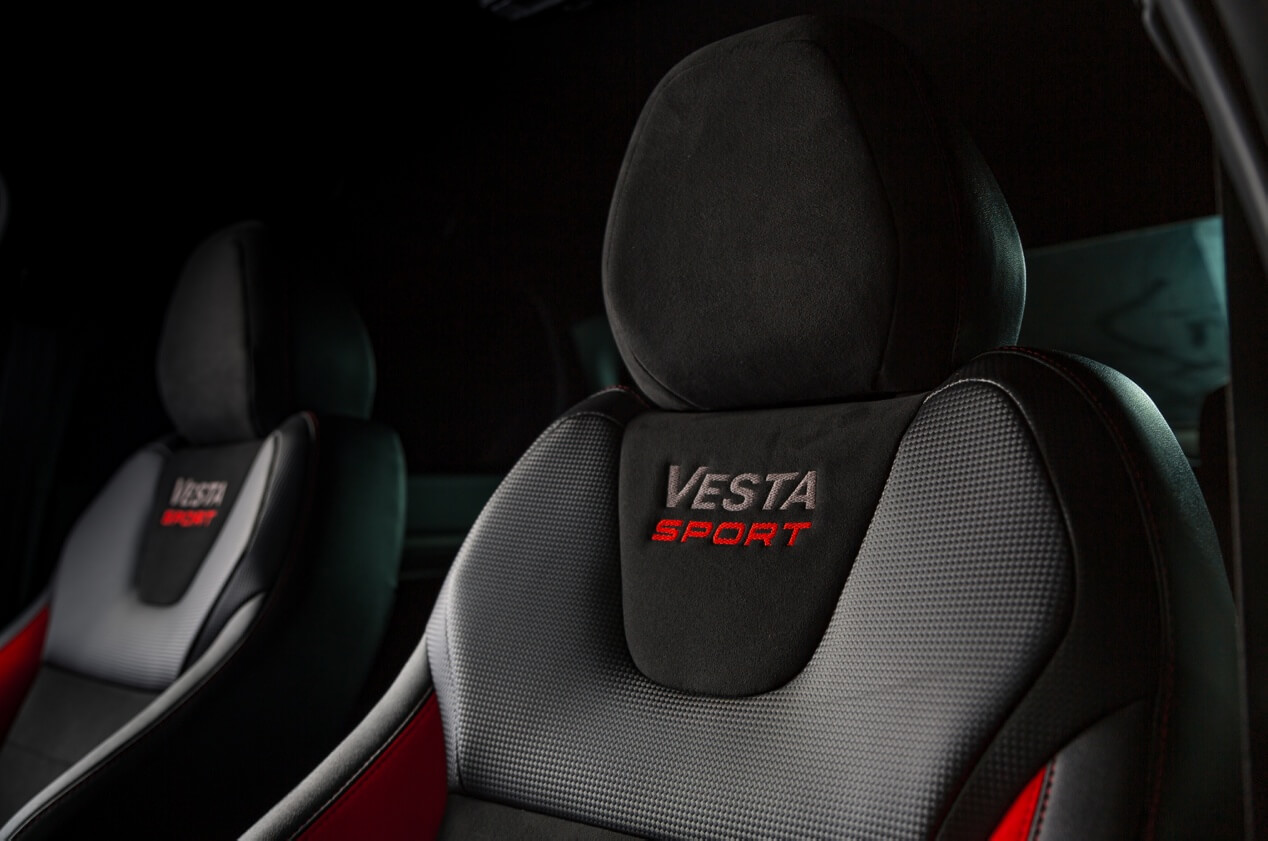
| Cabin | leather steering wheel with red stitching, sports front seats, steel pedal covers |
The five-stud hubs replaced the usual four-stud pattern so the larger wheels and brakes could fit. The front arches were enlarged for the same reason.
Performance in context
With about 1,322 kg of kerb weight in spec-database figures, the Sport carries about 12.4 kg per kW, by our calculation. That is warm-hatch territory rather than hot-hatch. Its appeal was a naturally aspirated engine and a manual gearbox in an affordable saloon. You can compare such figures with the power-to-weight calculator.

What happened next
Lada began exporting the Vesta to several EU countries in early 2017, including Germany, Austria, Hungary and Slovakia. A German launch of the Sport was described as uncertain in 2018, and Lada's exports to the EU ended in 2022. The Sport therefore stayed a rare sight in Western Europe. The brand's background is in the history of AvtoVAZ.

Should you buy a Vesta Sport? Our view
It suits drivers who want a simple, naturally aspirated manual saloon with sharper handling. Choose it over a standard Vesta if steering and braking matter more than comfort, because the lower suspension rides firmer. Avoid it if you need an automatic. For a direct rival, read the Lada Vesta vs Volkswagen Polo comparison, or open the comparison tool and the Lada catalogue.


FAQ
How much power does the Lada Vesta Sport have?
The 1.8-litre naturally aspirated engine produces 107 kW (145 PS) at 6,000 rpm and 182–184 Nm of torque. The standard Vesta 1.8 had 90 kW (122 PS), so the Sport gained about 17 kW.
Does the Lada Vesta Sport have a turbo?
No. It uses a naturally aspirated 1.8-litre four-cylinder engine. Extra power came from new camshaft settings, revised software and a cooler air intake rather than a turbocharger.
How fast is the Lada Vesta Sport?
It accelerates from 0 to 100 km/h in 9.6 seconds and reaches about 193 km/h. The standard 1.8 Vesta needed about 10.2 seconds to reach 100 km/h.
Is the Vesta Sport available with an automatic gearbox?
No. The Sport came only with a five-speed manual gearbox and front-wheel drive. The automated manual offered on other Vesta versions was not available on it.