
 Lada Granta
Specs, engines and history
Updated Published Sources (2) Report an error
By Oleksandr Hnatiuk, Automotive Editor & Used Car Specialist Reviewed by Felix Hartmann

- Built
- 2011–present
- Top power
- 87 kW (118 PS)
Which Granta to choose
Our verdict · Oleksandr Hnatiuk
The right Granta depends on the job it has to do.
- Simplest and cheapest to run: the 8-valve 64 kW (87 PS) manual, with the lowest NEDC consumption of the range.
- Automatic: the 16-valve 72 kW (98 PS) with the conventional 4-speed automatic, from July 2012.
- Best performance: the 16-valve 78–79 kW (106–107 PS), with a manual or automated manual gearbox.
- Safety: EU-specification cars, sold roughly 2013–2019, have two airbags, ABS and ESP as standard; elsewhere, check the equipment car by car.
- Practicality: the liftback (from 2014) or the estate, which add a large tailgate to the same footprint.
No large independent reliability survey from the EU, UK or US covers the Granta, so a documented service history matters more than the model year.
The Lada Granta is a low-cost, front-wheel-drive small car built by AvtoVAZ on the Lada Kalina platform. It was presented in May 2011 and went on sale on 1 December 2011. Every version uses a 1.6-litre petrol engine with 64–79 kW (87–107 PS), and the body range grew from a saloon to a liftback, hatchback and estate.
In short
- Production started on 29 November 2011; an automatic gearbox followed in July 2012 and a facelift with Lada's X-Design front in 2018.
- Three main 1.6-litre engines: 8-valve 64 kW (87 PS), 16-valve 72 kW (98 PS) and 16-valve 78–79 kW (106–107 PS).
- The saloon is 4,260 mm (167.7 in) long on a 2,476 mm (97.5 in) wheelbase.
- Front-wheel drive and petrol only: no all-wheel drive, hybrid or diesel.

Size at a glance
Renault Logan L52
The Lada Granta is 101 mm shorter, 33 mm narrower and 17 mm lower than the Renault Logan L52.
| Dimensions | Lada Granta | Renault Logan L52 | Difference |
|---|---|---|---|
| Length | 4,247 mm167.2 in | 4,348 mm171.2 in | −101 mm−4.0 in |
| Width | 1,700 mm66.9 in | 1,733 mm68.2 in | −33 mm−1.3 in |
| Height | 1,500 mm59.1 in | 1,517 mm59.7 in | −17 mm−0.7 in |
| Wheelbase | 2,476 mm97.5 in | 2,634 mm103.7 in | −158 mm−6.2 in |
| Boot | 520 L18.4 cu ft | - | - |
ZAZ Chance
The Lada Granta is 10 mm longer, 22 mm wider and 68 mm taller than the ZAZ Chance.
| Dimensions | Lada Granta | ZAZ Chance | Difference |
|---|---|---|---|
| Length | 4,247 mm167.2 in | 4,237 mm166.8 in | +10 mm+0.4 in |
| Width | 1,700 mm66.9 in | 1,678 mm66.1 in | +22 mm+0.9 in |
| Height | 1,500 mm59.1 in | 1,432 mm56.4 in | +68 mm+2.7 in |
| Wheelbase | 2,476 mm97.5 in | 2,520 mm99.2 in | −44 mm−1.7 in |
| Boot | 520 L18.4 cu ft | - | - |
Specs by version
Engines
Dimensions and weight
Show all 4 versions
| Version | Length | Width | Height | Wheelbase | Boot |
|---|---|---|---|---|---|
| 1.6 64 kW (87 PS) | 4,247 mm167.2 in | 1,700 mm66.9 in | 1,500 mm59.1 in | 2,476 mm97.5 in | 520 l18.4 cu ft |
| 72 kW (98 PS) | 4,247 mm167.2 in | 1,700 mm66.9 in | 1,500 mm59.1 in | 2,476 mm97.5 in | 520 l18.4 cu ft |
| 78 kW (106 PS) | 4,247 mm167.2 in | 1,700 mm66.9 in | 1,500 mm59.1 in | 2,476 mm97.5 in | 520 l18.4 cu ft |
| 87 kW (118 PS) | 4,247 mm167.2 in | 1,700 mm66.9 in | 1,500 mm59.1 in | 2,476 mm97.5 in | 520 l18.4 cu ft |
Verified Manufacturer and type-approval data from our catalog · Sources and methodology
At a glance: segment, body styles and where it is built
The Granta is AvtoVAZ's entry-level car, a front-wheel-drive saloon and hatchback that sits on the boundary between the B and C segments. It was conceived as an affordable car for as many buyers as possible.

The car is built by AvtoVAZ in Russia, with additional assembly in several other countries. LADA lists six body variants: saloon, liftback, hatchback, estate, the Cross estate and the Drive Active saloon. By late 2021, ten years after the first car left the line, LADA said more than one million Grantas had been built.
The Granta belongs to a long line of affordable Lada saloons; the history of AvtoVAZ and Lada cars shows where it fits, and the full Lada range lists its stablemates.
History and development
The Granta started life inside AvtoVAZ as the "Low Cost" project, which aimed at a car that most households could afford. Instead of a clean-sheet design, engineers used the platform of the Lada Kalina, which kept development costs and time down.

The name was chosen through a public naming contest, and the winning entrant received a Lada Kalina as the prize. Key dates:
- 11 May 2011: public presentation of the saloon.
- 16 May 2011: start of test production, which older articles describe as the start of mass production.
- 29 November 2011: first series-production cars.
- 1 December 2011: official sales start.
- 19 July 2012: production of the automatic version begins. According to LADA, it was the first mass-produced Lada with an automatic gearbox.
- 2014: the five-door liftback joins the saloon.
Hatchback and estate versions joined the range later. In August 2018 the range was facelifted with the X-Design front end already used on the Lada Vesta and Lada XRay. After that update the Granta replaced every Kalina and earlier Granta version, so one model line now covered saloon, liftback, hatchback, estate and Cross.
In 2025 Lada introduced the Iskra, a saloon and estate on a different platform, which Wikipedia lists as the Granta's successor. The Iskra is a separate model, and the sources consulted do not say that Granta production has ended.
Engines, gearboxes and performance
Every Granta has a 1.6-litre (1,596 cc) four-cylinder petrol engine driving the front wheels. The versions differ in valve count, tuning and gearbox.

| Engine code | Valves | Power | Torque | Gearbox |
|---|---|---|---|---|
| 21116 | 8 | 64 kW (87 PS) at 5,100 rpm | 140 Nm (103 lb-ft) at 3,800 rpm | 5-speed manual |
| 21126 | 16 | 72 kW (98 PS) at 5,600 rpm | 145 Nm (107 lb-ft) at 4,000 rpm | 4-speed automatic |
| 21127 | 16 | about 78–79 kW (106–107 PS) | 148 Nm (109 lb-ft) at 4,000 rpm | 5-speed manual or automated manual |
Rounding varies between sources: the 8-valve engine also appears as 88 or 90 hp, and the 21127 as 106 or 107 hp. A lower-output 8-valve version, the 11183, is usually quoted at 60 kW (82 PS).
The 8-valve engine with the manual gearbox is the simplest drivetrain. The ADAC catalogue lists the EU-specification car at 168 km/h (104 mph) and 11.8 seconds from 0 to 100 km/h (0–62 mph). The 16-valve automatic is slower off the line, at 12.6 seconds and 169 km/h (105 mph). The 106 PS manual is usually quoted at 10.9 seconds and 183 km/h (114 mph), the quickest Granta.
Cars sold in the EU met Euro 5 (8-valve, 2013–2015) and later Euro 6b (16-valve automatic, 2016–2019).
The chassis is conventional for the class: MacPherson struts at the front, a torsion-beam rear axle, electric rack-and-pinion power steering, front disc brakes and rear drums. LADA says the rear-wheel negative camber setting was taken from its motorsport work.
Dimensions, space and key specifications
The Granta saloon is 4,260 mm (167.7 in) long, 1,700 mm (66.9 in) wide and 1,500 mm (59.1 in) tall, on a 2,476 mm (97.5 in) wheelbase. The table covers the saloon with the 16-valve engines; ranges show the spread between versions.

| Parameter | Metric | Imperial |
|---|---|---|
| Engine | 1.6 L (1,596 cc) petrol, 4 cylinders | 97.4 cu in |
| Power | 64–79 kW (87–107 PS) by version | 86–106 hp |
| Torque | 140–148 Nm | 103–109 lb-ft |
| Length | 4,260 mm | 167.7 in |
| Width (with mirrors) | 1,700 mm (1,945 mm) | 66.9 in (76.6 in) |
| Height | 1,500 mm | 59.1 in |
| Wheelbase | 2,476 mm | 97.5 in |
| Boot (saloon, EU catalogue) | about 480 L | about 17.0 cu ft |
| Kerb weight (as usually quoted) | about 1,075–1,080 kg | about 2,370–2,381 lb |
| Top speed | 168–183 km/h by version | 104–114 mph |
| 0–100 km/h (0–62 mph) | 10.9–12.6 s | 10.9–12.6 s |
| Fuel tank | 50 L | 11.0 UK gal |
| Combined consumption (NEDC) | 6.6–7.1 L/100 km | 39.8–42.8 mpg (UK) |
| Drive | front-wheel drive | front-wheel drive |
Boot figures depend on how they are measured. The German ADAC catalogue gives 480 L (17.0 cu ft) for the 8-valve saloon and 440 L (15.5 cu ft) for the automatic, while some spec databases quote 520 L. Weights vary for the same reason: ADAC's EU figure, which includes a driver, is 1,135 kg (2,502 lb) for the 8-valve car.
Fuel economy
On the NEDC combined cycle, the 8-valve manual is rated at 6.6 L/100 km (42.8 mpg UK) and 150 g/km of CO2, according to ADAC. The 16-valve automatic uses 7.1 L/100 km (39.8 mpg UK) and emits 164 g/km. Urban figures are 9.0 and 9.9 L/100 km respectively. No WLTP figures were found for EU cars. With a 50 L (11.0 UK gal) tank, the 8-valve manual's NEDC rating suggests a theoretical range of about 750 km (470 miles).

Safety and equipment
The Granta's safety kit depends heavily on market and trim. German-market cars listed by ADAC had driver and passenger airbags, ABS with brake assist, ESP stability control, rear ISOFIX mountings and rear head restraints as standard.

Early specifications used trim names such as Standard, Norma and Lux, with the Lux adding ABS, air conditioning and a passenger airbag; equipment differed by country, so check the car rather than the badge.
No Euro NCAP result has been published for the Granta, so there is no European crash-test score to compare with rivals. According to Wikipedia, about 30,000 Granta and Kalina cars were recalled in May 2013 over a braking problem; a used car's service history should show whether that work was done.
The Granta in Europe
The Granta was sold in several EU countries, including Germany, the Czech Republic, Slovakia, Austria, Hungary and France, as usually listed. The ADAC catalogue covers German-market cars from October 2013 to April 2019. In that period ADAC gives a new-car base price of 12,490 EUR for the 1.6 16V Luxus Automatik (2016–2019). Exports to the EU are reported to have stopped in early 2022, so European examples are now used cars.

Rivals and alternatives
The Granta's natural rivals are other low-cost saloons and hatchbacks with simple petrol engines. The closest are the Renault Logan and the Hyundai Solaris, as well as the older Daewoo Nexia and ZAZ Chance. In the EU its obvious counterparts were Dacia's budget models. The Granta's case rested on a low price and simple mechanicals; its weak point against European rivals was the lack of an independent crash-test rating.

Rivals
Compare with…
Compare Lada Granta with
- ZAZ Chance quick spec comparison
- Renault Logan quick spec comparison
- Chevrolet Cobalt quick spec comparison
-
Ended 2015
- Years
- 2009–2015
- Body
- Sedan, Hatchback
- Fuel
- Petrol
- Power
- 51–74 kW (69–101 PS)
-
Ended 2020
- Years
- 2012–2020
- Body
- Sedan
- Fuel
- Petrol, Diesel
- Power
- 55–75 kW (75–102 PS)
-
In production
- Years
- 2011–present
- Body
- Sedan
- Fuel
- Petrol
- Power
- 64–77 kW (87–105 PS)


Lada Granta in our rankings
- No. 130 of 549 · Smallest cars (4,247 mm · top 24%)
- No. 79 of 321 · Biggest boot: cars (520 l · top 25%)
- No. 309 of 1134 · Longest-running car nameplates (15 years · top 28%)
- No. 151 of 381 · Oldest car models still on sale (15 years · top 40%)
- No. 431 of 549 · Longest cars (4,247 mm · top 79%)
- No. 560 of 690 · Biggest engines: cars (1,600 cc · top 83%)
Shorter than 76% of ranked cars in the 1CARS catalog (No. 130 of 549).
Lada Granta photos 37


Lada Granta videos 5

Lada Granta video 1
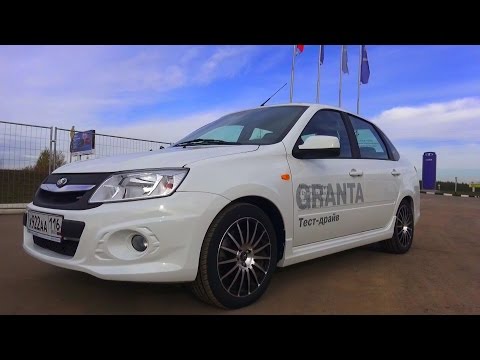
Lada Granta video 2

Lada Granta video 3

Lada Granta video 4

Lada Granta video 5
FAQ
What is the fuel consumption of the Lada Granta?
On the NEDC combined cycle, the 8-valve 1.6 manual is rated at 6.6 L/100 km (42.8 mpg UK), the 16-valve automatic at 7.1 L/100 km (39.8 mpg UK), according to ADAC data for EU cars. Real-world figures are usually higher than NEDC values.
Is the Lada Granta available with all-wheel drive or as a hybrid?
No. Every Granta is front-wheel drive and uses a 1.6-litre petrol engine. There has been no all-wheel-drive, hybrid, electric or diesel version; the Cross estate also drives the front wheels only.
What engines does the Lada Granta have?
Three main 1.6-litre petrol engines: the 8-valve 21116 with 64 kW (87 PS), the 16-valve 21126 with 72 kW (98 PS) paired with the automatic, and the 16-valve 21127 with about 78–79 kW (106–107 PS). A lower-output 8-valve 11183 is usually quoted at 60 kW (82 PS).
How big is the Lada Granta?
The saloon measures 4,260 mm (167.7 in) long, 1,700 mm (66.9 in) wide and 1,500 mm (59.1 in) tall, with a 2,476 mm (97.5 in) wheelbase. The EU catalogue lists a boot of about 480 L (17.0 cu ft) for the saloon.
What are the main rivals of the Lada Granta?
The usual comparisons are the Renault Logan, Hyundai Solaris, Daewoo Nexia and ZAZ Chance. In the EU, where the Granta was sold from about 2013 to 2019, its obvious counterparts were Dacia's budget models.
Was the Lada Granta sold in Europe?
Yes. It was sold in Germany, the Czech Republic, Slovakia, Austria, Hungary and France, among others. German-market cars were offered from October 2013 to April 2019 with Euro 5 and later Euro 6b engines, and EU exports reportedly stopped in early 2022.
Data sources
Data checked by an editor against the sources below.
- The text of this article (1cars archive)
- Automotiveworld - Lada Granta 10 Years On The Assembly Line


