
 Lada XRay
Specs, engines and history
Updated Published Sources (4) Report an error
By Oleksandr Hnatiuk, Automotive Editor & Used Car Specialist Reviewed by Felix Hartmann

- Built
- 2015–2022
- Top power
- 90 kW (122 PS)
Which Lada XRAY to buy
Our verdict · Oleksandr Hnatiuk
The 1.8-litre VAZ-21179 offers the best performance and, with the manual gearbox, is the simplest choice. The XRAY Cross with the HR16 engine and CVT suits drivers who want a two-pedal car with more ground clearance. Production ended in 2022 when imported components became unavailable, so check the supply of parts and the service history of any used example.
The Lada XRAY is a compact crossover-style hatchback built by AvtoVAZ from December 2015 to 2022. Designed by a team led by Steve Mattin and based on the Dacia Sandero's B0 platform, it offered 1.6 and 1.8-litre petrol engines with 78–90 kW, front-wheel drive and a raised 195 mm ground clearance. More than 161,000 were sold.
In short
- Engines: 1.6 VAZ-21129 with 78 kW (106 PS), 1.6 Renault-Nissan HR16 with 81 kW (110 PS) and 1.8 VAZ-21179 with 90 kW (122 PS).
- Gearboxes: 5-speed manual, 5-speed automated manual (AMT) and, on the XRAY Cross, a CVT.
- Size: 4,165 mm long, 2,592 mm wheelbase, 361–1,207 litre boot.
- XRAY Cross: wider body cladding and 215 mm ground clearance; a CVT version arrived in July 2019.

Size at a glance
Lifan X50
The Lada XRay is 65 mm longer, 43 mm wider and 32 mm taller than the Lifan X50.
| Dimensions | Lada XRay | Lifan X50 | Difference |
|---|---|---|---|
| Length | 4,165 mm164.0 in | 4,100 mm161.4 in | +65 mm+2.6 in |
| Width | 1,765 mm69.5 in | 1,722 mm67.8 in | +43 mm+1.7 in |
| Height | 1,572 mm61.9 in | 1,540 mm60.6 in | +32 mm+1.3 in |
| Wheelbase | 2,593 mm102.1 in | - | - |
| Boot | 376 L13.3 cu ft | 570 L20.1 cu ft | −194 L−6.9 cu ft |
Specs by version
Engines
Dimensions and weight
Show all 3 versions
| Version | Length | Width | Height | Wheelbase | Boot |
|---|---|---|---|---|---|
| 1.6 78 kW (106 PS) SUV | 4,165 mm164.0 in | 1,765 mm69.5 in | 1,572 mm61.9 in | 2,593 mm102.1 in | 376 l13.3 cu ft |
| 1.6 84 kW (114 PS) SUV | 4,165 mm164.0 in | 1,765 mm69.5 in | 1,572 mm61.9 in | 2,593 mm102.1 in | 376 l13.3 cu ft |
| 1.8 90 kW (122 PS) SUV | 4,165 mm164.0 in | 1,765 mm69.5 in | 1,572 mm61.9 in | 2,593 mm102.1 in | 376 l13.3 cu ft |
Verified Manufacturer and type-approval data from our catalog · Sources and methodology
Lada XRAY at a glance
The XRAY was AvtoVAZ's first crossover-style car developed together with the Renault–Nissan alliance. Its name reads as "X-ray" and is also explained as an abbreviation: X for the crossover class, followed by Recreation, Activity and Youth. It sits between the Lada Granta and the Lada Vesta in size and shares the design language of the Vesta. The brand's background is covered in the history of AvtoVAZ and Lada, and all models are in the Lada catalogue.

| Fact | Value |
|---|---|
| Maker | AvtoVAZ (Lada) |
| Production | December 2015 – 2022 |
| Sales start | 14 February 2016 |
| Platform | Renault/Dacia B0 (Dacia Sandero) |
| Body | 5-door crossover hatchback |
| Drive | Front-wheel drive |
| Internal code | GAB |
| Sales | more than 161,000 |
Design and development
The XRAY began as a concept car in August 2012, designed under Steve Mattin, who also led the design of the Vesta. A second concept, the XRAY Concept 2, followed in 2014, and the first production body was assembled for testing in October 2015. Production began in December 2015.

The front is built around the "X" theme that became Lada's signature: the grille and the angled headlights form a large letter X, picked out with polished inserts. Creased side panels with X-shaped stampings, LED daytime running lights and LED indicators in the door mirrors complete the look. According to the old 1cars text, the windscreen is steeply raked and the wheel arches combine convex surfaces with sharp edges.
Cabin, touchscreen and seating
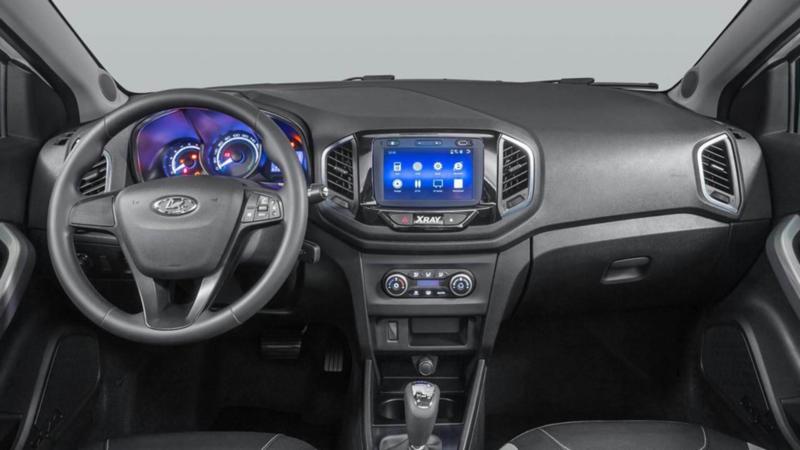
The dashboard is dominated by a large speedometer set in a gloss-dark panel, and higher trims have a 7-inch colour touchscreen with navigation, music and telephone functions. The old 1cars text describes two-tone seats with contrasting stitching, front seats with a wide adjustment range but modest side support, and a storage drawer under the front passenger seat. The glovebox can be cooled by the air conditioning.

Rear space is best for two adults; three fit, but the rear bench is narrow. The boot holds 361 litres with the rear seats up and 1,207 litres with them folded, with a full-size spare wheel under the floor.
Engines, gearboxes and performance
| Engine | Displacement | Power | Torque | Gearboxes |
|---|---|---|---|---|
| VAZ-21129 | 1,596 cc | 78 kW (106 PS) at 5,800 rpm | 148 Nm at 4,200 rpm | 5-speed manual, 5-speed AMT |
| Renault-Nissan HR16 (H4M) | 1,598 cc | 81 kW (110 PS) | 152 Nm | 5-speed manual; CVT on XRAY Cross |
| VAZ-21179 | 1,774 cc | 90 kW (122 PS) | 170 Nm at 3,750 rpm | 5-speed manual, 5-speed AMT |
According to the old 1cars text, the VAZ-21129 is a 16-valve engine with a cast-iron block, a timing belt and a variable-length intake manifold that improves torque across the rev range, while the HR16, developed by the Renault–Nissan alliance, has an aluminium block and a timing chain. The HR16 was dropped from the regular XRAY in July 2016 but returned in the XRAY Cross with a CVT. The 1.8-litre VAZ-21179 is based on the 1.6 with a longer stroke, and the automated manual gearbox was first offered with this engine.
| Version | 0–100 km/h | Top speed | Combined fuel use |
|---|---|---|---|
| 1.6 (78 kW) manual | 11.4 s | 176 km/h (109 mph) | 7.2 l/100 km (32.7 mpg US) |
| 1.6 (78 kW) AMT | 13.6 s | 174 km/h (108 mph) | 6.9 l/100 km (34.1 mpg US) |
| 1.8 (90 kW) AMT | 10.9 s | 187 km/h (116 mph) | 6.8 l/100 km (34.6 mpg US) |
| Cross 1.6 CVT | 12.8 s | 163 km/h (101 mph) | 7.3 l/100 km (32.2 mpg US) |
All versions meet the Euro 5 emissions standard. No all-wheel-drive version was produced.
XRAY and XRAY Cross dimensions

| Parameter | XRAY | XRAY Cross (CVT) | Imperial (XRAY) |
|---|---|---|---|
| Length | 4,165 mm | 4,171 mm | 164.0 in |
| Width | 1,764 mm | 1,810 mm | 69.4 in |
| Height | 1,570 mm | 1,645 mm | 61.8 in |
| Wheelbase | 2,592 mm | 2,592 mm | 102.0 in |
| Ground clearance | 195 mm | 215 mm | 7.7 in |
| Boot | 361–1,207 L | 361–1,207 L | 12.7–42.6 cu ft |
| Kerb weight | 1,190–1,250 kg | 1,295 kg | 2,624–2,756 lb |
| Fuel tank | 50 L | 50 L | 13.2 US gal |
XRAY Cross
The updated XRAY Cross, launched in July 2019 with an automatic gearbox, has a raised suspension with 215 mm of ground clearance, wider plastic wheel-arch cladding, a 1,810 mm body width and Android Auto and Apple CarPlay smartphone integration. The 1.6 HR16 engine with a CVT made it the first XRAY with a conventional automatic-style gearbox. The Cross Instinct special version followed in April 2020 with an updated multimedia system.

Airbags, stability control and trims
The XRAY was not tested by Euro NCAP or any other European crash-test programme. According to the old 1cars text, all versions have front airbags, ABS with brake-force distribution, brake assist, traction control, electronic stability control and an automatic emergency call system, and higher trims add side airbags. Seat belts have pretensioners and load limiters, and ISOFIX child-seat mounts are fitted.

Standard equipment included 16-inch wheels, central locking and an audio system with six speakers. Options included electrically adjustable driver's seat height, heated front seats, a heated windscreen and heated mirrors. The XRAY was offered in seven trim levels.
Rivals: how the XRAY compares
The XRAY competed with raised hatchbacks and small crossovers such as the Renault Sandero Stepway, the Renault Kaptur and the Kia Rio X-Line. Its strengths are high ground clearance, a modern design and a choice of three engines. Its weaknesses are the lack of all-wheel drive, a narrow rear bench, and a modest boot. Buyers who needed more space looked at the Lada Largus.

Rivals
Compare with…
Compare Lada XRay with
- Chery Tiggo 2 quick spec comparison
- Lifan X50 quick spec comparison
- Renault Sandero Stepway quick spec comparison
-
Ended 2017
- Years
- 2016–2017
- Body
- SUV
- Fuel
- Petrol
2 generations
- Tiggo 2
- Tiggo 2
-
In production
- Years
- 2008–present
- Body
- Hatchback
- Fuel
- Petrol, Diesel, LPG / CNG
- Power
- 51–85 kW (69–116 PS)
3 generations
- I
- II
- III
-
Ended 2022
- Years
- 2017–2022
- Body
- Hatchback
- Fuel
- Petrol
- Power
- 74–90 kW (101–122 PS)


Popular comparisons
Lada XRay in our rankings
- No. 16 of 198 · Smallest SUVs and crossovers (4,165 mm · top 9%)
- No. 105 of 563 · Smallest cars (4,165 mm · top 19%)
- No. 668 of 1146 · Longest-running car nameplates (7 years · top 61%)
- No. 221 of 321 · Biggest boot: cars (376 l · top 69%)
- No. 540 of 711 · Biggest engines: cars (1,800 cc · top 77%)
- No. 405 of 537 · Widest cars (1,765 mm · top 77%)
Shorter than 91% of ranked SUVs and crossovers in the 1CARS catalog (No. 16 of 198).
Lada XRay photos 10



Lada XRay videos 7

Lada XRay video 1

Lada XRay video 2

Lada XRay video 3

Lada XRay video 4

Lada XRay video 5

Lada XRay video 6

Lada XRay video 7
FAQ
What engines does the Lada XRAY have?
The XRAY was offered with a 1.6 VAZ-21129 (78 kW), a 1.6 Renault-Nissan HR16 (81 kW) and a 1.8 VAZ-21179 (90 kW). All are naturally aspirated four-cylinder petrol engines.
Is the Lada XRAY four-wheel drive?
No. Every XRAY and XRAY Cross is front-wheel drive. The Cross version adds ground clearance of 215 mm and protective body cladding, but not all-wheel drive.
What is the ground clearance of the Lada XRAY?
The regular XRAY has 195 mm of ground clearance. The XRAY Cross with the CVT gearbox is raised to 215 mm and is also wider, at 1,810 mm including the wheel-arch cladding.
Which car is the Lada XRAY based on?
It uses the Renault/Dacia B0 platform of the Dacia Sandero and was developed jointly by Renault and AvtoVAZ engineers, with Lada's own design led by Steve Mattin.
When was the Lada XRAY discontinued?
Production ran from December 2015 to 2022 and ended when imported components were no longer available. More than 161,000 XRAYs had been sold by then.
Data sources
Data checked by an editor against the sources below.
- The text of this article (1cars archive)
- Wikipedia - Lada XRAY
- Fastcarcheck
- Auto-data - Compare&carId1=24253&carId2=&carId3=


