
 Renault Sandero Stepway
All generations, specs and history
Updated Published Sources (2) Report an error
By Oleksandr Hnatiuk, Automotive Editor & Used Car Specialist Reviewed by Felix Hartmann

- Built
- 2008–present
- Generations
- 3
- Top power
- 85 kW (116 PS)
Timeline
Sandero Stepway generations
Click a generation for its own page


- Sandero Stepway I 2008–2012 · Hatchback · 51–82 kW (69–111 PS)
- Sandero Stepway II 2012–2020 · Hatchback · 53–66 kW (72–90 PS)
- Sandero Stepway III Current 2020–now · Hatchback · 66–85 kW (90–116 PS)
Newest first · 3 generations since 2008
-
2020

-
2012

-
2008

All generations by year: Sandero Stepway III (2020–now) · Sandero Stepway II (2012–2020) · Sandero Stepway I (2008–2012)
Which one is mine?
Pick the year of first registration to see which generation it is.
- Sandero Stepway III 2020–present
- Sandero Stepway II 2012–2020
- Sandero Stepway I 2008–2012
Which Sandero Stepway to buy
Our verdict · Oleksandr Hnatiuk
- Best all-rounder: a third-generation Stepway with the TCe 90 or TCe 110, the most modern body and the best equipment.
- Lowest running costs: an ECO-G 100 or ECO-G 120 with factory LPG, if filling stations are available where you drive.
- Cheapest used buy: a second-generation 0.9 TCe after the 2016 facelift; check the service history and the clutch.
- Avoid if safety is a priority: the Stepway's 2021 result lags behind many newer superminis, mainly because of driver assistance.
On every used Stepway, check the underbody and plastic cladding for damage from rough roads and make sure the roof bars are firmly fixed.
The Sandero Stepway is the raised, crossover-styled version of the Sandero supermini, sold as a Renault in Latin America and other markets and as a Dacia in Europe. It first appeared in Brazil in October 2008 and is now in its third generation, launched in September 2020 and facelifted in October 2025. It has always been front-wheel drive: the Stepway looks like a small SUV but drives like a hatchback.
In short
- Generations: I (2008–2012), II (2012–2020), III (since 2020); the Stepway has been launched alongside each new Sandero.
- Differences from the Sandero: higher ride height, plastic wheel-arch and sill cladding, crossover bumpers and roof rails.
- Engines: from a 51 kW 1.5 dCi diesel to the 85 kW ECO-G 120 petrol/LPG unit of 2025; front-wheel drive only.
- Euro NCAP: four stars for the second-generation Sandero (2013), two stars for the Stepway in 2021.

Specs by version
| Version | Engine | Power | Drive |
|---|---|---|---|
| Diesel · 1 version | |||
| Sandero Stepway I · 1.5 51 kW (69 PS) | 1.5 l · Diesel 1,500 cc | 51 kW 69 PS68 hp | Front-wheel drive |
| Petrol · 1 version | |||
| Sandero Stepway I · 1.6 62 kW (84 PS) | 1.6 l · Petrol 1,600 cc | 62 kW 84 PS83 hp | Front-wheel drive |
| Other · 1 version | |||
| Sandero Stepway I · 1.6 82 kW (111 PS) | 1.6 l 1,600 cc | 82 kW 111 PS110 hp | Front-wheel drive |
Verified Manufacturer and type-approval data from our catalog · Sources and methodology
Sandero Stepway at a glance

| Item | Data |
|---|---|
| Built | since 2008 (Brazil), 2009 (Europe) |
| Brands | Renault (Latin America, Africa and other markets), Dacia (Europe) |
| Body | five-door hatchback with raised suspension |
| Drive | front-wheel drive only |
| Engines | 0.9–1.6 l petrol, 1.0–1.2 l turbo petrol, LPG bi-fuel, 1.5 dCi diesel |
| Power range | 51–85 kW (70–115 hp) |
| Main plants | Mioveni (Romania), Tangier (Morocco), São José dos Pinhais (Brazil), Envigado (Colombia), Córdoba (Argentina) |
| Euro NCAP | 4 stars (Sandero II, 2013); 2 stars (Stepway III, 2021) |
How the Stepway differs from a normal Sandero
The Stepway is not a separate platform. It takes the Renault Sandero and adds raised suspension, grey or black plastic sill covers and wheel-arch extensions, crossover-style bumpers and roof bars. The old version of this page put the first generation's extra ground clearance at about 20 mm for European cars and 30 mm for Latin American ones. It also gave 195 mm for the second generation. These figures come from the old text and vary by market.

What the Stepway does not add is four-wheel drive. Every version, in every generation, drives the front wheels only; buyers who need an all-wheel-drive budget car should look at the Dacia and Renault Duster.
First generation (2008–2012)
Renault launched the Sandero Stepway in Brazil in October 2008, about ten months after the Sandero itself. It had a 1.6-litre sixteen-valve Hi-Flex engine that could run on petrol or ethanol, rated at 82 kW (112 hp). The car was sold in Brazil, Colombia, Argentina and Mexico. The old version of this page dated the project's start to 2005 and the first Sandero production to 2007 in Brazil.

The European Dacia Sandero Stepway was unveiled on 7 May 2009 at the Barcelona motor show and reached most European markets in September 2009. The old page placed this debut at Geneva in 2008, the year the Dacia Sandero itself was shown there. European buyers could choose a 1.6-litre petrol with 66 kW (90 hp) or a 1.5 dCi common-rail diesel with 51 kW (70 hp). The old page gave a boot of 320 litres, rising to 1,200 litres with the 60/40 split rear seat folded.
| Engine (gen I) | Power | Market |
|---|---|---|
| 1.6 8v petrol | 63 kW (85 hp) | several markets |
| 1.6 16v petrol | 66–77 kW (90–105 hp) | Europe and other markets |
| 1.6 16v Hi-Flex (petrol/ethanol) | 82 kW (112 hp) | Latin America |
| 1.5 dCi diesel | 51–66 kW (70–90 hp) | Europe |
Second generation (2012–2020)
The second Sandero and its Stepway version were revealed at the Paris Motor Show in September 2012, with a design close to the new Logan. In Brazil the Renault-badged model went on sale in June 2014. In Latin America the Stepway was sold under both the Dacia and Renault brands, and from 2020 it became a separate model there.

A facelift was shown in Paris in November 2016. It added LED daytime running lights and new tail lights. Entry versions got a 1.0-litre three-cylinder instead of the 1.2. A further update in 2019 applied only to the Renault-badged Brazilian car.
| Engine (gen II) | Power | Notes |
|---|---|---|
| 0.9 TCe three-cylinder turbo | 66 kW (90 PS) | main European petrol |
| 1.0 SCe three-cylinder | 54 kW (73 PS) | from 2016 |
| 1.2 16v LPG | 53 kW (72 PS) | bi-fuel |
| 1.6 8v / 16v petrol | 60 / 75 kW (82 / 102 hp) | markets outside the EU, old-text data |
The old version of this page described two 1.6-litre petrol engines with 60 kW (82 hp) and 134 Nm or 75 kW (102 hp) and 145 Nm. It quoted 12.3 and 11.2 seconds to 100 km/h and top speeds of 165 and 170 km/h. Those figures belong to cars for markets outside the European Union.
Euro NCAP tested the second-generation Sandero in May 2013 and gave it four stars: 80 % for adult occupants, 79 % for children, 57 % for pedestrians and 55 % for safety assist.
Third generation (since 2020)
The third Sandero and Stepway were presented on 7 September 2020 and launched on 29 September 2020, together with the Logan III. They use the low-cost version of the Renault-Nissan CMF-B platform and only three-cylinder engines. In June 2022 the cars got the new Dacia logo, a revised grille and a new steering wheel. On 6 October 2025 a facelift brought a new front end, headlights, wheels and infotainment, plus the ECO-G 120 bi-fuel engine.

| Engine (gen III) | Power | Fuel | Notes |
|---|---|---|---|
| TCe 90 | 66 kW (90 PS) | petrol | base Stepway engine |
| ECO-G 100 | 74 kW (100 PS) | petrol/LPG | factory LPG system |
| TCe 110 | 81 kW (110 PS) | petrol | Stepway only, shared with the Jogger |
| ECO-G 120 | 85 kW (115 hp) in petrol mode | petrol/LPG | from the 2025 facelift |
The factory LPG versions are the economy choice. LPG is usually cheaper per kilometre than petrol in the countries where it is common, and the car keeps a petrol tank for range. Our fuel cost calculator shows the difference at your local prices.
In the Euro NCAP test of 2021 the Stepway scored 70 % for adults, 72 % for children, 41 % for vulnerable road users and 42 % for safety assist. The result was two stars. Euro NCAP's secretary general, Michiel van Ratingen, said that "a two-star rating shows a lack of ambition, even for a low-cost product", pointing mainly to the basic driver-assistance systems.
Stepway against its rivals
The Stepway is one of the cheapest cars with a crossover look in Europe. Its rivals include the Renault Captur, the Suzuki Ignis and small crossovers such as the Opel Crossland, all of which cost more. Our car comparison tool helps line up their size, power and running costs. More about the two brands is in our history of Dacia and the Renault catalogue.

Renault Sandero Stepway evolution in numbers
Did you know?
- The Renault Sandero Stepway has been around for 18 years: 3 generations in our catalog since 2008.
- The longest-running generation is the Sandero Stepway II (2012–2020): 8 years.
- The biggest jump in power came with the Sandero Stepway III: up to 85 kW (116 PS), 19 kW more than the Sandero Stepway II.
Most powerful version, kW
Figures from the 1cars catalog: power is the strongest version of each generation; generations without the figure are left out.
Renault Sandero Stepway: first vs latest generation
| Spec | Sandero Stepway I | Sandero Stepway III | Change |
|---|---|---|---|
| Years | 2008–2012 | 2020–present | 12 years apart |
| Most powerful version | 82 kW (111 PS) | 85 kW (116 PS) | +3 kW (+4%) |
Oldest and newest generation in the 1cars catalog. Power is the strongest version of each; other rows are shown only when both generations have the figure.
Rivals
Compare with…
Compare Renault Sandero Stepway with
- Lada XRay quick spec comparison
- Dongfeng H30 Cross quick spec comparison
- Lada Vesta SW Cross quick spec comparison
-
Ended 2022
- Years
- 2015–2022
- Body
- SUV
- Fuel
- Petrol
- Power
- 78–90 kW (106–122 PS)
-
Ended 2010
- Years
- 2010
- Body
- Hatchback
- Fuel
- Petrol
- Power
- 86 kW (117 PS)
-
In production
- Years
- 2017–present
- Body
- Station wagon
- Fuel
- Petrol
- Power
- 78–90 kW (106–122 PS)
-
In production
- Years
- 2015–present
- Body
- Station wagon
- Fuel
- Petrol
- Power
- 77–78 kW (105–106 PS)


Renault Sandero Stepway in our rankings
- No. 247 of 1146 · Longest-running car nameplates (18 years · top 22%)
- No. 137 of 381 · Oldest car models still on sale (18 years · top 37%)
- No. 53 of 100 · Biggest engines: hatchbacks (1,600 cc · top 53%)
- No. 258 of 450 · Cars with the most generations (3 generations · top 62%)
- No. 104 of 149 · Most powerful hatchbacks (85 kW · top 70%)
- No. 59 of 80 · Most powerful French cars (85 kW · top 75%)
In production longer than 78% of ranked nameplates in the 1CARS catalog (No. 247 of 1146).
Renault Sandero Stepway photos 50


Renault Sandero Stepway videos 2

Renault Sandero Stepway video 1
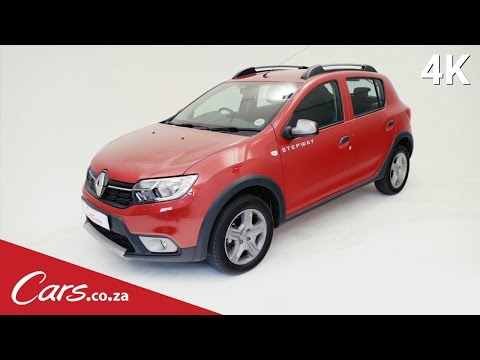
Video overview
FAQ
Is the Sandero Stepway a Renault or a Dacia?
Both. In Europe it is sold as the Dacia Sandero Stepway. In Latin America, South Africa and several other markets it carries the Renault badge, and since 2020 Latin America has sold it as a separate model.
Does the Sandero Stepway have four-wheel drive?
No. Every Sandero Stepway, in all three generations, is front-wheel drive. The raised suspension and plastic cladding help on rough roads, but not in deep mud or snow.
What is the difference between the Sandero and the Sandero Stepway?
The Stepway has a higher ride height, plastic wheel-arch and sill protection, crossover bumpers and roof bars. Since 2020 it has also offered engines not available on the normal Sandero, such as the TCe 110.
How safe is the Sandero Stepway?
The second-generation Sandero received four Euro NCAP stars in 2013. The third-generation Stepway received two stars in 2021: occupant protection was reasonable, but driver-assistance systems scored low.
Is there an LPG version of the Sandero Stepway?
Yes. Factory LPG bi-fuel versions have been offered since the first generation. The current ECO-G 100 and ECO-G 120 engines run on petrol or LPG and keep both tanks.
Data sources
Data checked by an editor against the sources below.
- The text of this article (1cars archive)
- Wikipedia - Dacia Sandero


