
 Renault Dokker
Specs, engines and history
Updated Published Sources (2) Report an error
By Oleksandr Hnatiuk, Automotive Editor & Used Car Specialist Reviewed by Felix Hartmann

- Built
- 2012–2021
- Top power
- 97 kW (132 PS)
Which Renault Dokker to buy
Our verdict · Oleksandr Hnatiuk
For a family or leisure car, choose a passenger Dokker from 2017 onwards with the 1.5 dCi 90 or Blue dCi 95 diesel. It has the best mix of economy and pulling power. The TCe 115 or TCe 130 petrol suits buyers who drive short distances and want quicker acceleration. For trade use, the Dokker Van with the Easy Seat gives the longest load floor. Check for worn suspension bushes, a slipping clutch and damaged sliding-door runners. The firm ride and basic safety kit are the price of the low cost. More of the brand's range is in the Renault car catalogue.
The Renault Dokker is a compact leisure activity vehicle and panel van built in Tangier, Morocco, from 2012 to 2021. It is the Dacia Dokker with a Renault badge, sold that way in markets such as Ukraine and the Middle East. Petrol and diesel engines deliver 55 to 97 kW, and every version drives the front wheels.
In short
- Five-seat passenger model and a two-seat Dokker Van, plus the raised Dokker Stepway.
- Up to 3,000 litres of space in the passenger car and 3,900 litres in the van with the Easy Seat removed.
- 1.6 petrol, 1.2 and 1.3 TCe turbo petrol, and 1.5 dCi diesel; manual gearboxes only.
- Replaced in 2021 by the Renault Express van; the Dacia Jogger took over the passenger role.

Specs by version
Engines
Dimensions and weight
Show all 2 versions
| Version | Fuel tank |
|---|---|
| 1.6 63 kW (86 PS) | 50 l13.2 gal US |
| 85 kW (116 PS) | 50 l13.2 gal US |
Verified Manufacturer and type-approval data from our catalog · Sources and methodology
The Renault Dokker at a glance
Dacia revealed the Dokker at the Casablanca Auto Show in May 2012, and sales started in Morocco that summer. Romania followed in September 2012, and Germany and Austria in spring 2013. The name comes from the English "dock worker", a hint at load capacity and toughness. Renault sold the same car under its own badge where the Dacia brand was not offered. In Latin America it later became the Renault Kangoo, built in Córdoba, Argentina, from 2018.

| Fact | Renault Dokker |
|---|---|
| Years | 2012–2021 (Morocco-built) |
| Class | Leisure activity vehicle (LAV) and small panel van |
| Plant | Renault Tanger Méditerranée, Morocco |
| Platform | Renault-Nissan B0 (M0), shared with the Dacia Lodgy |
| Bodies | 5-seat passenger, Dokker Van, Dokker Stepway |
| Drive | Front-wheel drive only |
| Power | 55–97 kW (75–132 PS) |
Where the Dokker came from: Lodgy roots and a Moroccan plant
The Dokker is closely related to the Renault Lodgy, and the two cars are almost identical up to the windscreen pillars. It is not a version of the Renault Kangoo, even though the Kangoo name was later used for it in Latin America. Using the Logan family's parts kept the price low, and the Tangier plant was built for this kind of low-cost production.

A light update arrived for the 2017 model year. It brought an eight-bar grille, new seat fabrics and trim, and a four-spoke steering wheel, while the technical layout stayed the same. The old 1cars text dated the Renault-badged update to January 2017. Stop/start had already become standard in July 2015, and Euro 6 engines followed in a later update.
Engines, gearboxes and performance
The range combined Renault's simple 1.6 petrol with the 1.5 dCi diesel, and later added turbocharged petrol units. Published figures differ slightly by source, so some rows show a range.

| Engine | Years | Power | Torque | 0–100 km/h | Top speed |
|---|---|---|---|---|---|
| 1.6 MPI petrol | 2012–2015 | 61–63 kW (83–86 PS) | 134 Nm (99 lb-ft) | 14.3 s | 159 km/h (99 mph) |
| 1.2 TCe 115 petrol | 2013–2018 | 84–86 kW (115–117 PS) | 190 Nm (140 lb-ft) | 10.7 s | 175 km/h (109 mph) |
| 1.6 SCe 100 petrol (also LPG) | 2017–2020 | 76 kW (103 PS) | 158 Nm (117 lb-ft) | - | - |
| 1.3 TCe 100 / TCe 130 petrol | 2019–2020 | 75 / 97 kW (101 / 132 PS) | - | - | - |
| 1.5 dCi 75 diesel | 2012–2017 | 55–56 kW (75–76 PS) | 180 Nm (133 lb-ft) | 15.9 s | 150 km/h (93 mph) |
| 1.5 dCi 90 diesel | 2012–2017 | 66–67 kW (90–91 PS) | 200 Nm (148 lb-ft) | 13.9 s | 162 km/h (101 mph) |
| 1.5 Blue dCi 95 diesel | 2018–2020 | 71 kW (96 PS) | - | - | - |
Five-speed manual gearboxes served the basic engines, and six-speed manuals came with the stronger ones. No automatic and no four-wheel drive were offered. The chassis uses MacPherson struts at the front and a twist-beam (H-beam) rear axle, with ventilated front discs and rear drums. The old 1cars text quoted a ground clearance of 190 mm and a kerb weight of 1,152 to 1,205 kg.
By our calculation, the 1.6 MPI moves about 18.3 kg per kW, while the TCe 115 needs only about 14.2 kg per kW. That is why the turbo petrol feels much livelier when the car is loaded. You can check other pairings with the 1cars power-to-weight calculator.
Cargo space, payload and the Dokker Van
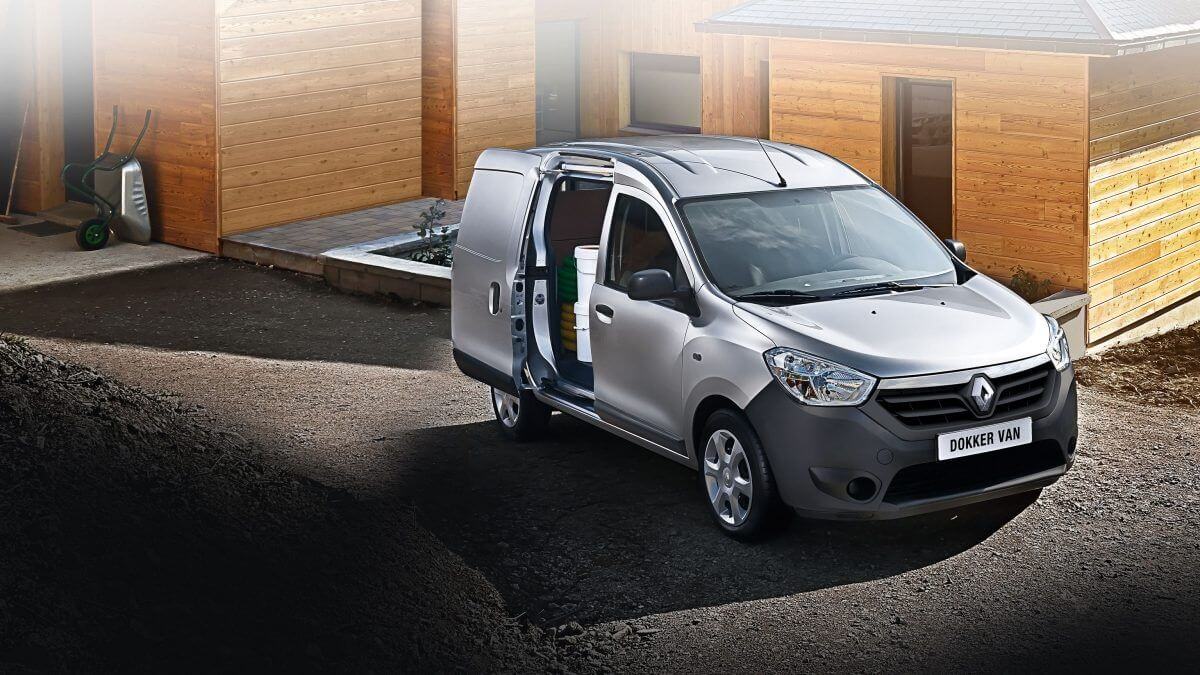
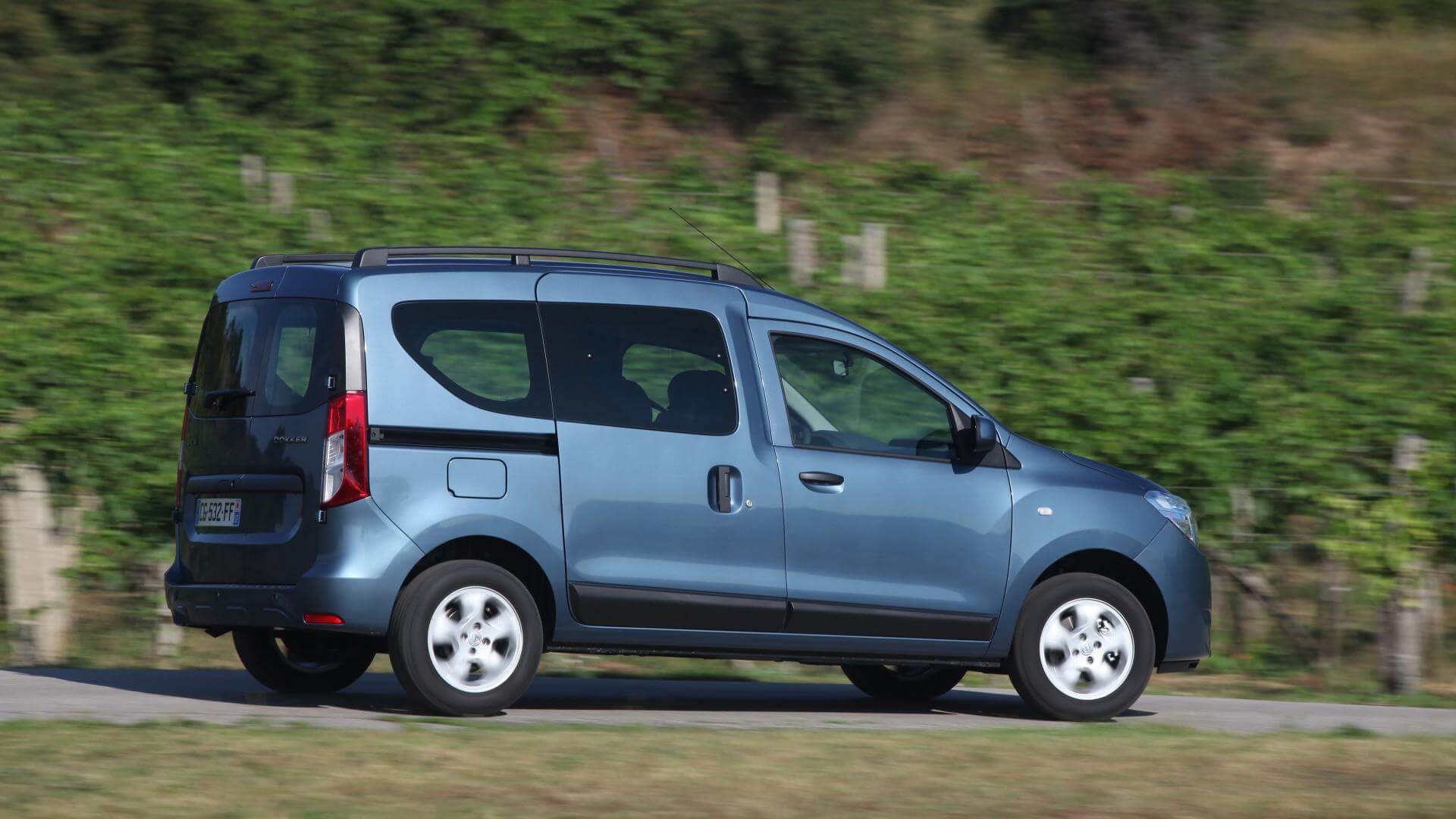
Space is the reason to buy a Dokker. The passenger version has two sliding side doors with a 703 mm opening and asymmetric twin rear doors that open to 180 degrees. The Dokker Van replaces the rear seats with a fully enclosed load area.

| Parameter | Metric | Imperial |
|---|---|---|
| Boot, passenger car (5 seats) | 800 l | 28.3 cu ft |
| Boot, rear bench folded | 3,000 l | 105.9 cu ft |
| Load volume, Dokker Van | 3,300 l | 116.5 cu ft |
| Load volume, van with Easy Seat removed | 3,900 l | 137.7 cu ft |
| Load length, van | 1.90 m (3.11 m with seat out) | 74.8 in (122.4 in) |
| Maximum payload | 750 kg | 1,653 lb |
| Fuel tank (old 1cars text) | 50 l | 13.2 US gal |
The "Easy Seat" is a folding, removable front passenger seat. Without it, a 3.11 m pipe or ladder fits inside the van. Options included a steel or mesh bulkhead and roof rails, according to the old 1cars text.
Interior, equipment and trims
The cabin is plain and built from hard plastics, with fabric seats and analogue dials. Higher trims added the Media-Nav system with a 7-inch touchscreen, navigation, Bluetooth and USB, plus a rear camera and rear parking sensors. Air conditioning, cruise control with a speed limiter and electric mirrors were on the option list. Renault trims were called Access, Life and Drive.

In Germany, Dacia priced the passenger Dokker from 8,990 EUR at launch, the cheapest car in its class at the time. Owner reviews quoted in the old 1cars text praised the space and the diesel's economy. They criticised the firm ride, the thin seat padding and the wide pillars.
Fuel use and running costs
The old 1cars text gave about 6.2 to 7.5 l/100 km (31 to 38 mpg US) for the petrol engines. The dCi diesels averaged about 4.5 l/100 km (52 mpg US). The engines and gearboxes are shared with millions of Dacia and Renault cars, so parts are cheap and easy to find. In the Middle East, Renault gave the van a three-year or 100,000 km warranty in 2015. Use the 1cars fuel cost calculator to compare petrol and diesel for your mileage.

Dokker safety: airbags and crash tests
European Dokkers came with front and front side airbags, ABS, brake assist and ESP. Commercial Dokker Vans in some markets had only a driver airbag, with the other items as options. We found no Euro NCAP crash test of the Dokker itself. Latin NCAP tested the Argentine-built Renault Kangoo with two airbags in 2019. It scored three stars for adult occupants (21.56 of 34 points) and four stars for children (38.02 of 49).

Rivals: Dokker vs Caddy, Doblo and Berlingo
| Model | Fuel options | Where it beats the Dokker | Where the Dokker wins |
|---|---|---|---|
| Volkswagen Caddy | Petrol, diesel, CNG | Cabin quality, DSG automatic, safety technology | Purchase price, simple mechanics |
| Fiat Doblo (2010–2022) | Petrol, diesel, CNG | Wider engine choice (66–99 kW) | Purchase price |
| Citroën Berlingo / Peugeot Partner | Petrol, diesel, electric | Comfort, automatic gearbox, electric version | Price, cheap parts |
| Renault Kangoo | Petrol, diesel, electric | Refinement, Renault dealer support | Price, cargo volume for the money |
The Dokker undercut all of them on price and matched them on space. The Caddy and Berlingo had better cabins, automatic gearboxes and more safety technology. The Doblo offered more engine choice. The Dokker won on simplicity and cost per litre of load space.

Rivals
Compare with…
Compare Renault Dokker with
- Lada Largus Cross quick spec comparison
-
In production
- Years
- 2015–present
- Body
- Station wagon
- Fuel
- Petrol
- Power
- 77–78 kW (105–106 PS)

Renault Dokker photos 25





Renault Dokker videos 4

Renault Dokker video 1

Renault Dokker video 2
Video review

Test drive
FAQ
What is the fuel consumption of the Renault Dokker?
The 1.5 dCi diesels use about 4.5 l/100 km (52 mpg US) on average. The petrol engines need roughly 6.2 to 7.5 l/100 km (31 to 38 mpg US), depending on the engine and load.
Is the Renault Dokker available with all-wheel drive or as a hybrid?
No. Every Dokker drives the front wheels through a five- or six-speed manual gearbox. There was no hybrid or electric version, although a 1.6 SCe engine running on LPG was offered from 2017.
What are the main rivals of the Renault Dokker?
Its rivals were compact vans and leisure vehicles such as the Volkswagen Caddy, Fiat Doblo, Citroën Berlingo, Peugeot Partner and Renault Kangoo. The Dokker was the cheapest of them, with similar space but a simpler cabin.
Is the Renault Dokker the same car as the Dacia Dokker?
Yes. Both were built in Tangier, Morocco, with the same body, engines and equipment. Renault used its own badge in markets where Dacia was not sold, such as Ukraine and the Middle East.
How much can the Renault Dokker Van carry?
The Dokker Van carries up to 750 kg. Its load area holds 3.3 cubic metres, or 3.9 cubic metres with the removable Easy Seat taken out, and the load length then grows from 1.90 m to 3.11 m.
Data sources
Data checked by an editor against the sources below.
- The text of this article (1cars archive)
- Wikipedia - Dacia Dokker


