
 Lada Vesta
Specs, engines and history
Updated Published Sources (4) Report an error
By Oleksandr Hnatiuk, Automotive Editor & Used Car Specialist Reviewed by Felix Hartmann

- Built
- 2015–present
- Top power
- 107 kW (145 PS)
- Used price today
- about €5,000–12,000 (AutoScout24, Nov 2026)
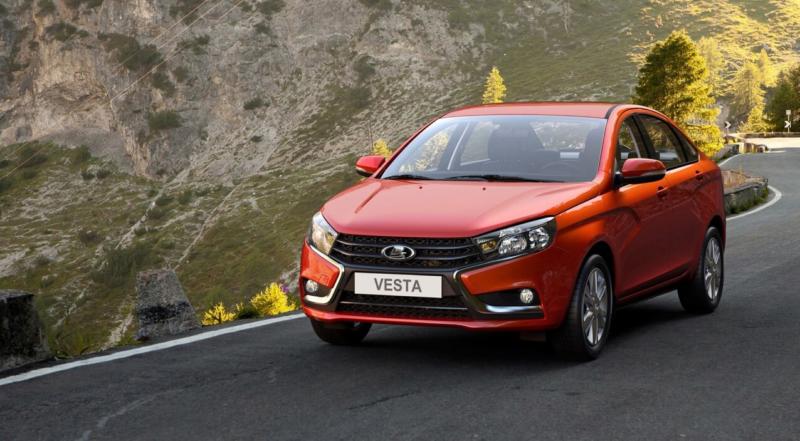
The Lada Vesta is a front-wheel-drive compact sedan built by AvtoVAZ in Russia and sold from 2015 as the successor to the Lada Priora. An estate (SW), raised Cross versions and a 107 kW Sport followed. It reached Germany and Austria in February 2017 as a 1.6-litre car with 78 kW (106 PS), and AvtoVAZ announced in 2019 that exports to Western Europe would end that year.
In short
- Series production of the sedan is usually dated to 25 September 2015, at the IzhAvto plant.
- The EU-spec car used a 1.6-litre petrol engine with 78 kW (106 PS) and 148 Nm (109 lb-ft), with a 5-speed manual or automated manual gearbox.
- In Germany it started at €12,490 in February 2017; AvtoVAZ announced in 2019 that Western European exports would stop at the end of that year.
- No Euro NCAP result for the Vesta has been found.

Size at a glance
Hyundai Solaris RB
The Lada Vesta is 40 mm longer and 203 mm lower than the Hyundai Solaris RB.
| Dimensions | Lada Vesta | Hyundai Solaris RB | Difference |
|---|---|---|---|
| Length | 4,410 mm173.6 in | 4,370 mm172.0 in | +40 mm+1.6 in |
| Width | 1,764 mm69.4 in | - | - |
| Height | 1,497 mm58.9 in | 1,700 mm66.9 in | −203 mm−8.0 in |
| Wheelbase | 2,635 mm103.7 in | 2,570 mm101.2 in | +65 mm+2.6 in |
| Boot | 480 L17.0 cu ft | - | - |
Kia Rio UB
The Lada Vesta is 44 mm longer, 44 mm wider and 42 mm taller than the Kia Rio UB.
| Dimensions | Lada Vesta | Kia Rio UB | Difference |
|---|---|---|---|
| Length | 4,410 mm173.6 in | 4,366 mm171.9 in | +44 mm+1.7 in |
| Width | 1,764 mm69.4 in | 1,720 mm67.7 in | +44 mm+1.7 in |
| Height | 1,497 mm58.9 in | 1,455 mm57.3 in | +42 mm+1.7 in |
| Wheelbase | 2,635 mm103.7 in | 2,570 mm101.2 in | +65 mm+2.6 in |
| Boot | 480 L17.0 cu ft | 500 L17.7 cu ft | −20 L−0.7 cu ft |
Specs by version
Engines
Dimensions and weight
Show all 2 versions
Verified Manufacturer and type-approval data from our catalog · Sources and methodology
Lada Vesta at a glance: class, design and where it is built
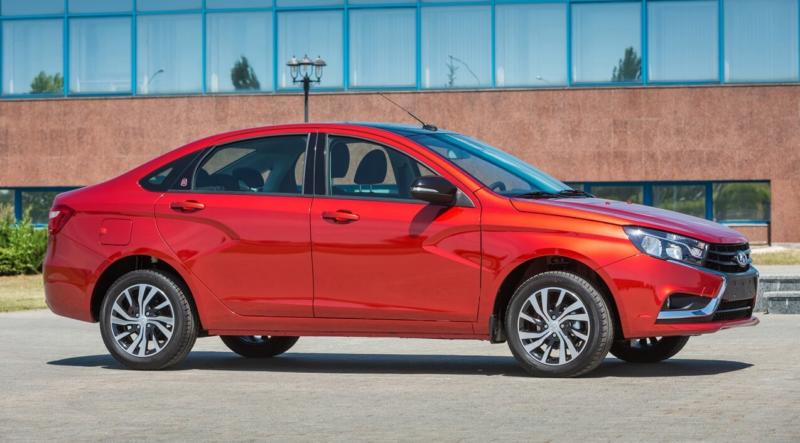
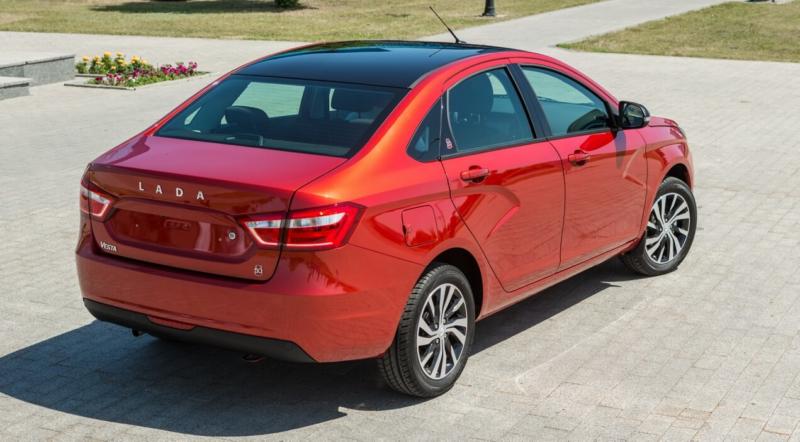
The Vesta is a compact (C-class) four-door sedan with front-wheel drive, positioned above the cheaper Lada Granta and replacing the Lada Priora. It was first shown in August 2014, and series production is usually dated to 25 September 2015, with sales beginning that November.

Its styling is credited to Steve Mattin, who had earlier worked at Mercedes-Benz and Volvo. The underpinnings are usually described as AvtoVAZ's B/C platform, and Lada's crossover of the same period was the Lada XRay. Assembly takes place at the IzhAvto plant; for the wider company background, see our AvtoVAZ history.
The car also has a racing record: Lada Sport is listed as running Vesta touring cars in the World Touring Car Championship in 2015 and 2016.
Vesta variants compared
Between 2015 and 2018 the Vesta grew from one sedan into five road-going variants.

| Variant | Introduced | Body | Engine / power | Notes |
|---|---|---|---|---|
| Vesta (sedan) | 2015 | 4-door sedan | 1.6 petrol, 78 kW (106 PS); 1.8 petrol, 90 kW (122 PS) outside the EU | EU-spec cars 1.6 only |
| Vesta SW | shown June 2017, production from September 2017 | 5-door estate | as sedan | in Germany from June 2018 |
| Vesta SW Cross | September 2017 | 5-door estate | as sedan | higher ride, plastic cladding, underbody guard |
| Vesta Cross | 2018 | 4-door sedan | as sedan | raised ground clearance |
| Vesta Sport | shown August 2018 | 4-door sedan | uprated petrol, 107 kW (145 PS) | SW Sport also offered |
The Lada Vesta SW Cross has its own page with equipment and dimensions.
The Sport is quoted with 107 kW (145 PS) and a claimed 0–100 km/h (0–62 mph) time of 9.6 seconds; more on it in our feature on the sports Lada Vesta.
Some sources also list a version that runs on compressed natural gas as well as petrol, but its launch date could not be confirmed. A facelift, often called Vesta NG, is reported to have been presented on 22 February 2022, with production from March 2023.
Engines and gearboxes
Every Vesta uses a four-cylinder petrol engine; EU-spec cars had only the 1.6.
| Engine | Power | Torque | Market notes |
|---|---|---|---|
| 1.6 16V (EU, 02/2017–12/2018) | 78 kW (106 PS) at 5,800 rpm | 148 Nm (109 lb-ft) at 4,200 rpm | Euro 6b |
| 1.6 16V (EU, 12/2018–12/2019) | 75 kW (102 PS) at 5,800 rpm, as listed by ADAC | 145 Nm (107 lb-ft) | Euro 6d-TEMP |
| 1.8 16V | 90 kW (122 PS) | 170 Nm (125 lb-ft) | not offered in the EU |
| Sport engine | 107 kW (145 PS) | - | Vesta Sport only |
The 1.6 displaces 1,596 cc and uses a timing belt; it is usually listed as the VAZ-21129, and the 1.8 as the VAZ-21179. The ADAC catalogue shows the output falling to 75 kW (102 PS) when the engine was re-certified to Euro 6d-TEMP from December 2018.
Two gearboxes were offered in Germany: a 5-speed manual and a 5-speed automated manual (AMT), priced at €760 extra. Auto Zeitung reported that the AMT used ZF components and software. It is not a conventional automatic: actuators shift a manual gearbox, which explains the slow changes German testers noted.
With the manual gearbox, the EU-spec 1.6 reaches 0–100 km/h (0–62 mph) in 11.8 seconds and 180 km/h (112 mph). The AMT version takes 13.3 seconds and tops out at 178 km/h (111 mph).
Dimensions, space and boot
The series-built Vesta sedan is 4,410 mm long with a 2,635 mm wheelbase, slightly larger than the pre-production figures still quoted on some sites.
Key specifications: Lada Vesta 1.6 (EU-spec, 02/2017–12/2018)
| Parameter | Metric | Imperial |
|---|---|---|
| Length | 4,410 mm | 173.6 in |
| Width (without / with mirrors) | 1,764 / 2,045 mm | 69.4 / 80.5 in |
| Height | 1,497 mm | 58.9 in |
| Wheelbase | 2,635 mm | 103.7 in |
| Boot | 480 L | 17.0 cu ft |
| Kerb weight (EU) | 1,250 kg | 2,756 lb |
| Fuel tank | 55 L | 14.5 US gal |
| Engine | 1.6 L petrol, 78 kW (106 PS) | 105 hp; 109 lb-ft |
| 0–100 km/h / 0–62 mph (manual) | 11.8 s | 11.8 s |
| Top speed (manual) | 180 km/h | 112 mph |
| Fuel consumption, NEDC combined | 6.1 L/100 km | 46.3 mpg UK / 38.6 mpg US |
| CO2 (NEDC) | 138 g/km | - |
| Tyres | 195/55 R16 | - |
The 480-litre boot is large for the car's length, although the Fiat Tipo and Skoda Rapid offered more. Auto Zeitung quoted up to 840 L (29.7 cu ft) with the rear seats folded. ADAC lists a turning circle of 11.0 m (36.1 ft), a maximum ground clearance of 178 mm (7.0 in) for the 2019 Luxus and a braked towing capacity of 900 kg (1,984 lb).
Kerb weights vary by source: ADAC lists 1,250 kg for the 2017 car and 1,270 kg (2,800 lb) for the later Luxus, while Auto Zeitung weighed its test car at 1,202 kg (2,650 lb).
The Vesta in Europe: Germany and Austria, 2017–2019
The Vesta was officially launched in Germany on 21 February 2017 at a ceremony in Hamburg, priced from €12,490. The Luxus trim cost €1,000 more, and the AMT added €760. In Austria the starting price is usually quoted as €12,990.

German-market cars had air conditioning, heated front seats, Bluetooth hands-free, a radio with AUX and USB, ESP and tyre pressure monitoring as standard; Auto Zeitung's 2018 test car added rain and light sensors and cruise control. The SW estate followed in Germany from 5 June 2018.
The European chapter was short. On 16 April 2019 Auto Bild reported that AvtoVAZ would stop exporting Lada cars to Western Europe at the end of 2019, because the Vesta and Lada 4x4 engines would not meet stricter EU emission rules, despite their Euro 6 approval. Orders for 2019 stood at about 2,500 vehicles, around 800 of them Vestas. According to the same report, Lada sold 2,545 new cars of all models in Germany in 2018. German registration totals for the Vesta are usually put at 1,971 for 2017–2020.
What the German road tests said
German magazines found the Vesta well equipped for its price but held back by chassis and drivetrain.

Auto Bild tested it at launch on 21 February 2017 and summed it up as "the price is hot, the equipment is right". It praised the low price, the well-stocked base car, the practical space and simple controls. Against it were hard plastics, few driver aids, a noisy engine at high revs, indirect steering and a suspension that passes bumps through.
Auto Zeitung tested the 1.6 AMT on 8 June 2018. Its testers liked the kit and space but criticised the slow, jerky AMT, a coarse engine, vague steering, an early grip limit, a harsh low-speed ride and a slow touchscreen. They called it a plain car that still needed work on steering, chassis and drivetrain. Test consumption was 7.4 L/100 km (38.2 mpg UK).
ADAC shows an overall Autotest score of 3.4 for a Vesta 1.6 16V Luxus. On the German school-grade scale, lower is better, so 3.4 is a middling result.
Safety, warranty and ownership
The EU-spec Vesta had ABS with brake assist, ESP, driver and passenger airbags (the passenger airbag can be switched off), rear parking sensors and tyre pressure monitoring as standard. None of the German sources mentions autonomous emergency braking.

No Euro NCAP result for the Vesta has been found, so there is no independent European crash rating to quote.
ADAC lists a 3-year vehicle warranty, 2 years on paint, 6 years against rust perforation and 3 years of mobility cover for German cars; check the paperwork of any used car for what still applies. We found no independent reliability statistics for the Vesta. A full service record is the best guide to an individual car.
Vesta against its rivals
At launch, the Vesta was priced below the Fiat Tipo and Skoda Rapid and slightly above a Dacia.

In February 2017 Auto Bild set the Vesta's €12,490 against the Fiat Tipo, which started at €14,250 with 70 kW (95 PS) and a 520-litre boot, and the Skoda Rapid, which started at €15,690 with 66 kW (90 PS) and 550 litres. Austrian site automobile.at added the Dacia Logan MCV estate at €11,290 with 66 kW (90 PS). The Vesta undercut the Tipo and Rapid by around €1,800 and €3,200 but trailed both on boot space.
Within Lada's own range it sits above the Granta; see all Lada models in our catalogue, or compare it with other sedans.
Rivals
Compare with…
Compare Lada Vesta with
- Hyundai Solaris quick spec comparison
- Kia Rio quick spec comparison
- Volkswagen Polo quick spec comparison
-
Ended 2017
- Years
- 2011–2017
- Body
- Sedan, Hatchback
- Fuel
- Petrol
- Power
- 79–90 kW (107–122 PS)
-
In production
- Years
- 1975–present
- Body
- Sedan, Hatchback
- Fuel
- Petrol, Diesel, LPG / CNG
- Power
- 29–110 kW (39–150 PS)
6 generations
- 86
- 86C
- 6N
- 9N
- 6R
- VI
-
Ended 2019
- Years
- 1935–2019
- Body
- Sedan, Convertible
- Fuel
- Petrol, Diesel
- Power
- 23–92 kW (31–125 PS)
3 generations


Lada Vesta in our rankings
- No. 76 of 399 · Lightest cars (1,190 kg · top 20%)
- No. 22 of 105 · Smallest sedans (4,410 mm · top 21%)
- No. 15 of 65 · Lightest sedans (1,190 kg · top 24%)
- No. 115 of 321 · Biggest boot: cars (480 l · top 36%)
- No. 420 of 1115 · Longest-running car nameplates (11 years · top 39%)
- No. 207 of 537 · Smallest cars (4,410 mm · top 39%)
Lighter than 80% of ranked cars in the 1CARS catalog (No. 76 of 399).
Lada Vesta photos 18



Lada Vesta videos 5

Lada Vesta video 1

Lada Vesta video 2

Lada Vesta video 3

Lada Vesta video 4

Lada Vesta video 5
FAQ
What engines does the Lada Vesta have?
EU-spec cars had a 1.6-litre petrol engine with 78 kW (106 PS), later listed at 75 kW (102 PS) for Euro 6d-TEMP. Outside the EU there was a 1.8 with 90 kW (122 PS), and the Vesta Sport has 107 kW (145 PS).
Is the Lada Vesta sold in Europe?
It was sold in Germany and Austria from February 2017. In April 2019 Auto Bild reported that AvtoVAZ would end exports to Western Europe at the end of that year because of stricter EU emission rules, with parts and warranty support continuing.
What is the fuel consumption of the Lada Vesta?
The EU-spec 1.6 manual is rated at 6.1 L/100 km (46.3 mpg UK) combined on the older NEDC cycle. Auto Zeitung recorded 7.4 L/100 km (38.2 mpg UK) with the AMT in its 2018 road test.
Is the Lada Vesta safe?
No Euro NCAP result for the Vesta has been found. EU cars had ESP, ABS with brake assist, two front airbags and tyre pressure monitoring as standard. ADAC shows an overall Autotest score of 3.4 for the 1.6 Luxus, a middling grade on its scale.
Is the Vesta available with all-wheel drive or as a hybrid?
No. Every Vesta, including the Cross and SW Cross, drives the front wheels only, and we found no hybrid version. Some sources list a version that can run on compressed natural gas as well as petrol.
Data sources
Data checked by an editor against the sources below.
- The text of this article (1cars archive)
- Wikipedia - Lada Vesta
- Auto-data - Lada Vesta Sport 1.8 16v 145hp 35903
- ADAC


