 Bugatti Type 35
Specs, engines and history
Published Sources (1) Report an error
By Felix Hartmann, Automotive Technology & EV Contributor
- Built
- 1924–1930
- Top power
- 103 kW (140 PS)
Which Type 35 to choose
Our verdict · Felix Hartmann
- For the authentic Grand Prix car: an original Type 35 with the roller-bearing engine and cast wheels.
- For road use: a Type 35A, simpler and less highly stressed, usually on wire wheels.
- For the fastest version: a supercharged 35B or 35C, the cars that won at Monaco and in the Grand Prix of France.
- For a lower-cost entry: the four-cylinder Type 37 on the same chassis.
Check the history carefully, because even the production figures differ between sources and versions look alike. The rest of the marque's story is in our history of Bugatti, and current and past models are in the Bugatti catalogue.
The Bugatti Type 35 was the Grand Prix car that Automobiles Ettore Bugatti built at Molsheim in Alsace from 1924 to 1930 and sold to private drivers as well as its own team. Its two-litre straight-eight, cast aluminium wheels and hollow front axle made it one of the most successful racing cars of its era: English Wikipedia credits it with more than 1,000 race wins, five Targa Florio victories in a row and the 1926 Grand Prix World Championship. The Type 51 replaced it in 1931.
In short
- First raced at the Grand Prix de l'ACF (French Grand Prix) in Lyon on 3 August 1924; built until 1930.
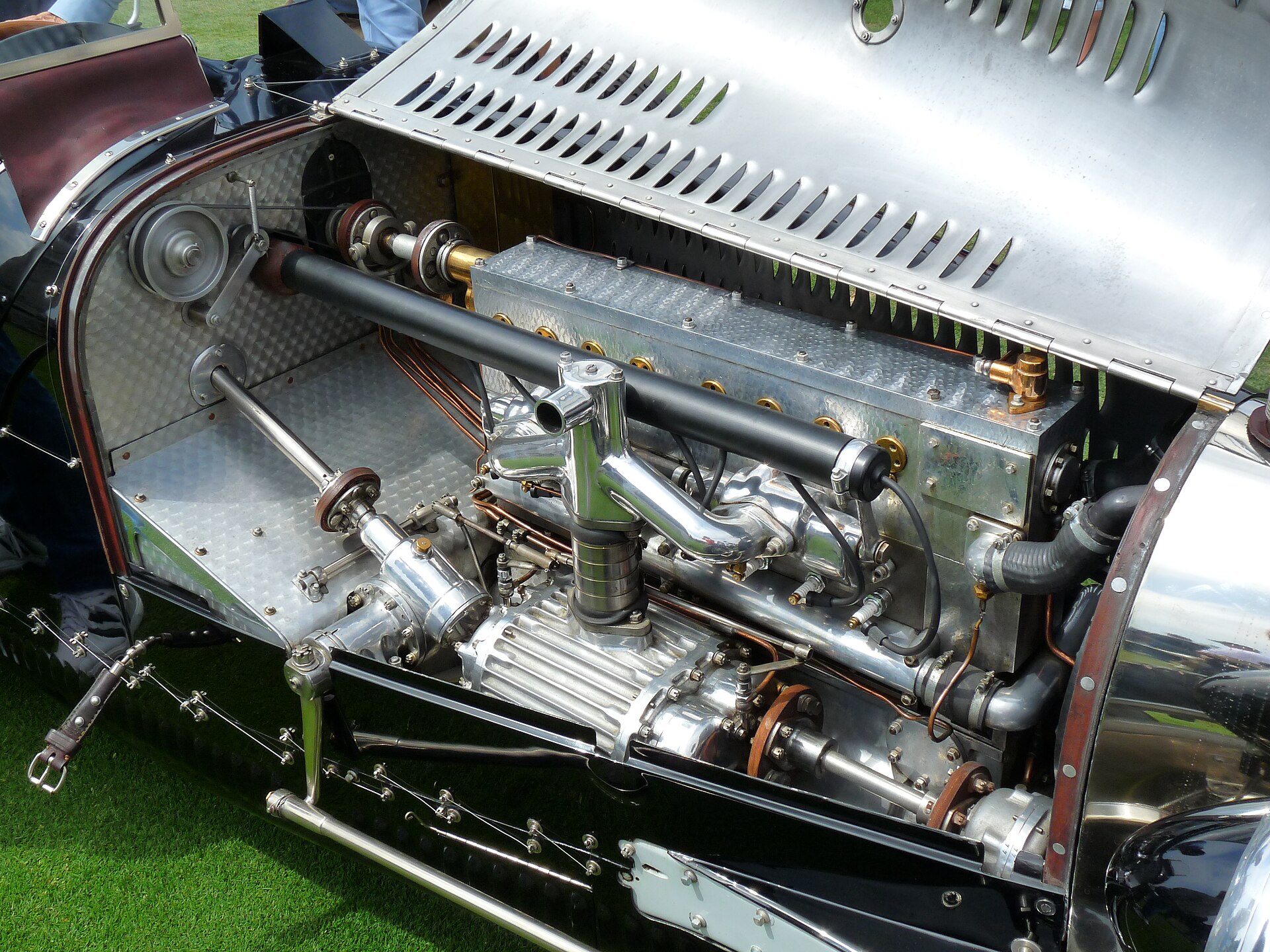
- 1,991 cc single-overhead-camshaft straight-eight with three valves per cylinder: 67 kW (90 hp), up to 103 kW (138 bhp) in the supercharged 35B.
- Credited with the first use of cast alloy wheels, with integral brake drums.
- Won the Targa Florio every year from 1925 to 1929 and the first Monaco Grand Prix in 1929.
Bugatti Type 35 at a glance
| Parameter | Metric | Imperial |
|---|---|---|
| Maker | Automobiles Ettore Bugatti, Molsheim-Dorlisheim | - |
| Production | 1924–1930 | - |
| Designer | Ettore Bugatti | - |
| Engine | straight-eight, SOHC, three valves per cylinder, 1,991 cc (Type 35) or 2,262 cc (35T, 35B) | 121.5 / 138 cu in |
| Bore × stroke | 60 × 88 mm; 60 × 100 mm for 2.3 litres | - |
| Power | 67 kW (90 hp, Type 35) to 103 kW (138 bhp, 35B) | - |
| Gearbox | four-speed manual, no synchromesh | - |
| Brakes | cable-operated drums on all four wheels | - |
| Wheelbase | 2,400 mm | 94.5 in |
| Length × width | 3,680 × 1,320 mm | 144.9 × 52.0 in |
| Weight | 650–750 kg | 1,435–1,655 lb |
| Predecessor / successor | Type 30 / Type 51 | - |
Lyon 1924: the debut
Ettore Bugatti presented the Type 35 at the Grand Prix de l'ACF (French Grand Prix) in Lyon in 1924. The debut was spoiled by poorly vulcanised Dunlop tyres. English Wikipedia still sees the car as a pioneer, a race-ready car designed as a whole and sold to customers who wanted to race it.
The look became a Bugatti signature. An arch- or egg-shaped radiator sat at the front of an aluminium body on a steel ladder frame. The tapering tail is often called the "Bordino tail", possibly inspired by Pietro Bordino's modified Fiat 804. The background of the factory and its founder is told in our history of pre-war Bugatti.

Straight-eight engine
The engine developed from the Type 29 and Type 30 units. The eight cylinders had a bore of 60 mm, and a single overhead camshaft, driven by a vertical shaft, worked two inlet valves and one exhaust valve per cylinder. In the original Type 35, a stroke of 88 mm gave 1,991 cc. The crankshaft ran in five roller bearings, which allowed up to 6,000 rpm and an output of up to 67 kW (90 hp); German Wikipedia gives 70 kW (95 PS).
Later versions changed the formula. The 35T for the Targa Florio used a 100 mm stroke for 2,262 cc, above the two-litre Grand Prix limit, with plain bearings. The 35C added a Roots supercharger, despite Ettore Bugatti's dislike of forced induction, and produced nearly 95 kW (128 bhp). The 35B combined the 2.3-litre engine with a larger supercharger for 103 kW (138 bhp), the most of any version. It had more torque but revved lower and used more fuel, so production went back to the 35C.
With about 750 kg, the Type 35 had roughly 89 kW per tonne and the 35B about 137 kW per tonne. Our power-to-weight calculator compares that with modern sports cars.

Chassis, wheels and brakes
The Type 35 is credited with the first use of cast alloy wheels. German Wikipedia describes them as cast aluminium with eight flat spokes, an integral brake drum, a detachable rim and Rudge centre-lock fixing. The front axle was hollow to reduce unsprung weight, and the springs passed through it, a detail that became a Bugatti trademark. At the rear, quarter-elliptic springs and trailing arms located a solid axle.
The four-speed gearbox, separate from the engine and without synchromesh, had its lever on the outside right of the body. Cable-operated drum brakes on all four wheels had a balancing mechanism, and the handbrake was a separate outer lever. Worm-gear steering needed only one turn of the wheel from lock to lock. The radiator had no fan, so the engine tended to overheat after a run, and the dashboard carried an eight-day Doxa clock.
Starting a Type 35 is a ritual. German Wikipedia describes it step by step: switch on the battery, pressurise the fuel tank with a hand pump, open the fuel tap, set the ignition to "late" with a lever on the dashboard and raise the idle with a hand wheel. Then open the left side of the bonnet to flood both carburettors and turn the engine a few times with the starting handle. Once it runs, the driver lowers the idle, sets the ignition to "early" and warms the engine slowly. First gear sits to the left and back.
Type 35, 35A, 35T, 35C and 35B
| Variant | Years | Body / purpose | Engine | Notes |
|---|---|---|---|---|
| Type 35 | 1924–1930 | Grand Prix two-seater | 1,991 cc, 67 kW (90 hp) | 96 built (English Wikipedia) |
| Type 35A "Tecla" | from May 1925 | road car with racing looks | 1,991 cc, plain bearings, coil ignition, 55–66 kW (75–90 PS) | 139 built; usually wire wheels |
| Type 35T | 1926 | Targa Florio version | 2,262 cc | 13 built |
| Type 35C | 1926–1930 | supercharged 2.0-litre | 1,991 cc, about 95 kW (128 bhp) | about 45 built |
| Type 35B (35TC) | 1927–1930 | supercharged 2.3-litre | 2,262 cc, 103 kW (138 bhp) | about 37 built |
| Type 37 / 37A | - | four-cylinder sports car on the same chassis | 1,496 cc, 45 kW (60 bhp); 37A supercharged | about 223 and 67 built |
| Type 39 / 39A | - | 1.5-litre Grand Prix car | about 1,493 cc, some supercharged | 10 built |
Production totals differ by source. English Wikipedia's figures for the Type 35 family add up to about 330 cars, while German Wikipedia quotes estimates from about 200 to about 340. The Type 35A was the cheaper customer car, nicknamed "Tecla" and sometimes called "Course Imitation". Top speeds also vary in German Wikipedia's sources: 180–190 km/h for the original car and up to about 210–215 km/h for the 35B.

Racing record
| Year | Event |
|---|---|
| 3 August 1924 | debut at the Grand Prix de l'ACF (French Grand Prix) in Lyon |
| 1925 | Targa Florio win, Bartolomeo Costantini; first of five in a row |
| 1926 | 35C finishes first and second on its debut at the Milan Grand Prix; Bugatti wins the Grand Prix World Championship |
| 1926 | Jules Goux wins the Grand Prix de l'ACF in a Type 39A |
| 1928 | William Grover-Williams wins the Grand Prix de l'ACF in a 35C |
| 1929 | Grover-Williams wins the first Monaco Grand Prix in a 35B; Albert Divo wins the Targa Florio |
| 1930 | René Dreyfus wins at Monaco; Louis Chiron in Belgium; Philippe Étancelin in France |
English Wikipedia reports more than 1,000 race wins in the car's era and about 14 wins a week at its peak. The 1926 world title followed 351 wins and 47 records in the two previous years. Drivers included Tazio Nuvolari, Emilio Materassi, Aymo Maggi and Louis Chiron, who won in Italy, Rome, San Sebastián and Spain in 1928.

Photo gallery

FAQ
When was the Bugatti Type 35 built?
From 1924, when it first raced at Lyon on 3 August, to 1930, at Molsheim in Alsace.
What engine does the Bugatti Type 35 have?
A single-overhead-camshaft straight-eight with three valves per cylinder: 1,991 cc and 67 kW (90 hp) in the original car, 2,262 cc in the 35T and 35B, and supercharged in the 35C and 35B.
How many Bugatti Type 35 were made?
Sources differ. English Wikipedia lists 96 Type 35, 139 Type 35A, 13 Type 35T, about 45 Type 35C and about 37 Type 35B; German Wikipedia quotes estimates from about 200 to about 340 cars.
How many races did the Type 35 win?
More than 1,000 in its era, according to English Wikipedia, including five Targa Florios in a row from 1925 to 1929 and the first Monaco Grand Prix in 1929.
Why are the Type 35's wheels special?
They are credited as the first cast alloy wheels: cast aluminium with eight flat spokes and the brake drum built in.
Data sources
Data checked by an editor against the sources below.