 Volkswagen Multivan T7
Specs, engines and history
Published Sources (2) Report an error
By Felix Hartmann, Automotive Technology & EV Contributor
- Built
- 2021–present
- Top power
- 180 kW (245 PS)
Which Multivan T7 to choose
Our verdict · Felix Hartmann
For families who mostly drive in town and can charge at home, the eHybrid is the logical choice: 46 to 50 km of electric range covers many daily trips. The 4MOTION eHybrid from late 2024 adds all-wheel drive, more power and roughly twice the usable battery. Drivers who tow, cover long motorway distances or cannot charge are better served by the 2.0 TDI with 360 Nm. The 1.5 TSI is the cheapest way in but needs 13.5 seconds to 100 km/h with a full load of seats.
Choose the long body only if the extra 200 mm of luggage space is needed every day, and check garage length first. The full Volkswagen range is on the Volkswagen catalogue page.
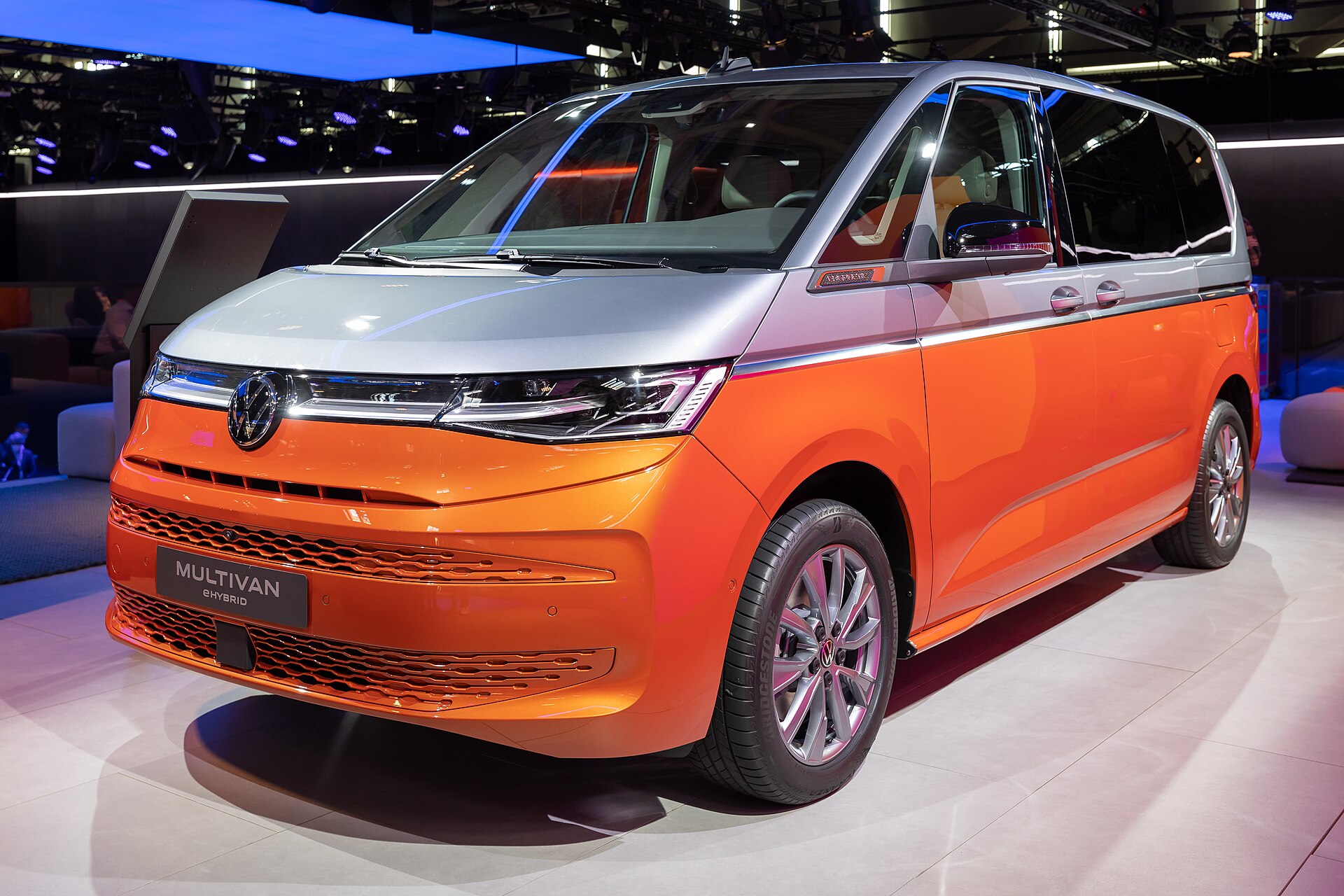
The Volkswagen Multivan T7 is a large people carrier with up to seven seats, built in Hanover since November 2021. Unlike every Multivan before it, it no longer shares its body with the Transporter van: it sits on the MQB Evo platform of Volkswagen's passenger cars and has front-wheel drive. Engines range from a 100 kW 1.5 TSI to a 180 kW plug-in hybrid with all-wheel drive. It comes in two lengths, 4,973 mm and 5,173 mm.
In short
- Unveiled in June 2021; production in Hanover from November 2021; German price from €44,839.20 (1.5 TSI DSG, announced August 2021).
- Engines: 1.5 TSI 100 kW, 2.0 TSI 150 kW, 2.0 TDI 110 kW, 1.4 eHybrid 160 kW; 1.5 eHybrid 4MOTION from November 2024.
- eHybrid: 10.4 kWh usable battery, 46–50 km of WLTP electric range, AC charging at 3.6 kW.
- Euro NCAP awarded five stars in 2022; the adult-occupant score was 90 per cent.
Size at a glance
| Dimensions | Volkswagen Multivan T7 |
|---|---|
| Length | 4,973 mm195.8 in |
| Width | 1,941 mm76.4 in |
| Height | 1,887 mm74.3 in |
| Wheelbase | 3,124 mm123.0 in |
Running cost
Fuel · Multivan T7 T7 1.5 TSI
about 2,100 EUR fuel a year at 15,000 km
8.0 l/100 km · petrol at 1.75 EUR/l · change mileage, fuel price or version
Specs by version
Engines
| Version | Engine | Power | Torque | Gearbox | Drive | Production years |
|---|---|---|---|---|---|---|
| Plug-in hybrid · 2 versions | ||||||
| 1.4 eHybrid | Plug-in hybrid | 160 kW 218 PS215 hp | 350 Nm258 lb-ft | 6-sp Dual-clutch | Front-wheel drive | 2021–2024 |
| 1.5 eHybrid 4MOTION | Plug-in hybrid | 180 kW 245 PS241 hp | 350 Nm258 lb-ft | Dual-clutch | All-wheel drive | 2024 |
| Diesel · 1 version | ||||||
| 2.0 TDI | Diesel | 110 kW 150 PS148 hp | 360 Nm266 lb-ft | 7-sp Dual-clutch | Front-wheel drive | 2022 |
| Petrol · 2 versions | ||||||
| 1.5 TSI | Petrol | 100 kW 136 PS134 hp | 220 Nm162 lb-ft | 7-sp Dual-clutch | Front-wheel drive | 2021 |
| 2.0 TSI | Petrol | 150 kW 204 PS201 hp | 320 Nm236 lb-ft | 7-sp Dual-clutch | Front-wheel drive | 2021 |
Performance
Show all 5 versions
| Version | 0–100 km/h | Top speed | Fuel consumption | CO₂ |
|---|---|---|---|---|
| Plug-in hybrid · 2 versions | ||||
| 1.4 eHybrid | 11.6 s 0–62 mph | 190 km/h118 mph | — | — |
| 1.5 eHybrid 4MOTION | — | 200 km/h124 mph | — | — |
| Diesel · 1 version | ||||
| 2.0 TDI | 11.6 s 0–62 mph | 190 km/h118 mph | 6.6 l/100 km35.6 mpg US · 42.8 mpg UK | 172 g/km |
| Petrol · 2 versions | ||||
| 1.5 TSI | 13.5 s 0–62 mph | 182 km/h113 mph | 8.0 l/100 km29.4 mpg US · 35.3 mpg UK | 181 g/km |
| 2.0 TSI | 8.4 s 0–62 mph | 200 km/h124 mph | 8.9 l/100 km26.4 mpg US · 31.7 mpg UK | 203 g/km |
Dimensions and weight
Show all 5 versions
| Version | Length | Width | Wheelbase | Kerb weight | Battery |
|---|---|---|---|---|---|
| Plug-in hybrid · 2 versions | |||||
| 1.4 eHybrid | 4,973 mm195.8 in | 1,941 mm76.4 in | 3,124 mm123.0 in | — | 10 kWh |
| 1.5 eHybrid 4MOTION | 4,973 mm195.8 in | 1,941 mm76.4 in | 3,124 mm123.0 in | — | 20 kWh |
| Diesel · 1 version | |||||
| 2.0 TDI | 4,973 mm195.8 in | 1,941 mm76.4 in | 3,124 mm123.0 in | 2,105 kg4,641 lb | — |
| Petrol · 2 versions | |||||
| 1.5 TSI | 4,973 mm195.8 in | 1,941 mm76.4 in | 3,124 mm123.0 in | 2,004 kg4,418 lb | — |
| 2.0 TSI | 4,973 mm195.8 in | 1,941 mm76.4 in | 3,124 mm123.0 in | 2,057 kg4,535 lb | — |
Verified Manufacturer and type-approval data from our catalog · Sources and methodology
Volkswagen Multivan T7 at a glance
| Parameter | Volkswagen Multivan T7 |
|---|---|
| Production | since November 2021, Hanover (Germany) |
| Body | five-door people carrier, three rows, up to seven seats |
| Platform | MQB Evo, front-wheel drive (all-wheel drive only on the 4MOTION eHybrid) |
| Length | 4,973 mm (standard), 5,173 mm (long) |
| Width / height | 1,941 mm / 1,887–1,907 mm |
| Wheelbase | 3,124 mm |
| Kerb weight | 1,941–2,257 kg |
| Engines | 1.5 TSI, 2.0 TSI, 2.0 TDI, 1.4 and 1.5 TSI plug-in hybrids |
| Power | 100–180 kW |
| Gearbox | seven-speed DSG; six-speed DSG on the first eHybrid |
| Predecessors | Multivan T6.1 and Sharan |
A Multivan without the Transporter
The Multivan name first appeared on the T3 Transporter and stayed with the passenger version through the T4, T5 and T6. Our overview of the Multivan T6.1 and T7 covers that earlier van-based model in detail. The T7 broke the link: Volkswagen built it on the MQB Evo kit for transverse engines, taken from its passenger cars. Wikipedia EN lists both the T6 Multivan/Caravelle and the Volkswagen Sharan as its predecessors.
The commercial T6.1 Transporter continued alongside it until 2023. Its successor, sold from February 2025 as the Transporter T7 and Caravelle, is a different vehicle altogether. Ford Otosan builds it in Turkey, and it shares its technology with the Ford Transit Custom. So the "T7" label covers two unrelated vehicles: the MQB-based Multivan and the Ford-based Transporter. The van line's history is in our Volkswagen Transporter article.
In the brand's line-up the Multivan sits above the Volkswagen Caddy and the electric ID. Buzz and below the Crafter. Wikipedia EN notes that it is priced above the third-generation Mercedes-Benz V-Class.

Engines and the eHybrid
Volkswagen launched the T7 with petrol and plug-in hybrid drive; the diesel followed in March 2022. All versions use dual-clutch gearboxes.
| Version | Engine | Power | Torque | 0–100 km/h | Top speed | Period |
|---|---|---|---|---|---|---|
| 1.5 TSI | 1.5 turbo petrol (EA211) | 100 kW (136 PS) | 220 Nm | 13.5 s | 182 km/h | from 11/2021 |
| 2.0 TSI | 2.0 turbo petrol (EA888) | 150 kW (204 PS) | 320 Nm | 8.4 s | 200 km/h | from 11/2021 |
| 2.0 TDI | 2.0 turbodiesel (EA288) | 110 kW (150 PS) | 360 Nm | 11.6 s | 190 km/h | from 03/2022 |
| 1.4 eHybrid | 1.4 TSI plus electric motor | 160 kW (218 PS) | 350 Nm | 11.6 s | 190 km/h | 11/2021–2024 |
| 1.5 eHybrid 4MOTION | 1.5 TSI plus two electric motors | 180 kW (245 PS) | 350 Nm | 11.6 s | 200 km/h | from 11/2024 |
The 2.0 TSI reaches 100 km/h 5.1 seconds sooner than the 1.5 TSI, while the diesel has the most torque of the combustion engines, 40 Nm more than the 2.0 TSI. Wikipedia EN contradicts itself on the diesel: the table gives 110 kW and 360 Nm, the text 150 kW and 320 Nm. The table figures are used here, because the text repeats the data of the 2.0 TSI.
Using the lowest quoted kerb weight of 1,941 kg, the 1.5 TSI has to move at least 19 kg per kW and the 2.0 TSI at least 13 kg per kW. The 4MOTION eHybrid has 20 kW more than the front-drive eHybrid. For the 4MOTION eHybrid the same source gives 180 kW (245 PS) in the text and 182 kW (248 PS) in the table.
In the front-wheel-drive eHybrid a 1.4 TSI with 110 kW (150 PS) and 250 Nm works with an 85 kW (115 PS) electric motor with 330 Nm. The battery holds 13 kWh gross and 10.4 kWh usable; it charges at up to 3.6 kW in under 3 hours 40 minutes, and there is no DC fast charging. The WLTP electric range is 46 to 50 km, or roughly 4.4 to 4.8 km per usable kWh. The 4MOTION version of November 2024 adds a 100 kW motor on the rear axle and a much larger battery of 25.7 kWh gross and 19.7 kWh usable. Wikipedia EN gives about 95 km of electric range for it, without naming the test cycle.
Cabin, seats and luggage space
The T7 has three rows and seven seats as standard. The rear seats run on rails and can be removed; the second-row seats can also turn through 180 degrees, so that passengers face each other, as automobile.at described at launch. Electric sliding doors are part of the Style trim.
| Seat configuration | Luggage space |
|---|---|
| All seats in use | 469 l |
| Third row folded | 1,850 l |
| Second row removed | 3,672 l |
| Long wheelbase, second and third rows out | 4,053 l |
The long version adds 200 mm of length on the same 3,124 mm wheelbase. At 5,173 mm it is longer than many private garages allow; the will-it-fit-in-my-garage tool checks a given space quickly. The height of up to 1,907 mm is also worth measuring against multi-storey car parks.

Trims and equipment
Wikipedia EN lists three trim levels. Life comes with 16-inch alloy wheels, a digital instrument cluster and a 10-inch infotainment screen. Style adds IQ.Light LED Matrix headlights, Discover Media navigation, Park Assist, electric sliding doors and 17-inch wheels. Energetic is the plug-in hybrid trim with 18-inch wheels, a panoramic glass roof and a 14-speaker Harman Kardon system with an 840 W amplifier. Twelve paint colours were offered, three of them two-tone.
A California camper version was shown as a concept at a caravan trade fair in mid-2023. The November 2024 update with the 4MOTION eHybrid also applies to the California.
Safety: Euro NCAP 2022 and 2025
Euro NCAP gave the Multivan five stars in 2022. It scored 90 per cent for adult occupants, 89 per cent for children, 69 per cent for vulnerable road users and 87 per cent for safety assistance. A later assessment in 2025, under stricter rules, gave 77, 87, 78 and 75 per cent; Wikipedia EN does not state a star rating for it. Pedestrian protection improved in the second test, while the adult-occupant and assistance scores fell.
The 2026 facelift
In June 2026 Volkswagen announced a facelift with new styling and interior changes, according to Wikipedia EN. In some markets, including the United Kingdom, the model returns to the Caravelle name; in Germany it stays the Multivan.
Volkswagen Multivan T7 in our rankings
- No. 51 of 420 · Longest cars (4,973 mm · top 13%)
- No. 84 of 403 · Widest cars (1,941 mm · top 21%)
- No. 64 of 304 · Heaviest cars (2,105 kg · top 22%)
- No. 93 of 256 · Most economical cars (6.6 l/100 km · top 37%)
- No. 58 of 105 · Fastest cars of the 2020s (200 km/h · top 56%)
- No. 527 of 859 · Most powerful cars (180 kW · top 62%)
Longer than 87% of ranked cars in the 1CARS catalog (No. 51 of 420).
FAQ
Is the Multivan T7 based on the Transporter?
No. The T7 Multivan uses the MQB Evo car platform. The 2025 Transporter T7 is a separate vehicle developed with Ford and built in Turkey.
How long is the VW Multivan T7?
4,973 mm in standard form and 5,173 mm in the long version; both use a 3,124 mm wheelbase.
How far can the Multivan eHybrid drive on electricity?
The front-wheel-drive eHybrid manages 46 to 50 km WLTP with its 10.4 kWh usable battery. The 4MOTION eHybrid of November 2024 has 19.7 kWh usable and about 95 km.
Is there a diesel Multivan T7?
Yes, a 2.0 TDI with 110 kW (150 PS) and 360 Nm has been available since March 2022.
How many seats does the Multivan T7 have?
Seven in three rows as standard. The rear seats slide on rails and can be removed, and the second row can be turned to face backwards.
Data sources
Data checked by an editor against the sources below.
- Wikipedia — Volkswagen Multivan (T7)
- EEA CO₂ monitoring (European Environment Agency, CC BY 4.0)