 Volkswagen ID. Buzz
Specs, engines and history
Published Sources (3) Report an error
By Felix Hartmann, Automotive Technology & EV Contributor
- Built
- 2022–present
- Top power
- 250 kW (340 PS)
Which ID. Buzz to choose
Our verdict · Felix Hartmann
- For a family of up to five: the short-wheelbase Pro, which carries 1,121 litres behind the second row.
- For seven seats: the long-wheelbase Pro with the 86 kWh battery and the longest range.
- For towing or bad weather: the GTX with all-wheel drive and up to 1,800 kg braked trailer load.
- For mostly local trips: the Pure or Freestyle with 59 kWh; plan longer journeys around a forecast WLTP range of about 330 km.
- For business: the Cargo, with 3.9 m³ and room for two Euro pallets.
The petrol and diesel ancestors are covered in our articles on the Volkswagen Transporter and the used VW T5. The history of Volkswagen explains the Bulli's origins, and the Volkswagen catalogue lists all versions.
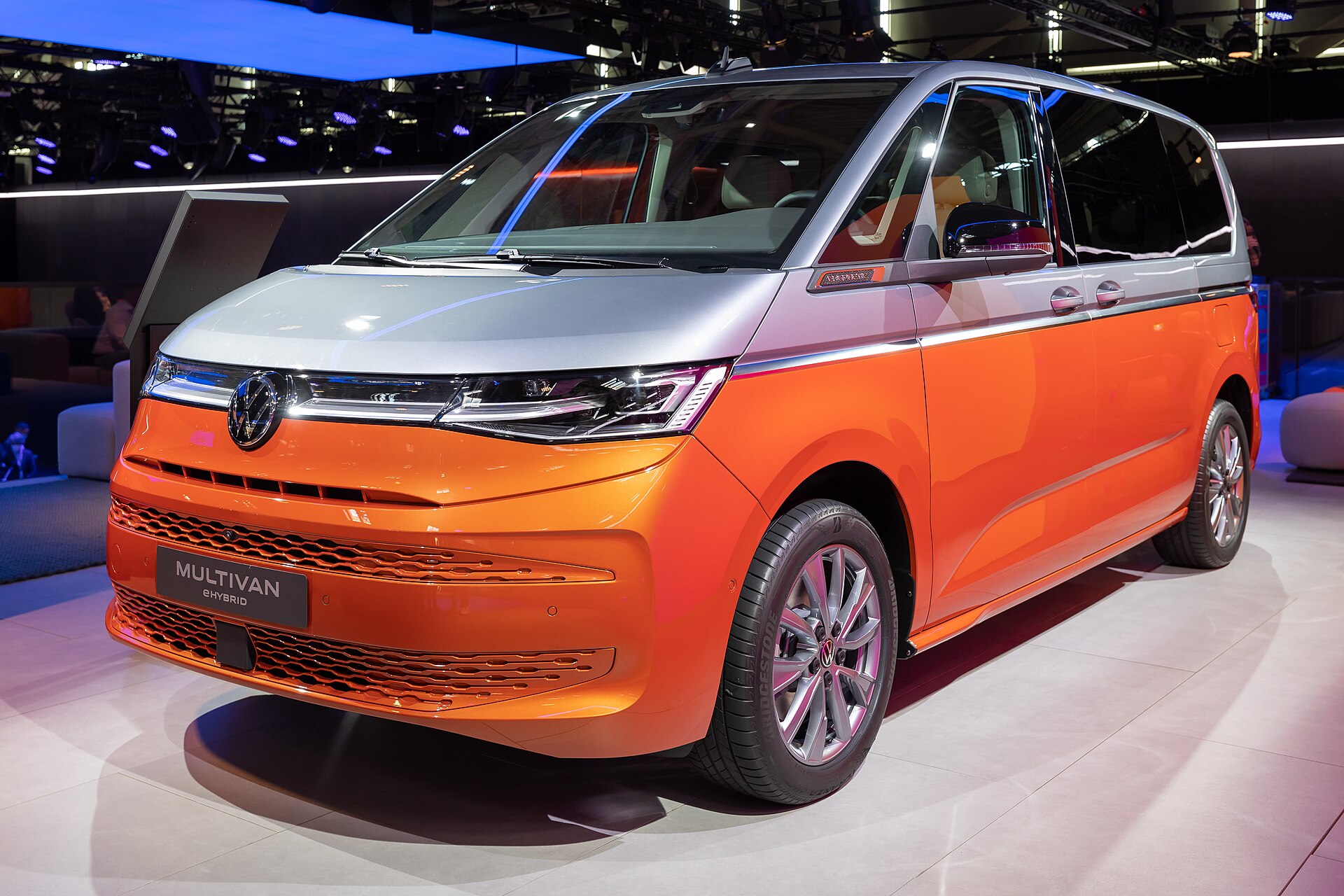
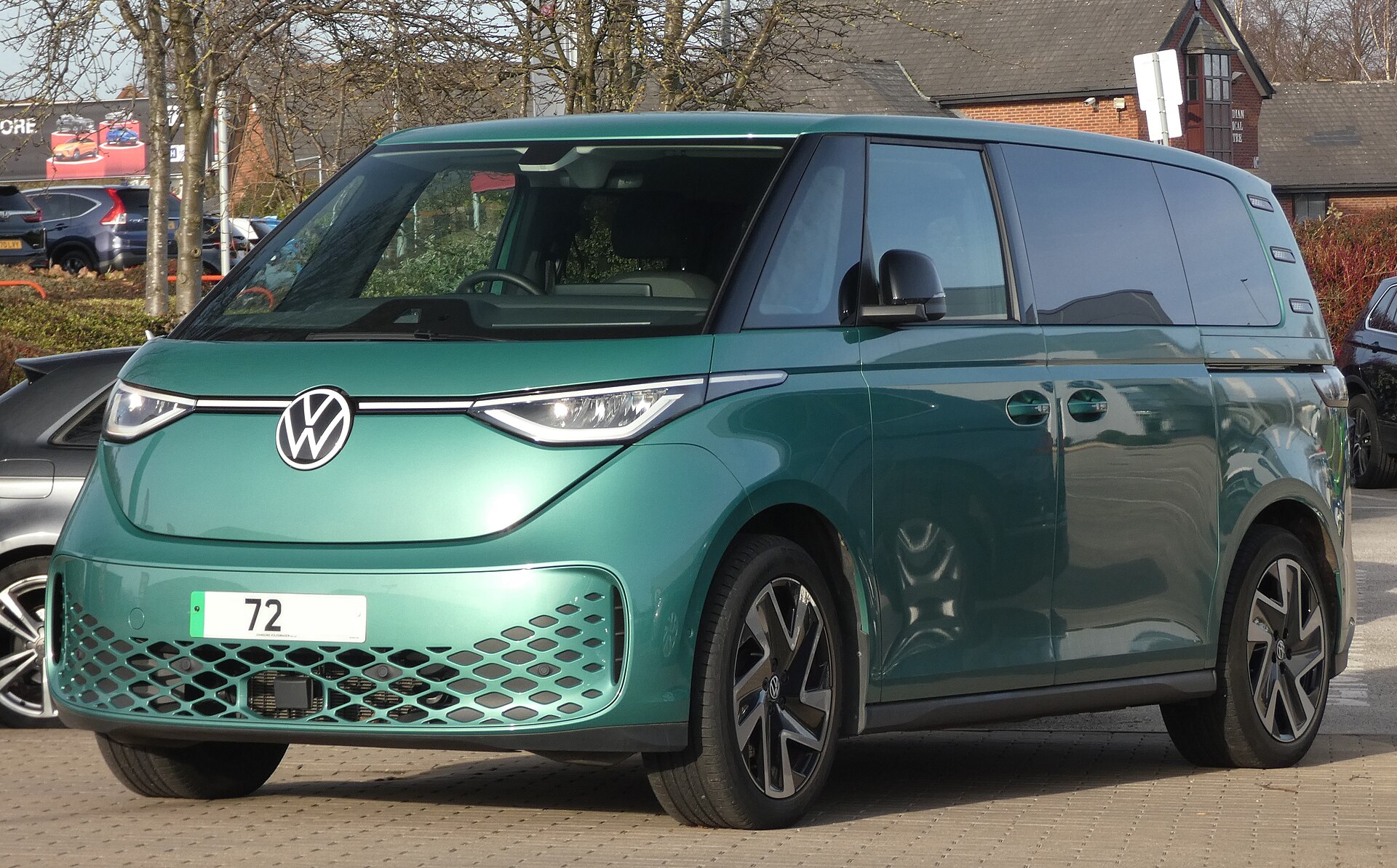
The Volkswagen ID. Buzz is an electric van built in Hanover since 2022, both as a people carrier and as the ID. Buzz Cargo. Its design recalls the Type 2 Bulli of the 1950s. It shares the MEB platform with the ID.3 and ID.4, but with a longer body and a much higher roof. Short-wheelbase cars have five or six seats, and the long-wheelbase version added in 2023 has seven. Outputs range from 125 to 250 kW.
In short
- Concept at Detroit in 2017, production version revealed on 9 March 2022; built in Hanover with capacity for 130,000 a year.
- Short wheelbase 4,712 mm long, long wheelbase 4,962 mm; up to 2,469 litres of luggage space with the seats folded.
- Power 150 kW at launch; from 2024, 125 kW (Pure), 210 kW (Pro) and 250 kW (GTX with all-wheel drive).
- German list prices in August 2024: from €49,998 (Freestyle) to €74,928 (GTX, long wheelbase).
Size at a glance
| Dimensions | Volkswagen ID. Buzz I |
|---|---|
| Length | 4,712 mm185.5 in |
| Width | 1,985 mm78.1 in |
| Height | 1,937 mm76.3 in |
| Wheelbase | 2,988 mm117.6 in |
| Boot | 1,121 L39.6 cu ft |
Specs by version
Engines
| Version | Engine | Power | Torque | Gearbox | Drive | Production years |
|---|---|---|---|---|---|---|
| Pure 59 kWh | Electric | 125 kW 170 PS168 hp | — | 1-sp Single-speed | Rear-wheel drive | 2024 |
| Pro 77 kWh | Electric | 150 kW 204 PS201 hp | 310 Nm229 lb-ft | 1-sp Single-speed | Rear-wheel drive | 2022 |
| Cargo 77 kWh | Electric | 150 kW 204 PS201 hp | 310 Nm229 lb-ft | 1-sp Single-speed | Rear-wheel drive | 2022 |
| Pro 79 kWh | Electric | 210 kW 286 PS282 hp | — | 1-sp Single-speed | Rear-wheel drive | 2024 |
| Pro LWB 86 kWh | Electric | 210 kW 286 PS282 hp | 550 Nm406 lb-ft | 1-sp Single-speed | Rear-wheel drive | 2024 |
| GTX 79 kWh | Electric | 250 kW 340 PS335 hp | — | 1-sp Single-speed | All-wheel drive | 2024 |
| GTX LWB 86 kWh | Electric | 250 kW 340 PS335 hp | — | 1-sp Single-speed | All-wheel drive | 2024 |
Performance
Show all 6 versions
| Version | 0–100 km/h | Fuel consumption |
|---|---|---|
| Pure 59 kWh | — | 20.7 kWh/100 km33.3 kWh/100 mi |
| Pro 77 kWh | 10.2 s 0–62 mph | 21.2 kWh/100 km34.1 kWh/100 mi |
| Cargo 77 kWh | — | 21.2 kWh/100 km34.1 kWh/100 mi |
| Pro LWB 86 kWh | 7.9 s 0–62 mph | — |
| GTX 79 kWh | 6.1 s 0–62 mph | — |
| GTX LWB 86 kWh | — | — |
Dimensions and weight
Show all 7 versions
| Version | Length | Width | Height | Wheelbase | Kerb weight | Battery |
|---|---|---|---|---|---|---|
| Pure 59 kWh | 4,712 mm185.5 in | 1,985 mm78.1 in | 1,937 mm76.3 in | 2,988 mm117.6 in | 2,375 kg5,236 lb | 59 kWh |
| Pro 77 kWh | 4,712 mm185.5 in | 1,985 mm78.1 in | 1,937 mm76.3 in | 2,988 mm117.6 in | 2,459 kg5,421 lb | 77 kWh |
| Cargo 77 kWh | 4,712 mm185.5 in | 1,985 mm78.1 in | 1,937 mm76.3 in | 2,988 mm117.6 in | 2,462 kg5,428 lb | 77 kWh |
| Pro 79 kWh | 4,712 mm185.5 in | 1,985 mm78.1 in | 1,937 mm76.3 in | 2,988 mm117.6 in | — | 79 kWh |
| Pro LWB 86 kWh | 4,962 mm195.4 in | 1,985 mm78.1 in | 1,937 mm76.3 in | 3,238 mm127.5 in | — | 86 kWh |
| GTX 79 kWh | 4,712 mm185.5 in | 1,985 mm78.1 in | 1,937 mm76.3 in | 2,988 mm117.6 in | — | 79 kWh |
| GTX LWB 86 kWh | 4,962 mm195.4 in | 1,985 mm78.1 in | 1,937 mm76.3 in | 3,238 mm127.5 in | — | 86 kWh |
Verified Manufacturer and type-approval data from our catalog · Sources and methodology
Volkswagen ID. Buzz at a glance
| Parameter | Value |
|---|---|
| Production | since spring 2022, Volkswagen Commercial Vehicles plant, Hanover |
| Platform | MEB |
| Bodies | five-door van (people carrier), Cargo panel van |
| Length | 4,712 mm (SWB), 4,962 mm (LWB) |
| Width / height | 1,985 / 1,937 mm |
| Wheelbase | 2,988 mm (SWB), 3,238 mm (LWB) |
| Kerb weight | 2,459 kg (SWB people carrier) |
| Seats | 5 or 6 (SWB), 7 (LWB), 2 or 3 (Cargo) |
| Power | 125 to 250 kW (170 to 340 PS) |
| Battery (usable) | 59, 77, 79 or 86 kWh |
| Drag coefficient | Cd 0.285 (people carrier), 0.29 (Cargo) |
From the 2017 concept to series production
Volkswagen first showed the ID. Buzz concept in Detroit, at the North American auto show of January 2017 and again in Geneva that March. The concept had either 200 kW and rear-wheel drive or 275 kW and all-wheel drive. In August 2017, chief executive Herbert Diess confirmed that it would go into production for 2022. A Cargo study followed at the IAA Commercial Vehicles show in Hanover in 2018.
The production van was revealed on 9 March 2022. Hanover, the traditional home of the Transporter, was converted for electric vehicles. The Cargo started first in early April 2022 and the passenger version in May, according to Wikipedia DE. Orders opened on 20 May 2022, at about €65,000 for the Pro in Germany before the state subsidy of the time. The first Cargo was handed to a customer in Isernhagen on 15 November 2022.
Short and long wheelbase, Pure and GTX
At launch there was one drive: a 150 kW (204 PS) motor with 310 Nm at the rear and a 77 kWh battery. Volkswagen revealed the long-wheelbase version on 2 June 2023. Its wheelbase is 250 mm longer, it has a third row of seats and a larger battery. A stronger motor of 210 kW (286 PS) and 550 Nm came with it.
In July 2024 Hanover converted the line again, and the range was rebuilt around three drives:
| Version | Drive | Power | Battery (usable) | DC charging | WLTP range | Price (Germany, Aug 2024) |
|---|---|---|---|---|---|---|
| Freestyle / Pure | rear | 125 kW | 59 kWh | 165 kW | 330 km (forecast) | €49,998 / €54,127 |
| Pro, short wheelbase | rear | 210 kW | 79 kWh | 185 kW | 423–461 km | €60,892 |
| Pro, long wheelbase | rear | 210 kW | 86 kWh | 200 kW | 453–487 km | €62,719 |
| GTX, short wheelbase | all-wheel | 250 kW | 79 kWh | 185 kW | 423 km | €73,102 |
| GTX, long wheelbase | all-wheel | 250 kW | 86 kWh | 200 kW | 475 km | €74,928 |
The GTX adds a second motor at the front, for 250 kW (340 PS) in total. With the 79 kWh battery it reaches 100 km/h in 6.1 seconds. The first 150 kW van needed 10.2 seconds, and the long-wheelbase Pro needs 7.9. Top speed was limited to 145 km/h at first; since summer 2024 every version reaches 160 km/h. The original 77 kWh battery charges from 5 to 80 percent in about 30 minutes at up to 170 kW.
Design, cabin and space
Designer Einar Castillo worked under group design chief Klaus Zyciora. The brief, in the words of product manager Jeffrey Lear, was a design that is "modern and fresh and exciting" while keeping cues from the T1. The van is 81 mm wider than the T6 Transporter.
Inside, the seats use recycled materials; leather is not offered. A 5.3-inch display sits behind the wheel. A 10-inch touchscreen is standard and a 12-inch one optional, and the cabin has up to eight USB ports. The short-wheelbase people carrier holds 1,121 litres behind the rear bench and 2,205 litres with it folded. The long-wheelbase version reaches 2,469 litres.
The Cargo has a partition behind two or three front seats. Its load space measures 3.9 m³ and takes two Euro pallets. Load length is 2,208 mm with a tailgate or 2,232 mm with wing doors. Payload is 592 to 607 kg within a gross weight of 3,000 kg. Braked towing loads are 1,200 kg for the Pro and up to 1,800 kg for the GTX. Our garage fit tool checks whether a van 1,937 mm tall fits a given space.


Safety and markets
Euro NCAP gave the ID. Buzz five stars in its test at the end of 2022. Adult occupants were protected to 92 percent and children to 87 percent; pedestrian protection reached 60 percent and the assistance systems 90 percent. A long-wheelbase Pro tested in 2025 under newer rules scored 84, 85, 70 and 73 percent. As a commercial vehicle, the Cargo received a Platinum rating with 83 percent in March 2024.
Production reached 11,013 units in 2022, 35,272 in 2023 and 29,900 in 2024. Germany registered 11,164 passenger versions from May 2022 to December 2024; Cargo vans are counted separately. 2023 was the best year so far, with 5,028 cars. The ID. Buzz was named German Car of the Year 2023.
North America received only the long-wheelbase version with three rows, from 2024. In December 2025 Volkswagen said the van would skip the US market for the 2026 model year and return for 2027. Prototypes with automated-driving hardware from Argo AI were tested in Munich from late 2021; after Argo closed, Volkswagen turned to Bosch and Horizon Robotics in October 2022.
Volkswagen ID. Buzz in our rankings
- No. 6 of 48 · Heaviest electric cars (2,459 kg)
- No. 23 of 304 · Heaviest cars (2,459 kg · top 8%)
- No. 52 of 403 · Widest cars (1,985 mm · top 13%)
- No. 58 of 420 · Longest cars (4,962 mm · top 14%)
- No. 24 of 78 · Biggest batteries: electric cars (86 kWh · top 33%)
- No. 141 of 368 · Most torque: cars (550 Nm · top 39%)
Heavier than 92% of ranked cars in the 1CARS catalog (No. 23 of 304).
FAQ
How far can the ID. Buzz go on one charge?
From a forecast 330 km (59 kWh) to 487 km WLTP for the long-wheelbase Pro with 86 kWh, depending on version.
How many seats does the ID. Buzz have?
Five or six with the short wheelbase and seven with the long wheelbase; the Cargo has two or three.
What is the difference between the short and long ID. Buzz?
The long version has a 250 mm longer wheelbase, is 4,962 mm long instead of 4,712 mm and has a third seat row and an 86 kWh battery.
Is there an all-wheel-drive ID. Buzz?
Yes. The GTX and the all-wheel-drive Cargo have an extra front motor and 250 kW (340 PS).
How much does the ID. Buzz cost?
German list prices in August 2024 ranged from €49,998 for the Freestyle to €74,928 for the long-wheelbase GTX.
Data sources
Data checked by an editor against the sources below.
- Wikipedia — Volkswagen ID. Buzz
- Electrive — Neue Id Buzz Versionen Vom Gtx Bis Zur 50 000 Euro Basisversion
- EEA CO₂ monitoring (European Environment Agency, CC BY 4.0)