 Volkswagen Sharan
All generations, specs and history
Published Sources (2) Report an error
By Felix Hartmann, Automotive Technology & EV Contributor
- Built
- 1995–2022
- Generations
- 2
Timeline
Sharan generations
Click a generation for its own page


Newest first · 2 generations since 1995
All generations by year: Sharan II (2010–2022) · Sharan I (1995–2010)
Which one is mine?
Pick the year of first registration to see which generation it is.
- Sharan II 2010–2022
- Sharan I 1995–2010
The Volkswagen Sharan is a people carrier that Volkswagen built from 1995 to 2022, with front- or all-wheel drive, a five-door body and five or seven seats. It offers good safety, a versatile cabin, solid build quality and decent driving manners. The name is said to come from a Persian word meaning "carrier of kings". Between 1995 and 2015 about one million Sharans were sold worldwide.
In short
- Two generations: 1995 (developed together with Ford) and March 2010; the second generation was facelifted in Geneva in 2015.
- Turbocharged petrol engines with 110 and 162 kW (150 and 220 PS) and a 2.0 diesel with 85–135 kW (115–184 PS).
- Six-speed manual or DSG, with optional 4Motion all-wheel drive.
- Sliding rear doors; up to 2,430 litres of luggage space in the five-seater.
Volkswagen Sharan at a glance
The second-generation Sharan is a monocoque MPV with a transverse engine on the Volkswagen PQ46 platform, independent suspension and sliding rear doors. More Volkswagen models are listed in our Volkswagen catalogue, and other articles about the model are collected in our Volkswagen Sharan section.
History
The Sharan was developed in close cooperation with Ford and arrived in 1995. It became very common in many European countries, Latin America and parts of Asia. Two generations were built, and production ended in 2022 without a direct successor. The second was unveiled at the Geneva motor show in March 2010, and its facelift followed at the same show in 2015, bringing a fresher exterior, a reworked interior, a revised engine range and more electronic features.
Second generation (2010–2022)
Exterior
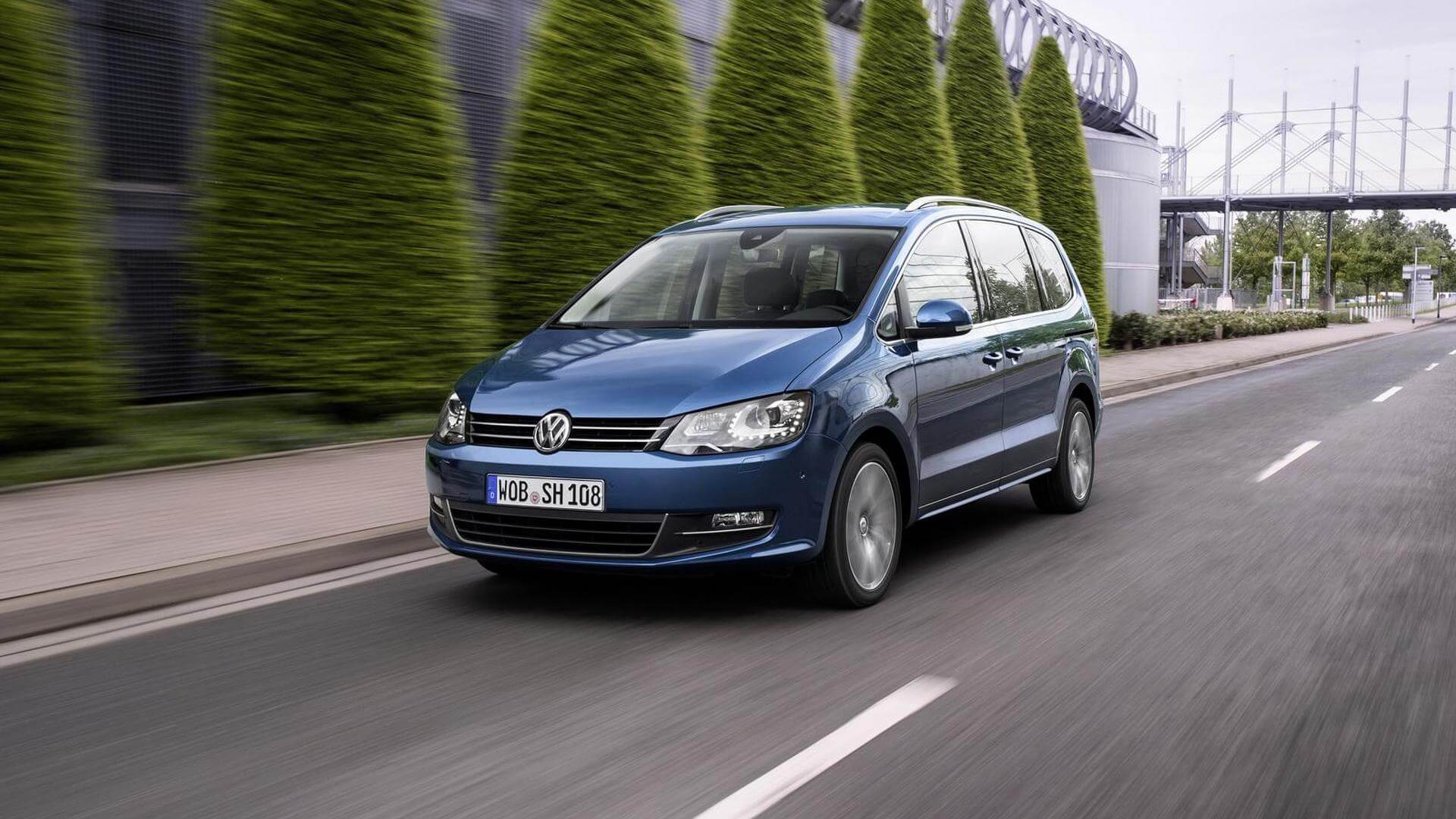
Like other cars of its class, the second Sharan has a restrained, slightly strict style that underlines its family role; almost everything is focused on practicality and ease of use. It is a large vehicle without design flourishes, yet it looks stylish and modern. The facelift brought cosmetic improvements at the front: slightly updated headlights with LED daytime running lights and a revised bumper with new fog lamps.
From the side, large wheel arches and sliding rear doors stand out; the doors make it easy to get in and out in tight parking spaces. Sculpted flanks and a large glass area complete the profile. Ground clearance is an average 152 mm — enough for city kerbs and the occasional country lane, but no more. Standard wheels are 16 inches, with 17- and 18-inch alloys optional, giving the family car a sporty look. At the rear, updated LED tail lights with a three-dimensional effect and a new bumper were added. The large tailgate with a big rear window, giving excellent visibility, and a small spoiler with a third brake light were carried over. The exhaust is hidden under the car, and more paint colours became available.
Interior
The cabin has clean lines and neat shapes. It is modern but a little dull, the flip side being almost perfect ergonomics: every control is exactly where it should be. A slightly flat-bottomed multifunction steering wheel faces easy-to-read instruments with two analogue dials and a colour trip-computer display. Depending on version, a 5- or 6.5-inch colour infotainment screen sits at the top of the console, flanked by buttons and vertical air vents. A trim line across the dashboard carries the hazard switch, above a neat climate control panel. Materials and fit are praiseworthy, though not yet at the level of premium MPVs.
The Sharan is available with five or seven seats. The front seats are moderately firm and comfortable, with noticeable side support and a wide range of adjustment; electric adjustment, heating, ventilation and massage are optional. The second row has three full-size seats on rails that slide fore and aft, with reclining backrests. The optional third row is best suited to children or teenagers, as adults lack knee room.
In five-seat form the luggage area holds 711 litres loaded to the window line or 1,167 litres to the roof, and 2,430 litres with the second-row backrests folded — enough for a compact fridge. The seven-seater offers 300 litres with all seats in use and 2,297 litres with the second and third rows folded.
Engines and transmissions
| Engine | Fuel | Power (kW / PS) | Torque |
|---|---|---|---|
| 1.4 four-cylinder turbo, direct injection | Petrol | 110 kW / 150 PS | 250 Nm |
| 2.0 four-cylinder turbo, direct injection | Petrol | 162 kW / 220 PS | — |
| 2.0 four-cylinder turbodiesel, direct injection (three outputs) | Diesel | 85–135 kW / 115–184 PS | 280–380 Nm |
The petrol engines have 16 valves and variable valve timing. They use 5.1–7.0 l/100 km on the combined cycle, reach 100 km/h in 7.5–8.9 seconds and reach up to 209 km/h. The diesels use 4.1–6.5 l/100 km, reach 100 km/h in 9.3–12.6 seconds and reach 184–205 km/h.
Gearboxes are a six-speed manual or a DSG dual-clutch automatic, with front-wheel drive as standard. For better traction, 4Motion all-wheel drive is available, using a multi-plate clutch to engage the rear axle; it is offered only with the mid-range diesel.
Chassis
The facelifted second generation uses the PQ46 platform, with a transverse engine and a monocoque body that makes extensive use of high-strength steel; Volkswagen says ultra-high-strength steel grades considerably improved body rigidity. Suspension is fully independent, with MacPherson struts at the front and a four-link rear axle. Rack-and-pinion steering has electromechanical assistance, and the brakes are discs all round (ventilated at the front) with ABS, EBD and other electronic aids.
Safety and equipment
The Sharan offers front and side airbags, three-point belts with pretensioners, automatic emergency braking, forward collision warning, lane monitoring, blind-spot monitoring, a parking assistant, driver fatigue monitoring, cruise control, a rear camera, ABS, stability control, brake-force distribution and Park Assist, which can park the car without the driver steering.
Prices
In Germany in 2016, the facelifted Sharan started at €32,375. The base version had seven airbags, an eight-speaker audio system, air conditioning, 16-inch wheels, ESP, ABS, ASR, MSR and electric windows. The top-spec version cost €38,475 and added 17-inch alloys, three-zone climate control, adaptive cruise control, parking assistance, heated front seats and an infotainment system with a colour display.
Key specifications (second generation)
| Parameter | Value |
|---|---|
| Presented | March 2010, Geneva (facelift 2015) |
| Platform | PQ46 |
| Seats | 5 or 7 |
| Power (kW / PS) | 85–162 kW / 115–220 PS |
| 0–100 km/h | 7.5–12.6 s |
| Ground clearance | 152 mm |
| Luggage space, 5 seats | 711 / 1,167 / 2,430 l |
| Luggage space, 7 seats | 300 / 2,297 l |
| Wheels | 16–18 in |
Strengths and weaknesses
Owners describe a comfortable, versatile and attractive interior, good comfort, plenty of space and reasonable fuel consumption. They praise the responsive diesels and the all-wheel drive, which copes with poor surfaces, and the seven seats make it suitable for large families and active holidays. The mechanicals are reliable and the handling is good. On the downside, sound insulation is not the best, the engines can feel underpowered, the cabin takes a long time to warm up in winter and older cars need expensive parts and repairs. Rivals included the Ford Galaxy and S-Max, Renault Espace, Citroën Grand C4 Picasso, Opel Zafira Tourer and Kia Carnival, while the SEAT Alhambra was its twin.
Image credits · Photos from Wikimedia Commons under free licences
- Volkswagen Sharan I · Photo: Eric Rayner / Wikimedia Commons, CC BY 2.0
- Volkswagen Sharan II · Photo: Vauxford / Wikimedia Commons, CC BY-SA 4.0
Volkswagen Sharan in our rankings
- No. 86 of 912 · Longest-running car nameplates (27 years · top 11%)
- No. 254 of 345 · Cars with the most generations (2 generations)
In production longer than 89% of ranked nameplates in the 1CARS catalog (No. 86 of 912).
FAQ
What does the name Sharan mean?
It is said to come from a Persian word meaning "carrier of kings".
How many generations of the Volkswagen Sharan are there?
Two: the first from 1995, developed with Ford, and the second from 2010, facelifted in 2015.
Does the Volkswagen Sharan have seven seats?
Yes, a third row is optional; it is best suited to children or teenagers.
Is there an all-wheel-drive Volkswagen Sharan?
Yes. 4Motion all-wheel drive with a multi-plate clutch is offered with the mid-range diesel.
How big is the Volkswagen Sharan boot?
711 litres in five-seat form (to the window line), up to 2,430 litres with the second row folded.
Data sources
Data checked by an editor against the sources below.
- Wikipedia — Volkswagen Sharan
- Wikipedia — VW Sharan