 Mercedes-Benz EQV
Specs, engines and history
Published Sources (4) Report an error
By Felix Hartmann, Automotive Technology & EV Contributor
- Built
- 2019–present
- Top power
- 150 kW (204 PS)
Which EQV to choose
Our verdict · Felix Hartmann
The EQV 300 with the 90 kWh usable battery is the version to buy; the 60 kWh EQV 250 only suits short, predictable routes. A post-2023 car has the better screens and current MBUX software. Check the charging history and the battery's state of health on a used example, and make sure the seat layout matches the number of passengers.
For buyers who need range and towing, the diesel V-Class or the Mercedes-Benz Vito remain the practical choice; for those who can wait, the VLE promises a purpose-built electric platform. Other vans and MPVs of the brand are on the Mercedes-Benz catalogue page.
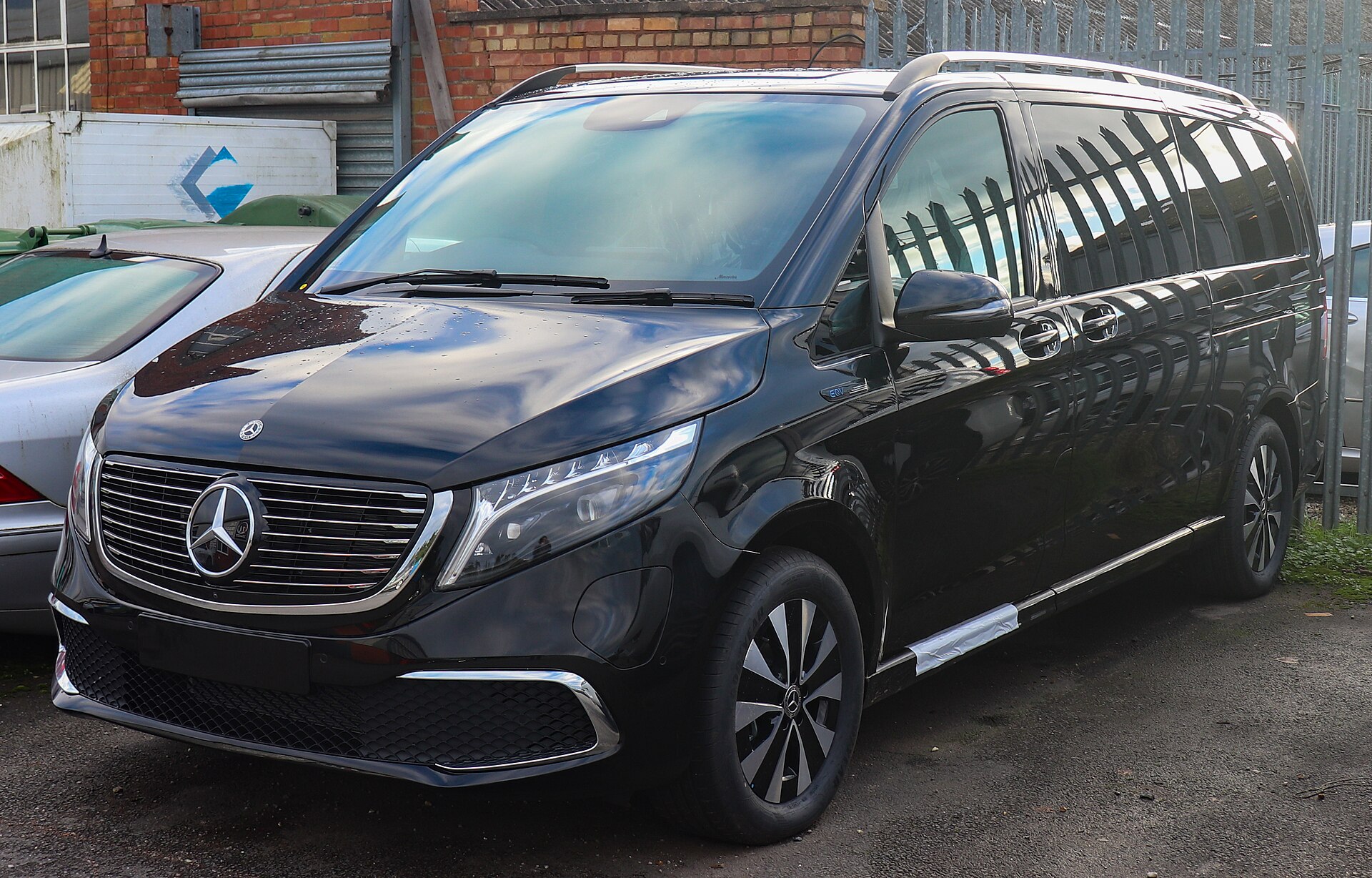
The Mercedes-Benz EQV is the battery-electric version of the V-Class people carrier, on sale since 2020 and built in Vitoria, Spain. It carries six to eight people on a 90 kWh usable battery, with 150 kW and roughly 350 km of WLTP range. In 2026 Mercedes revealed the VLE on a new van platform as its successor.
In short
- Shown as the Concept EQV at Geneva in March 2019; the production version followed at the IAA in September 2019.
- EQV 300: 150 kW (204 PS) peak, 362 Nm, 100 kWh installed and 90 kWh usable.
- About 350–364 km WLTP, depending on the source; fast charging at up to 110 kW takes the battery from 10 to 80 per cent in roughly three-quarters of an hour.
- In Germany the EQV 300 cost €71,388 including VAT when sales began in May 2020.
Specs by version
Engines
Performance
Show all 1 versions
| Version | Fuel consumption |
|---|---|
| EQV 300 | 28.2 kWh/100 km45.4 kWh/100 mi |
Dimensions and weight
Show all 1 versions
| Version | Length | Wheelbase | Kerb weight | Battery |
|---|---|---|---|---|
| EQV 300 | 5,140 mm202.4 in | 3,200 mm126.0 in | 2,635 kg5,809 lb | 90 kWh |
Verified Manufacturer and type-approval data from our catalog · Sources and methodology
Mercedes-Benz EQV at a glance
| Parameter | EQV 300 |
|---|---|
| Production | sales from May 2020; plant in Vitoria-Gasteiz (Spain) |
| Base | V-Class (W447), one electric motor |
| Seats | 6, 7 or 8 |
| Length | 5,140 mm (long) or 5,370 mm (extra-long) |
| Wheelbase | 3,200 or 3,430 mm |
| Power / torque | 150 kW (204 PS) peak, 70 kW continuous / 362 Nm |
| Battery | 100 kWh installed, 90 kWh usable |
| WLTP range | about 350–364 km |
| Charging | up to 110 kW DC, 11 kW AC |
| Top speed | 140 km/h; 160 km/h as an option |
| Successor | Mercedes-Benz VLE (revealed March 2026) |
From concept to production
Mercedes showed the Concept EQV at the 89th Geneva Motor Show in March 2019 as an electric take on its luxury van. A production prototype appeared that summer, and the finished EQV was presented at the IAA in Frankfurt in September 2019. Sales of the EQV 300 began in May 2020, with production on the same line in Vitoria as the combustion V-Class and the Vito.
The EQV uses the body of the V-Class (W447) and offers the same choice of six to eight seats. The commercial counterpart is the eVito Tourer, which uses the same drivetrain and the same 90 kWh usable battery.

Battery, range and charging
The pack holds 100 kWh, of which 90 kWh can be used. Mercedes quoted 417–418 km on the old NEDC cycle at launch; under WLTP the figures are lower. Wikipedia EN gives 350 km, Wikipedia DE 352 km and EV Database 226 miles (about 364 km). Consumption on the test cycle is about 26 kWh per 100 km. That is around three-quarters more than the 14.9 kWh Volvo quotes for its EX60 P6 SUV, the price of a box 1.9 metres tall.
| Charging | Power | Time (Mercedes) |
|---|---|---|
| DC fast charger | up to 110 kW | 10–80 % in about 45 minutes |
| AC wallbox, three-phase | 11 kW | full charge in under 10 hours |
In everyday terms a 45-minute stop adds about 63 kWh, enough for roughly 240 km at the test-cycle consumption. Wikipedia DE also lists an EQV 250 with a 60 kWh battery and 273 km of WLTP range, aimed at shorter shuttle work.

Drive and performance
The EQV has a single electric motor. Its peak output is 150 kW (204 PS), with 70 kW available continuously, and torque is 362 Nm. Top speed is 140 km/h as standard and 160 km/h with an option. EV Database lists the unladen EU weight at 2,635 kg, or about 17.6 kg per kilowatt of peak power.
One practical limit stands out: EV Database lists no tow hitch for the EQV 300, so it cannot pull a trailer. Buyers who need towing should look at the combustion V-Class.
Seats, size and practicality
The EQV comes in two lengths: 5,140 mm with a 3,200 mm wheelbase and 5,370 mm with a 3,430 mm wheelbase. Seat layouts include six, seven or eight places. EV Database gives 1,030 litres of luggage space for the long version and a maximum of 4,630 litres.
At over five metres long and about 1.9 metres tall, the EQV will not fit every underground car park or garage. The will-it-fit-in-my-garage tool checks that before a test drive, and the size comparison tool sets it against other MPVs.
The EQV in figures per seat
Large people carriers look expensive in energy terms until the seats are counted. The table works the published data down to one seat and to charging time.
| Figure | Calculation | Result |
|---|---|---|
| Energy per seat (eight seats) | 26.3 kWh/100 km ÷ 8 | about 3.3 kWh per seat per 100 km |
| Energy per seat (six seats) | 26.3 kWh/100 km ÷ 6 | about 4.4 kWh per seat per 100 km |
| Unladen weight per seat (seven seats) | 2,635 kg ÷ 7 | about 376 kg |
| Range added per minute at a fast charger | 63 kWh in 45 min ÷ 26.3 kWh/100 km | about 5.3 km per minute |
Fully occupied, the EQV therefore uses far less energy per person than a Volvo EX60 P6 (14.9 kWh/100 km) carrying only its driver. The charging figure shows its weakness: the 800-volt EX60 P10 adds about 29 km of WLTP range per minute.
The 2023 update
Mercedes presented an updated V-Class family, including the EQV, in late July 2023, ahead of the 2024 model year. The cabin gained two 12.3-inch widescreen displays and the latest MBUX infotainment with a touchscreen. Sliding doors on both sides and keyless entry are optional extras.

What the EQV is like to live with
The EQV makes most sense as a shuttle: hotel transfers, airport runs and family use within a radius of about 150 km, where it can charge overnight or between jobs. In that role the daily distance stays well inside the WLTP range. On long journeys the modest range and 110 kW charging rate are its weaknesses, especially in winter, when range falls with cabin heating.

Successor: the Mercedes-Benz VLE
On 10 March 2026 Mercedes revealed the VLE, the first passenger van on its new VAN.EA electric platform, previewed by the Vision V concept of April 2025. Production started in June 2026 in Vitoria-Gasteiz, the same plant as the EQV, and Wikipedia lists the EQV as its predecessor. Unlike the EQV, which is derived from the combustion V-Class, the VLE uses the new VAN.EA architecture.
Photo gallery

Mercedes-Benz EQV in our rankings
- No. 3 of 48 · Heaviest electric cars (2,635 kg)
- No. 11 of 304 · Heaviest cars (2,635 kg · top 4%)
- No. 23 of 420 · Longest cars (5,140 mm · top 6%)
- No. 21 of 78 · Biggest batteries: electric cars (90 kWh · top 27%)
- No. 230 of 368 · Most torque: cars (362 Nm · top 63%)
- No. 578 of 859 · Most powerful cars (150 kW · top 68%)
Heavier than 96% of ranked cars in the 1CARS catalog (No. 11 of 304).
FAQ
What is the range of the Mercedes-Benz EQV?
About 350 to 364 km on the WLTP cycle with the 90 kWh usable battery, depending on the source. The EQV 250 with 60 kWh is rated at 273 km.
How fast does the EQV charge?
At a DC fast charger the EQV accepts up to 110 kW; Mercedes quotes about 45 minutes from 10 to 80 per cent. On an 11 kW wallbox a full charge takes under 10 hours.
How many seats does the EQV have?
Six, seven or eight, depending on the layout chosen.
Can the EQV tow a trailer?
EV Database lists no tow hitch and a towing weight of zero for the EQV 300.
What replaces the EQV?
The Mercedes-Benz VLE, revealed on 10 March 2026 and built in Vitoria-Gasteiz from June 2026 on the new VAN.EA platform.
Data sources
Data checked by an editor against the sources below.
- Wikipedia — Mercedes Benz V Class
- Insideevs — Mercedes Benz Start Sales Eqv 300
- Ev-database — Mercedes EQV 300
- EEA CO₂ monitoring (European Environment Agency, CC BY 4.0)