 Ford Maverick
Specs, engines and history
Published Sources (2) Report an error
By Sarah Whitmore, Senior Automotive Writer
- Built
- 1970–1977
- Top power
- 157 kW (213 PS)
Which Maverick to choose
Our verdict · Sarah Whitmore
- For performance: a 1971–1975 Grabber with the 302 V8; check that the V8 is original to the car.
- For comfort: a 1972–1977 LDO with the vinyl roof and better trim.
- For practicality: a four-door on the longer wheelbase, with more room in the back.
- For a rarity: a 1972 Sprint or a 1976 Stallion, both short-lived packages.
The rest of the range, including the Falcon that the Maverick replaced, is listed in the Ford catalogue. Its 1970s contemporaries are gathered in our 1970s classics guide, and our comparison tool helps line up the Maverick with its rivals.
The Ford Maverick was a compact two- and four-door sedan that Ford built for the 1970 to 1977 model years as the simpler, cheaper successor to the Falcon. Launched at $1,995, it offered sixes from 2.8 to 4.1 litres and, from 1971, a 302 V8, and it sold nearly 579,000 cars in its first year. Ford built about 2.1 million in North America before the Fairmont replaced it for 1978. The name returned in 2022 on an unrelated compact pickup.
In short
- Introduced on 17 April 1969 as a 1970 model; built until the end of the 1977 model year.
- Engines: 170, 200 and 250 cu in sixes and the 302 V8, from 78 kW (105 hp) to 157 kW (210 hp) gross.
- Two-door sedan from launch, four-door sedan from 1971; Grabber, Sprint, LDO and Stallion packages.
- About 2.1 million built in North America; also made in Mexico, Venezuela and Brazil.
Specs by version
Engines
| Version | Engine | Power | Drive | Production years |
|---|---|---|---|---|
| 170 cu in six (2-door) | 2.8 l · 6 cyl · Petrol 2,786 cc | 78 kW 106 PS105 hp | Rear-wheel drive | 1970–1972 |
| 200 cu in six (2-door) | 3.3 l · 6 cyl · Petrol 3,277 cc | 89 kW 121 PS119 hp | Rear-wheel drive | 1970–1977 |
| 302 Windsor V8 (2-door) | 4.9 l · 8 cyl · Petrol 4,949 cc | 157 kW 213 PS211 hp | Rear-wheel drive | 1971–1977 |
Dimensions and weight
Show all 3 versions
| Version | Wheelbase | Kerb weight |
|---|---|---|
| 170 cu in six (2-door) | 2,616 mm103.0 in | 1,366 kg3,012 lb |
| 200 cu in six (2-door) | 2,616 mm103.0 in | 1,366 kg3,012 lb |
| 302 Windsor V8 (2-door) | 2,616 mm103.0 in | 1,366 kg3,012 lb |
Verified Manufacturer and type-approval data from our catalog · Sources and methodology
Ford Maverick at a glance
| Parameter | Metric | Imperial |
|---|---|---|
| Production | model years 1970–1977 | - |
| Built (North America) | about 2.1 million | - |
| Bodies | two-door sedan; four-door sedan from 1971 | - |
| Engines | 2.8, 3.3, 4.1-litre sixes; 4.9-litre V8 | 170, 200, 250, 302 cu in |
| Power | 78–157 kW (gross) | 105–210 hp |
| Wheelbase | 2,616 mm (2-door) / 2,791 mm (4-door) | 103 in / 109.9 in |
| Kerb weight (sedan) | 1,366 kg | 3,011 lb |
| Price at launch | $1,995 (1970) | - |
| Twin | Mercury Comet (1971–1977) | - |
| Predecessor / successor | Ford Falcon / Ford Fairmont | - |
Launch in April 1969
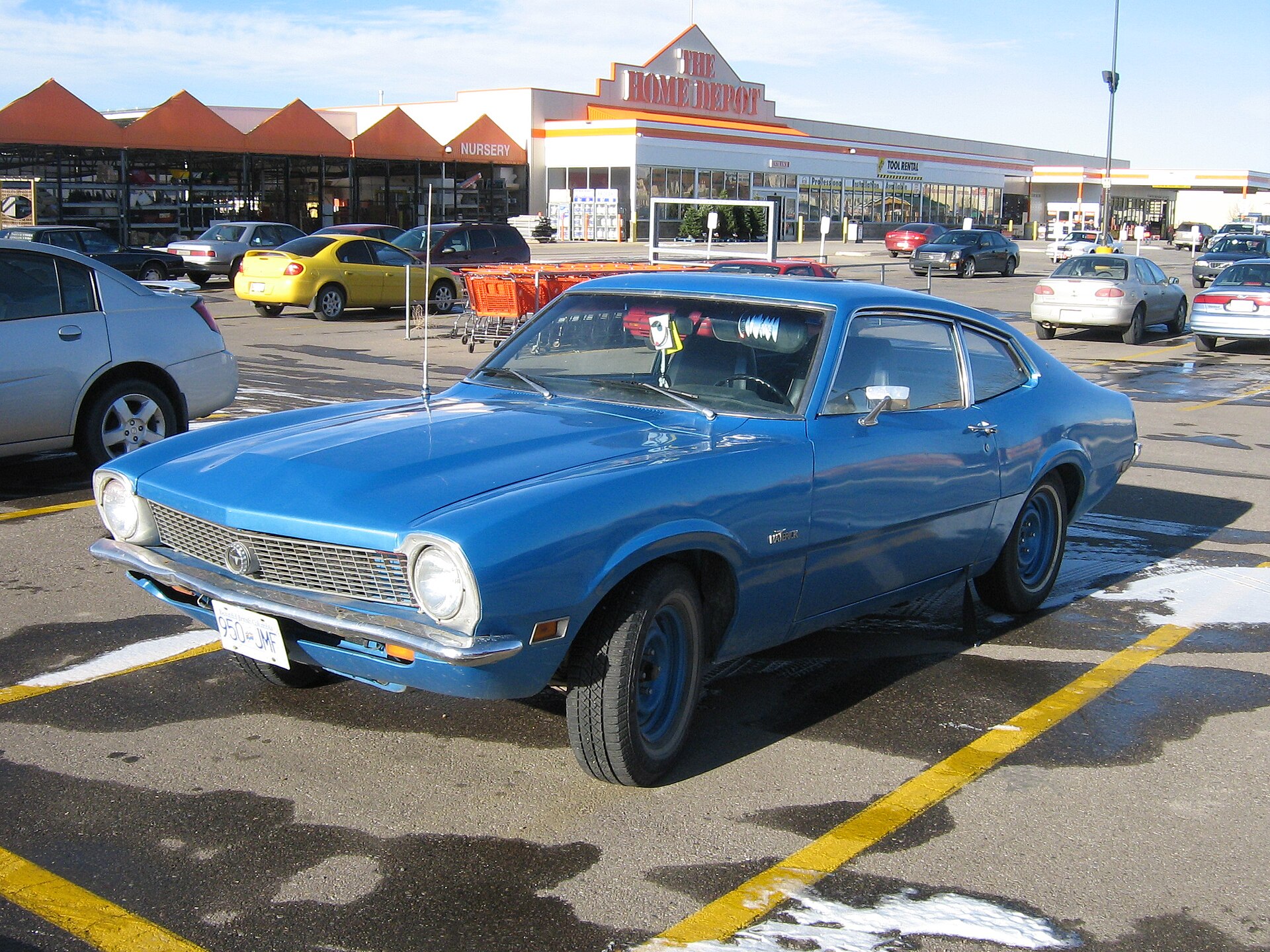
Ford introduced the Maverick on 17 April 1969, well ahead of the 1970 model year, as a two-door sedan with a semi-fastback roof, a long bonnet and a short boot. The 1970 price of $1,995 put it close to imported small cars, although English Wikipedia notes that a 1970 Volkswagen Beetle was still about $500 cheaper. Classic Industries describes the project, developed under Lee Iacocca, as a deliberately cheap car to buy and run.
The name came from Samuel Augustus Maverick, a Texas pioneer who refused to brand his cattle, and the emblem showed a Longhorn's head. Buyers liked the formula: Ford built nearly 579,000 Mavericks for the first model year, close to the first-year figure of the original Mustang (nearly 619,000) and far more than the Mustang's own 1970 sales of under 200,000. The man behind both cars is portrayed in our article on Lee Iacocca.


Maverick timeline
| Date | Event |
|---|---|
| 17 April 1969 | Maverick introduced as a 1970 two-door sedan at $1,995 (1970 price) |
| mid-1970 | Grabber package and 250 six added; 170 six offered only in early 1970 |
| 1971 | four-door sedan, 302 V8 and the Mercury Comet twin |
| 1972 | Sprint package for the Olympic year; LDO late in the model year |
| 1973 | larger federal bumpers; 200 six becomes standard |
| 1975 | last year of the Grabber |
| 1976 | Stallion package |
| 1977 | police package; final model year |
| 1978 | Ford Fairmont takes over |
Engines and chassis
The first cars used the 170 cu in (2.8-litre) six with 78 kW (105 hp), available in the first half of 1970 with an optional three-speed semi-automatic. A 200 cu in (3.3-litre) six with 89 kW (120 hp) and, from the middle of 1970, a 250 cu in (4.1-litre) six followed. For 1971 the 302 cu in (4.9-litre) Windsor V8 with 157 kW (210 hp) became available in both the Maverick and its new Mercury twin, the Comet. The 170 was dropped for 1973, when the 200 became the standard engine.
| Engine | Years | Displacement | Power (gross) | Note |
|---|---|---|---|---|
| six | 1970–1972 | 170 cu in (2.8 l) | 78 kW (105 hp) | launch engine |
| six | 1970–1977 | 200 cu in (3.3 l) | 89 kW (120 hp) | standard from 1973 |
| six | mid-1970–1977 | 250 cu in (4.1 l) | - | output not in the sources |
| Windsor V8 | 1971–1977 | 302 cu in (4.9 l) | 157 kW (210 hp) | also in the Comet |
Mercury's version, the revived Comet of 1971–1977, used the same body and engines with its own grille, rear lights, trim and bonnet, so the two cars differ mainly in their details and badges.
The two-door rode on a 103-inch (2,616 mm) wheelbase. The four-door, added for 1971, had a longer 109.9-inch (2,791 mm) wheelbase for more rear legroom. A sedan weighed about 1,366 kg (3,011 lb). Our power converter turns these period horsepower ratings into any other unit.
Production by year
| Model year | Two-door | Four-door | Grabber |
|---|---|---|---|
| 1970 | 578,914 (incl. early 1969 builds) | - | in two-door total |
| 1971 | 159,726 | 73,208 | 38,963 |
| 1972 | 145,931 | 73,686 | 35,347 |
| 1973 | 148,943 | 110,382 | 32,350 |
| 1974 | 139,818 | 137,728 | 23,502 |
| 1975 | 63,404 | 90,695 | 8,473 |
| 1976 | 60,611 | 79,076 | - |
| 1977 | 40,086 | 58,420 | - |
Figures from Classic Industries; the 1970 line combines its 127,833 cars listed under 1969 and 451,081 under 1970. Over 1.3 million Mavericks had been sold by 1973.
Grabber, Sprint, LDO and Stallion
The Grabber arrived in the middle of the 1970 model year and stayed until 1975. It added wider tyres, graphics, trim and a rear spoiler, and the 1971–1972 cars had a hood with twin scoops. Combined with the optional V8, it was the sportiest Maverick of the range.
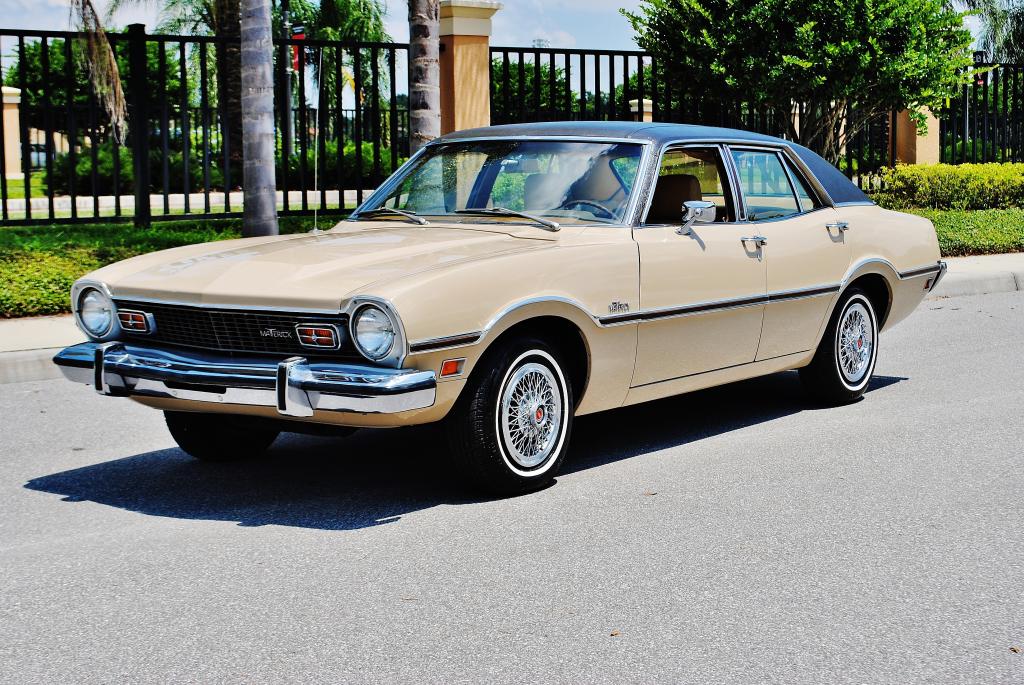
The Sprint of 1972 was a one-year package tied to the Olympic Games, with two-tone paint and a matching interior. The LDO (Luxury Decor Option), added late in the 1972 model year, brought plusher upholstery, a vinyl roof and imitation wood trim. The Stallion of 1976 was a paint-and-trim package. In 1977 Ford also offered a police package, which sold fewer than 400 cars.

Bumpers, four doors and decline (1973–1977)
Federal rules brought larger energy-absorbing bumpers from 1973. The four-door gained ground: in 1974 Ford built 137,728 four-doors against 139,818 two-doors, and from 1975 the four-door outsold the two-door every year.
Ford had planned the Granada to replace the Maverick for 1975, but positioned it instead as a more luxurious compact and kept both cars in the range. Volumes fell steadily, to under 100,000 in 1977. For 1978 the Fairmont, the first car on Ford's Fox platform, took the Maverick's place.
Maverick outside the United States
Mavericks were assembled at Claycomo (Missouri), Milpitas (California) and Wayne (Michigan), at Talbotville and Oakville in Ontario, in Mexico City, in São Bernardo do Campo near São Paulo and in Valencia, Venezuela. Venezuela built the car from 1970 to 1977. Brazil produced it from 1973 to 1979, including a GT version, although English Wikipedia notes it did not reach the expected sales. Early Mexican cars were sold as the "Falcon Maverick".

The Maverick name since 1977
Ford has reused the name several times. In Australia it was a version of the Nissan Patrol (1988–1994), in Europe a version of the Nissan Terrano II (1993–1999) and later the Ford Escape (2001–2004). Since 2021 it has been a compact pickup: revealed on 8 June 2021 and built at Hermosillo, Mexico, from 2 September 2021, it uses the front-wheel-drive-based C2 unibody platform. Its standard 2.5-litre hybrid gives 142 kW (191 hp) combined, a 2.0-litre EcoBoost 186 kW (250 hp), and a headline cited by English Wikipedia gives a starting price of $19,995 for the 2022 model year. Apart from the name it has nothing in common with the 1970s car.
Photo gallery

Ford Maverick in our rankings
- No. 34 of 131 · Biggest engines: sedans (4,949 cc · top 26%)
- No. 151 of 557 · Biggest engines: cars (4,949 cc · top 28%)
- No. 19 of 52 · Power-to-weight: sedans (115 kW/t · top 37%)
- No. 111 of 304 · Lightest cars (1,366 kg · top 37%)
- No. 22 of 53 · Lightest sedans (1,366 kg · top 42%)
- No. 136 of 301 · Power-to-weight: cars (115 kW/t · top 46%)
Bigger engine than 74% of ranked sedans in the 1CARS catalog (No. 34 of 131).
FAQ
What years was the Ford Maverick car made?
For the 1970 to 1977 model years. Ford introduced it on 17 April 1969, and the Fairmont replaced it for 1978.
How much did a Ford Maverick cost in 1970?
The starting price was $1,995 in US dollars of the time, about $500 more than a Volkswagen Beetle.
What engines were offered in the 1970s Maverick?
Sixes of 170, 200 and 250 cu in and, from 1971, the 302 V8 with 157 kW (210 hp) gross.
What was the Maverick Grabber?
A sporty package offered from mid-1970 to 1975 with wider tyres, graphics, a spoiler and, in 1971–72, a twin-scoop hood. From 1971 it could be ordered with the 302 V8.
Is the new Ford Maverick pickup related to the old car?
No. The pickup introduced in 2021 is a front-wheel-drive-based unibody truck built in Mexico; it shares only the name with the 1970–1977 compact sedan.
Data sources
Data checked by an editor against the sources below.
- Wikipedia - Ford Maverick (Americas)
- Wikipedia - Ford Maverick (1970–1977)