 Aston Martin Vulcan
Specs, engines and history
Published Sources (1) Report an error
By Felix Hartmann, Automotive Technology & EV Contributor
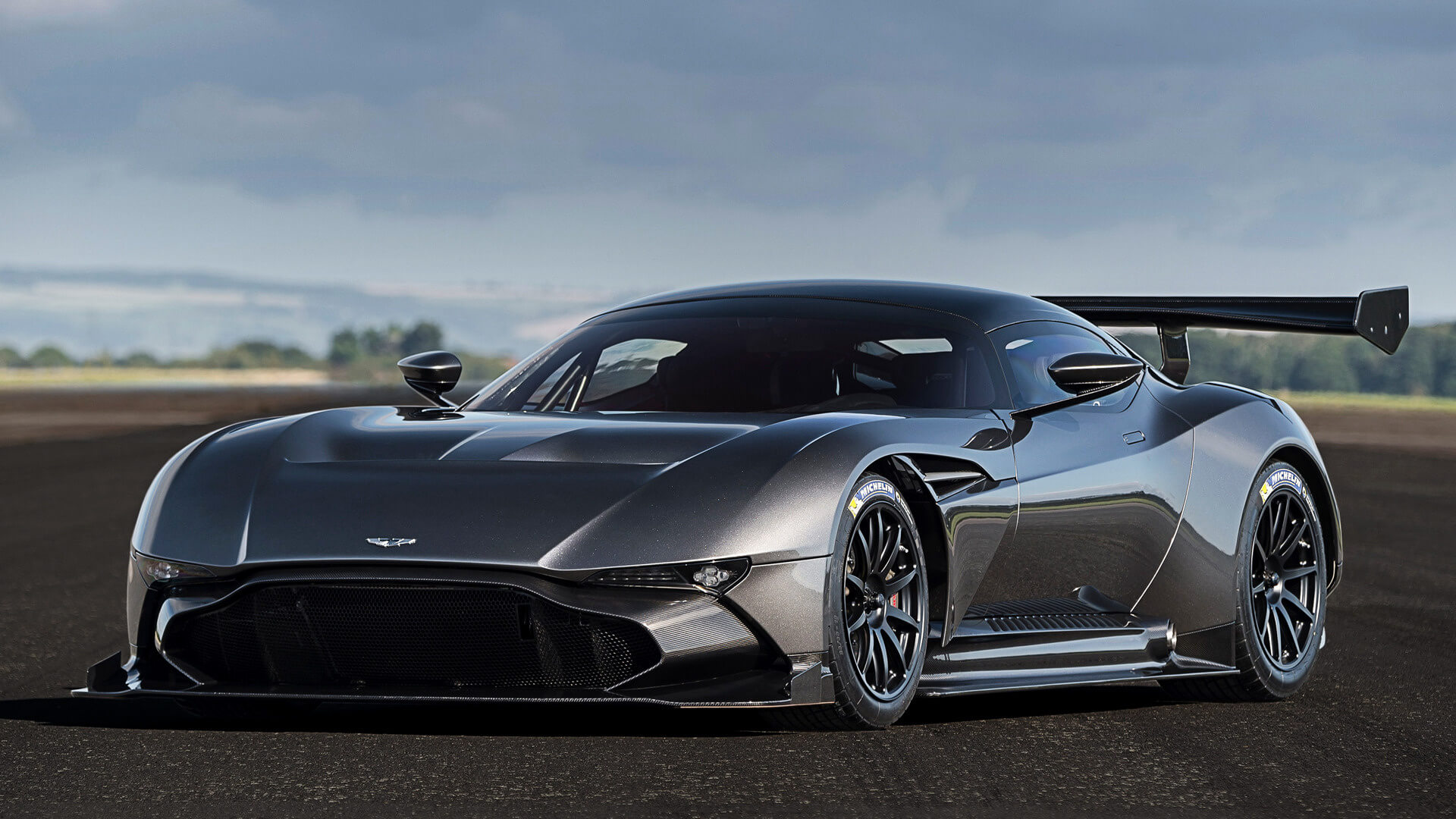
The Aston Martin Vulcan is a track-only hypercar unveiled at the Geneva motor show in March 2015 and built at Gaydon in 2015 and 2016. It is one of the most technologically advanced cars Aston Martin has made, and only 24 were built - one for each hour of the Le Mans 24 Hours, a race with which the brand has a long history. The Vulcan is named after the Avro Vulcan, the British delta-wing bomber.
In short
- 7.0-litre naturally aspirated V12 with 611 kW (831 PS) at 7,750 rpm and 780 Nm.
- Xtrac six-speed sequential gearbox and a limited-slip differential driving the rear wheels.
- Carbon-fibre body, dry weight of about 1,350 kg and a top speed of 335 km/h.
- Only 24 cars; one was later converted for road use by RML.
Aston Martin Vulcan at a glance
The Vulcan is a front-engined two-seat coupé built for circuits, with a carbon-fibre body and rear-wheel drive. It was never homologated for the road from the factory. More Aston Martin models are listed in our Aston Martin catalogue.
Why the Vulcan matters
For Aston Martin, the Vulcan was a statement. The brand was best known for elegant grand tourers, and the Vulcan showed that it could also build an extreme, very fast machine able to stand comparison with the fastest track cars of its time. It changed how many enthusiasts saw the British marque and paved the way for its later hypercar projects. Because it was sold with a complete support package rather than as a simple car, it also became a model for exclusive track-day programmes, in which the manufacturer looks after the car, the driver training and the events for a small circle of owners.
Exterior
The Vulcan's exterior, like its cabin and engineering, represents the top level of Aston Martin's engineering and design. Thanks to the latest lightweight composite materials, the car weighs only about 1,350 kg dry, and its lightness and aggression are obvious at a glance. It is wide and low with a noticeably long front end, and it carries many carbon-fibre aerodynamic parts, including a splitter, diffuser and sills. Every surface follows racing-car principles, with flowing, well-proportioned shapes. The car rides on 19-inch centre-lock wheels with Michelin Pilot Sport Cup 2 tyres.
The titanium exhaust pipes exit through the sills, just ahead of the rear wheels, and are known for spitting flames on upshifts. Many observers felt the Vulcan's design was not only striking but also set a direction for future Aston Martin sports cars. At the rear, a large wing and slim LED tail lights sit above a huge diffuser - made possible because the side-exit exhaust left the whole rear end free for aerodynamics.
Interior
The cockpit is focused on the driver and on lap times, but it is not bare. Alcantara, leather and carbon fibre are used, along with aluminium and titanium details, and the finish is of high quality. The heavily bolstered seats are shaped to fit each owner. A roll cage reinforces the cabin. The steering wheel has no top section, giving a clear view of the digital display, which shows vehicle status and race data. The windows are polycarbonate. Aston Martin offered a long list of options and personalisation, promising that no two cars would be the same.
Each of the 24 owners received a tailored driver-development programme, progressing from other Aston Martin models to the Vulcan itself, with their own engineer and instructor, technical support and dedicated track days.
Engine and transmission
| Parameter | Value |
|---|---|
| Engine | 6,949 cc naturally aspirated V12 |
| Power | 611 kW (831 PS) at 7,750 rpm |
| Torque | 780 Nm at 6,500 rpm |
| Gearbox | Xtrac six-speed sequential |
| Differential | Limited-slip |
| 0–60 mph | 2.9 s |
| Top speed | 335 km/h (without rear wing) |
The V12 was the most powerful engine Aston Martin had built at the time. Power goes to the rear wheels through the Xtrac sequential gearbox and a limited-slip differential.
Chassis
The Vulcan has an aluminium-alloy chassis structure clothed in a carbon-fibre body. The suspension uses adjustable dampers and adjustable anti-roll bars. Brakes are Brembo carbon-ceramic discs, 380 mm at the front and 360 mm at the rear, with six-piston front and four-piston rear calipers, and a Bosch ABS system.
AMR Pro and the road-legal Vulcan
At the 2017 Goodwood Festival of Speed, Aston Martin unveiled the AMR Pro package. It added a dual-element rear wing with a Gurney flap, larger dive planes, louvres in the front wheel arches and turning vanes, increasing downforce by 27% and shifting the weight distribution to 47/53. Engine output was unchanged, but a shorter final drive improved acceleration. The package could be fitted to existing cars by Aston Martin's Q division.
Although the Vulcan is not road-legal, the RML Group spent about 18 months converting one car for the road. Changes included a higher ride height, new headlights, DB11 mirrors, a windscreen wiper, revised suspension, gearing, clutch and steering lock, and a number-plate mounting; the owner can return the car to track specification. It remains the only road-legal Vulcan. One Vulcan has also raced in a British endurance championship alongside GT3 cars.
Key specifications
| Parameter | Value |
|---|---|
| Revealed | March 2015, Geneva |
| Production | 24 cars, 2015–2016 |
| Length | 4,807 mm |
| Width | 2,063 mm |
| Height | 1,235 mm |
| Wheelbase | 2,791 mm |
| Dry weight | about 1,350–1,360 kg |
| Power | 611 kW (831 PS) |
| Brakes | 380 / 360 mm carbon-ceramic |
Strengths and weaknesses
The Vulcan's strengths are its glorious naturally aspirated V12, outstanding performance, a low weight for such a large engine, extreme aerodynamics, high-quality materials and the full factory driver-development programme that came with it. Its weaknesses are obvious: it cannot be driven on public roads without conversion, only 24 exist, and all were sold. Its closest rivals among track-only hypercars are the Ferrari FXX K and McLaren P1 GTR.
Aston Martin Vulcan in our rankings
FAQ
How many Aston Martin Vulcans were built?
24, one for each hour of the Le Mans 24 Hours race.
How powerful is the Aston Martin Vulcan?
Its 7.0-litre V12 produces 611 kW (831 PS) and 780 Nm.
Is the Aston Martin Vulcan road-legal?
No, it is a track-only car, but RML converted one car for road use.
What is the Aston Martin Vulcan AMR Pro?
An aerodynamic package unveiled at Goodwood in 2017 that increases downforce by 27%.
Data sources
Data checked by an editor against the sources below.