Skoda Fabia: Generations, Specs and History
The Skoda Fabia is the Czech brand's small car (B-segment). It replaced the Felicia in 1999 and has been offered as a hatchback, a wagon (Combi) and, in the first generation, a sedan. Three generations appeared between 1999 and 2014 and are covered here; the fourth, the first Fabia on the MQB A0 platform, was revealed in May 2021. The name combines the first syllable of "fabulous" with the "-ia" ending traditional for Skoda models.
Key takeaways
- Three generations: 1999 (Frankfurt debut), 2007 (Geneva) and 2014 (Paris).
- 1,788,063 first-generation Fabias were sold; the range included a sporty RS with a 96 kW (130 PS) 1.9 TDI.
- The third generation offers 1.0 MPI, 1.2 TSI and 1.4 TDI engines from 44 to 81 kW (60–110 PS) and scored five stars in Euro NCAP.
- Owners like the build quality, economy and price; the firm ride and small hatchback boot draw criticism.
Skoda Fabia at a glance
All Fabias are front-wheel drive with transverse engines and are built on Volkswagen Group platforms. More Skoda models are listed in our Skoda catalogue; the brand's larger hatchback is covered in our Skoda Octavia RS article, and a popular sibling in the Skoda Rapid review.
Skoda Fabia generations
First generation (1999–2007)
The first Fabia was officially presented at the 58th Frankfurt motor show in September 1999, and series production began a month later. The Fabia Combi wagon followed at the end of summer 2000 and the Fabia Sedan in winter 2001, along with a sporty RS version. In total, 1,788,063 first-generation cars were sold.
Its lines recalled the more upmarket Octavia rather than the Felicia, with Skoda's chrome rectangular grille and large badge, and trapezoidal headlights with clear glass. It was the largest car in its class at the time - the Volkswagen Polo was 65 mm smaller - and its longer wheelbase made the cabin roomier than its rivals. Ground clearance is 165 mm. A facelift shown at the 2004 Paris motor show brought a new bumper with a narrow rectangular grille, new wheels, new fog lamps (optional or on higher trims) and tail lights with horizontal reversing-light slots in the style of the Octavia.
The interior is solidly made and resembles many Volkswagen models. Ergonomics are excellent; there are two storage bins on the centre console, and even base cars came wired for an audio system with four speakers and an antenna. Two large dials flank a rectangular monochrome display. The boot has tie-down points, and there is a full-size spare and a moulded storage box under the floor. After 2004, a new four-spoke steering wheel and a column adjustable for height and reach became standard.
The Fabia used the Volkswagen Group A04 platform and offered eight engines: five petrol units of 1.2 to 2.0 litres with 40–85 kW (55–116 PS) and three diesels of 1.4 to 1.9 litres with 51–74 kW (70–101 PS). Gearboxes were a five-speed manual or a four-speed automatic. The Fabia RS had a 1.9-litre turbodiesel with 96 kW (130 PS). Brakes were ventilated discs at the front and drums at the rear. Owners appreciated the thoughtful ergonomics, good noise insulation, solid build, stability, handling and precise brakes, although the weakest engines lacked power.
Second generation (2007–2014)
The second Fabia was unveiled at the Geneva motor show in spring 2007, facelifted in 2010 and sold until 2014, as a hatchback and a Combi. It grew slightly and became roomier for passengers and luggage. Base cars ride on 14-inch steel wheels with covers. The paint chips fairly easily, but the body resists corrosion well.
Despite its compact exterior, the cabin fits four adults and a child, and a tall passenger can sit behind an equally tall driver. The hatchback's boot is on the small side for holidays, so buyers who need space usually choose the Combi. Materials are good for the class and ergonomics are excellent. New features included an iPod connection with the factory radios and a 3.5 mm input, a leather steering wheel package and fully automatic Climatronic climate control. Door bins hold 1.5-litre bottles.
Typical petrol engines were a three-cylinder 1.2 with 51 kW (69 PS) and four-cylinder units with 63–77 kW (86–105 PS). Owners report about 5 l/100 km on the motorway and 7.5 l/100 km in town with the 1.4. The most powerful version could be paired with a six-speed Tiptronic automatic with manual shifting; the others used manual gearboxes. All versions came with power steering, front and side airbags, central locking, front electric windows and a height-adjustable driver's seat.
Third generation (2014–2021)
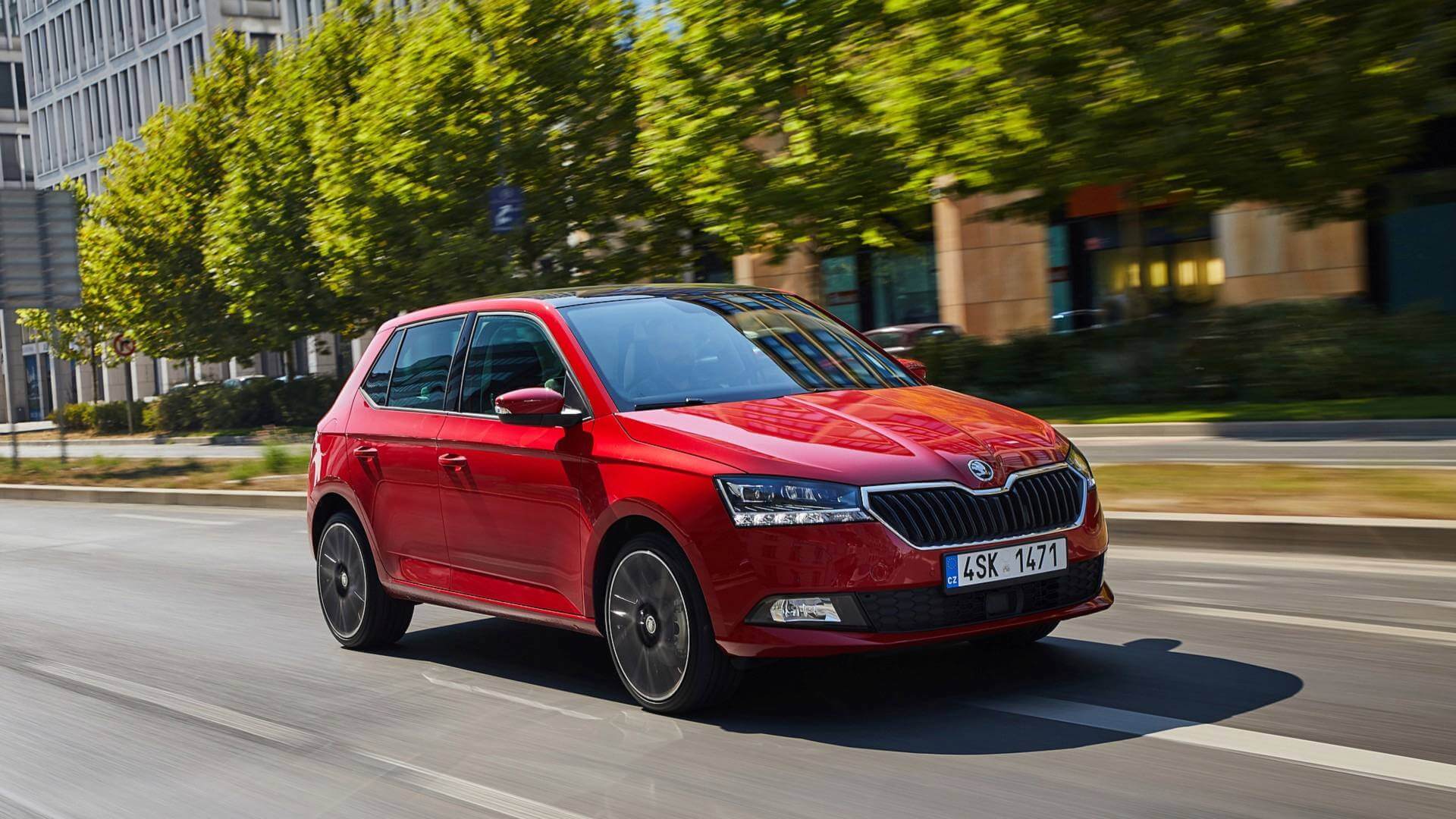
The third Fabia was unveiled at the Paris Motor Show in October 2014 as a five-door hatchback and a Combi. It uses the PQ26 platform, a deep update of its predecessor's base. Chief designer Jozef Kabaň drew on the Vision C concept and Skoda's latest Rapid, Octavia, Yeti and Superb, giving the car a crisper, more expressive look: a new grille, large headlights with projector low beams, LED daytime running lights, bigger fog lamps and sharp creases along the sides. Ground clearance is 133 mm. With 15 paint colours, contrasting roofs, pillars, mirrors and wheels, about 125 combinations are possible.
Interior materials and ergonomics improved, the gear lever moved closer to the driver and the seats, though firm, became more comfortable. There is a 6.5-inch infotainment screen, and options include a panoramic roof, cruise control and parking sensors. Three adults fit in the back. The hatchback's boot holds 330 litres (1,150 litres with the seats folded); the Combi offers 530 litres.
Engines and transmissions (third generation)
| Engine | Fuel | Power (kW / PS) | Torque |
|---|---|---|---|
| 1.0 MPI, three-cylinder | Petrol | 44 kW / 60 PS or 55 kW / 75 PS | - |
| 1.2 TSI | Petrol, turbo | 66 kW / 90 PS or 81 kW / 110 PS | 160 / 175 Nm |
| 1.4 TDI, three-cylinder | Diesel, turbo | 55 / 66 / 77 kW (75 / 90 / 105 PS) | - |
| 1.6 MPI (some markets) | Petrol | 77 kW / 105 PS | - |
Petrol versions use up to about 5 l/100 km and diesels from about 3.1 l/100 km. All engines have start/stop and meet Euro 6. Gearboxes are five- and six-speed manuals, a seven-speed DSG on more expensive versions, and a six-speed automatic with the 1.6. Suspension is MacPherson at the front with a torsion beam at the rear; brakes are ventilated discs at the front and drums at the rear.
Key specifications by generation
| Parameter | 1st | 2nd | 3rd |
|---|---|---|---|
| Years | 1999–2007 | 2007–2014 | 2014–2021 |
| Bodies | Hatchback, Combi, sedan | Hatchback, Combi | Hatchback, Combi |
| Power (kW / PS) | 40–96 kW / 55–130 PS | 51–77 kW / 69–105 PS (petrol, typical) | 44–81 kW / 60–110 PS |
Safety
The third Fabia comes with ESC, ABS, electronic brake-force distribution and engine drag torque control (MSR). City emergency braking, driver-fatigue detection, adaptive cruise control, keyless entry, a parking assistant, lane assist - new for this class at the time - and up to six airbags are available. It achieved five stars in the Euro NCAP crash test.
Strengths and weaknesses
Owners like the Fabia's looks and body quality, compact size for city traffic, reasonable price, economy, comfort and safety, and say the suspension copes well with poor roads. Criticisms include insufficient sound insulation, a firm ride, a small boot in the hatchback, a slightly cramped cabin and slow acceleration with the weaker engines. Rivals include the Ford Fiesta, SEAT Ibiza, Citroën C3, Volkswagen Polo, Suzuki Swift, Opel Corsa and Nissan Micra.
FAQ
How many generations of the Skoda Fabia are there?
Four: 1999, 2007, 2014 and 2021. This article covers the first three in detail.
Where does the name Fabia come from?
It combines the first syllable of "fabulous" with the "-ia" ending used on many Skoda models.
How many first-generation Skoda Fabias were sold?
1,788,063.
How safe is the Skoda Fabia?
The third generation earned five stars in Euro NCAP testing.
How big is the Skoda Fabia boot?
The third-generation hatchback holds 330 litres (1,150 litres with the rear seats folded) and the Combi 530 litres.