
 Skoda Škoda 110 R
Specs, engines and history
Published Sources (2) Report an error
By Oleksandr Hnatiuk, Automotive Editor & Used Car Specialist
- Built
- 1970–1980
- Top power
- 96 kW (131 PS)
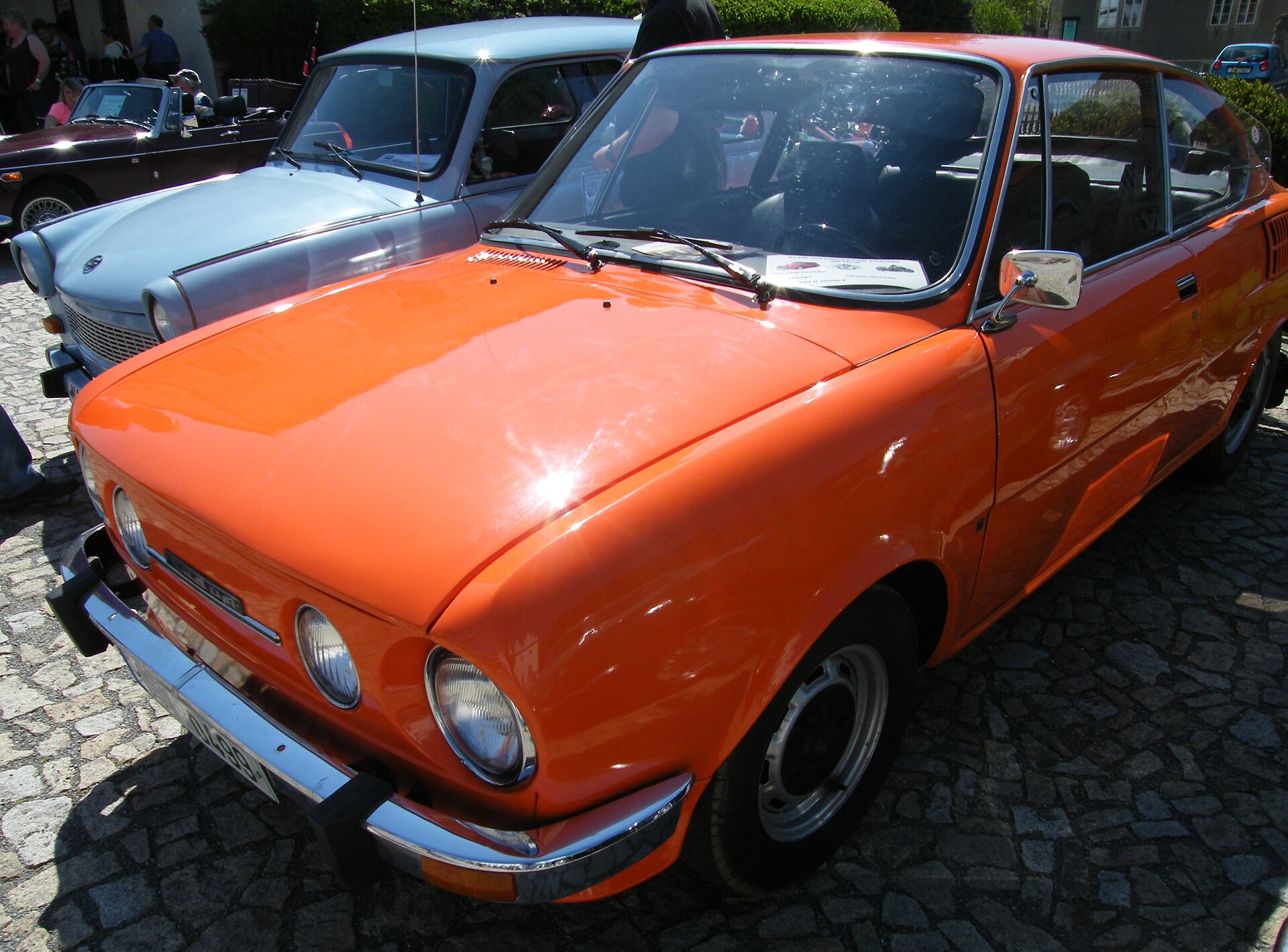
The Škoda 110 R is the two-door rear-engined coupé that AZNP built at Kvasiny from 1970 to 1980, derived from the Škoda 100 and 110 saloons. Its 1,107 cc four-cylinder produced 38 kW (52 PS) for 145 km/h, most cars went for export, and it was the basis of the 130 RS racing car that earned the nickname "Porsche of the East".
In short
- 57,085 built between 1970 and 30 December 1980, all at Kvasiny (Škoda figure; Wikipedia EN gives 56,902).
- Rear-mounted 1,107 cc OHV engine with an aluminium block, twin carburettors and an oil cooler: 38 kW (52 PS) at 4,650 rpm.
- Priced from 78,000 Kčs, about 40 months of an average wage; 93% of the 1973 output was exported.
- The 130 RS derivative won its class at the 1977 Monte Carlo Rally and took the manufacturers' ranking of the 1981 European Touring Car Championship.
Size at a glance
| Dimensions | Skoda 110 R |
|---|---|
| Length | 4,155 mm163.6 in |
| Width | 1,620 mm63.8 in |
| Height | 1,340 mm52.8 in |
| Wheelbase | 2,400 mm94.5 in |
Running cost
Fuel · Škoda 110 R 1.1 (two headlamps)
about 2,250 EUR fuel a year at 15,000 km
8.5 l/100 km · petrol at 1.75 EUR/l · change mileage, fuel price or version
Specs by version
Engines
| Version | Engine | Power | Gearbox | Drive | Production years |
|---|---|---|---|---|---|
| 1.1 (two headlamps) | 1.1 l · 4 cyl · Petrol 1,107 cc | 38 kW 52 PS51 hp | 4-sp Manual | Rear-wheel drive | 1970–1972 |
| 1.1 (four headlamps) | 1.1 l · 4 cyl · Petrol 1,107 cc | 38 kW 52 PS51 hp | 4-sp Manual | Rear-wheel drive | 1973–1980 |
| 130 RS (competition) | 4 cyl · Petrol | 96 kW 131 PS129 hp | - | Rear-wheel drive | 1975 |
Performance
Show all 2 versions
| Version | 0–100 km/h | Top speed | Fuel consumption |
|---|---|---|---|
| 1.1 (two headlamps) | 18.5 s 0–62 mph | 145 km/h90 mph | 8.5 l/100 km27.7 mpg US · 33.2 mpg UK |
| 1.1 (four headlamps) | 18.5 s 0–62 mph | 145 km/h90 mph | 8.5 l/100 km27.7 mpg US · 33.2 mpg UK |
Dimensions and weight
Show all 3 versions
| Version | Length | Width | Height | Wheelbase | Kerb weight | Fuel tank |
|---|---|---|---|---|---|---|
| 1.1 (two headlamps) | 4,155 mm163.6 in | 1,620 mm63.8 in | 1,340 mm52.8 in | 2,400 mm94.5 in | 880 kg1,940 lb | 32 l8.5 gal US |
| 1.1 (four headlamps) | 4,155 mm163.6 in | 1,620 mm63.8 in | 1,340 mm52.8 in | 2,400 mm94.5 in | 880 kg1,940 lb | 32 l8.5 gal US |
| 130 RS (competition) | - | - | - | - | 720 kg1,587 lb | - |
Verified Manufacturer and type-approval data from our catalog · Sources and methodology
Škoda 110 R at a glance
| Item | Škoda 110 R |
|---|---|
| Years | 1970-1980 |
| Production | 57,085 (Škoda); 56,902 (Wikipedia EN) |
| Plant | Kvasiny, Czechoslovakia |
| Body style | 2-door 2+2 fastback coupé with frameless door glass |
| Layout | rear engine, rear-wheel drive, gearbox ahead of the rear axle |
| Engine | 1,107 cc OHV inline-four, 9.5:1 compression, twin carburettors |
| Power | 38 kW (52 PS) DIN at 4,650 rpm; 46 kW (62 bhp) SAE |
| Gearbox | 4-speed manual |
| Length / width / height | 4,155 / 1,620 / 1,340 mm; wheelbase 2,400 mm |
| Kerb weight | 880 kg, up to 57% over the rear wheels when loaded |
| Top speed | 145 km/h |
| 0-100 km/h | 18.5-19 s (Wikipedia EN, Škoda) |
| Price new | 78,000 Kčs in 1973, against 56,750 Kčs for a Škoda 100 |
From the saloon to a coupé
Škoda started work on a coupé in 1966, while it was developing the 100 and 110 saloons that replaced the 1000 MB. The first prototype, internally the Š 718 K, was finished at Kvasiny in March 1968. It already had the sloping rear, a more steeply raked windscreen and two wide doors with frameless windows, and on test drives on East German motorways it reached 145 km/h. A second prototype followed in March 1969 with a twin carburettor and an alternator in place of the dynamo.
Journalists saw the car first at a vocational school in Mladá Boleslav, with test drives at Hoškovice airfield. The public debut came on 5 September 1970 at the Brno engineering fair, where three cars were shown, and in October 1970 the coupé appeared at the Paris, London and Turin motor shows. The coupé stood 40 mm lower than the saloon. The wider story of the company, from Laurin & Klement to the present, is in our history of Škoda.
Engineering at the back
The engine sat behind the rear axle. Its cylinder block and crankcase were die-cast in aluminium using a Czech patent, topped by a cast-iron head; the gearbox bell housing was die-cast aluminium too. The coupé had twin carburettors and a separate oil cooler as standard. The four-speed gearbox sat ahead of the rear axle, and the rear suspension used swing axles with coil springs.
Front disc brakes were built by Škoda under a Dunlop licence, with drums at the rear and a dual-circuit system. Radial tyres were 165 SR 14 at first. The 32-litre fuel tank was in the nose, which left 250 litres of luggage space under the front lid plus 120 litres behind the rear seats, reachable from inside. Inside, five round dials faced the driver; the rev counter was red-lined from 5,750 rpm and the speedometer read to 180 km/h. Average consumption was quoted at 8.5 l/100 km.

Built for export: production year by year
The coupé was a hard-currency product. Only 121 cars were finished by the end of 1970, and of about 3,000 built in 1971 just 442 went to Mototechna, the state dealer at home. Right-hand-drive cars were exported from September 1972, and in 1975 Britain took 2,371 coupés, 36% of exports. New Zealand, Kuwait and Nicaragua were among the other markets; in the last year, 1980, exports went only to Yugoslavia and Spain.
| Year | Approximate output | Note |
|---|---|---|
| 1970 | 121 | first cars after the Brno debut |
| 1971 | about 3,000 | 442 for the home market |
| 1973 | about 6,000 | 93% exported |
| 1974 | about 7,500 | - |
| 1970-1980 | 57,085 | last car on 30 December 1980 |
At home the price of 78,000 Kčs put it far beyond most buyers. In 1973 a Škoda 100 cost 56,750 Kčs and still had a waiting list.
Changes during the run
Early cars had two headlamps. From January 1973 the 110 R had four, the front seats gained headrests, and the wood-effect dashboard gave way to matt black. Late in production the wheels shrank by an inch, with 165 SR 13 tyres and plastic wheel covers. A front spoiler was also added.
From 110 R to 130 RS
Škoda began racing the coupé with a modified factory car in 1973. The 180 RS and two 200 RS prototypes followed, with overhead-camshaft engines of up to 2.0 litres, a Porsche-made five-speed gearbox and a new trailing-arm rear axle; they appeared at the Barum Rally in June 1974. In 1975 Bořivoj Kořínek built a fuel-injected 2.0 special with 186 kW (250 hp), known as the Grenade.
The homologated 130 RS arrived in spring 1975. Aluminium roof, bonnet and door skins, glass-fibre wings and a roll cage brought weight down to 720 kg, while a 1.3-litre dry-sump engine with an eight-port head and two Weber carburettors gave up to 96 kW (130 PS), roughly two and a half times the 38 kW of the road coupé, a ratio easy to check in hp with our engine output converter. On circuits it reached about 220 km/h. The 130 RS won its class at the 1977 Monte Carlo Rally and gave Škoda the manufacturers' ranking of the 1981 European Touring Car Championship, while the S110R was a class winner at eight RAC Rallies.
The road coupé was replaced in September 1981 by the Garde, based on the 105/120 saloon with semi-trailing-arm rear suspension and rack-and-pinion steering; it was built at Kvasiny and from spring 1982 at BAZ in Bratislava. The Garde in turn became the Rapid of 1984-1990, described in our article on the rear-engined Škoda Rapid coupé.

Škoda 110 R today: what to check when buying
The monocoque matters most, because the outer panels bolt on. A buyer's review on Classic Cars For Sale points to the rear sills, which rot when the seal between rear wing and body fails, the rear trailing-arm mounts and the boot hinge mounts, all hard to repair. The coupé's doors are longer than the saloon's and their lower edges rust. New panels are scarce, although glass-fibre front wings are made in the UK.
The aluminium block corrodes from inside if the coolant level has been low, and blocks can crack. Check for head cracks between cylinders, a warped head face and emulsified oil, the sign of a failed gasket. Second and third gears that are hard to engage usually mean a gearbox replacement. The swing-axle rear needs greasing every 6,000 miles (about 10,000 km), and interior trim and dashboard switches are fragile and hard to find.
Originality decides value in the Czech market, where most cars survive. CNN Prima News reported in March 2023 that neglected or incomplete coupés start at about EUR 4,300 (CZK 100,000), while good original cars commonly cost about EUR 17,000 (CZK 400,000) or more; cars converted into 130 RS replicas or fitted with non-original interiors are worth less to collectors. In July 2023 the same outlet reported a highly original 1975 car offered in Prague for about EUR 38,000 (CZK 921,000). Other Škodas old and new are in our Škoda catalogue, and more cars of the era in our classic cars section.
Skoda Škoda 110 R in our rankings
- No. 2 of 101 · Lightest coupes (720 kg)
- No. 5 of 55 · Most economical coupes (8.5 l/100 km)
- No. 6 of 446 · Lightest cars (720 kg)
- No. 13 of 113 · Smallest coupes (4,155 mm · top 12%)
- No. 108 of 588 · Smallest cars (4,155 mm · top 19%)
- No. 147 of 443 · Power-to-weight: cars (133 kW/t · top 34%)
Lighter than 98% of ranked coupes in the 1CARS catalog (No. 2 of 101).
FAQ
How many Škoda 110 R coupés were built?
Škoda gives 57,085 cars built at Kvasiny between 1970 and 30 December 1980. Wikipedia EN lists 56,902, so figures vary slightly between sources. Most were exported, including 93% of the roughly 6,000 cars built in 1973.
How fast is a Škoda 110 R?
The road car reached 145 km/h and took 18.5 to 19 seconds from 0 to 100 km/h. Its 1,107 cc rear engine produced 38 kW (52 PS) at 4,650 rpm and moved an 880 kg car through a four-speed gearbox.
Why is it called the "Porsche of the East"?
The nickname belongs mainly to the 130 RS racing derivative, a lightened 110 R with a 1.3-litre engine of up to 96 kW (130 PS). Its rear-engined layout and fastback shape invited the comparison with Porsche.
What replaced the Škoda 110 R?
The Škoda Garde, introduced in September 1981 and based on the 105/120 saloon. It became the Rapid in 1984, which stayed in production until 1990.
Data sources
Data checked by an editor against the sources below.
- Wikipedia - Škoda 110 R
- Škoda Storyboard - 50 Years Of The 110 R Half A Century Ago Skoda Presented Its Legendary Sports Coupe


