
 Skoda Škoda 1000 MB
Specs, engines and history
Published Sources (2) Report an error
By Oleksandr Hnatiuk, Automotive Editor & Used Car Specialist
- Built
- 1964–1969
- Top power
- 38 kW (52 PS)
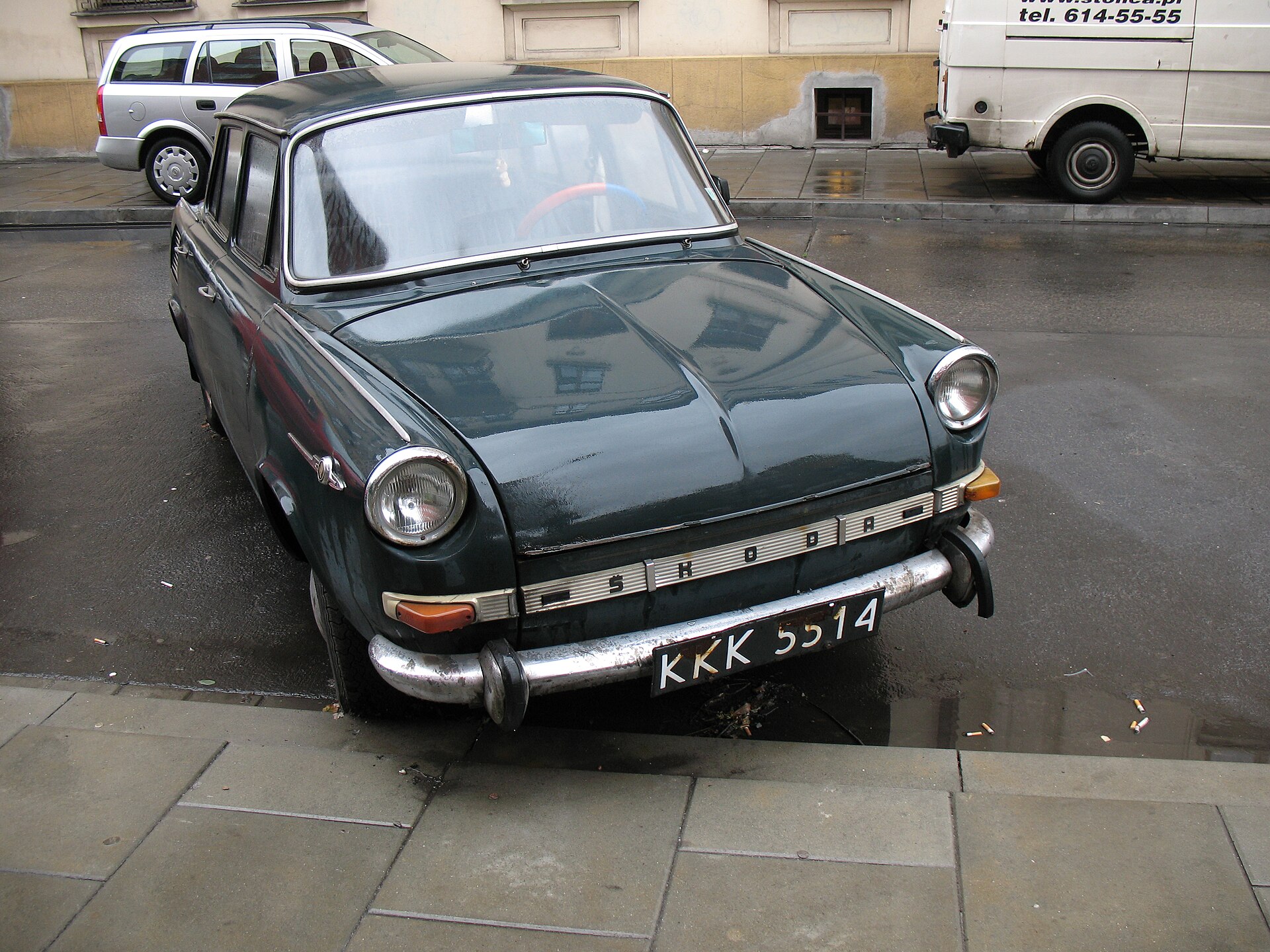
The Škoda 1000 MB is the rear-engined four-door saloon that Škoda built at Mladá Boleslav from 1964 to 1969, joined in 1966 by the rare two-door MBX hardtop. A 988 cc water-cooled four with an aluminium crankcase sat behind the rear axle. With 443,141 cars made, Škoda calls it the first Czech car built in true mass production.
In short
- Series production began on 11 April 1964 and ended in 1969, when the Škoda 100 and 110 took over.
- 443,141 built in six versions; only 2,517 were MBX two-door hardtops.
- Output rose from 27 kW (37 PS) at launch to 32 kW (43 PS) in 1966; the 1.1-litre 1100 MB had 38 kW (52 PS).
- More than half of all saloons were exported, and in 1965 the export share reached 70%.
Size at a glance
| Dimensions | Skoda 1000 MB |
|---|---|
| Length | 4,170 mm164.2 in |
| Width | 1,620 mm63.8 in |
| Height | 1,390 mm54.7 in |
Specs by version
Engines
| Version | Engine | Power | Gearbox | Drive | Production years |
|---|---|---|---|---|---|
| 1000 MB 1.0 (37 PS) | 1.0 l · 4 cyl · Petrol 988 cc | 27 kW 37 PS36 hp | 4-sp Manual | Rear-wheel drive | 1964–1966 |
| 1000 MB 1.0 (43 PS) | 1.0 l · 4 cyl · Petrol 988 cc | 32 kW 44 PS43 hp | 4-sp Manual | Rear-wheel drive | 1966–1969 |
| 1000 MBX de Luxe 1.0 twin carb (46 PS) | 1.0 l · 4 cyl · Petrol 988 cc | 34 kW 46 PS46 hp | 4-sp Manual | Rear-wheel drive | 1966–1969 |
| 1100 MB de Luxe 1.1 (52 PS) | 1.1 l · 4 cyl · Petrol 1,107 cc | 38 kW 52 PS51 hp | 4-sp Manual | Rear-wheel drive | 1967–1969 |
Performance
Show all 2 versions
| Version | Top speed |
|---|---|
| 1000 MB 1.0 (37 PS) | 120 km/h75 mph |
| 1000 MB 1.0 (43 PS) | 120 km/h75 mph |
Dimensions and weight
Show all 2 versions
| Version | Length | Width | Height | Kerb weight |
|---|---|---|---|---|
| 1000 MB 1.0 (37 PS) | 4,170 mm164.2 in | 1,620 mm63.8 in | 1,390 mm54.7 in | 755 kg1,664 lb |
| 1000 MBX de Luxe 1.0 twin carb (46 PS) | - | - | - | 815 kg1,797 lb |
Verified Manufacturer and type-approval data from our catalog · Sources and methodology
Škoda 1000 MB at a glance
| Item | Škoda 1000 MB |
|---|---|
| Years | 1964-1969 (series production from 11 April 1964) |
| Production | 443,141 in all versions (Wikipedia EN); Škoda says more than 443,000 |
| Plant | Mladá Boleslav, Czechoslovakia (new production halls) |
| Body styles | 4-door saloon; 2-door MBX hardtop coupé from 1966 |
| Layout | rear engine, rear-wheel drive, steel monocoque, rear swing axles |
| Engines | 988 cc OHV four; 1,107 cc OHV four (1100 MB) |
| Power | 27 kW (37 PS) in 1964; 32 kW (43 PS) from 1966; 38 kW (52 PS) for the 1100 MB |
| Kerb weight | 755 kg (Škoda); about 800 kg measured (Wikipedia DE) |
| Length x width x height | 4,170 x 1,620 x 1,390 mm |
| Top speed | 120 km/h |
| 0-100 km/h | about 27 s (Wikipedia EN, ČTK 2024) |
| Price new | Kčs 44,000 in 1964; GBP 579 in the UK in 1965; DM 4,980 in West Germany in 1967 |
A new factory for a rear-engined Škoda
The 1000 MB, project name NOV, replaced the front-engined Octavia that had been built since 1959. Škoda looked at front-wheel drive and rejected it as too costly and complex, and the rear-engined Renault Dauphine, the air-cooled Volkswagen Beetle, Fiat 600 and Hillman Imp served as points of reference. The letters MB stand for Mladá Boleslav, the town that built it.
Testing was thorough for the time. By May 1962, fifty prototypes had covered 1,598,840 km, including brake, fuel and cooling trials in the Caucasus at up to 45 °C. To build the car, Škoda added a whole new part to the Mladá Boleslav plant. More than 300 companies, 134 of them from abroad, delivered equipment for over 40 halls on an 80-hectare site with 13 km of roads, 10 km of railway track and 11 km of overhead conveyors.
The monocoque body used 665 pressed parts held by 6,900 welding spots. The radiator and an engine-driven fan sat at the back, so cooling air entered through slats in the rear wings and tail panel. Suspension was independent all round, with swing axles at the rear and drum brakes on every wheel. The front boot held up to 220 litres. The car was shown at the Brno engineering fair in September 1964 and in Paris and London a month later. By the end of 1965 the line built at least 150 cars a day. The wider story of the company is in our history of Škoda.
Engines and versions, from 1000 MB to 1100 MBX
The crankcase, cylinder block and gearbox bell housing were die-cast in aluminium, which Škoda says shortened production time and saved energy. The head was cast iron, bore and stroke were 68 x 68 mm, and the four-speed manual gearbox had synchromesh on all forward gears. The same engine family stayed in production into the 1990s, after Škoda joined the Volkswagen Group.
| Version | Type | Years | Body | Built |
|---|---|---|---|---|
| 1000 MB | 990 | 1964-1969 | saloon | 349,348 |
| 1000 MB de Luxe | 721 | 1966-1969 | saloon | 65,502 |
| 1000 MBG de Luxe | 710 | from 1966 | saloon, twin carburettors | 3,287 |
| 1000 MBX de Luxe | 990T | 1966-1969 | 2-door hardtop | 1,403 |
| 1100 MB de Luxe | 715 | 1967-1969 | saloon | 22,487 |
| 1100 MBX de Luxe | 723 | 1967-1969 | 2-door hardtop | 1,114 |
Power figures vary between sources because period data mixed SAE and DIN ratings. Škoda's own heritage material gives 27 kW (37 PS) for the 1964 car, 32 kW (43 PS) from 1966 and 38 kW (52 PS) for the 1100 MB. The twin-carburettor MBG saloon and MBX hardtop used a 9.2:1 compression ratio; Wikipedia DE quotes 34 kW (46 PS) at 4,800 rpm for this engine, while Wikipedia EN gives 38 kW. The MBX coupé weighed 815 kg according to Wikipedia DE, and Škoda notes that this two-door version is the one collectors look for.

Exports, prices and the Embéčko at home
Exports took a large share from the start. In 1965 seven of every ten cars went abroad, and over the whole run more than half of the saloons left Czechoslovakia. In Britain an early-1965 1000 MB cost GBP 579, against GBP 592 for a Ford Cortina 1200 and GBP 636 for a Hillman Minx Deluxe. In West Germany it cost DM 4,980 in 1967, more than the DM 4,485 asked for a Volkswagen Beetle 1200. East Germany imported more than 60,000 cars, all basic versions, and Australians knew the car as the Škoda Sabre.
At home the price was Kčs 44,000 at launch. Czechs and Slovaks called it the Embéčko, after the letters MB, and joked that 1000 MB meant "a thousand little pains". Period tests judged it modern by Eastern standards and average by Western ones; Wikipedia DE notes that the Renault 8, with its five-bearing crankshaft and disc brakes, was considered more advanced. A 12,000 km test returned 7.9 l/100 km.
The 1000 MB in rallying
New FIA rules in 1966 created Group 5 of Class B, and the factory built the 1000 MB B5 for it. With twin Jikov 32 SOPc carburettors the one-litre engine made 55 kW (75 PS) at 6,500 rpm and 88 Nm at 5,000 rpm. The car reached 100 km/h in 14.2 s and 160 km/h on a long straight. In 1967 Vladimír Krček and Milan Žid ran an 63 kW (85 PS) car and beat two V8-engined Tatra 603 B5 racers in the six-hour race at Brno. For 1968 the engine grew to 1,143 cc and 1,150 cc, and twin Weber carburettors brought up to 71 kW (97 PS), which made it the most successful B5 season.

Škoda 1000 MB today: what to check when buying
Wikipedia DE lists rust as the first known problem, so check the sills, floor and wheel arches of any car before looking at the mechanicals. The same source names overheating, which leads to head gasket failure and, in bad cases, cracks in the aluminium block. Ask whether the cooling system has been flushed and the thermostat renewed. Radio Prague recalls that the rubber fuel hoses running from the tank through the engine bulkhead dried out and cracked quickly; replace any original-looking hose before the first drive. Above 80 km/h the swing-axle rear can feel unsettled, so tyre pressures and suspension bushes matter.
Survival is good in the home country. A ČTK report of March 2024 counted more than 16,000 cars still registered in Czechia, including 122 MBX coupés and 80 MBG saloons. Because the engine family stayed in production for decades, mechanical parts are easier to find than trim. Values from the same March 2024 report: about CZK 50,000-70,000 (about EUR 2,000-2,800) for an unrestored saloon and up to CZK 300,000 (about EUR 12,000) for a restored one. Cebia wrote in December 2023 that an MBX hardtop rarely sells below CZK 1 million (about EUR 40,000) and that buyers should budget for about CZK 1.5 million (about EUR 60,000). Other Škodas are listed in the Škoda catalogue, and more cars of the decade are in our classic cars section.
Skoda Škoda 1000 MB in our rankings
- No. 1 of 95 · Lightest coupes (815 kg)
- No. 2 of 71 · Lightest sedans (755 kg)
- No. 7 of 415 · Lightest cars (755 kg)
- No. 10 of 106 · Smallest coupes (4,170 mm)
- No. 12 of 113 · Smallest sedans (4,170 mm · top 11%)
- No. 105 of 554 · Smallest cars (4,170 mm · top 19%)
Lighter than 98% of ranked coupes in the 1CARS catalog (No. 1 of 95).
FAQ
When was the Škoda 1000 MB built?
Series production started on 11 April 1964 at Mladá Boleslav and ended in 1969. The two-door MBX hardtop was added in 1966 and the 1.1-litre 1100 MB in 1967. The Škoda 100 and 110 replaced the whole range.
How many Škoda 1000 MB cars were made?
443,141 according to the version totals on Wikipedia EN, of which 349,348 were basic 1000 MB saloons. Škoda gives "more than 443,000". Only 2,517 were MBX hardtops, so the coupé is the rarest body.
What does MB stand for?
Mladá Boleslav, the Czech town where Škoda built the car and where it still has its main plant. The letters also gave the car its Czech nickname, Embéčko, which is still in everyday use.
How fast is a Škoda 1000 MB?
About 120 km/h flat out. The standard car needed roughly 27 s to reach 100 km/h, and Škoda quoted 7 to 8 l/100 km. The 1966 B5 rally version reached 100 km/h in 14.2 s.
Data sources
Data checked by an editor against the sources below.
- Wikipedia - Škoda 1000 MB
- Škoda Storyboard - Skoda 1000 Mb 1964 1969 The Revolutionary Change Of Concept


