
Aston Martin DBX vs Lamborghini Urus: super-SUVs
Updated Report an error By Felix Hartmann

Aston Martin · 2019–present
DBX AM8
- Power
- 520 kW707 PS
- 0–100 km/h
- —
- Top speed
- 310 km/h
- Kerb mass
- 2,310 kg

Lamborghini · 2018–present
Urus
- Power
- 490 kW666 PS
- 0–100 km/h
- 3.3 s
- Top speed
- 306 km/h
- Kerb mass
- 2,237 kg
At a glance
Who suits what, worked out from the catalog figures of the versions above.
Categories won: DBX AM8 0 Urus 1
- City Too close to call Length: 5,039 mm vs 5,113 mm
- Performance Too close to call Power per tonne: 225 kW/t vs 219 kW/t
- Running costs Too close to call Fuel per year: €3,750 vs €3,700 (estimated)
- Off-road Urus Drive and body: All-wheel drive · SUV vs All-wheel drive · Crossover
Verdict Opinion
Among the petrol-only versions the DBX has the upper hand on paper. The DBX S has 535 kW and 900 Nm against 490 kW and 850 Nm for the Urus Performante, matches its 3.3-second sprint and has a higher top speed.
The Urus is the more complete range. The SE plug-in hybrid has the highest output and top speed of all and adds electric driving, and the Urus is the far bigger commercial success.
— Felix Hartmann
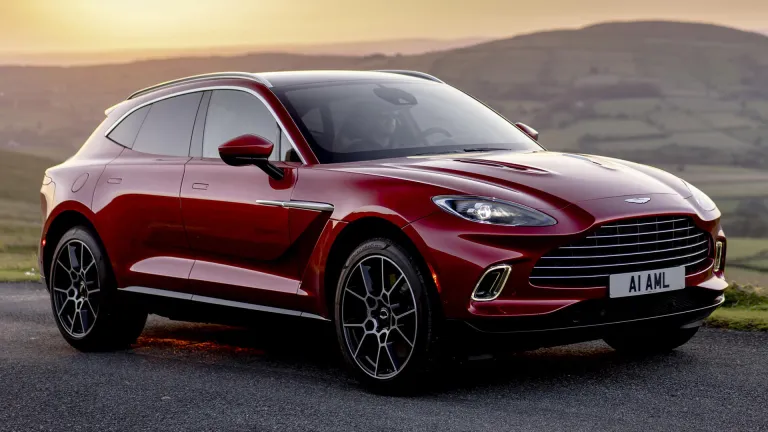
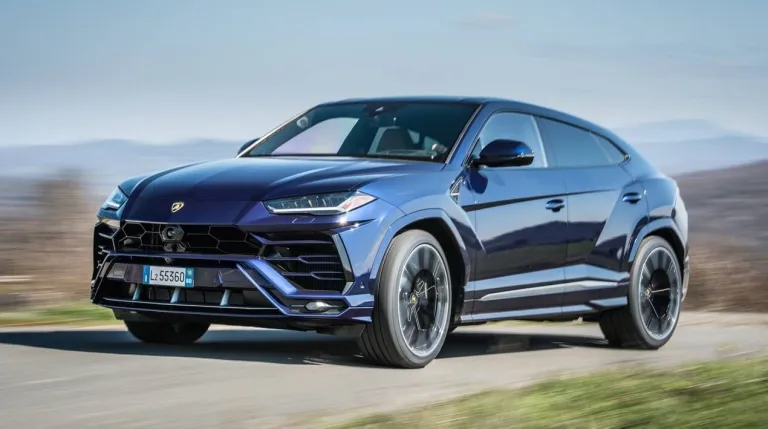
The Lamborghini Urus and the Aston Martin DBX are the two sports-car makers' answers to the question of what a super-SUV should be. The Urus was unveiled on 4 December 2017 at Lamborghini's headquarters in Sant'Agata Bolognese. It sits on the Volkswagen Group's MLB Evo platform shared with the Porsche Cayenne, Bentley Bentayga and Audi Q7. The DBX, launched in November 2019, was the first SUV Aston Martin had made and the first car built at its new plant in St Athan, Wales, on a dedicated platform related to the Vantage.
In short: both use a 4.0-litre twin-turbo V8. The DBX707 and DBX S have the most power and torque among the combustion versions, while the Urus SE plug-in hybrid has the most of all. Both are in our catalogue: Aston Martin DBX and Lamborghini Urus.
Aston Martin DBX vs Lamborghini Urus: engines, speed and size
Two V8s, two suppliers
The DBX uses the Mercedes-AMG M177 4.0-litre twin-turbo V8. In the original DBX it produces 405 kW (550 PS) and 700 Nm with a nine-speed automatic. The DBX707 raised output to 520 kW (707 PS) and 900 Nm, and the DBX S to 535 kW (727 PS) with the same 900 Nm. The Urus has a 4.0-litre twin-turbo V8 of its own group and an eight-speed ZF 8HP automatic. It started with 478 kW (650 PS) and 850 Nm; the Urus S and Performante have 490 kW (666 PS).
Plug-in hybrid only from Lamborghini
The Urus SE combines the V8, here rated at 462 kW (628 PS) and 800 Nm, with a 141 kW electric motor and a 25.9 kWh battery. Wikipedia gives a combined 596 kW (810 PS) and 950 Nm; our catalogue lists 588 kW. The SE weighs roughly 300 kg more than the Urus S. Aston Martin offers no hybrid DBX.
Acceleration and top speed
The DBX S reaches 100 km/h in 3.3 seconds and 310 km/h, the same top speed as the DBX707; the original DBX needs 4.5 seconds and tops out at 292 km/h. The Urus Performante also needs 3.3 seconds according to Lamborghini and reaches 306 km/h. The Urus SE needs 3.4 seconds and is the fastest of all at 312 km/h.
- DBX: 405 kW, 700 Nm, 4.5 s, 292 km/h
- DBX707: 520 kW, 900 Nm, 310 km/h
- DBX S: 535 kW, 900 Nm, 3.3 s, 310 km/h
- Urus Performante: 490 kW, 850 Nm, 3.3 s, 306 km/h
- Urus SE: 596 kW, 950 Nm, 3.4 s, 312 km/h
Size and weight
The Urus is the longer car at 5,113 mm, against 5,039 mm for the DBX, and it is wider at 2,017 mm against 1,998 mm. The DBX has the longer wheelbase, 3,060 mm against 3,002 mm, and stands taller at 1,680 mm against 1,638 mm. Lamborghini quotes a kerb weight of 2,200 kg for the Urus; the DBX weighs 2,245 kg.
Sales
The Urus became Lamborghini's best-selling model in the shortest time: the 20,000th car was reached in 2022, and annual production rose to 7,265 in 2025. The DBX's fiscal-year sales peaked at 3,219 in 2022 and fell to 1,717 in 2025.
Race Stats side by side
Each figure is a 0–100 score from the catalog numbers, the same as on the 1CARS Race cards. PI is the overall performance index (100–999) and its class D–S.
| Stat | DBX AM8 | Urus |
|---|---|---|
| PI | A · 715 | A · 711 |
| Power | 75 | 74 |
| Grip | 70 | 66 |
| Handling | 35 | 35 |
| Top speed | 81 | 79 |
| Launch | 78 | 83 |
Grip and handling are estimates from drive type, weight, height and body (hover a figure to see where it comes from). 1CARS Race
Who wins a race?
Quarter-mile (402 m) drag from a standing start, dry road, no reaction time — the 1CARS Race physics on the catalog figures of these versions.
- 1 UrusPerformante · petrol · 490 kW (666 PS) 10.18 sat 256 km/h
- 2 DBX AM8DBX707 (707 PS) · petrol · 520 kW (707 PS) 11.66 sat 197 km/h · +1.48 s
Size and weight
Side view to scale, all cars from the front bumper.
| DBX AM8 | Urus | |
|---|---|---|
| Length | 5,039 mm198.4 in † | 5,113 mm201.3 in † +74 mm +2.9 in +1.5% |
| Width | 1,998 mm78.7 in † | 2,017 mm79.4 in † +19 mm +0.7 in +1.0% |
| Height | 1,680 mm66.1 in † | 1,638 mm64.5 in † −42 mm −1.7 in −2.5% |
| Wheelbase | 3,060 mm120.5 in † | 3,002 mm118.2 in † −58 mm −2.3 in −1.9% |
| Kerb weight | 2,310 kg5,093 lb | 2,237 kg4,932 lb −73 kg −161 lb −3.2% |
| Fits a standard garage? | Too long and too wide | Too long and too wide |
Difference vs DBX AM8 (±). Garage check: a standard single garage takes a car up to about 5.0 m (16 ft 5 in) long and 1.9 m (6 ft 3 in) wide (width as listed in the catalog; some makers include the mirrors). Leave about 0.6 m (2 ft) to open the doors. † from another version of this generation.
Full specifications
| Aston Martin DBX | Lamborghini Urus | |
|---|---|---|
| General | ||
| Version | DBX707 (707 PS) · petrol · 520 kW (707 PS) | Performante · petrol · 490 kW (666 PS) |
| Production years | 2019–present | 2018–present |
| Body | Crossover | SUV |
| Class | SUV / crossover | SUV / crossover |
| Country | United Kingdom | Italy |
| Performance | ||
| Power Why it matters: More power means stronger acceleration and easier overtaking, especially with a full load. | 520 kW (707 PS) 697 hp Better | 490 kW (666 PS) 657 hp |
| Power, all versions | 320–535 kW (435–727 PS) 429–717 hp | 478–588 kW (650–799 PS) 641–789 hp |
| Torque Why it matters: Torque is the pulling force you feel when accelerating from low revs, towing or climbing hills. | 900 Nm 664 lb-ft Better | 850 Nm 627 lb-ft |
| 0–100 km/h Why it matters: A shorter 0–100 km/h time means quicker getaways and safer merging onto fast roads. | No data | 3.3 s |
| Top speed Why it matters: Top speed hints at how relaxed the car is at motorway speeds, even if you never reach it. | 310 km/h 193 mph | 306 km/h 190 mph |
| Power per tonne | 225 kW/t 274 hp/ton calculated | 219 kW/t 266 hp/ton calculated |
| Engine and transmission | ||
| Fuel | Petrol | Petrol |
| Engine | 3,982 cc · 8 cyl 4.0 l | No data |
| Gearbox | 9-speed automatic | No data |
| Drive | All-wheel drive | All-wheel drive |
| Dimensions and weight | ||
| Length | 5,039 mm 198.4 in † | 5,113 mm 201.3 in † |
| Width | 1,998 mm 78.7 in † | 2,017 mm 79.4 in † |
| Height | 1,680 mm 66.1 in † | 1,638 mm 64.5 in † |
| Wheelbase | 3,060 mm 120.5 in † | 3,002 mm 118.2 in † |
| Kerb weight Why it matters: A lighter car is usually more agile and uses less energy. | 2,310 kg 5,093 lb | 2,237 kg 4,932 lb Better |
| Economy and running costs | ||
| Fuel consumption Why it matters: Lower consumption cuts running costs and CO₂ emissions on every trip. | 14.3 l/100 km 16.4 mpg US | 14.1 l/100 km 16.7 mpg US |
| CO₂ | 323 g/km | 320 g/km |
| Fuel cost per year | €3,750/year estimated | €3,700/year estimated |
These cars do not differ in the data we have.
Equal rows hidden (3): Class, Fuel, Drive.
Better marks the stronger figure — only for measurable specs (power, torque, 0–100 km/h, consumption, boot, weight).
Estimated at 15,000 km a year with fuel at €1.75/l petrol. † from another version of this generation.
In plain words
Aston Martin DBX has more power: 520 kW (707 PS) against 490 kW (666 PS) for Lamborghini Urus. Lamborghini Urus is 74 mm longer than Aston Martin DBX (5,113 mm vs 5,039 mm). Lamborghini Urus is lighter by 73 kg (2,237 kg vs 2,310 kg). At 15,000 km a year, fuel would cost about €3,750 (Aston Martin DBX), €3,700 (Lamborghini Urus) (estimated). Lamborghini Urus is the older design (from 2018); Aston Martin DBX arrived in 2019. On the catalog figures, the Lamborghini Urus is the pick for off-road. Our catalog has no 0–100 km/h for the Aston Martin DBX yet, so some checks above leave it out.
Which one to choose
Choose the Aston Martin DBX if you want the most powerful petrol-only version of the two, the AMG-sourced V8 and a longer wheelbase.
Choose the Lamborghini Urus if you want a plug-in hybrid super-SUV with up to 596 kW, the higher top speed or the clearly bigger-selling model.
Lamborghini's V12 flagship meets Ferrari in Ferrari 812 vs Lamborghini Aventador, and the Urus's platform sibling is compared in BMW X5 vs Porsche Cayenne.
Frequently asked questions
Which is more powerful, the DBX707 or the Urus?
The DBX707 has 520 kW (707 PS) and the DBX S 535 kW (727 PS), against 490 kW (666 PS) for the Urus S and Performante. The plug-in Urus SE is the most powerful of all with a combined 596 kW (810 PS) according to Wikipedia.
Who makes the engines?
The DBX uses the Mercedes-AMG M177 4.0-litre twin-turbo V8. The Urus uses a 4.0-litre twin-turbo V8 and shares its MLB Evo platform with the Porsche Cayenne, Bentley Bentayga and Audi Q7.
Is there a hybrid DBX?
No. The only plug-in hybrid of the pair is the Urus SE, with a 25.9 kWh battery and a 141 kW electric motor.
Which is faster to 100 km/h?
The DBX S and Urus Performante are level at 3.3 seconds. The Urus SE needs 3.4 seconds and the original DBX 4.5 seconds.
Where are they built?
The DBX at Aston Martin's St Athan plant in Wales, the Urus at Sant'Agata Bolognese in Italy.