
 Haval H9
All generations, specs and history
Published Sources (3) Report an error
By Sarah Whitmore, Senior Automotive Writer
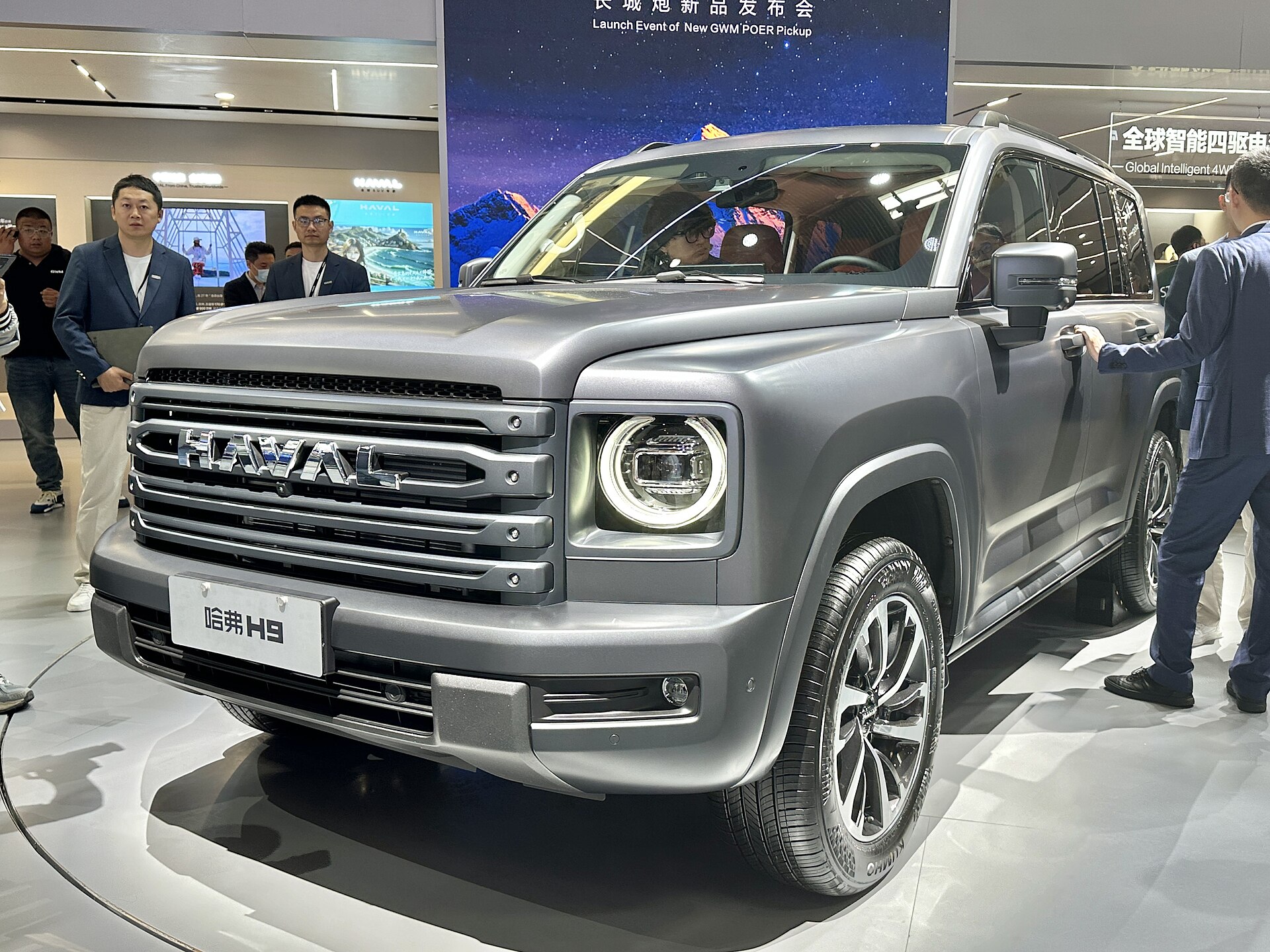
- Built
- 2014–present
- Generations
- 2
- Top power
- 180 kW (245 PS)
Timeline
Haval H9 generations
Click a generation for its own page

- H9 first generation 2014–2024 · SUV · 160–180 kW (218–245 PS)
- H9 second generation Current 2024–now · SUV · 135–167 kW (184–227 PS)
Newest first · 2 generations since 2014
- 2024 H9 second generation In production 2024–now · SUV · 135–167 kW (184–227 PS)
-
2014
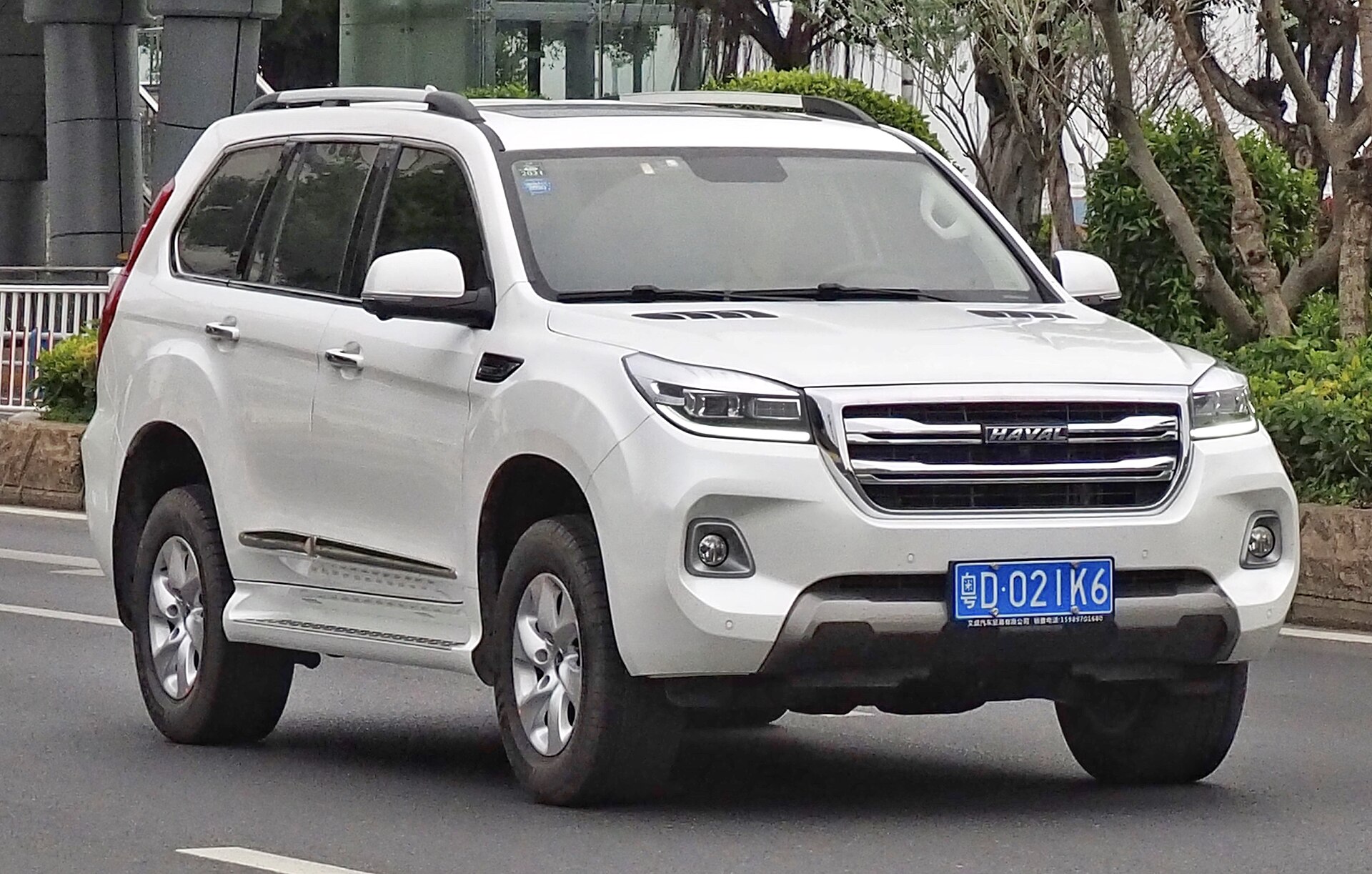
All generations by year: H9 second generation (2024–now) · H9 first generation (2014–2024)
Which one is mine?
Pick the year of first registration to see which generation it is.
- H9 second generation 2024–present
- H9 first generation 2014–2024
The Haval H9 is Great Wall Motor's seven-seat, body-on-frame SUV, built since 2014 and in its second generation since 2024. The current H9 has a 2.0-litre turbo petrol engine with an eight-speed automatic or a 2.4-litre turbo diesel with a nine-speed automatic, low-range four-wheel drive and locking front and rear differentials. It is built in China, Brazil and Uzbekistan.
In short
- First generation 2014-2024: 2.0 turbo petrol with 160 kW, from 2017 180 kW with a ZF eight-speed; four ANCAP stars in 2015.
- Second generation revealed in January 2024; 2.4 diesel with 135 kW (184 cv) and 480 Nm, 2.0 turbo petrol with 160-167 kW.
- 2,850 mm wheelbase, 800 mm wading depth, 2,500 kg towing (Brazil), seven seats.
- From BRL 319,000 in Brazil (September 2025) and AED 119,900 plus VAT in the UAE (2026).
Size at a glance
| Dimensions | Haval H9 second generation |
|---|---|
| Length | 4,859 mm191.3 in |
| Width | 1,934 mm76.1 in |
| Height | 1,853 mm73.0 in |
| Wheelbase | 2,850 mm112.2 in |
| Boot | 791 L27.9 cu ft |
Running cost
Fuel · Haval H9 2.0T 180 kW ZF
about 2,900 EUR fuel a year at 15,000 km
11.0 l/100 km · petrol at 1.75 EUR/l · change mileage, fuel price or version
Specs by version
Engines
| Version | Engine | Power | Torque | Gearbox | Drive | Production years |
|---|---|---|---|---|---|---|
| Diesel · 1 version | ||||||
| H9 second generation · 2.4 TD480 135 kW | 4 cyl · Diesel | 135 kW 184 PS181 hp | 480 Nm354 lb-ft | 9-sp Automatic | Four-wheel drive (4×4) | 2024 |
| Petrol · 3 versions | ||||||
| H9 first generation · 2.0T 160 kW | 4 cyl · Petrol | 160 kW 218 PS215 hp | 353 Nm260 lb-ft | 6-sp Automatic | Four-wheel drive (4×4) | 2014–2017 |
| H9 first generation · 2.0T 180 kW ZF | 4 cyl · Petrol | 180 kW 245 PS241 hp | 350 Nm258 lb-ft | 8-sp Automatic | Four-wheel drive (4×4) | 2017–2024 |
| H9 second generation · 2.0T 167 kW | 4 cyl · Petrol | 167 kW 227 PS224 hp | - | 8-sp Automatic | Four-wheel drive (4×4) | 2024 |
Performance
Show all 2 versions
| Version | 0–100 km/h | Fuel consumption |
|---|---|---|
| H9 first generation · 2.0T 160 kW | 13.4 s 0–62 mph | 12.1 l/100 km19.4 mpg US · 23.3 mpg UK |
| H9 first generation · 2.0T 180 kW ZF | 10.6 s 0–62 mph | 11.0 l/100 km21.4 mpg US · 25.7 mpg UK |
Dimensions and weight
Verified Manufacturer and type-approval data from our catalog · Sources and methodology
Haval H9 at a glance
| Specification | Haval H9 (second generation) |
|---|---|
| Body and segment | five-door, seven-seat large SUV, body-on-frame |
| Production | since 2024; Baoding (China), Iracemápolis (Brazil), Jizzakh (Uzbekistan) |
| Engines | 2.0 turbo petrol; 2.4 turbo diesel |
| Power and torque | petrol 160-167 kW, 380 Nm (UAE); diesel 135 kW (184 cv), 480 Nm |
| Gearboxes | eight-speed automatic (petrol), nine-speed automatic (diesel) |
| Drive | four-wheel drive with low range, BorgWarner torque-on-demand, front and rear locking differentials |
| Length, width, height | 4,859 mm, 1,934 mm, 1,853 mm (Chinese version, CarExpert) |
| Wheelbase | 2,850 mm |
| Off-road | 224 mm clearance, 31 degrees approach, 25 degrees departure, 800 mm wading |
| Boot | 88 l (seven seats), 791 l (five seats), 1,580 l (two seats) |
| Towing | 2,500 kg (Brazil) |
| Price from | BRL 319,000 (Brazil, 2025); AED 119,900 plus VAT (UAE, 2026) |
First-generation Haval H9 (2014-2024)
Haval showed the H9 at the 2014 Beijing motor show and started production in November 2014. Like the earlier H3 and H5 it used a separate ladder frame, with double wishbones at the front and a multi-link live axle at the rear. The launch engine was a 2.0-litre turbo petrol four with 160 kW (214 hp) and 353 Nm, driving through a six-speed automatic and four-wheel drive with an All-Terrain control system offering Auto, Snow, Sand, Mud and 4 Low modes. Buyers could choose five or seven seats.
The 2018 model-year update, launched in late 2017, was a big step. Output rose to 180 kW (241 hp) and 350 Nm, a ZF eight-speed automatic replaced the six-speed, and Haval quoted 11.0 L/100 km instead of 12.1 L/100 km. The 0-100 km/h time fell from 13.4 s to 10.6 s, and lane departure warning and blind-spot monitoring became standard. A 2019 facelift brought a new front end and moved the spare wheel from the tailgate to under the body. Wikipedia lists the first-generation length as 5,090 mm with the spare wheel mounted outside and 4,856 mm with it inside.
Australia was an important export market. Haval Australia developed a local suspension tune with Ironman 4X4, and ANCAP tested the H9 in 2015, awarding four stars out of five, with 12.05 of 16 points in the frontal offset test and full marks for side impact.

Second-generation Haval H9 (since 2024)
GWM released the first images of the second-generation H9 in January 2024. The body is squarer, the interior uses two large screens and the gear selector from the GWM Tank 300, and Chinese media reported that the ladder frame carries over. Chinese sales were 11,009 in 2024 and 14,251 in 2025, and in August 2025 the 2026 model year added more standard equipment in China.
| Version | Engine | Power | Torque | Gearbox | Markets |
|---|---|---|---|---|---|
| 2.0T petrol | 2.0 turbo four | 160-167 kW (214-224 hp) | 380 Nm | 8-speed automatic (ZF in UAE) | China, Middle East |
| 2.4 TD480 diesel | 2.4 turbo diesel four | 135 kW (184 cv) | 480 Nm | 9-speed automatic (GWM) | China, Brazil |
Petrol outputs differ by source: CarExpert quotes 167 kW for the Chinese car, while the UAE launch material gives 160 kW (214 hp) and 380 Nm. The carsales launch report said the diesel may be the same unit as in the GWM Cannon Alpha pickup, and Brazil names the version after its torque, TD480. CarExpert noted in 2024 that no hybrid H9 was offered. The 4x4 system has seven drive modes, a reduction gear and locking differentials front and rear, and the Brazilian H9 can climb a 57 percent gradient.

Haval H9 prices and markets
| Market (date) | Version | Price |
|---|---|---|
| Brazil (September 2025) | Exclusive TD480 diesel | BRL 309,000 launch offer, then BRL 319,000 |
| UAE (2026) | 2.0T petrol | from AED 119,900 plus VAT |
| China | 2.0T petrol and 2.4 diesel | sold since 2024 |
The Brazilian H9 is built at GWM's Iracemápolis plant in São Paulo state, the brand's first factory in the Americas, which opened just before the H9 went on sale on 12 September 2025. The plant's current capacity is 50,000 vehicles a year. At BRL 319,000 the H9 costs much less in Brazil than the Argentine-built Toyota SW4, which Autopapo puts above BRL 400,000 in 2025. In Uzbekistan the H9 is assembled by ADM in Jizzakh. In Australia, GWM sold the first-generation H9 and said in 2024 that the new model was under consideration; CarsGuide's H9 page, with news to April 2026, shows no Australian launch or price for the new model.
Haval H9 safety, space and equipment
Brazilian cars have six airbags including curtain airbags for all three rows, adaptive cruise control with stop and go, lane-keeping assistance, autonomous emergency braking, blind-spot warning and rear cross-traffic alert, plus an Integrated Braking Control system in place of a conventional hydraulic brake booster. UAE versions add a 360-degree camera. None of the sources read lists an ANCAP, Latin NCAP or Euro NCAP result for the second generation.
With all seven seats in use the boot holds 88 litres, which grows to 791 litres with the third row folded and 1,580 litres with both rear rows down. CarExpert found that the second row takes three average adults and the third suits children or smaller adults. UAE cars have a 14.6-inch touchscreen, a 10.25-inch digital instrument cluster, ventilated and massaging front seats and a panoramic sunroof.
Haval H9 vs Fortuner, Pajero Sport and Tank 300
The H9's natural rivals are other ladder-frame seven-seaters: the Toyota Fortuner, sold as the SW4 in Brazil, the Mitsubishi Pajero Sport, and the Ford Everest. Against them the H9 offers two locking differentials, an 800 mm wading depth and, in Brazil, a lower price than the SW4. Within GWM, the Tank 300 is the shorter, more off-road focused model, and the similarly sized Tank 500 sits alongside it in GWM's range.
Haval H9: which one to buy
For towing and long distances, the 2.4 diesel with 480 Nm is the better choice, and at the Brazilian launch it was the only version. The 2.0 petrol suits markets with cheap fuel such as the Gulf. A used first-generation H9 is best bought from 2018 onwards, when the 180 kW engine, the ZF eight-speed and better fuel economy arrived; check the service history of the automatic and the condition of the 4WD system after off-road use. The rest of the range is in the Haval catalogue.
Photo gallery

Haval H9: first vs latest generation
| Spec | H9 first generation | H9 second generation | Change |
|---|---|---|---|
| Years | 2014–2024 | 2024–present | 10 years apart |
| Most powerful version | 180 kW (245 PS) | 167 kW (227 PS) | −13 kW (−7%) |
Oldest and newest generation in the 1cars catalog. Power is the strongest version of each; other rows are shown only when both generations have the figure.
Haval H9 in our rankings
- No. 144 of 688 · Widest cars (1,934 mm · top 21%)
- No. 159 of 731 · Longest cars (4,859 mm · top 22%)
- No. 69 of 286 · Longest SUVs and crossovers (4,859 mm · top 25%)
- No. 74 of 276 · Widest SUVs and crossovers (1,934 mm · top 27%)
- No. 39 of 136 · Most torque: diesel cars (480 Nm · top 30%)
- No. 438 of 1344 · Longest-running car nameplates (12 years · top 34%)
Wider than 79% of ranked cars in the 1CARS catalog (No. 144 of 688).
FAQ
Is the Haval H9 a body-on-frame SUV?
Yes. Both generations of the Haval H9 use a separate ladder frame, low-range four-wheel drive and a live rear axle in the first generation. The second generation adds locking front and rear differentials and an 800 mm wading depth.
What engine does the Haval H9 have?
The second-generation Haval H9 offers a 2.0-litre turbo petrol with 160-167 kW and an eight-speed automatic, or a 2.4-litre turbo diesel with 135 kW (184 cv), 480 Nm and a nine-speed automatic.
How much does the Haval H9 cost?
In Brazil the H9 Exclusive TD480 diesel was launched at BRL 309,000 and then listed at BRL 319,000 in September 2025. In the UAE the 2026 H9 starts at AED 119,900 plus VAT.
Is the Haval H9 sold in Australia?
The first-generation H9 was sold in Australia and scored four ANCAP stars in 2015. GWM said in 2024 that the second generation was under consideration, but CarsGuide, with news to April 2026, shows no Australian launch.
How much can the Haval H9 tow?
GWM Brazil rates the second-generation H9 diesel to tow up to 2,500 kg. Towing figures for other markets and for the 2.0 petrol had not been published in the sources checked.
Data sources
Data checked by an editor against the sources below.
- Wikipedia - Haval H9
- Com - 2024 Haval H9 Review Quick Drive
- Com - Gwm Lanca No Brasil O Haval H9 Suv Inteligente De 7 Lugares Para Grandes Aventuras


