
 Toyota Sports 800
Specs, engines and history
Published Sources (3) Report an error
By Sarah Whitmore, Senior Automotive Writer
- Built
- 1965–1969
- Top power
- 33 kW (45 PS)
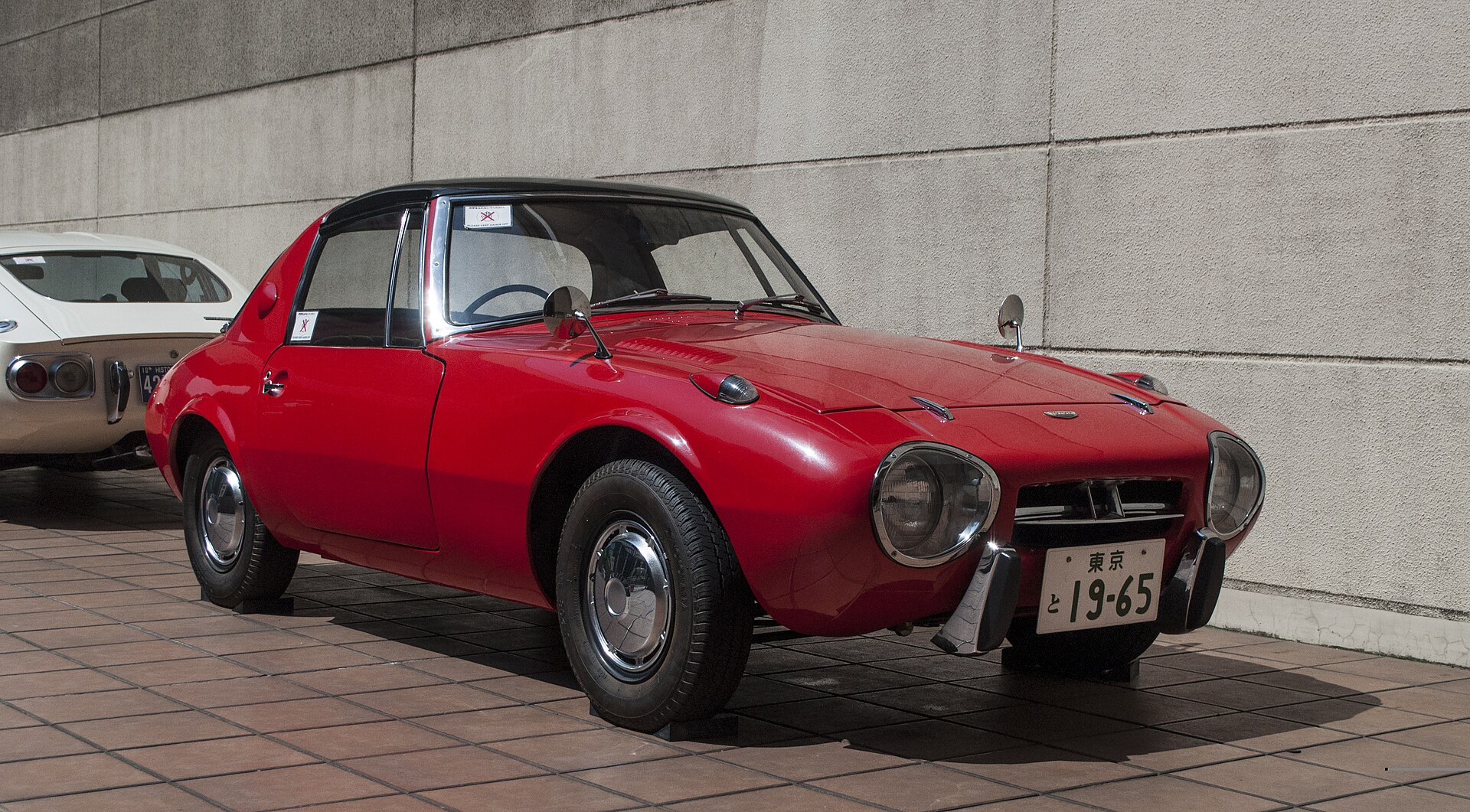
The Toyota Sports 800 is a small two-seat coupé that Toyota sold in Japan from April 1965 to October 1969. It used a 790 cc air-cooled flat-twin from the Publica economy car, tuned to 33 kW (45 PS), and weighed only 580 kg. Kanto Auto Works built 3,131, each with a lift-out roof panel that could be stowed in the boot.
In short
- Toyota's first production sports car, on sale from 1 April 1965 at JPY 595,000 in Tokyo.
- Catalogue top speed of 155 km/h from just 33 kW (45 PS), thanks to low weight and an aerodynamic fastback shape.
- 3,131 built in five years; 1,235 of them in 1965 and only 215 in 1969.
- Took first and second places in the 1966 Suzuka 500 km race by running without a fuel stop.
Size at a glance
| Dimensions | Toyota Sports 800 UP15 |
|---|---|
| Length | 3,580 mm140.9 in |
| Width | 1,465 mm57.7 in |
| Height | 1,175 mm46.3 in |
| Wheelbase | 2,000 mm78.7 in |
Specs by version
Engines
| Version | Engine | Power | Gearbox | Drive | Production years |
|---|---|---|---|---|---|
| Sports 800 (1965-1967) | 0.8 l · 2 cyl · Petrol 2U | 33 kW 45 PS44 hp | 4-sp Manual | Rear-wheel drive | 1965–1967 |
| Sports 800 (1967-1969) | 0.8 l · 2 cyl · Petrol 2U | 33 kW 45 PS44 hp | 4-sp Manual | Rear-wheel drive | 1967–1969 |
Performance
Show all 2 versions
| Version | Top speed |
|---|---|
| Sports 800 (1965-1967) | 155 km/h96 mph |
| Sports 800 (1967-1969) | 155 km/h96 mph |
Dimensions and weight
Show all 2 versions
| Version | Length | Width | Height | Wheelbase | Kerb weight |
|---|---|---|---|---|---|
| Sports 800 (1965-1967) | 3,580 mm140.9 in | 1,465 mm57.7 in | 1,175 mm46.3 in | 2,000 mm78.7 in | 580 kg1,279 lb |
| Sports 800 (1967-1969) | 3,580 mm140.9 in | 1,465 mm57.7 in | 1,175 mm46.3 in | 2,000 mm78.7 in | 580 kg1,279 lb |
Verified Manufacturer and type-approval data from our catalog · Sources and methodology
Toyota Sports 800 at a glance
| Specification | Toyota Sports 800 |
|---|---|
| Years | April 1965 to October 1969 |
| Production | 3,131 |
| Plant | Kanto Auto Works, Yokosuka (Kanagawa) |
| Chassis code | UP15 |
| Body style | two-seat coupé with lift-out roof panel |
| Designers | Tatsuo Hasegawa (Toyota) and Shozo Sato |
| Layout | front engine, rear-wheel drive, monocoque on the Publica floorpan |
| Engine | 790 cc 2U air-cooled flat-twin, two carburettors |
| Power | 33 kW (45 PS) at 5,400 rpm |
| Gearbox | four-speed manual |
| Weight | 580 kg |
| Top speed | 155 km/h (catalogue figure) |
| Price new | JPY 595,000 in Tokyo in 1965 |
From the 1962 Publica Sports to the Yota-Hachi
In 1955 Japan's trade ministry asked carmakers for a cheap "national car", and Toyota's answer was the Publica of 1961, a basic saloon with a 697 cc twin. Engineer Tatsuo Hasegawa, who had studied aeronautical engineering and designed aircraft before joining Toyota in 1946, saw a sports car in the same parts. Shozo Sato, a stylist on loan from Nissan, helped shape it. The Publica Sports prototype appeared at the 1962 Tokyo show.
The production car kept the prototype's idea of low drag and low mass. Toyota launched it on 1 April 1965, after Honda had already put the S500 and S600 on the road and while the Datsun Fairlady and Daihatsu Compagno were also on sale. Buyers called it Yota-Hachi, a short form of "Toyota eight".
Low-drag body and lift-out roof
Hasegawa's background shows in the details. The body is a monocoque built on the Publica floorpan, with the wheelbase cut by 100 mm to 2,000 mm. The car is 3,580 mm long, 1,465 mm wide and only 1,175 mm high. Aluminium was used for the bonnet, boot lid and bumpers, and in the early years even for the seat frames. JAF describes the removable roof as fibreglass-reinforced plastic, while Wikipedia calls it aluminium.
That roof panel lifts out and fits in the boot, so the coupé becomes an open car. Hagerty notes that the arrangement came two years before the Porsche Targa. The rounded fastback was shaped for low drag, because a 790 cc twin was never going to make much power.

The 790 cc flat-twin and its updates
The engine is the Publica's air-cooled horizontally opposed twin, bored from 697 cc to 790 cc and fitted with two carburettors. Output rose from 21 kW (28 PS) in the 700 cc Publica to 33 kW (45 PS) at 5,400 rpm. A four-speed manual gearbox drove the rear wheels; first gear had no synchromesh until 1967, when Toyota also fitted a larger alternator.
Hagerty gives a fuel consumption of 19.13 km per litre, about 5.2 L/100 km. Its US article lists the top speed as 144 km/h (90 mph), while the Japanese catalogue figure, repeated by JAF and Hagerty UK, is 155 km/h (96 mph). Wikipedia, without a catalogue figure, says the car could reach about 160 km/h (100 mph) on a track.
Later changes were small. In March 1968 the car received stronger bumpers, amber indicators and reversing lights, and Zircon Blue joined the colour range. In February 1969 indicators were added to the front wings to meet North American rules. Production ended in October 1969.

Production by year and where the cars went
| Year | Built |
|---|---|
| 1965 | 1,235 |
| 1966 | 703 |
| 1967 | 538 |
| 1968 | 440 |
| 1969 | 215 |
| Total | 3,131 |
The Sports 800 was sold only through the Toyota Publica Store network in Japan. About 300 left-hand-drive cars were made, mainly for Okinawa, which then drove on the right. Toyota sent around 40 to the USA for test marketing in 1965, and they stayed with American dealers. Best Car puts total exports at about 500. Hagerty estimates that fewer than 10% of the cars survive, most of them in Japan.
Toyota Sports 800 vs Honda S600 and the 1966 Suzuka win
The light car suited endurance events, where its small appetite for fuel counted. At the 1966 Suzuka 500 km race Sports 800s finished first and second after running the distance without refuelling, according to JAF. The main rival on track and in the showroom was Honda's small four-cylinder S600, which had followed the S500 in 1964.
Sports 800 legacy and the 2000GT
The Sports 800 was Toyota's first step into sports cars, and the six-cylinder Toyota 2000GT followed in 1967. The small coupé reappeared at shows long after production ended: a one-off Sports 800 Gas Turbine Hybrid was displayed at the 1979 Tokyo Motor Show, and in 2010 its body was used for the Sports EV and Sports EV Twin electric concepts. The roots of the company itself are covered in how Toyota began.
Toyota Sports 800 today: what to check when buying
With about 300 survivors at most, finding a car is the first hurdle; Hagerty UK describes an owner who lost five auctions before buying one in Nagoya. Most cars are in Japan, so import paperwork is part of the cost for European buyers.
Hagerty UK warns that the thin-gauge steel panels have almost no rust resistance, so the whole shell needs inspecting from underneath. Crash repairs are common because the light structure offers little protection. Many cars were modified in the 1970s, and original parts are scarce because Kanto Auto Works made many components only for this model. Hagerty UK quotes USD 1,300 (about GBP 1,045) for a single genuine wheel. The factory option petrol heater has its own fuel pump and deserves a careful check. The Toyota catalogue lists the brand's other models from the Publica era onward, and the classic cars section covers other small sports cars of the 1960s. The Sports 800 is also ranked among the best Japanese classic cars.
Toyota Sports 800 in our rankings
- No. 1 of 110 · Lightest coupes (580 kg)
- No. 3 of 121 · Smallest coupes (3,580 mm)
- No. 3 of 508 · Lightest cars (580 kg)
- No. 20 of 650 · Smallest cars (3,580 mm · top 4%)
- No. 32 of 50 · Fastest cars of the 1960s (155 km/h · top 64%)
- No. 933 of 1242 · Longest-running car nameplates (4 years · top 82%)
Lighter than 99% of ranked coupes in the 1CARS catalog (No. 1 of 110).
FAQ
How many Toyota Sports 800s were made?
Kanto Auto Works built 3,131 Sports 800s between April 1965 and October 1969. The best year was 1965 with 1,235 cars, and only 215 were made in 1969. Hagerty estimates that fewer than 10% survive.
What engine is in the Toyota Sports 800?
It has a 790 cc air-cooled horizontally opposed twin, the 2U, taken from the Publica and fitted with two carburettors. It produces 33 kW (45 PS) at 5,400 rpm and drives the rear wheels through a four-speed manual gearbox.
How fast is the Toyota Sports 800?
Toyota's catalogue gave a top speed of 155 km/h, a high figure for 33 kW (45 PS) that came from the 580 kg weight and the low-drag body. Hagerty's US article quotes a lower 144 km/h (90 mph).
Was the Toyota Sports 800 sold outside Japan?
Only in small numbers. About 300 left-hand-drive cars were built mainly for Okinawa, around 40 went to the USA for test marketing in 1965, and Best Car puts total exports at about 500.
Data sources
Data checked by an editor against the sources below.
- Wikipedia - Toyota Sports 800
- Jafmate - Todays Memories 20260401
- Bestcarweb


