
 Toyota Land Cruiser 40
Specs, engines and history
Published Sources (3) Report an error
By Sarah Whitmore, Senior Automotive Writer
- Built
- 1960–1984
- Top power
- 99 kW (135 PS)
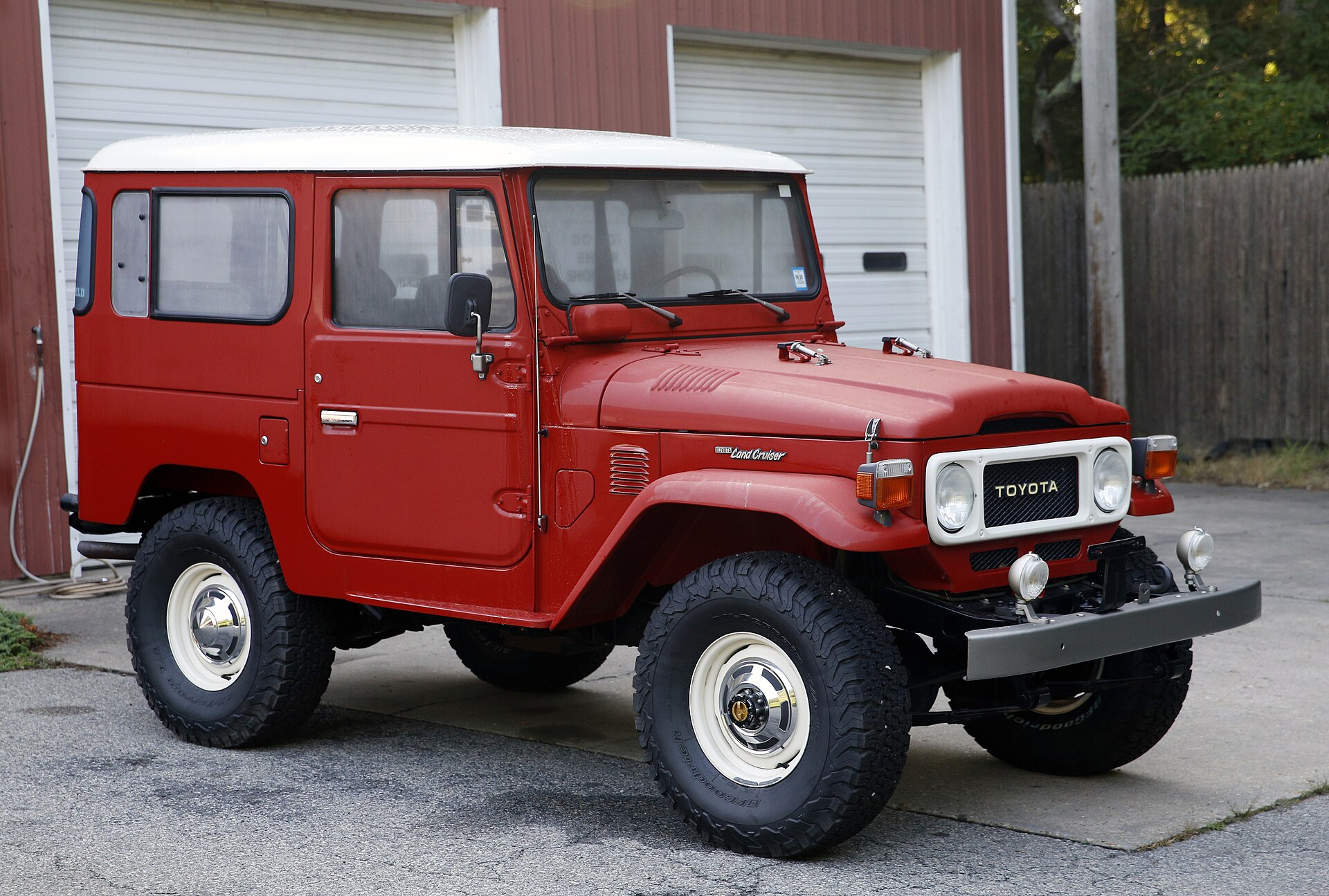
The Toyota Land Cruiser 40 Series, or J40, is the body-on-frame four-wheel drive that Toyota built from August 1960 to 1984, best known as the short-wheelbase FJ40. Four wheelbases, petrol sixes of 3.9 and 4.2 litres and diesels from 3.0 to 4.0 litres kept it in production for 24 years, and its Brazilian derivative, the Bandeirante, lasted until 2001.
In short
- Launched in August 1960 and built in Japan until 1984, with assembly in Brazil, Venezuela and Indonesia; replaced by the 70 Series in 1984.
- Wheelbases of 2,285, 2,430, 2,650 and 2,950 mm; soft tops, hardtops, pickups and, until the late 1960s, a four-door estate.
- Engines: F and 2F petrol sixes of 78-99 kW (106-135 PS); B, 2B, 3B, H and 2H diesels of 60-78 kW (81-106 PS).
- Land Cruiser output, all series combined, passed 300,000 in 1973; US sales started with 162 trucks in 1960.
Size at a glance
| Dimensions | Toyota J40 |
|---|---|
| Length | 3,840 mm151.2 in |
| Width | 1,665 mm65.6 in |
| Height | 1,950 mm76.8 in |
| Wheelbase | 2,285 mm90.0 in |
Specs by version
Engines
| Version | Engine | Power | Torque | Gearbox | Drive | Production years |
|---|---|---|---|---|---|---|
| Diesel · 3 versions | ||||||
| BJ40 3.0 Diesel | 4 cyl · Diesel B | 60 kW 82 PS80 hp | 191 Nm141 lb-ft | 4-sp Manual | Four-wheel drive (4×4) | 1974–1984 |
| HJ45 3.6 Diesel | 3.6 l · 6 cyl · Diesel H | 70 kW 95 PS94 hp | 216 Nm159 lb-ft | - | Four-wheel drive (4×4) | 1973–1980 |
| HJ47 4.0 Diesel | 6 cyl · Diesel 2H | 78 kW 106 PS105 hp | 240 Nm177 lb-ft | - | Four-wheel drive (4×4) | 1980–1984 |
| Petrol · 2 versions | ||||||
| FJ40 3.9 | 3.9 l · 6 cyl · Petrol F | 92 kW 125 PS123 hp | - | 3-sp Manual | Four-wheel drive (4×4) | 1960–1975 |
| FJ40 4.2 | 4.2 l · 6 cyl · Petrol 2F | 99 kW 135 PS133 hp | 284 Nm209 lb-ft | 4-sp Manual | Four-wheel drive (4×4) | 1975–1984 |
Dimensions and weight
Verified Manufacturer and type-approval data from our catalog · Sources and methodology
Land Cruiser 40 at a glance
| Specification | Land Cruiser 40 |
|---|---|
| Years | August 1960 to 1984 (Japan); Bandeirante in Brazil until 2001 |
| Production | no J40-only total published by Toyota; all Land Cruisers passed 100,000 in 1968 and 300,000 in 1973 |
| Plants | Toyota Honsha plant, Gifu Auto Body (from December 1960) and Araco (from 1962) in Japan; São Bernardo do Campo (Brazil), Cumaná (Venezuela), Jakarta (Indonesia) |
| Body styles | two-door soft top and hardtop, pickup, four-door estate FJ45V (to 1967) |
| Frame and axles | ladder frame, leaf springs, live axles front and rear |
| Wheelbases | 2,285 mm (90.0 in), 2,430 mm (95.7 in), 2,650 mm (104.3 in), 2,950 mm (116.1 in) |
| Drive | part-time four-wheel drive with two-speed transfer case; FJ42 4x2 for the Middle East |
| Engines | 3.9 F and 4.2 2F petrol sixes; 3.0 B, 3.2 2B, 3.4 3B diesel fours; 3.6 H and 4.0 2H diesel sixes |
| Power | 60 kW (81 PS) BJ40 diesel to 99 kW (135 PS) 2F petrol |
| Kerb weight | 1,480 kg (FJ40), 1,590 kg (FJ43), 1,850 kg (FJ45V), Toyota data |
| Gearboxes | three-speed manual, four-speed from 1974, five-speed in the final years |
| Top speed | 137 km/h (85 mph) factory claim for the FJ40 |
From the Toyota BJ to the Land Cruiser 40 Series
During the Korean War the US military asked Toyota for jeep-type vehicles, and the BJ of 1951 was the answer, with a 3.4-litre six and no low-range gearing. The Land Cruiser name arrived in the mid-1950s with the J20 series. The wartime vehicle that set the pattern for all of these is covered in the Willys MB hub.
Toyota launched the third-generation Land Cruiser in August 1960. Compared with the J20 it gained a two-speed transfer case with a proper low range for slow work on steep ground, worked by a lever on the dashboard, while the three-speed gear lever moved to the steering column.
Land Cruiser 40 wheelbases: FJ40, FJ43 and FJ45
Toyota built the 40 on a ladder frame with leaf-sprung live axles and offered it in four lengths. The short J40, J41 and J42 used a 2,285 mm (90.0 in) wheelbase, slightly longer than a Jeep CJ; Toyota gives the FJ40 as 3,840 mm long, 1,665 mm wide and 1,950 mm high. The medium J43, J44 and J46 on 2,430 mm (95.7 in) are rare. The long J45 and J47 used 2,650 mm (104.3 in), and from 1963 an FJ45-B pickup chassis stretched to 2,950 mm (116.1 in).
The four-door FJ45V estate was 4,630 mm long and weighed 1,850 kg; in July 1967 Toyota replaced the four-door van with the FJ55 station wagon, a separate model. The FJ42 was a two-wheel-drive version built only for Middle Eastern buyers.
Petrol sixes and diesel fours and sixes
The engine letter forms the first part of each model code: F for the petrol six, B for the four-cylinder diesels, H for the six-cylinder diesels. The 2F was never sold in Japan, where the diesels had a tax advantage: Toyota notes that they qualified the Land Cruiser for the small-truck class, which cut costs for private owners.
| Engine | Capacity | Power | Torque | Years |
|---|---|---|---|---|
| F petrol six | 3.9 litres (3,878 cc) | 78-96 kW (106-130 PS) by year and market | 256-294 Nm | 1960-1975 |
| 2F petrol six | 4.2 litres (4,230 cc) | 99 kW (135 PS) | 284 Nm | 1975-1984 |
| B diesel four | 3.0 litres | 60-63 kW (81-85 PS) | 191-196 Nm | 1974-1984 |
| 2B diesel four | 3.2 litres | 68 kW (93 PS) | 215 Nm | 1979-1981 |
| 3B diesel four | 3.4 litres | 67 kW (91 PS) | 217 Nm | 1979-1984 |
| H diesel six | 3.6 litres (3,576 cc) | 70 kW (95 PS) | 216 Nm | 1973-1980 |
| 2H diesel six | 4.0 litres | 78 kW (106 PS) | 240 Nm | 1980-1984 |
Ratings come from Wikipedia's engine table and Silodrome's history; figures vary between sources. Toyota's own data gives the F engine 92 kW (125 PS, net) at 3,600 rpm, Retro Rides quotes 101 kW for the Australian 4.2, and Toyota and Silodrome date the H diesel to 1973.


Year-by-year changes from 1973 to 1984
The HJ45 brought the H six-cylinder diesel in 1973, and in 1974 the four-cylinder B diesel created the BJ40 and BJ43, while a four-speed gearbox replaced the three-speed and US FJ40s gained a factory roll bar. The 4.2-litre 2F arrived in 1975 together with rear barn doors for US cars. Front disc brakes followed in 1976, and the front quarter-lights disappeared in 1977.
In 1979 power steering on petrol models and air conditioning became options, and the US final drive changed from 4.11 to 3.70. The 1980 range added the HJ47 with the 4.0-litre 2H and the BJ42, BJ45 and BJ46 with the 3.4-litre 3B, and power steering reached the diesel BJ models in 1981. Retro Rides records free-wheeling front hubs as standard in Australia from 1982 and a five-speed gearbox from 1983.
FJ40 sales in America and Australia
The Land Cruiser was one of Toyota's first successes in the United States, starting from 162 trucks sold there in 1960, according to The Drive. Total Land Cruiser production, all series combined, passed 50,000 in 1965, 100,000 in 1968 and 300,000 in 1973, according to conceptcarz. Jalopnik's road impressions describe a heavy clutch, a tall first gear and weak brakes, with a claimed top speed of 85 mph (137 km/h).
In Australia the Land Cruiser overtook Land Rover as the most common four-wheel drive in the late 1970s, and owners called them Tojos. Retro Rides notes that the HJ45 diesel used 20-30 percent less fuel off-road than the 4.2 petrol, which suited outback stations and mines.
Bandeirante: the Brazilian 40 that ran to 2001
Toyota do Brasil, founded in 1958, began building Land Cruisers at São Bernardo do Campo with the J20-based FJ25 in 1962. J40-derived trucks followed, sold as the Bandeirante and powered by Mercedes-Benz diesels made in Brazil: the OM324 of 57 kW (78 PS) until 1973, the OM314 of 63 kW (85 PS) until 1989 and the OM364 of 66 kW (90 PS) until 1994. From 1994 the imported Toyota 14B four of 71 kW (96 PS) took over, and the last Bandeirante was built in 2001.

Land Cruiser 40 vs Jeep CJ and Land Rover Series
The 40 Series competed directly with the Jeep CJ in the Americas and with the Land Rover Series across Africa, the Middle East and Australia. Its advantage in those markets was a large six-cylinder engine and a heavy frame at a time when the Land Rover still relied on four-cylinder engines in most versions. In 2006 Toyota used the FJ40's round headlamps and white roof as styling cues for the FJ Cruiser.
Land Cruiser 40 today: what to check when buying
Retro Rides' February 2025 buyer's guide names rust as the main risk, especially where it hides: body mounting points, the inside of the sills and the windscreen pillars. Once rot shows on the outside, major work is usually needed, and a badly corroded frame may not be worth repairing. Check the leaf springs for cracked leaves, listen for noisy transfer cases and differentials, and on later Australian cars make sure the free-wheeling hubs lock and release.
Parts supply is good. Silodrome describes new pressed-steel body panels and nearly all mechanical parts as available, and fibreglass panels exist for cheaper repairs. Many trucks have been fitted with later engines or gearboxes, so match the engine code with the model code on the plate.
Values: Retro Rides put tidy FJ40s at AUD 30,000-50,000 in Australia in 2025, about EUR 17,000-28,500 at 0.57, with rough runners from about AUD 20,000; US prices for short-wheelbase trucks are higher, and Silodrome reported restomods above USD 100,000 in 2020. More Land Cruiser generations are listed in the Toyota catalogue. The 40 Series also appears among the best Japanese classic cars.
Toyota Land Cruiser 40 in our rankings
- No. 3 of 244 · Smallest SUVs and crossovers (3,840 mm)
- No. 45 of 650 · Smallest cars (3,840 mm · top 7%)
- No. 29 of 171 · Biggest engines: SUVs and crossovers (4,230 cc · top 17%)
- No. 46 of 186 · Lightest SUVs and crossovers (1,480 kg · top 25%)
- No. 232 of 772 · Biggest engines: cars (4,230 cc · top 31%)
- No. 240 of 508 · Lightest cars (1,480 kg · top 48%)
Shorter than 98% of ranked SUVs and crossovers in the 1CARS catalog (No. 3 of 244).
FAQ
What is the difference between the FJ40 and the BJ40?
Both are short-wheelbase 40 Series Land Cruisers. The FJ40 has the F or 2F petrol six of 3.9 or 4.2 litres, while the BJ40 uses the B four-cylinder diesel of 3.0 litres, introduced in 1974.
When did Toyota stop making the Land Cruiser 40?
Toyota ended 40 Series production in 1984, when the 70 Series replaced it. The Brazilian Bandeirante, derived from the 40, stayed in production until 2001.
What engines did the FJ40 have?
The FJ40 used the 3.9-litre F petrol six from 1960 and the 4.2-litre 2F from 1975, rated at 99 kW (135 PS). Diesel versions carried B, H or 2H engines and BJ or HJ model codes.
How many wheelbases did the Land Cruiser 40 have?
Four: 2,285 mm for the short J40, 2,430 mm for the rare medium J43, 2,650 mm for the long J45 and 2,950 mm for the FJ45-B pickup chassis added in 1963.
Data sources
Data checked by an editor against the sources below.
- Wikipedia - Toyota Land Cruiser (J40)
- Toyota
- Silodrome - Toyota Land Cruiser Fj40 Bj40 History


