 Willys MB
Specs, engines and history
Published Sources (1) Report an error
By Sarah Whitmore, Senior Automotive Writer
- Built
- 1941–1945
- Top power
- 45 kW (61 PS)
Willys-Overland was the Toledo, Ohio, carmaker built by John North Willys. In 1908 he bought the Overland Automotive Division of the Standard Wheel Company, and in 1912 he renamed the business the Willys–Overland Motor Company. From 1912 to 1918 Willys was the second-largest American carmaker after Ford. It licensed Charles Yale Knight's sleeve-valve engine in 1913 for the Willys-Knight, built until 1933, and sold the small Whippet from 1926 to 1931. The Depression pushed it into receivership in the early 1930s; in 1933 it sold only 12,800 Willys 77s, and Ward M. Canaday had become chairman in 1932.
The Willys MB saved the company and made its name. It is the 1/4-ton 4×4 utility truck the US Army used in the Second World War, known everywhere as the Jeep. Willys won the main contract in July 1941 and began building the MB in November 1941. Ford built the same design as the GPW, and by the end of the war the two firms had made more than 647,000 Jeeps. The MB is the direct ancestor of the civilian Jeep CJ and of every Jeep since.
Specs by version
Engines
| Version | Engine | Power | Drive | Production years |
|---|---|---|---|---|
| 2.2 L134 Go Devil | 2.2 l · 4 cyl · Petrol 2,199 cc | 45 kW 61 PS60 hp | Four-wheel drive (4×4) | 1941–1945 |
Performance
Show all 1 versions
| Version | Top speed |
|---|---|
| 2.2 L134 Go Devil | 105 km/h65 mph |
Dimensions and weight
Show all 1 versions
| Version | Length | Width | Wheelbase | Kerb weight |
|---|---|---|---|---|
| 2.2 L134 Go Devil | 3,353 mm132.0 in | 1,575 mm62.0 in | 2,032 mm80.0 in | 1,113 kg2,454 lb |
Verified Manufacturer and type-approval data from our catalog · Sources and methodology
In short
- Built from 1941 to 1945 by Willys-Overland (MB) and Ford (GPW) to a single standard design; Willys made about 360,000 and Ford about 280,000.
- Willys L134 "Go Devil" inline-four of 134 cu in (2.2 l): 45 kW (60 hp) gross, 40 kW (54 hp) net.
- Part-time four-wheel drive, three-speed gearbox with a two-range transfer case, live axles on leaf springs; 1,113 kg with fluids and fuel.
- Top speed 105 km/h (65 mph) and a range of about 480 km (300 miles) on 57 litres of fuel.
Willys MB at a glance
| Parameter | Metric | Imperial |
|---|---|---|
| Makers | Willys-Overland (MB); Ford (GPW) | — |
| Production | 1941–1945 | — |
| Type | 1/4-ton 4×4 utility truck | — |
| Crew | 3–4 | — |
| Engine | Willys L134 "Go Devil" inline-four, 2.2 l | 134 cu in |
| Power | 45 kW (60 hp) gross; 40 kW (54 hp) net | — |
| Gearbox | three-speed manual with two-range transfer case | — |
| Drive | part-time four-wheel drive | — |
| Suspension | live axles on leaf springs, front and rear | — |
| Wheelbase | 2,032 mm | 80 in |
| Length × width | 3,350 × 1,570 mm | 132 × 62 in |
| Height | 1,770 mm, top up; 1,320 mm lowered | 69¾ in; 52 in |
| Ground clearance | 220 mm | 8¾ in |
| Kerb weight | 1,113 kg with fluids and full fuel; 1,060 kg dry | 2,453 lb; 2,337 lb |
| Payload | 540 kg on road; 360 kg cross-country | 1,200 lb; 800 lb |
| Fuel tank and range | 57 l; 480 km | 15 US gal; 300 miles |
| Top speed | 105 km/h | 65 mph |
Development: Bantam, Ford and Willys
In June 1940 the US Army Quartermaster Corps issued its first specification for a light reconnaissance vehicle of about 1,200 lb (544 kg) with a payload of up to 600 lb (272 kg). On 11 July 1940 the Army sent formal requirements to 135 manufacturers, with bids due on 22 July. The winner had 49 days to build a prototype and 75 days to complete 70 test vehicles. The empty weight was first limited to about 1,275–1,300 lb and later raised to 2,160 lb (980 kg).
American Bantam delivered its Bantam Reconnaissance Car, designed by Harold Crist and Karl Probst, at 4:30 pm on 23 September 1940, half an hour before the deadline. The Army tested it at Camp Holabird from 27 September to 16 October 1940. That story is told in our article on the Bantam BRC-40. Ford answered with the Pygmy and the GP, whose tractor engine was tuned from 22 to 30 kW (30 to 40 bhp). Willys built the Quad, then the MA. Its 45 kW (60 hp) engine, designed by Delmar "Barney" Roos, impressed the soldiers who tested it.
| Vehicle | Maker | Production start | Built |
|---|---|---|---|
| BRC-40 | American Bantam | 31 March 1941 | 2,605 by 6 December 1941 |
| MA | Willys-Overland | 5 June 1941 | 1,555 |
| MB | Willys-Overland | November 1941 | about 360,000 |
| GPW | Ford | 2 January 1942 | about 280,000 |
In July 1941 Willys won a contract for 16,000 vehicles, mainly because of its engine and its lower price, and its design became the MB. Ford received orders for 30,000 in October 1941 and for 63,146 GPWs in December 1941. Roos's design patent 136819, assigned to Willys-Overland, covered the Jeep's front end.

Design and engineering
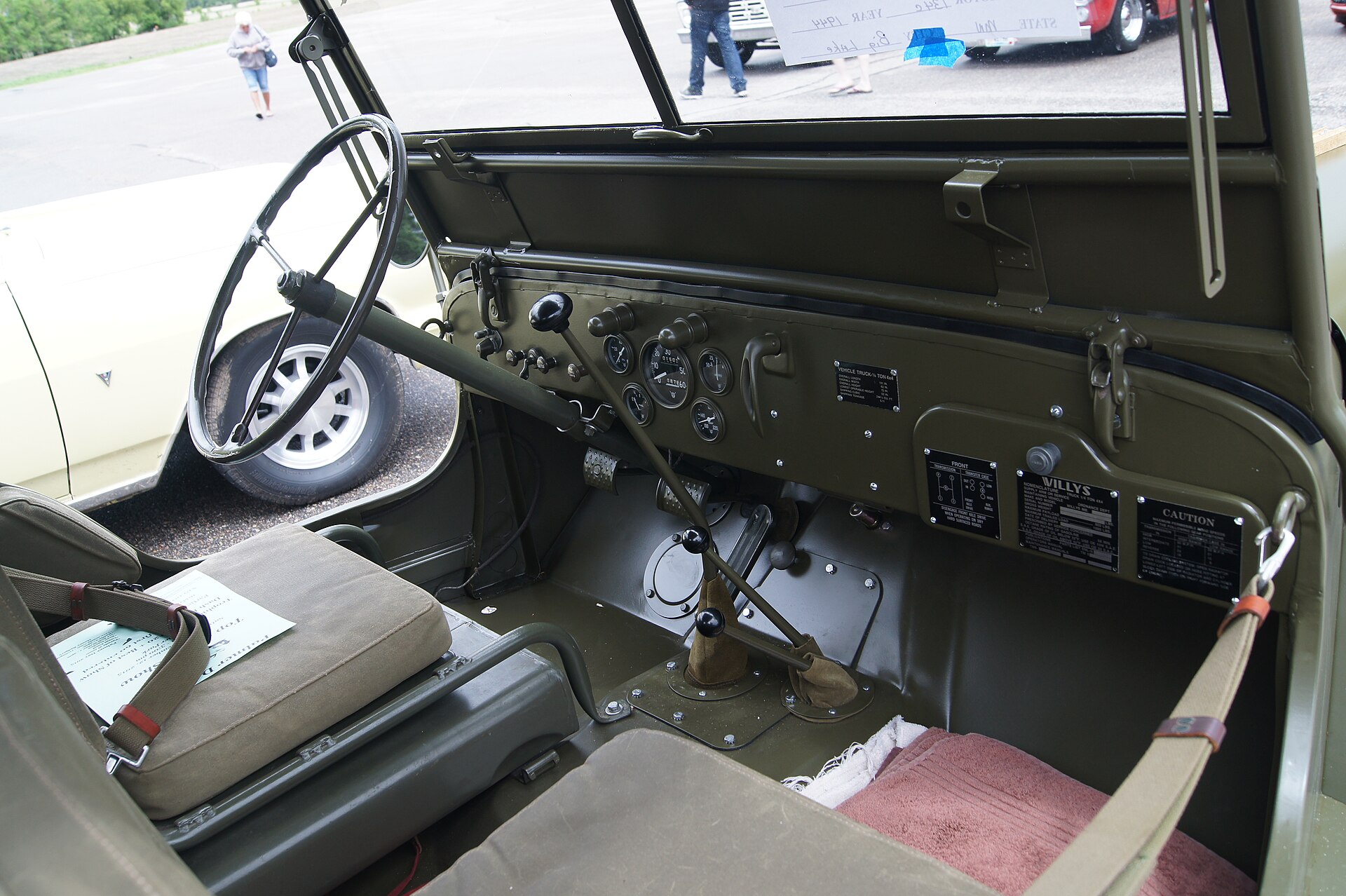
The MB is a small open vehicle for a crew of three or four. Its frame carries live axles on leaf springs front and rear. The engine drives through a three-speed gearbox and a two-range transfer case to a part-time four-wheel-drive system. It was designed to carry a .30 or .50 calibre gun on a post between the front seats. Height with the top up is 69¾ in (1,770 mm), and the vehicle can be lowered to 52 in (1,320 mm) for shipping.
The pressed-steel slat grille is one of the details collectors use to date a Jeep. Ford designed it, with nine vertical slots, and Willys adopted it after vehicle number 25,808. Both firms built the 1/4-ton Jeep to a single standard design. American Central Manufacturing (ACM) made about three-quarters of all the bodies.
Go Devil engine and drivetrain
The Willys L134 "Go Devil" is an inline-four of 134 cu in (2.2 litres). It gives 45 kW (60 hp) gross and 40 kW (54 hp) net. With 45 kW and 1,113 kg, the MB has about 40 kW per tonne. The power-to-weight calculator sets that against a modern off-roader.
| Item | Specification |
|---|---|
| Engine | Willys L134 "Go Devil", inline-four, 134 cu in (2.2 l) |
| Output | 45 kW (60 hp) gross, 40 kW (54 hp) net |
| Gearbox | three-speed manual |
| Transfer case | two-range |
| Drive | part-time 4×4 |
| Top speed | 105 km/h (65 mph) |
| Fuel | 57 l (15 US gal), about 480 km (300 miles) |
Production and variants
| Variant | Years | Body / purpose | Built | Notes |
|---|---|---|---|---|
| Willys MB | 1941–1945 | 1/4-ton 4×4 utility truck | over 359,489 (infobox); about 363,000 (text) | Willys-Overland article: 362,841 |
| Ford GPW | 1942–1945 | same design, built by Ford | over 277,896 (infobox); about 280,000 (text) | five Ford plants |
| Ford GPA "Seep" | wartime | amphibious Jeep | 12,778 (infobox); about 13,000 (text) | — |
| 1/4-ton trailers | wartime | cargo trailer | about 150,000 | mostly by Bantam and Willys |
Ford built its GPWs at five plants: River Rouge (21,559), Dallas (93,748), Louisville (93,364), Chester (18,533) and Edgewater (1,333). The total for the war is more than 647,925 Jeeps, including the early pre-production vehicles. Some early GPWs used Willys-design frames, and some late-1943 GPWs had unmodified Willys bodies.
In service
The Jeep became the main light vehicle of the US forces and their allies, replacing horses, mules and motorcycles in many roles. In his memoirs Dwight D. Eisenhower wrote that senior officers counted it among the five most vital pieces of equipment for success in Africa and Europe. George C. Marshall called it "America's greatest contribution to modern warfare".
Soldiers and depots adapted Jeeps in the field. They added gun mounts such as the M31 pedestal and M48 bracket, radio fittings, wire cutters, stretcher racks and deep-water fording kits. The MB served on through the Korean War. The M38 (Willys MC) of 1949 replaced it, then the M38A1 (MD) of 1952 and the Ford-designed M151 of 1960.

The Jeep name and the civilian CJ
Willys applied to register "Jeep" as a trademark on 13 February 1943, and the US Federal Trade Commission opened a case over its advertising on 6 May 1943. In 1948 the FTC ruled that Willys could not claim to have created the Jeep alone. The trademark was finally granted on 13 June 1950. In 2015 the Pennsylvania General Assembly passed a resolution crediting Bantam with inventing the Jeep.
Willys's first post-war product was the civilian CJ-2A of 1945, the world's first mass-produced civilian four-wheel-drive vehicle. The Jeep Station Wagon followed in 1946 and the Jeepster in 1948. Kaiser bought Willys-Overland in 1953 and renamed it Willys Motor Company, then Kaiser-Jeep in 1963, and American Motors bought it in 1970. The brand's later history is in our page on Jeep's history and landmark models, and today's descendant in our article on the Jeep Wrangler.

Preservation and collecting today
In 1991 the American Society of Mechanical Engineers named the MB an International Historic Mechanical Engineering Landmark. For collectors, the details that date and identify a Jeep come from the production story:
- Grille: Willys adopted Ford's pressed slat grille after vehicle 25,808, so the grille helps to place an MB in the production run.
- Maker: a Willys MB and a Ford GPW look almost the same, but some GPWs used Willys frames or bodies.
- Rarities: only 27 Willys MAs are known to exist, and four of the four-wheel-steering Ford GPs survive.
More vehicles of the decade are in the 1940s classics section, and other Willys models are in the Willys catalogue.

FAQ
When was the Willys MB made?
From 1941 to 1945. Willys began building the MB in November 1941, and Ford built the same design as the GPW from January 1942.
What engine does the Willys MB have?
The Willys L134 "Go Devil", a 134 cu in (2.2-litre) inline-four with 45 kW (60 hp) gross and 40 kW (54 hp) net, driving through a three-speed gearbox and a two-range transfer case.
How many Willys MB Jeeps were built?
Willys built about 360,000 MBs: the infobox gives over 359,489, the text about 363,000 and the Willys-Overland article 362,841. With Ford's GPWs, the war total is more than 647,925.
What is the difference between a Willys MB and a Ford GPW?
They are the same standardised design built by two companies. Ford designed the pressed slat grille, which Willys adopted after vehicle 25,808, and some GPWs used Willys frames or bodies.
Who invented the Jeep?
American Bantam built the first prototype, the BRC, in September 1940, and Willys and Ford built rival designs. In 1948 the FTC ruled that Willys could not claim sole credit, and Pennsylvania credited Bantam in 2015.
Data sources
Data checked by an editor against the sources below.