
 Lancia Aurelia
All generations, specs and history
Published Sources (2) Report an error
By Sarah Whitmore, Senior Automotive Writer
- Built
- 1950–1958
- Generations
- 2
- Top power
- 82 kW (111 PS)
Timeline
Aurelia generations
Click a generation for its own page
saloon B10-B22 and B20 GT and B24 overlapped in 1951–1955, so B20 GT and B24 sits on a second lane
- Aurelia saloon B10-B22 1950–1955 · Sedan · 41–66 kW (56–90 PS)
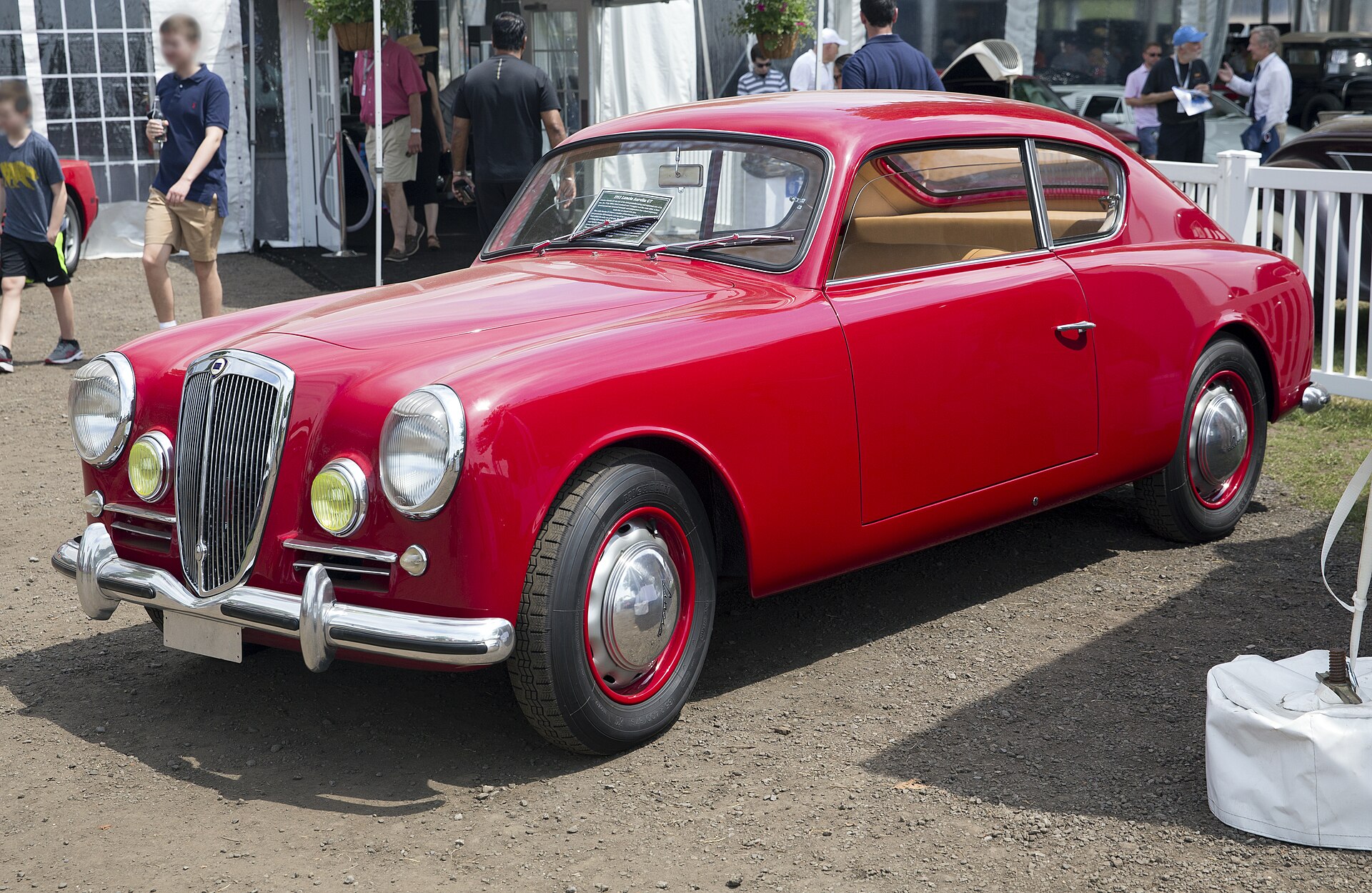
- Aurelia B20 GT and B24 1951–1958 · Coupe, Convertible · 55–82 kW (75–111 PS)
Newest first · 2 generations since 1950
- 1951 B20 GT and B24 1951–1958 · Coupe, Convertible · 55–82 kW (75–111 PS) saloon B10-B22 and B20 GT and B24 overlapped in 1951–1955
- 1950 saloon B10-B22 1950–1955 · Sedan · 41–66 kW (56–90 PS)
All generations by year: Aurelia B20 GT and B24 (1951–1958) · Aurelia saloon B10-B22 (1950–1955)
Which one is mine?
Pick the year of first registration to see which generation it is.
- Aurelia B20 GT and B24 1951–1958
- Aurelia saloon B10-B22 1950–1955
The Lancia Aurelia is the saloon, coupé and spider range that Lancia built in Turin from 1950 to 1958, powered by the first V6 engine in series production. Vittorio Jano's team paired the all-alloy V6 of 1.8 to 2.5 litres with a rear transaxle and inboard brakes. Only 18,201 were made, and the B20 coupé won its class at Le Mans and the 1954 Monte Carlo Rally.
In short
- B10 saloon shown at the Turin Motor Show in May 1950; the last B20 and B24 cars were built in the second half of 1958.
- V6 engines of 1,754, 1,991, 2,266 and 2,451 cc with 41-82 kW (56-112 PS).
- 18,201 built in six series, including 3,871 B20 coupés and 761 B24 spiders and convertibles.
- Transaxle, inboard rear drum brakes and, from 1954, a de Dion rear axle; Wikipedia credits it as the first car on radial tyres as standard.
Size at a glance
| Dimensions | Lancia Aurelia B20 GT and B24 |
|---|---|
| Length | 4,370 mm172.0 in |
| Width | 1,540 mm60.6 in |
| Height | 1,400 mm55.1 in |
| Wheelbase | 2,660 mm104.7 in |
Running cost
Fuel · Aurelia B20 GT 2.5 (sixth series)
about 3,400 EUR fuel a year at 15,000 km
13.0 l/100 km · petrol at 1.75 EUR/l · change mileage, fuel price or version
Specs by version
Engines
| Version | Engine | Power | Gearbox | Drive | Production years |
|---|---|---|---|---|---|
| Aurelia saloon B10-B22 · B10 1.8 V6 | 1.8 l · 6 cyl · Petrol 1,754 cc | 41 kW 56 PS55 hp | 4-sp Manual | Rear-wheel drive | 1950 |
| Aurelia saloon B10-B22 · B22 2.0 V6 | 2.0 l · 6 cyl · Petrol 1,991 cc | 66 kW 90 PS89 hp | 4-sp Manual | Rear-wheel drive | 1952 |
| Aurelia B20 GT and B24 · B20 GT 2.0 | 2.0 l · 6 cyl · Petrol 1,991 cc | 55 kW 75 PS74 hp | 4-sp Manual | Rear-wheel drive | 1951–1953 |
| Aurelia B20 GT and B24 · B20 GT 2.5 (sixth series) | 2.5 l · 6 cyl · Petrol 2,451 cc | 82 kW 111 PS110 hp | 4-sp Manual | Rear-wheel drive | 1957–1958 |
| Aurelia B20 GT and B24 · B24 Convertible 2.5 | 2.5 l · 6 cyl · Petrol 2,451 cc | 82 kW 111 PS110 hp | 4-sp Manual | Rear-wheel drive | 1956–1958 |
Performance
Show all 2 versions
| Version | 0–100 km/h | Top speed | Fuel consumption |
|---|---|---|---|
| Aurelia saloon B10-B22 · B10 1.8 V6 | - | 135 km/h84 mph | 10.5 l/100 km22.4 mpg US · 26.9 mpg UK |
| Aurelia B20 GT and B24 · B20 GT 2.5 (sixth series) | 14.8 s 0–62 mph | 180 km/h112 mph | 13.0 l/100 km18.1 mpg US · 21.7 mpg UK |
Dimensions and weight
Show all 1 versions
| Version | Length | Width | Height | Wheelbase | Kerb weight |
|---|---|---|---|---|---|
| Aurelia B20 GT and B24 · B20 GT 2.5 (sixth series) | 4,370 mm172.0 in | 1,540 mm60.6 in | 1,400 mm55.1 in | 2,660 mm104.7 in | 1,050 kg2,315 lb |
Verified Manufacturer and type-approval data from our catalog · Sources and methodology
Lancia Aurelia at a glance
| Specification | Lancia Aurelia |
|---|---|
| Years | May 1950 to 1958; on the price list until May 1959 |
| Production total | 18,201 (15,468 registered in Italy, 2,733 exported) |
| Plant | Lancia, Turin |
| Body styles | B10/B21/B22/B12 saloon, B15 limousine, B20 coupé, B24 spider and convertible, bare chassis for coachbuilders |
| Design | Vittorio Jano (technical director), Francesco De Virgilio (V6); B20 by Felice Mario Boano at Ghia, built by Pinin Farina; B24 by Pinin Farina |
| Layout | front engine, rear transaxle, rear-wheel drive, sliding-pillar front suspension |
| Engines | 60-degree pushrod V6 of 1,754 to 2,451 cc |
| Power | 41 kW (56 PS) B10 to 82 kW (112 PS) B20 sixth series |
| Kerb weight | 1,050-1,215 kg |
| Top speed | about 135 km/h (B10) to about 180 km/h (B20 2.5) |
| 0-100 km/h | 14.8 s (B20 GT sixth series, Auto Bild) |
| Price new | DM 28,700 for a B20 GT in Germany in 1957 |
Why Lancia built the Aurelia after the war
When Gianni Lancia became general director in 1948, the company was working on a rear-engined prototype called the A10. He cancelled it as too costly and asked for a new car with the classic Lancia layout. Vittorio Jano, who had designed Alfa Romeo's pre-war racing cars, took charge of the technical side. Francesco De Virgilio, a young engineer who had married Rita Lancia in 1947, had joined Lancia in 1943 and proposed a V6. Experimental engines of 1,569 cc ran from 1946 to 1948.
The name came from the Via Aurelia, the Roman road from Rome to Pisa. The B10 saloon appeared at the Turin Motor Show, which opened on 4 May 1950. Like the Lancia Lambda of 1922, it had a load-bearing body and sliding-pillar front suspension, and it kept Lancia's habit of putting engineering ahead of cost.
Aurelia V6 engine, transaxle and specs by series
The engine was a 60-degree V6 in aluminium alloy, with a single central camshaft, pushrods, hemispherical combustion chambers and, on most versions, one Solex or Weber carburettor. The B10 had 1,754 cc and 41 kW (56 PS), enough for about 135 km/h. Behind it the clutch, four-speed gearbox and differential were combined in a transaxle at the rear, with drum brakes mounted inboard next to it. The rear suspension used semi-trailing arms until the fourth series of 1954 changed to a de Dion tube.
| Series | Year | Main models | Displacement | Power |
|---|---|---|---|---|
| 1 | 1950-1951 | B10, B21, B20 | 1,754 / 1,991 cc | 41-55 kW (56-75 PS) |
| 2 | 1952 | B22, B20 | 1,991 cc | 59-66 kW (80-90 PS) |
| 3 | 1953 | B20, B12 | 2,451 / 2,266 cc | - |
| 4 | 1954-1955 | B20, B24 Spider | 2,451 cc | - |
| 5 | 1956 | B20, B24 convertible | 2,451 cc | - |
| 6 | 1957-1958 | B20, B24 convertible | 2,451 cc | 82 kW (112 PS) |
Outputs for the third to fifth series are not given consistently in the sources used here. The sixth series had less peak power than some earlier 2.5-litre cars but more torque, 172 Nm at 3,500 rpm according to Auto Bild.
Aurelia B20 GT and B24 Spider versions
The B20 coupé of 1951 put the saloon's mechanicals into a shorter, lighter two-door body designed by Felice Mario Boano at Ghia and built by Pinin Farina. With 55 kW (75 PS) from the 2.0-litre V6 and later 59 kW (80 PS), it was built for fast long-distance touring. Lancia built 1,231 B20s with the 2.0-litre engine and 2,640 with the 2.5. Auto Bild notes that a B20 cost DM 28,700 in Germany in 1957, only a few hundred marks less than a Mercedes-Benz 300 SL.
The B24 Spider of 1954-1955, with its wraparound windscreen, had a 2,450 mm wheelbase; 240 were built, 181 with left-hand drive and 59 with right-hand drive. The B24 convertible of 1956-1958 added wind-up windows and a proper hood, and 521 were made. A 1958 convertible starred in Dino Risi's 1962 film Il Sorpasso.


Aurelia racing at the Mille Miglia, Le Mans and Monte Carlo
Racing made the B20's reputation within months. Giovanni Bracco and Umberto Maglioli finished second overall on the 1951 Mille Miglia in a 2.0-litre Aurelia, behind a Ferrari 340 America. The same year an Aurelia won its class at Le Mans and finished 12th overall. Modified cars took the first three places on the 1952 Targa Florio, with Felice Bonetto winning, and an Aurelia won the Liège-Rome-Liège rally in 1953. Louis Chiron and Ciro Basadonna won the 1954 Monte Carlo Rally in a B20.
How the Flaminia replaced the Aurelia in 1958
Racing and engineering cost money Lancia did not have. Auto Bild records that Gianni Lancia had to sell half the company to the cement industrialist Carlo Pesenti, who then removed him; Italian Wikipedia dates the takeover to 1956. The Flaminia, developed as the new flagship, replaced the saloon from 1957. The last B20 and B24 cars left the factory in the second half of 1958, after 18,201 Aurelias in total. Annual output had peaked at 4,723 in 1951. The company's story before and after is told in the history of Lancia, and the later narrow-angle V4 coupé was the Lancia Fulvia.
Lancia Aurelia today: values and what to check when buying
Every Aurelia was partly hand-built, and Auto Bild warns that parts from one car often do not fit another. Classic Car Passion lists rust in the footwells, wheel arches, bulkhead, sills, rear suspension turrets, rear wings and boot lid edge on cars that have not been rebuilt.
The alloy V6 is durable only with the correct coolant; wrong antifreeze and hard water have damaged many engines. Watch for overheating, head gasket failure and wet cylinder liners that have sunk. The sliding-pillar front suspension needs its oil reservoir kept full, and tired systems need a specialist rebuild. Gearboxes were revised through the first four series, and later units are stronger. Service parts are available, mostly from Italy, while trim is scarce. Auto Bild rates the fourth series, with the de Dion axle, and the mature sixth series as the most sought after.
Auto Bild reported B20 coupés at EUR 100,000 and more in November 2013, with the best near EUR 200,000. In 2023 an unrestored B24 Spider America sold as a barn find for EUR 540,000, while Gooding & Company sold a restored 1955 Spider for USD 1,815,000 in 2014, about EUR 1.35 million at the exchange rate then. Lancia's other models are in the Lancia catalogue.
Photo gallery

Lancia Aurelia: first vs latest generation
| Spec | Aurelia saloon B10-B22 | Aurelia B20 GT and B24 | Change |
|---|---|---|---|
| Years | 1950–1955 | 1951–1958 | 1 years apart |
| Most powerful version | 66 kW (90 PS) | 82 kW (111 PS) | +16 kW (+24%) |
| Top speed | 135 km/h | 180 km/h | +45 km/h |
Oldest and newest generation in the 1cars catalog. Power is the strongest version of each; other rows are shown only when both generations have the figure.
Lancia Aurelia in our rankings
- No. 63 of 535 · Lightest cars (1,050 kg · top 13%)
- No. 18 of 118 · Lightest coupes (1,050 kg · top 16%)
- No. 35 of 127 · Smallest coupes (4,370 mm · top 28%)
- No. 238 of 676 · Smallest cars (4,370 mm · top 36%)
- No. 21 of 47 · Longest convertibles and roadsters (4,370 mm · top 45%)
- No. 599 of 1278 · Longest-running car nameplates (8 years · top 52%)
Lighter than 87% of ranked cars in the 1CARS catalog (No. 63 of 535).
FAQ
Was the Lancia Aurelia the first car with a V6 engine?
Yes, the Aurelia had the first V6 in series production. Francesco De Virgilio developed the 60-degree engine under Vittorio Jano, and the B10 saloon went on sale in 1950 with 1,754 cc and 41 kW (56 PS).
How many Lancia Aurelias were built?
Lancia built 18,201 Aurelias from 1950 to 1958, according to English and Italian Wikipedia. The saloons account for most, while Lancia built 3,871 B20 coupés, 761 B24 spiders and convertibles and 783 bare chassis for coachbuilders.
What is the difference between the B24 Spider and the B24 convertible?
The Spider of 1954-1955 had a wraparound windscreen, side curtains and a light hood; 240 were built. The convertible of 1956-1958 had a conventional screen, wind-up windows and a better hood, and 521 were made. The Spider is the more valuable car.
How much is a Lancia Aurelia B20 GT worth?
Auto Bild put good B20 GT coupés at EUR 100,000 and more in November 2013, with the best near EUR 200,000. Spiders cost far more: a restored 1955 B24 Spider sold for USD 1,815,000 at Gooding & Company in 2014.
What replaced the Lancia Aurelia?
The Lancia Flaminia, introduced as a saloon in 1957, replaced the Aurelia saloon, and Flaminia coupés and convertibles took over from the B20 and B24 after the last Aurelias were built in 1958.
Data sources
Data checked by an editor against the sources below.
- Wikipedia - Lancia Aurelia
- Autobild - Lancia Aurelia B20 Gt 4412406


