 Lancia Lambda
Specs, engines and history
Published Sources (1) Report an error
By Felix Hartmann, Automotive Technology & EV Contributor
- Built
- 1922–1931
- Top power
- 51 kW (69 PS)
Which Lambda to choose
Our verdict · Felix Hartmann
- For the pure idea: a car of series 1 to 6 with the original self-supporting Torpedo body.
- For more power and four speeds: a series 7 or 8 car with the 2.4- or 2.6-litre engine.
- For coachwork: a series 7–9 chassis with a body by Casaro, Albany or another builder.
- For touring comfort: a long-wheelbase car or a Weymann Berlina of series 8 or 9.
Check which series a car belongs to and whether the body is original to it, because later chassis were bodied by many firms. Other Lancia models are listed in the Lancia catalogue, and more cars of the period appear in our classic cars section.
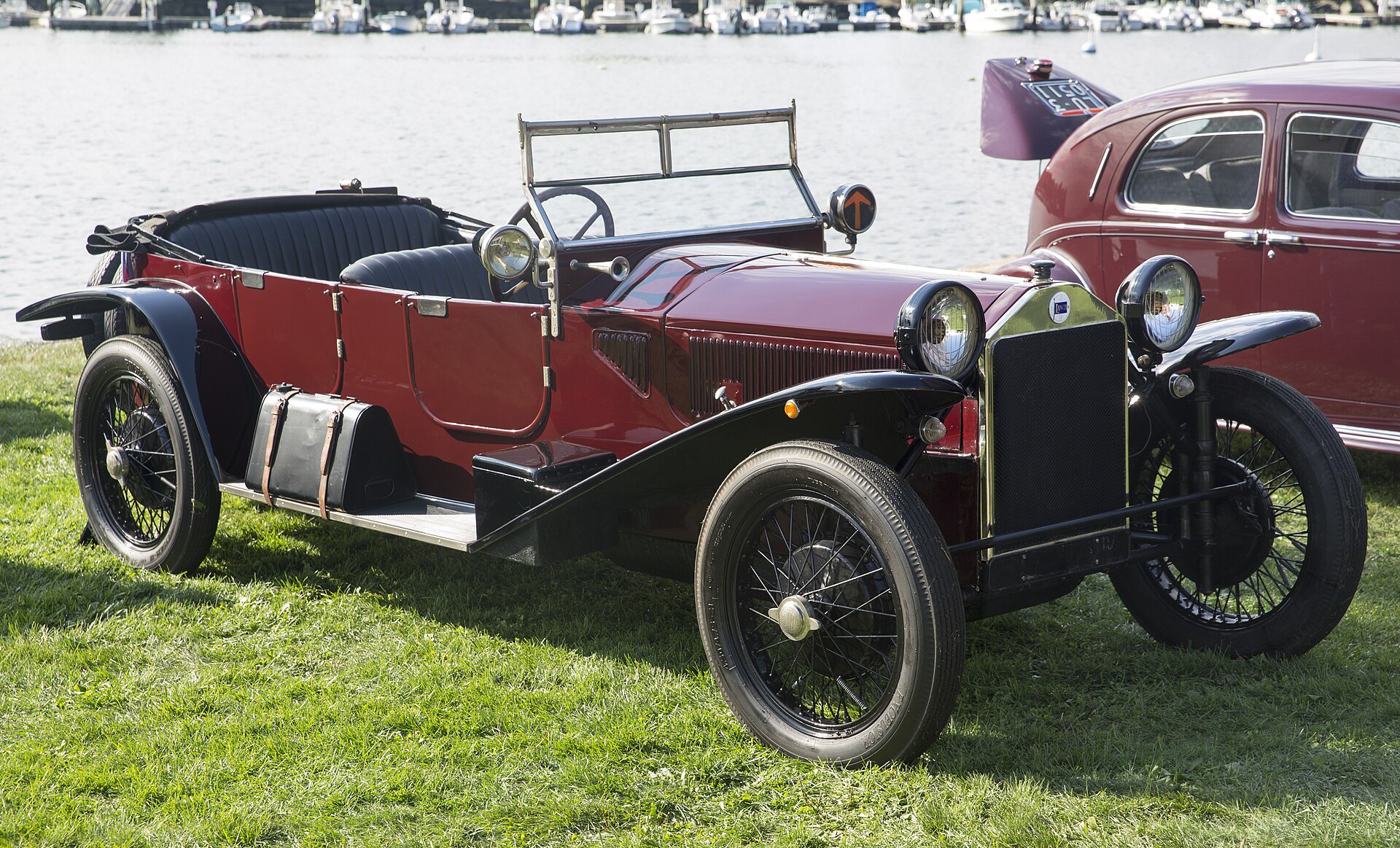
The Lancia Lambda was an Italian touring car built from 1922 to 1931, and it is claimed as the first car with a load-bearing unitary body. Vincenzo Lancia's company combined that body with independent front suspension by sliding pillars and a narrow-angle V4 engine, three ideas that were far ahead of most cars of the early 1920s. About 13,000 were built in nine series before the Artena took over.
In short
- Unveiled at the Paris motor show in 1922; built in nine series until 1931, about 13,000 cars in all.
- Self-supporting body without a stressed roof, sliding-pillar independent front suspension with coil springs.
- Narrow-angle V4 with a single overhead camshaft: 2.1 to 2.6 litres and 36 kW (49 PS) to 51 kW (69 PS).
- Four-wheel brakes; three-speed gearbox on the first four series, four speeds from the fifth.
Lancia Lambda at a glance
| Parameter | Metric | Imperial |
|---|---|---|
| Maker | Lancia | — |
| Production | 1922–1931 | — |
| Built | about 13,000 (English Wikipedia); over 10,000 (German Wikipedia) | — |
| Body | Torpedo (all series), Weymann Berlina (series 8 and 9) | — |
| Engine | narrow-angle V4, 13° to 14°, single overhead camshaft | — |
| Displacement | 2,121 cc, 2,375 cc, 2,569 cc | 129 / 145 / 157 cu in |
| Power | 36 kW (49 PS) to 51 kW (69 PS) at 3,250–3,500 rpm | — |
| Gearbox | three-speed (series 1–4), four-speed (series 5–9) | — |
| Front suspension | independent, sliding pillars and coil springs | — |
| Wheelbase | 3,100 mm; 3,420 mm long version (series 6–9) | 122.0 / 134.6 in |
| Kerb weight | 1,200–1,350 kg | 2,646–2,976 lb |
| Predecessor / successor | Lancia Kappa (1919) / Lancia Artena | — |
From patent to prototype
Italian Wikipedia traces the design to a patent that Vincenzo Lancia filed on 7 December 1918 and was granted on 28 March 1919, number 171922. Its drawings already showed a tapering body with a pointed tail and a round radiator. Pinin Farina later said that Lancia took the idea of the load-bearing body from the hull of a ship. The independent front suspension is said to have followed a broken front spring on a trip in the earlier Kappa.
Work on the car itself began in March 1921, when the engineer Battista Falchetto recalled the first meeting; he drew 14 suspension proposals for Lancia to choose from. The engineers Rocco and Cantarini designed the V4, and the head of experimental work, Scacchi, developed it. The first prototype was ready on 1 September 1921, and Lancia tested it with Luigi Gismondi on the road from Turin over the Mont Cenis pass. That car had no front brakes; they were added before production. The Lambda was shown at the Paris and London motor shows in autumn 1922, and deliveries began in mid-1923.
A body that carried the load
Instead of a separate frame carrying the body, the Lambda's body was itself the load-bearing structure. English Wikipedia describes it as the first car with a load-bearing unitary body, with the qualification that the roof did not carry loads, and German Wikipedia also calls it the first vehicle with a self-supporting body.
For series 1 to 6 this meant that the body could not be replaced by a coachbuilder's design. German Wikipedia notes that series 7 and 8 used a separate platform, which allowed individual bodies, and English Wikipedia lists the sixth and ninth series as sold as bare chassis. From then on specialist coachbuilders could work on the car.


Sliding-pillar front suspension
The second big idea was at the front. Each front wheel moved up and down on a vertical sliding pillar inside a tube, with a coil spring around it. German Wikipedia adds hydraulic shock absorbers at the front, and English Wikipedia credits Vincenzo Lancia with inventing a shock absorber for the car. The rear kept a rigid axle on leaf springs with mechanical friction dampers, and drive went to the rear wheels through a dry multi-plate clutch. All four wheels had brakes, which English Wikipedia describes as excellent.
The narrow-angle V4
The engine was a water-cooled V4 with an unusually narrow angle between the cylinder banks: 13° for the first engine, 14° for the second and 13° 40' for the third. Because the banks sat so close together, one cylinder head covered both, and a single overhead camshaft, driven by a vertical shaft, worked all the valves.
| Variant | Years | Body / purpose | Engine | Notes |
|---|---|---|---|---|
| Series 1–6 | 1923–1926 | Torpedo with self-supporting body | 2,121 cc, 36 kW (49 PS) at 3,250 rpm | bore 75 mm, stroke 120 mm |
| Series 7 | 1926–1928 | Torpedo; bodies by coachbuilders | 2,375 cc, 43 kW (59 PS) at 3,250 rpm | new, larger engine |
| Series 8 | 1928–1930 | Torpedo, Weymann Berlina | 2,569 cc, 51 kW (69 PS) at 3,500 rpm | the largest series, 3,903 cars |
| Series 9 | 1931 | bare chassis only | 2,569 cc, 51 kW (69 PS) | last series, 500 cars |
All three engines shared the 120 mm stroke and used a single carburettor; German Wikipedia gives a compression ratio of 4.8:1. English Wikipedia's infobox quotes 2,119, 2,370 and 2,568 cc, slightly different from the 2,121, 2,375 and 2,569 cc in its engine table. With 36 kW and 1,200 kg, an early car had about 30 kW per tonne; a series 8 with 51 kW and 1,350 kg reached about 38 kW per tonne. Our power-to-weight calculator makes the same comparison for other cars.
Performance improved with each engine. Italian Wikipedia gives a top speed of under 110 km/h for series 1 to 4 and about 115 km/h for series 5 and 6. Series 7 came close to 120 km/h, and series 8 and 9 close to 125 km/h. Fuel use rose from 12–13 l/100 km for the early cars to 14–15 l/100 km for the larger engines, from a 68-litre tank. The same source gives the engine an aluminium block with cast-iron liners and a compression ratio of 5.0:1 to 5.15:1, slightly higher than the 4.8:1 quoted in German Wikipedia.

Nine series, 1922–1931
| Year | Event |
|---|---|
| 1922 | Lambda unveiled at the Paris motor show |
| 1923 | 1st series, 400 cars; 2nd series begins (1,100 cars to 1924) |
| 1924 | 3rd series, 800 cars, with a modified engine |
| 1924–1925 | 4th series, 850 cars, new windscreen |
| 1925 | 5th series, 1,050 cars, four-speed gearbox |
| 1925–1926 | 6th series, 1,300 cars, sold as a bare chassis on two wheelbases |
| 1926–1928 | 7th series, 3,100 cars, 2.4-litre engine |
| 1928–1930 | 8th series, 3,903 cars, 2.6-litre engine |
| 1931 | 9th series, 500 cars, bare chassis only |
The series figures in English Wikipedia add up to 13,003 cars, which matches its total of about 13,000. The eighth series was the largest, and the seventh and eighth together account for more than half of all Lambdas.
Mille Miglia results
The Lambda was a strong class car in Italy's thousand-mile road race. Italian Wikipedia records that ten Lambdas started the first Mille Miglia on 26–27 March 1927 and seven finished. Strazza and Varallo were fourth overall and Pugno and Bergia fifth, the top two places in the 2–3 litre class. For 1928 the works team used three Casaro spiders with engines said to give over 59 kW (80 hp). Gismondi and Valsania ran second for much of the race before retiring, and Strazza finished third overall and won his class. In 1929 Strazza and Varallo were fourth overall and class winners again.
Coachwork in Italy and Britain
Once the platform allowed separate bodies, coachbuilders produced a wide variety. German Wikipedia names Casaro for special bodies in Italy, and Albany and Curtis in London for the British market, where Curtis was also the Lancia importer. Albany made some fabric-covered bodies on the Weymann principle. Its Airway Saloon of 1927, styled like an aircraft, is among the most unusual Lambda bodies. The factory's own Berlina used the Weymann method in series 8 and 9.
After the larger Lancia Dilambda arrived, the Lambda was sold at a lower price beneath it. The Artena, shown at the Paris motor show in October 1931, replaced it. Italian Wikipedia adds that exports took more than 40% of output between 1926 and 1930. The marque's later engineering firsts and rally titles are covered in our history of Lancia.

Photo gallery

Lancia Lambda in our rankings
- No. 391 of 912 · Longest-running car nameplates (9 years · top 49%)
- No. 829 of 859 · Most powerful cars (51 kW · top 97%)
- No. 124 of 127 · Most powerful Italian cars (51 kW · top 98%)
In production longer than 51% of ranked nameplates in the 1CARS catalog (No. 391 of 912).
FAQ
Why is the Lancia Lambda important?
Its self-supporting body is regarded as a first, and it pioneered independent front suspension with sliding pillars and coil springs.
How many Lancia Lambda were built?
About 13,000 in nine series between 1922 and 1931, according to English Wikipedia; German Wikipedia says more than 10,000.
What engine did the Lancia Lambda have?
A narrow-angle V4 with a single overhead camshaft: 2,121 cc and 36 kW (49 PS) at first, later 2,375 cc and 43 kW, and finally 2,569 cc and 51 kW (69 PS).
What gearbox did the Lambda use?
A three-speed manual on series 1 to 4 and a four-speed manual from series 5.
What replaced the Lancia Lambda?
The Lancia Artena.
Data sources
Data checked by an editor against the sources below.