
 Lancia Beta
All generations, specs and history
Published Sources (1) Report an error
By Oleksandr Hnatiuk, Automotive Editor & Used Car Specialist
- Built
- 1972–1984
- Generations
- 2
- Top power
- 99 kW (135 PS)
Timeline
Beta generations
Click a generation for its own page
- Beta Series 1 1972–1975 · Sedan, Coupe · 60–88 kW (82–120 PS)
- Beta Series 2 1975–1984 · Sedan, Station wagon · 63–99 kW (86–135 PS)
Newest first · 2 generations since 1972
- 1975 Series 2 1975–1984 · Sedan, Station wagon · 63–99 kW (86–135 PS)
- 1972 Series 1 1972–1975 · Sedan, Coupe · 60–88 kW (82–120 PS)
All generations by year: Beta Series 2 (1975–1984) · Beta Series 1 (1972–1975)
Which one is mine?
Pick the year of first registration to see which generation it is.
- Beta Series 2 1975–1984
- Beta Series 1 1972–1975
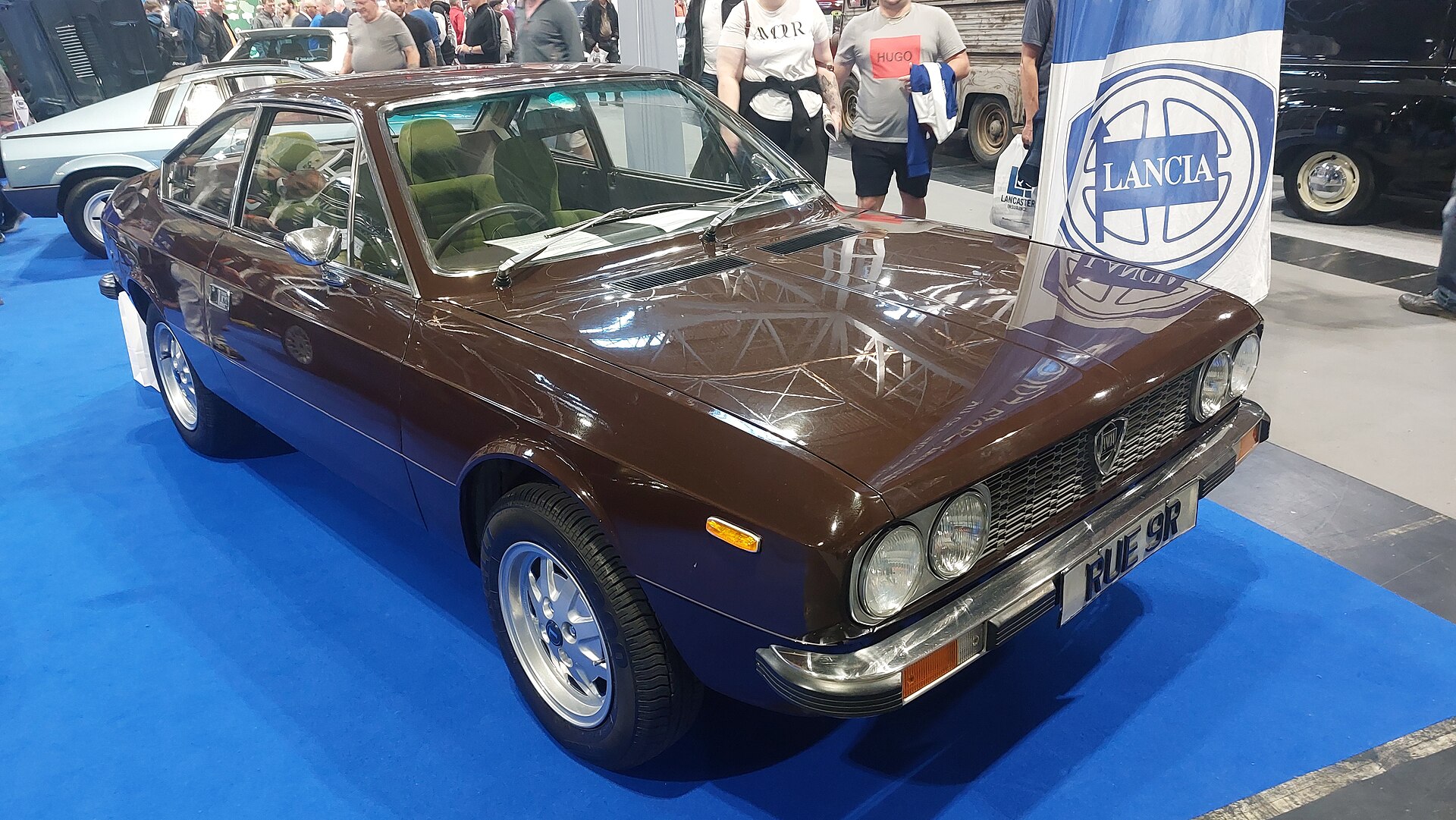
The Lancia Beta is the front-wheel-drive range that Lancia built from 1972 to 1984, the first new Lancia developed after Fiat bought the company in 1969. It came as the Berlina fastback saloon, Coupé, Spider, HPE estate and Trevi saloon, with the mid-engined Montecarlo alongside, all with Fiat-derived twin-cam engines. In Britain the name is still tied to the rust scandal of 1980.
In short
- Built 1972-1984 in Turin, with bodies also from Pininfarina (Grugliasco), Zagato (Milan) and, for 1979-1980, SEAT in Pamplona.
- Twin-cam four-cylinders from 1.3 to 2.0 litres, from 60 kW (82 PS) up to 99 kW (135 PS) in the supercharged Volumex.
- Every front-drive Beta had a five-speed manual gearbox, four disc brakes and MacPherson struts at both ends.
- By 10 April 1980 Lancia had bought back 504 corroded Betas in the UK, at a cost of about GBP 1 million.
Specs by version
| Version | Engine | Power | Gearbox | Drive | Production years |
|---|---|---|---|---|---|
| Beta Series 1 · 1400 | 1.4 l · 4 cyl · Petrol 1,438 cc | 66 kW 90 PS89 hp | 5-sp Manual | Front-wheel drive | 1972–1974 |
| Beta Series 1 · 1600 | 1.6 l · 4 cyl · Petrol 1,592 cc | 74 kW 101 PS99 hp | 5-sp Manual | Front-wheel drive | 1972–1975 |
| Beta Series 1 · 1800 | 1.8 l · 4 cyl · Petrol 1,756 cc | 81 kW 110 PS109 hp | 5-sp Manual | Front-wheel drive | 1972–1975 |
| Beta Series 2 · 1600 | 1.6 l · 4 cyl · Petrol 1,585 cc | 74 kW 101 PS99 hp | 5-sp Manual | Front-wheel drive | 1975–1984 |
| Beta Series 2 · 2000 | 2.0 l · 4 cyl · Petrol 1,995 cc | 88 kW 120 PS118 hp | 5-sp Manual | Front-wheel drive | 1975–1984 |
| Beta Series 2 · 2000 i.e. | 2.0 l · 4 cyl · Petrol 1,995 cc | 90 kW 122 PS121 hp | 5-sp Manual | Front-wheel drive | 1980–1984 |
| Beta Series 2 · 2000 VX Volumex | 2.0 l · 4 cyl · Petrol 1,995 cc | 99 kW 135 PS133 hp | 5-sp Manual | Front-wheel drive | 1982–1984 |
Verified Manufacturer and type-approval data from our catalog · Sources and methodology
Lancia Beta at a glance
| Item | Lancia Beta |
|---|---|
| Years | 1972-1984 (Berlina to 1981, Trevi 1980-1984, Montecarlo 1975-1978 and 1980-1981) |
| Production | Berlina 194,914; Coupé 111,801; HPE 73,626; Trevi 36,784; Spider 9,390; Montecarlo 7,798 (Wikipedia EN; figures vary between sources) |
| Plants | Turin (Lancia), Grugliasco (Pininfarina), Milan (Zagato, Spider), Pamplona (SEAT, Coupé and HPE) |
| Body styles | 4-door fastback saloon, 2+2 coupé, targa Spider, 3-door HPE estate, notchback Trevi, mid-engined Montecarlo |
| Design | Centro Stile Fiat (Berlina); Centro Stile Lancia under Aldo Castagno (Coupé); Pininfarina (HPE, Spider, Montecarlo) |
| Layout | transverse engine tilted 20 degrees rearwards on a subframe, front-wheel drive (Montecarlo: mid-engine, rear-wheel drive) |
| Engines | Fiat-derived DOHC inline-fours, 1,297 to 1,995 cc |
| Power | 60 kW (82 PS) to 99 kW (135 PS) |
| Kerb weight | 1,000-1,195 kg |
| Top speed | 163-200 km/h (101-124 mph) for Coupé, HPE and Spider |
| 0-60 mph | 12.3 to 8.9 s for Coupé, HPE and Spider (Classic & Sports Car); Montecarlo 0-100 km/h 9.3 s (Lancia claim) |
| Price new | GBP 1,594 (1400) to GBP 1,989 (1800) in the UK in 1973; GBP 7,046 for an HPE 2000 in 1979 |
Why Fiat needed the Beta
Fiat took over Lancia in 1969, paying a nominal one lira per share, and the Beta was the first car developed under the new owner. It replaced the Fulvia and had to use Fiat's Lampredi-designed twin-cam engine, which Ettore Zaccone Mina adapted for Lancia, while Citroën developed the five-speed gearbox. The Berlina was introduced in October 1972 and reached British showrooms in 1973 at GBP 1,594.45 for the 1400, GBP 1,798.22 for the 1600 and GBP 1,988.88 for the 1800.
The plan worked commercially. By 1976 the Beta was Lancia's best-selling car, and in the late 1970s Lancia outsold BMW, Audi and Saab in the UK. Britain was Lancia's largest export market, with 11,800 sales in 1978. The wider story of the marque, from the Lambda to the Delta, is told in our Lancia history, and the parent company's side in our history of Fiat.
Engineering under the fastback
The Berlina weighed 1,100 kg at launch. Its engine sat transversely, tilted 20 degrees rearwards and carried on a subframe, driving the front wheels. MacPherson struts were used front and rear, and Lancia never patented the rear design. Disc brakes were fitted on all four wheels, with rack-and-pinion steering and ZF power assistance on some left-hand-drive cars, and on right-hand-drive cars from 1981.
The range was updated steadily. Electronic ignition arrived in 1978, along with an automatic gearbox, the first factory automatic offered on a Lancia. Bosch electronic fuel injection followed on the 2.0 in 1981, and the Volumex supercharged 2.0 appeared in 1982.
| Engine | Years | Displacement | Power |
|---|---|---|---|
| 1400 | 1972-1974 | 1,438 cc | 66 kW (90 PS) |
| 1600 | 1972-1975 | 1,592 cc | 74-79 kW (100-108 PS) |
| 1800 | 1972-1975 | 1,756 cc | 81-88 kW (110-120 PS) |
| 1300 | 1974-1975 | 1,297 cc | 60 kW (82 PS) |
| 1300 | 1976-1979 | 1,301 cc | 63 kW (85 PS) |
| 1600 | 1975-1984 | 1,585 cc | 74 kW (100 PS) |
| 2000 | 1975-1984 | 1,995 cc | 88 kW (119 PS) |
| 2000 i.e. (injection) | 1980-1984 | 1,995 cc | 90 kW (122 PS) |
| 2000 VX (supercharged) | 1982-1984 | 1,995 cc | 99 kW (135 PS) |
Coupé, Spider, HPE and Trevi
The Coupé was launched in 1973 and reached customers early in 1974. Its body came from Lancia's own studio under Aldo Castagno, with Piero Castagnero as styling consultant, and it became the second most common Beta with 111,801 built. The Spider, a targa with a folding rear section, was designed by Pininfarina and built by Zagato from 1975; American buyers knew it as the Zagato.
The HPE (High Performance Estate) arrived in March 1975. It combined the Coupé's front end with the Berlina's longer wheelbase and a three-door estate rear, and from 1979 it dropped the Beta name. A June 1983 update brought a minor facelift and the VX, of which 2,370 were made, 186 of them with right-hand drive. The Trevi, a notchback saloon shown in Turin in May 1980, took over from the Berlina. Its Mario Bellini dashboard was widely criticised by the press of the time.
Montecarlo and the racing link
The Montecarlo grew out of a Pininfarina mid-engined project first planned with a 3.0 V6 and finally given the Beta's 2.0 twin-cam with 88 kW (120 PS). Lancia claimed more than 190 km/h. The first series of 1975-1978 had a brake servo acting only on the front wheels, which locked easily in the wet, so production stopped. A revised second series without the Beta prefix ran in 1980-1981. In the US, 1,805 cars were sold as the Scorpion with a 1,756 cc engine of 60 kW (81 hp).
The car mattered more on track. The Group 5 Montecarlo Turbo won the 1980 World Championship for Makes outright and the 1981 World Endurance Championship for Makes, and the 037 rally car kept the Montecarlo's centre section. That car followed the Lancia Stratos as the brand's rally weapon and won the 1983 manufacturers' title.

The 1980 rust scandal
On 9 April 1980 the Daily Mirror ran a front page headed "Luxury Cars in Rust Riddle", and ITV and the BBC programme That's Life followed. Lancia had been quietly recalling cars for eight to nine months; by 10 April it had bought back 504 Betas, at a cost of about GBP 1 million. Owners were first offered a discount on another Beta, then a cheap Fiat, and finally cash.
Most affected cars were built in 1974-1975. The weak point was the rear box section of the front subframe, which carried the drivetrain mountings, collected rainwater and had no drain holes. Heavy rot could let the engine and gearbox drop about 76 mm at the rear, until the cylinder head caught on the bulkhead. The often-repeated story about Soviet steel is unverified; poor paint preparation, bare shells stored outdoors and road salt are more likely causes. Lancia revised the crossmember from a U-section to an n-section, the last condemned cars were crushed by late 1983, and UK sales fell to 569 by 1993, when Fiat ended right-hand-drive production.
Lancia Beta today: what to check when buying
Start underneath. Classic & Sports Car lists the front subframes, especially the mounting box, and the rear suspension mounts as the first checks; Octane adds cracked underseal, wheel arches, door bottoms and, on the HPE, the tailgate and strut mountings. Panels are scarce, although the specialist BetaBoyz remanufactures many of them.
Mechanically the twin-cam is durable if serviced. The cambelt needs changing every three years or 36,000 miles (58,000 km), and corrosion inhibitor in the coolant protects the alloy head and gasket. On a Volumex, look for oil smoke, bearing noise and the supercharger's oil level. Carburettor spindles wear, while the Bosch injection is reliable. The gearbox fails if it leaks its oil; a vague change is usually linkage wear, fixed with an inexpensive kit. Seized rear calipers and handbrakes are common, and good switchgear is hard to find.
| Model | Price guide | Source and date |
|---|---|---|
| Coupé | about EUR 8,900 (GBP 7,500) average; about EUR 23,600 (GBP 20,000) show car | Classic & Sports Car, July 2022 |
| HPE | about EUR 7,100 (GBP 6,000) average; about EUR 21,200 (GBP 18,000) show car | Classic & Sports Car, July 2022 |
| Spider | about EUR 26,000 (GBP 22,000) show car | Classic & Sports Car, July 2022 |
| HPE, right-hand drive | about EUR 4,800-14,300 (GBP 4,000-12,000); Volumex above EUR 17,900 (GBP 15,000) | Octane, October 2024 |
Classic & Sports Car bases its figures on 2000 models and adds about 50% for VX cars. More cars of the period are collected in our classic cars section, and every Lancia we list is in the Lancia catalogue.
Photo gallery

Lancia Beta: first vs latest generation
| Spec | Beta Series 1 | Beta Series 2 | Change |
|---|---|---|---|
| Years | 1972–1975 | 1975–1984 | 3 years apart |
| Most powerful version | 88 kW (120 PS) | 99 kW (135 PS) | +11 kW (+13%) |
Oldest and newest generation in the 1cars catalog. Power is the strongest version of each; other rows are shown only when both generations have the figure.
Lancia Beta in our rankings
- No. 354 of 1130 · Longest-running car nameplates (12 years · top 35%)
- No. 489 of 685 · Biggest engines: cars (1,995 cc · top 72%)
- No. 124 of 161 · Biggest engines: sedans (1,756 cc · top 78%)
- No. 62 of 79 · Most powerful cars of the 1980s (99 kW · top 79%)
- No. 154 of 192 · Most powerful sedans (81 kW · top 81%)
- No. 888 of 1063 · Most powerful cars (99 kW · top 84%)
In production longer than 65% of ranked nameplates in the 1CARS catalog (No. 354 of 1130).
FAQ
How many Lancia Betas were built?
Wikipedia's figures add up to roughly 434,000 cars: 194,914 Berlinas, 111,801 Coupés, 73,626 HPEs, 36,784 Trevis, 9,390 Spiders and 7,798 Montecarlos. Some sources differ for the HPE and Trevi, so treat the total as approximate.
Why did the Lancia Beta rust so badly?
Early cars, mostly built in 1974-1975, had a front subframe box section that trapped water without drain holes. Poor paint preparation and outdoor storage of bare shells made it worse, and in 1980 Lancia bought back affected cars in the UK.
What is the most powerful Lancia Beta?
The Volumex models of 1982-1984, with a Roots-type supercharger on the 2.0 twin-cam, rated at 99 kW (135 PS). Lancia built 1,272 Coupé VX, 2,370 HPE VX and about 3,900 Trevi VX cars.
Is the Montecarlo a Beta?
Yes, at first. The 1975-1978 first series was sold as the Lancia Beta Montecarlo; the revised 1980-1981 second series dropped the Beta prefix. It used the Beta's 2.0 engine mounted behind the seats, driving the rear wheels.
Data sources
Data checked by an editor against the sources below.
- Wikipedia - Lancia Beta


