 Lancia Thema
All generations, specs and history
Published Sources (1) Report an error
By Felix Hartmann, Automotive Technology & EV Contributor
- Built
- 1984–1994
- Generations
- 3
- Top power
- 158 kW (215 PS)
Timeline
Thema generations
Click a generation for its own page
- Thema Series 1 1984–1988 · Sedan, Station wagon · 74–158 kW (101–215 PS)
- Thema Series 2 1988–1992 · Sedan, Station wagon · 151 kW (205 PS)
- Thema Series 3 1992–1994 · Sedan, Station wagon · 151 kW (205 PS)
Newest first · 3 generations since 1984
- 1992 Series 3 1992–1994 · Sedan, Station wagon · 151 kW (205 PS)
- 1988 Series 2 1988–1992 · Sedan, Station wagon · 151 kW (205 PS)
- 1984 Series 1 1984–1988 · Sedan, Station wagon · 74–158 kW (101–215 PS)
All generations by year: Thema Series 3 (1992–1994) · Thema Series 2 (1988–1992) · Thema Series 1 (1984–1988)
Which one is mine?
Pick the year of first registration to see which generation it is.
- Thema Series 3 1992–1994
- Thema Series 2 1988–1992
- Thema Series 1 1984–1988
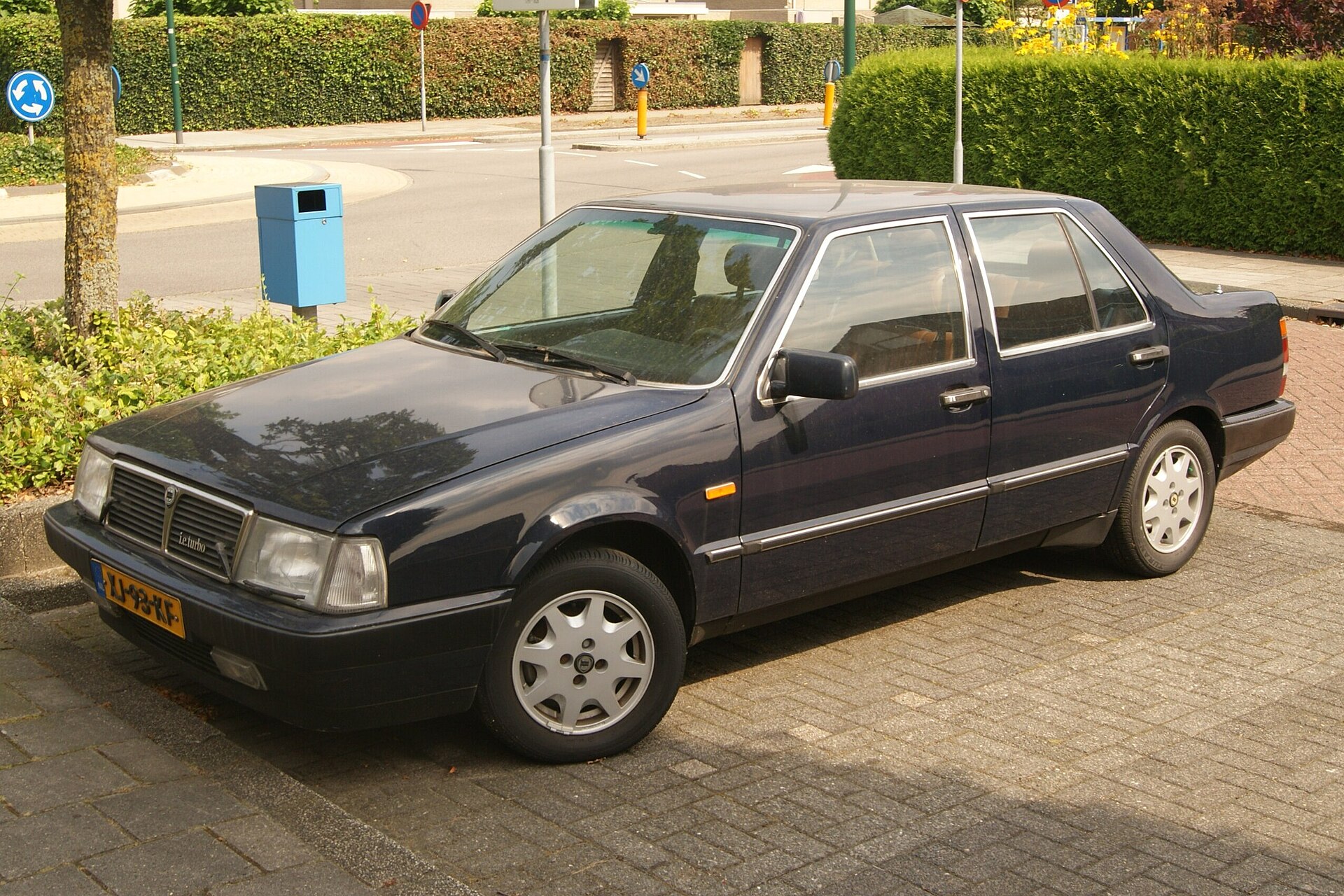
The Lancia Thema (Type 834) was Lancia's executive saloon and estate from 1984 to 1994, built in Turin and styled by Giorgetto Giugiaro's Italdesign. It was one of four cars from the joint "Type Four" project with Fiat, Alfa Romeo and Saab, and it became the best-known member of that family thanks to the Thema 8.32, which used a Ferrari V8. More than 336,000 saloons were built according to Wikipedia, and the Italian edition gives a total of more than 370,000 cars including estates.
In short
- Front-wheel-drive executive car (E-segment), four-door saloon and Pininfarina-built estate, 1984-1994.
- Three series: 1984-1988, 1988-1992 and 1992-1994, with engines from a 2.5 turbodiesel to a 2.9 Ferrari V8.
- Power from 74 kW (100 PS) for the first turbodiesel to 158 kW (215 PS) for the uncatalysed 8.32.
- Replaced by the Lancia Kappa; the name returned from 2011 to 2014 on a rebadged Chrysler 300.
Lancia Thema at a glance: maker, production years (1984-1994), purpose
| Specification | Lancia Thema (Type 834) |
|---|---|
| Maker | Lancia (Fiat group) |
| Production | 1984-1994 |
| Plants | Mirafiori, Turin; 8.32 and Limousine at Borgo San Paolo, Turin; estate by Pininfarina, Grugliasco |
| Segment | Executive car (E-segment) |
| Body styles | Four-door saloon; five-door estate (Station Wagon, from 1986) |
| Platform | Type Four, front engine, front-wheel drive |
| Design | Italdesign (Giorgetto Giugiaro) saloon; Pininfarina estate |
| Drag coefficient | Cd 0.32 |
| Power range | 74-158 kW (100-215 PS) |
| Successor | Lancia Kappa (1994) |
The Thema replaced the Lancia Gamma as the brand's flagship. It is one of the most important Lancias of the 1980s, alongside the Delta, and you can find its stablemates in our Lancia catalogue.
Development and production history
Lancia announced the Thema in May 1984, presented it to the press in Vienna in October 1984 and showed it to the public at the Turin Motor Show in November 1984. The car came from the Type Four programme, in which Fiat and Saab developed a common floorpan for large front-wheel-drive cars. Each brand gave its version its own body and its own engines.
| Series | Years | Main changes |
|---|---|---|
| Series 1 | 1984-1988 | Launch range: 2.0 i.e., 2.0 i.e. turbo, 2.8 V6 and turbodiesel; estate from 1986; 8.32 from 1986 |
| Series 2 | 1988-1992 | Shown in Paris in September 1988; 16-valve engines, horizontally split headlamps, wood interior trim |
| Series 3 | 1992-1994 | Shown in Paris in September 1992; new bumpers, Solextra tinted glass, Euro 1 engines, Alfa Romeo 3.0 V6 replaces the 2.8 PRV V6; trims base, LE, LS and LX |
Production ended late in 1994, when the Lancia Kappa took over. The Pininfarina estate was introduced in 1986 and built at Grugliasco; 21,074 were made between 1986 and 1994.

Design and engineering
Giugiaro gave the saloon a clean three-box shape with a drag coefficient of 0.32. Pininfarina designed and built the Station Wagon, which kept the saloon's front and added a long, square roof.
Under the skin the Thema used transverse front engines and front-wheel drive, like its Type Four relatives. The twin-cam four-cylinder engines descended from the design of former Ferrari engineer Aurelio Lampredi, while the original V6 was the 2.8-litre PRV unit also used by Peugeot, Renault and Volvo. According to the Italian Wikipedia, an automatic gearbox, a three-speed unit, was offered only on the first-series 2.8 V6.
Engine and drivetrain
| Engine | Power | Torque | 0-100 km/h | Top speed | Years |
|---|---|---|---|---|---|
| 2.0 8V | 88 kW (120 PS) | 170 Nm | 9.7 s | 195 km/h | 1985-1989 |
| 2.0 16V | 108 kW (147 PS) | 173 Nm | 10.4 s | 202 km/h | 1989-1992 |
| 2.0 16V | 114 kW (155 PS) | 181 Nm | 10.1 s | 205 km/h | 1992-1995 |
| 2.0 Turbo 8V | 121 kW (165 PS) | 290 Nm | 7.2 s | 210-218 km/h | 1985-1988 |
| 2.0 Turbo 16V | 132 kW (180 PS) | 270 Nm | 8.0 s | 222 km/h | 1989-1992 |
| 2.0 Turbo 16V | 151 kW (205 PS) | 304 Nm | 7.2 s | 230 km/h | 1992-1995 |
| 2.8 PRV V6 | 110 kW (150 PS) | 225-245 Nm | 8.2-8.4 s | 205-208 km/h | 1985-1992 |
| 3.0 Alfa Romeo V6 | 129 kW (175 PS) | 250 Nm | 8.1 s | 220 km/h | 1992-1995 |
| 2.4 turbodiesel | 74 kW (100 PS) | 217 Nm | 11.9 s | 185 km/h | 1985-1989 |
| 2.5 turbodiesel | 87 kW (118 PS) | 245 Nm | 11.0-11.5 s | 195 km/h | 1989-1995 |
| 2.9 V8 (8.32) | 158 kW (215 PS) | 285 Nm | 6.8 s | 240 km/h | 1986-1988 |
| 2.9 V8 (8.32, catalysed) | 151 kW (205 PS) | 263 Nm | 7.2 s | 235 km/h | 1989-1992 |
The years in the table are the engine years listed by Wikipedia and run slightly beyond the end of saloon production. Wikipedia also lists lower-output versions: a 2.0 8V with 85 kW (116 PS) for 1987-1989 and a 2.0 Turbo 8V with 110 kW (150 PS) for 1988-1989. The original turbodiesel had 2,445 cc, the later one 2,499 cc. The 2.0 Turbo 16V of the third series, with 151 kW (205 PS) and 304 Nm, was as quick to 100 km/h as the catalysed 8.32. Use our power converter to compare these outputs with modern cars.
Lancia Thema specifications
The sources do not give a complete set of standard saloon dimensions. The figures below come from the Limousine data (a wheelbase stretched by 300 mm to 2,960 mm and an overall length of 4,890 mm), from which the standard car's values follow.
| Parameter | Metric | Imperial |
|---|---|---|
| Wheelbase (Limousine) | 2,960 mm | 116.5 in |
| Length (Limousine) | 4,890 mm | 192.5 in |
| Drag coefficient | Cd 0.32 | - |
| 8.32 brake discs, front / rear | 294 / 251 mm | 11.6 / 9.9 in |
Variants and derivatives
Thema 8.32
Lancia unveiled the Thema 8.32 in 1986. The name stands for eight cylinders and 32 valves. Its 2,927 cc Ferrari F105L V8 with a cross-plane crankshaft was derived from the engine of the Ferrari 308 GTB and Mondial. According to the Italian Wikipedia, it was detuned from 240 to 215 CV for front-wheel drive, which gave 158 kW (215 PS), 0-100 km/h in 6.8 seconds and a top speed of 240 km/h. The catalysed version from 1989 had 151 kW (205 PS).
The 8.32 had only a five-speed manual gearbox, 294 mm front and 251 mm rear brake discs and a retractable rear spoiler. Lancia built 2,370 first-series cars from 1986 to 1988. For the second series (1989-1992), the English Wikipedia gives 1,601 cars and the Italian edition 1,150. The car was dropped when the third series arrived in 1992.
Station Wagon
The estate, introduced in 1986, was designed and built by Pininfarina. With 21,074 made over eight years, it was a rare body style; the Italian Wikipedia records a special estate built for Gianni Agnelli.
Limousine
Built only to order for wealthy customers and Fiat group executives, the Limousine had a wheelbase stretched by 30 cm to 2,960 mm, weighed about 1,400 kg and cost nearly 60 percent more than a comparable standard V6. Most used the 2.8 PRV V6, the last ones the Alfa Romeo 3.0 V6. Only 24 were built.
Thema 2011-2014
Lancia revived the name for a rebadged Chrysler 300 sold in left-hand-drive European markets from 2011 to 2014, while the UK and Ireland kept the Chrysler name. It was rear-wheel drive and offered a 3.6-litre Pentastar V6 petrol with 210 kW (286 PS) and a 3.0-litre VM Motori V6 diesel with 140 kW (190 PS) or 176 kW (239 PS). It has nothing in common with the original Thema except the badge.

In service: operation, reliability and legacy
More than 336,000 saloons were built over ten years, a large number for an Italian executive car. The Type Four engineering was shared with three other makers, and its engines came from the Fiat group, PRV and Alfa Romeo, so mechanical parts for the four-cylinder and V6 cars have a broad base. The Ferrari V8 of the 8.32 is a specialist engine and should be maintained by people who know it. The sources consulted give no quantified data on corrosion or common faults, so buyers should rely on an inspection by a marque specialist.
Preservation and collecting today
Today the 8.32 is the most sought-after Thema, because of its Ferrari engine and its low production of roughly 3,500 to 4,000 cars. The 2.0 Turbo 16V, especially in 151 kW (205 PS) third-series form, offers similar performance at lower cost, and the Station Wagon is rare in any version. Lancia Thema prices change quickly in the classic market, so check current auction results. Our classic cars section covers other Italian cars of the period.
Photo gallery


Lancia Thema evolution in numbers
Did you know?
- The Lancia Thema ran for 10 years, from 1984 to 1994, over 3 generations in our catalog.
Most powerful version, kW
Figures from the 1cars catalog: power is the strongest version of each generation; generations without the figure are left out.
Lancia Thema: first vs latest generation
| Spec | Thema Series 1 | Thema Series 3 | Change |
|---|---|---|---|
| Years | 1984–1988 | 1992–1994 | 8 years apart |
| Most powerful version | 158 kW (215 PS) | 151 kW (205 PS) | −7 kW (−4%) |
Oldest and newest generation in the 1cars catalog. Power is the strongest version of each; other rows are shown only when both generations have the figure.
Lancia Thema in our rankings
- No. 423 of 1082 · Longest-running car nameplates (10 years · top 43%)
- No. 30 of 69 · Most powerful cars of the 1980s (158 kW · top 44%)
- No. 53 of 111 · Most powerful cars of the 1990s (151 kW · top 48%)
- No. 179 of 411 · Cars with the most generations (3 generations · top 64%)
- No. 655 of 1011 · Most powerful cars (158 kW · top 65%)
- No. 118 of 146 · Most powerful Italian cars (158 kW · top 81%)
In production longer than 57% of ranked nameplates in the 1CARS catalog (No. 423 of 1082).
FAQ
What engine does the Lancia Thema 8.32 have?
A 2,927 cc Ferrari F105L V8 with 32 valves and a cross-plane crankshaft, derived from the Ferrari 308 GTB and Mondial engine. It produced 158 kW (215 PS), or 151 kW (205 PS) with a catalytic converter from 1989.
How many Lancia Thema 8.32 were built?
2,370 in the first series (1986-1988) and, depending on the source, 1,150 or 1,601 in the second series (1989-1992).
Which cars share the Lancia Thema platform?
The Saab 9000, Fiat Croma and Alfa Romeo 164, all from the Type Four project.
When was the Lancia Thema built?
From 1984 to 1994 in three series. The Lancia Kappa replaced it. From 2011 to 2014 the name was used again for a rebadged Chrysler 300.
Who designed the Lancia Thema?
The saloon was styled by Giorgetto Giugiaro at Italdesign; the Station Wagon was designed and built by Pininfarina.
Data sources
Data checked by an editor against the sources below.