
 Lancia Flavia
All generations, specs and history
Published Sources (1) Report an error
By Felix Hartmann, Automotive Technology & EV Contributor
- Built
- 1960–1975
- Generations
- 3
- Top power
- 93 kW (126 PS)
Timeline
Flavia generations
Click a generation for its own page
- Flavia Series 1 1960–1967 · Sedan, Coupe · 57–77 kW (77–105 PS)
- Flavia 819 1967–1971 · Sedan, Coupe · 59–93 kW (80–126 PS)
- Lancia 2000 1971–1975 · Sedan, Coupe · 84–93 kW (114–126 PS)
Newest first · 3 generations since 1960
- 1971 Lancia 2000 1971–1975 · Sedan, Coupe · 84–93 kW (114–126 PS)
- 1967 819 1967–1971 · Sedan, Coupe · 59–93 kW (80–126 PS)
- 1960 Series 1 1960–1967 · Sedan, Coupe · 57–77 kW (77–105 PS)
All generations by year: Lancia 2000 (1971–1975) · Flavia 819 (1967–1971) · Flavia Series 1 (1960–1967)
Which one is mine?
Pick the year of first registration to see which generation it is.
- Lancia 2000 1971–1975
- 819 1967–1971
- Flavia Series 1 1960–1967
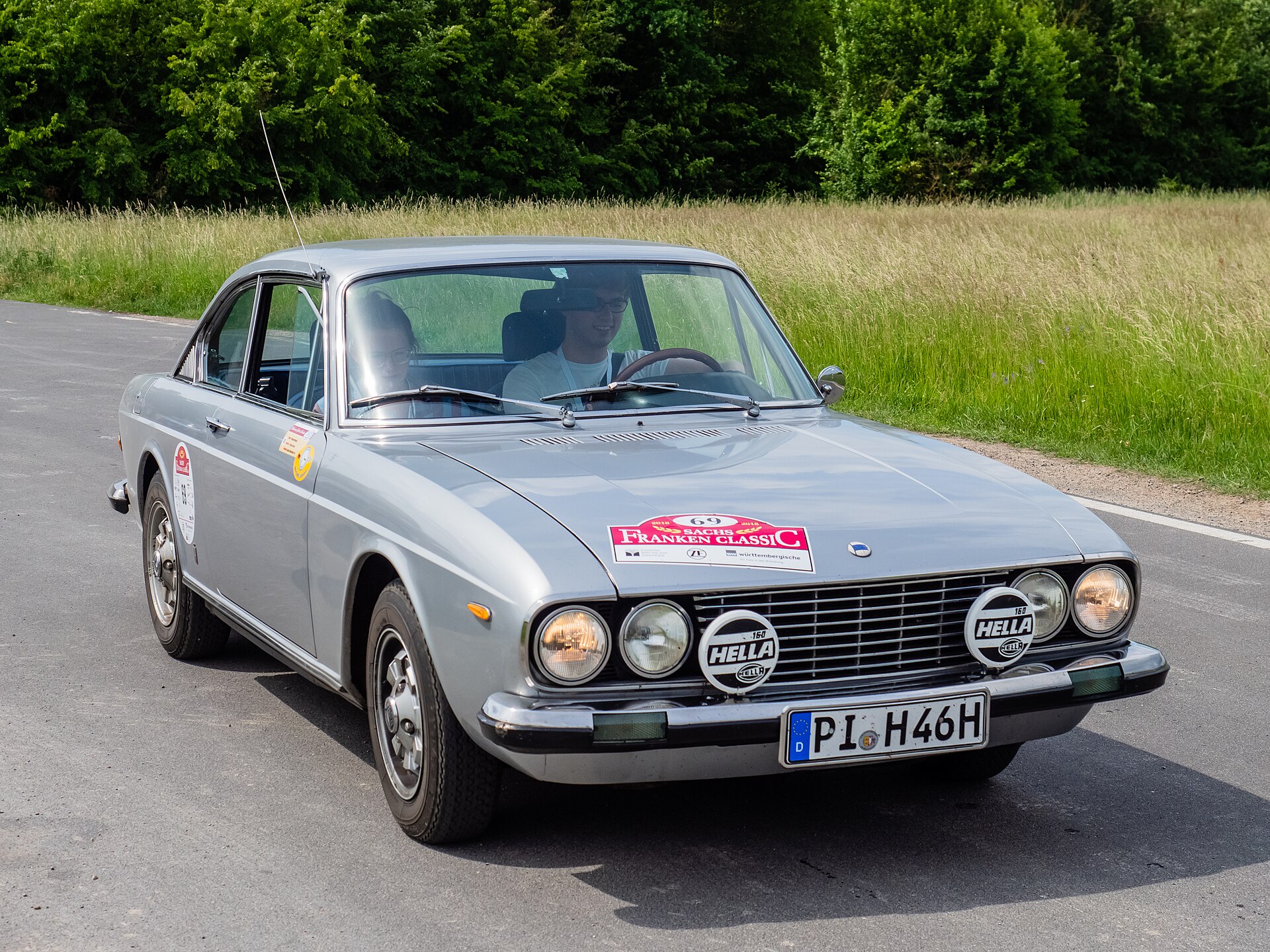
The Lancia Flavia is a mid-size car built from 1960 to 1975 and the first front-wheel-drive Lancia. Engineer Antonio Fessia gave it an aluminium flat-four of 1.5 to 2.0 litres, disc brakes on all four wheels and a body for every taste: a Lancia saloon plus coupe, convertible and Sport versions by Pininfarina, Vignale and Zagato. From 1971 it was sold as the Lancia 2000.
In short
- Shown at the Turin Motor Show in November 1960; the first Italian production car with a flat-four engine.
- Engines from 1,500 cc with 57 kW (78 PS) to the 1,991 cc injection unit with 93 kW (126 PS).
- Coachbuilt versions: Pininfarina coupe, 1,601 Vignale convertibles and about 727 Zagato Sports including prototypes.
- Renamed Lancia 2000 under Fiat ownership in 1971, then replaced by the Lancia Gamma in 1976.
Size at a glance
| Dimensions | Lancia Flavia Series 1 |
|---|---|
| Length | 4,600 mm181.1 in |
| Width | 1,610 mm63.4 in |
| Height | 1,500 mm59.1 in |
| Wheelbase | 2,600 mm102.4 in |
Specs by version
Engines
| Version | Engine | Power | Gearbox | Drive | Production years |
|---|---|---|---|---|---|
| Flavia Series 1 · 1500 saloon | 1.5 l · 4 cyl · Petrol 1,500 cc | 57 kW 77 PS76 hp | 4-sp Manual | Front-wheel drive | 1960–1962 |
| Flavia Series 1 · 1500 coupe | 1.5 l · 4 cyl · Petrol 1,500 cc | 66 kW 90 PS89 hp | 4-sp Manual | Front-wheel drive | 1962–1964 |
| Flavia Series 1 · 1800 Iniezione | 1.8 l · 4 cyl · Petrol 1,800 cc | 75 kW 102 PS101 hp | 4-sp Manual | Front-wheel drive | 1965–1968 |
| 819 · 1967–1971 | |||||
| 819 · 2000 | 2.0 l · 4 cyl · Petrol 1,991 cc | 84 kW 114 PS113 hp | 4-sp Manual | Front-wheel drive | 1969–1971 |
| 2000 Iniezione (Lancia 2000) | 2.0 l · 4 cyl · Petrol 1,991 cc | 93 kW 126 PS125 hp | - | Front-wheel drive | 1971–1975 |
Performance
Show all 3 versions
| Version | 0–100 km/h | Top speed |
|---|---|---|
| Flavia Series 1 · 1500 saloon | - | 149 km/h93 mph |
| Flavia Series 1 · 1500 coupe | - | 166 km/h103 mph |
| 2000 Iniezione (Lancia 2000) | 10.4 s 0–62 mph | 187 km/h116 mph |
Dimensions and weight
Show all 2 versions
| Version | Length | Width | Height | Wheelbase | Kerb weight |
|---|---|---|---|---|---|
| Flavia Series 1 · 1500 saloon | 4,600 mm181.1 in | 1,610 mm63.4 in | 1,500 mm59.1 in | 2,600 mm102.4 in | - |
| Flavia Series 1 · 1500 coupe | 4,485 mm176.6 in | - | - | - | 1,160 kg2,557 lb |
Verified Manufacturer and type-approval data from our catalog · Sources and methodology
Lancia Flavia at a glance
| Item | Lancia Flavia |
|---|---|
| Years | 1960-1971 as Flavia; Lancia 2000 1971-1975 |
| Production | 105,848 (Wikipedia EN infobox; figures vary between sources) |
| Plants | Borgo San Paolo, Turin, then Chivasso from 1962-1963 |
| Body styles | four-door saloon; two-door coupe, convertible and Sport |
| Designers | engineering Antonio Fessia; saloon Piero Castagnero; coupe Pininfarina; convertible Giovanni Michelotti for Vignale; Sport Ercole Spada at Zagato |
| Layout | front engine, front-wheel drive, about 62% of weight on the front wheels |
| Engines | 1.5, 1.8 and 2.0 litre flat-four; Kugelfischer and Bosch injection |
| Power | 57 kW (78 PS) to 93 kW (126 PS) |
| Saloon size | 4,600 mm long, 1,610 mm wide, wheelbase 2,600 mm |
| Kerb weight | coupe about 1,160 kg |
| Top speed | saloon 1500: 149 km/h (The Motor, 1961); 2000 injection saloon: 187 km/h (Autocar, 1972) |
| Price new | 1,800,000 lire for the saloon in 1960; coupe 2,145,000 lire in 1961 |
The Flavia and its successors are listed in the Lancia catalogue.
Fessia's front-drive Lancia
Lancia owner Carlo Pesenti needed a car between the small Appia and the big Flaminia. His technical director, Antonio Fessia, had already shown a front-drive saloon with a flat-four, the CEMSA Caproni F11, at the 1947 Paris Motor Show, but it never went into production. The Flavia gave him a second chance. It was named after the Roman Via Flavia, and the history of Lancia shows how often the company chose engineering over convention, from the load-bearing body of the Lancia Lambda onwards.
Fessia wanted about 62% of the weight over the driven front wheels. Engine, gearbox, differential, suspension and steering were carried on a subframe mounted to the body through elastic bushes, which isolated vibration and simplified assembly. The front suspension used unequal-length wishbones. Dunlop disc brakes were fitted at all four wheels with a dual hydraulic circuit, and the four-speed gearbox had synchromesh on every forward gear. The Flavia was the first front-drive Lancia, and every later Lancia until 2012 kept front-wheel drive.

Engines: from 1.5-litre boxer to fuel-injected 2000
The flat-four was cast in aluminium and was the first boxer engine in an Italian production car. The first saloon had 1,500 cc and 57 kW (78 PS) on a single carburettor, while the coupe, convertible and Sport used twin carburettors and 66 kW (90 PS). In 1963 a 1.8-litre with 68 kW (92 PS) joined the range, and in 1965 a Kugelfischer mechanical injection version gave 75 kW (102 PS). The 1,991 cc engine of 1969 produced 84 kW (114 PS) with a carburettor and 93 kW (126 PS) with injection.
| Engine | Years | Displacement | Power | Fuel system |
|---|---|---|---|---|
| Saloon 1500 | 1960-1962 | 1,500 cc | 57 kW (78 PS) | single carburettor |
| Coupe, convertible, Sport 1500 | 1962 | 1,500 cc | 66 kW (90 PS) | twin carburettors |
| 1500 | 1963-1970 | 1,488-1,490 cc | 59 kW (80 PS) | single carburettor |
| 1800 | 1963-1970 | 1,800-1,815 cc | 68 kW (92 PS) | single carburettor |
| 1800 Sport | 1963-1967 | 1,800 cc | 77 kW (105 PS) | twin carburettors |
| 1800 Iniezione | 1965-1968 | 1,800 cc | 75 kW (102 PS) | Kugelfischer injection |
| 2000 | 1969-1971 | 1,991 cc | 84 kW (114 PS) | single carburettor |
| 2000 Iniezione | 1969-1971 | 1,991 cc | 93 kW (126 PS) | fuel injection |
Wikipedia IT gives slightly different ratings for some engines, such as 85 kW (115 PS) for the carburettor 2000, so figures vary between sources.
Saloons, Pininfarina coupes and the coachbuilt specials
The saloon body was styled in-house by Piero Castagnero. In May 1967 the Series 2 saloon (type 819) received a new body and interior, and a better-trimmed LX followed at the 1968 Turin show. In 1971, after Fiat had taken control, the Flavia name and the smaller engines were dropped and the remaining 2000 saloon and coupe were sold as the Lancia 2000, with Bosch electronic injection from late 1971.
Pininfarina designed and assembled the coupe on a shortened platform; the wheelbase was cut by 12 cm according to Secret Classics and 17 cm according to Wikipedia IT. It arrived in 1961 and became the best-selling two-door. A new coupe body appeared at Geneva in March 1969 with the 2.0 engine, and the coupe 2000 HF of 1971-1974 approached 200 km/h. Car and Driver tested an 1800 coupe in April 1964 at 169 km/h and 0-60 mph in 14.2 seconds.
| Coupe version (Wikipedia IT) | Years | Units built |
|---|---|---|
| 1500, first series | 1962-1964 | 3,725 |
| 1800, first series | 1963-1968 | 13,418 |
| 1800 Iniezione | 1965-1969 | 2,150 |
| 2000, second series | 1969-1970 | 3,458 |
| 2000 Iniezione | 1969-1970 | 705 |
| 2000, third series | 1971-1974 | 1,399 |
| 2000 HF | 1971-1974 | 1,229 |
Vignale built 1,601 convertibles to a design by Giovanni Michelotti: 724 with the 1500, 834 with the 1800 and 43 with injection. Zagato's Sport, drawn by Ercole Spada, was built in about 727 examples including three prototypes, and the Sport 1800 with injection reached 188 km/h. Lancia's next small car, the narrow-angle V4 Lancia Fulvia of 1963, carried the front-drive idea into the lower class.

Lancia Flavia today: what to check when buying
The Flavia was expensive when new. The Autocar test of 1967 listed the 1.8 saloon at GBP 1,909 in the UK, against GBP 1,498 for a BMW 1800 TI. Today it is one of the more affordable ways into a classic Lancia: The Classic Valuer's auction database, checked in November 2026, shows a median of about EUR 14,100 (GBP 12,249) for an average Flavia coupe across 50 sales.
Brian Long's 1997 technical notes on the Viva Lancia owners' site describe a very durable bottom end. The head can corrode if the coolant is not kept fresh with inhibitor, which leads to head gasket or plug leaks, so check for emulsion in the coolant and pale oil. The timing chain can jump if the engine turns backwards, for example when the car is pushed in reverse gear. Brake calipers corrode internally when the fluid is old and are best resleeved in stainless steel. Check the CV joint gaiters and listen for clicking on full lock, and measure the front ride height, because tired springs let the nose sag. Later 2000s used a five-speed gearbox described as notchy, and the Bosch injection can be hard to keep in tune. Rust should be checked on a lift, as on any steel-bodied Italian car of the 1960s. Parts are fairly easy to obtain from specialists such as Omicron in the UK. The coachbuilders' story continues in the history of Pininfarina, and more cars of the decade are in the classic cars section.

Lancia Flavia evolution in numbers
Did you know?
- The Lancia Flavia ran for 15 years, from 1960 to 1975, over 3 generations in our catalog.
- The longest-running generation is the Flavia Series 1 (1960–1967): 7 years.
- The biggest jump in power came with the Flavia 819: up to 93 kW (126 PS), 16 kW more than the Flavia Series 1.
Most powerful version, kW
Figures from the 1cars catalog: power is the strongest version of each generation; generations without the figure are left out.
Lancia Flavia: first vs latest generation
| Spec | Flavia Series 1 | Lancia 2000 | Change |
|---|---|---|---|
| Years | 1960–1967 | 1971–1975 | 11 years apart |
| Most powerful version | 77 kW (105 PS) | 93 kW (126 PS) | +16 kW (+21%) |
| Top speed | 166 km/h | 187 km/h | +21 km/h |
Oldest and newest generation in the 1cars catalog. Power is the strongest version of each; other rows are shown only when both generations have the figure.
Lancia Flavia in our rankings
- No. 9 of 17 · Fastest cars of the 1960s (166 km/h)
- No. 10 of 15 · Quickest cars of the 1970s, 0–100 (10.4 s)
- No. 11 of 89 · Lightest coupes (1,160 kg · top 13%)
- No. 66 of 397 · Lightest cars (1,160 kg · top 17%)
- No. 285 of 1109 · Longest-running car nameplates (15 years · top 28%)
- No. 34 of 104 · Smallest sedans (4,600 mm · top 33%)
Lighter than 87% of ranked coupes in the 1CARS catalog (No. 11 of 89).
FAQ
Was the Lancia Flavia front-wheel drive?
Yes. The Flavia of 1960 was the first front-wheel-drive Lancia, with a flat-four at the front and about 62% of the weight on the driven wheels. All later Lancias until 2012 used front-wheel drive.
What engine is in the Lancia Flavia?
An aluminium flat-four designed under Antonio Fessia. It grew from 1,500 cc and 57 kW (78 PS) in 1960 to 1,991 cc and up to 93 kW (126 PS) with fuel injection in 1969, and no Italian production car had used a boxer engine before it.
How many Lancia Flavia coupes were made?
Wikipedia IT lists about 26,000 Pininfarina coupes from 1962 to 1974, including 1,229 of the 2000 HF. The 1800 first series was the most common at 13,418 cars.
What replaced the Lancia Flavia?
In 1971 the Flavia was renamed Lancia 2000, keeping only the 2.0 saloon and coupe. The Lancia Gamma took over in 1976. Lancia later revived the Flavia name in 2012 for a convertible based on the Chrysler 200.
Data sources
Data checked by an editor against the sources below.
- Wikipedia - Lancia Flavia


