
 Kia PV5
Specs, engines and history
Published Sources (3) Report an error
By Felix Hartmann, Automotive Technology & EV Contributor
- Built
- 2025–present
- Top power
- 120 kW (163 PS)
Which PV5 to choose
Our verdict · Felix Hartmann
For family use the 71.2 kWh Passenger makes the most sense: 412 km WLTP, 120 kW and a 1,500 kg towing limit for EUR 4,000 more than the small battery at the 2025 launch. The 51.5 kWh Passenger suits shuttle and town work where 295 km is enough. Tradespeople should look at the Cargo Long with 71.2 kWh, which pairs the longest range of the family, 416 km, with the most load space. The seven-seat Passenger arrived only in July 2026. Other electric vans and cars are listed in our electric car section, and every Kia model is in the Kia catalogue.
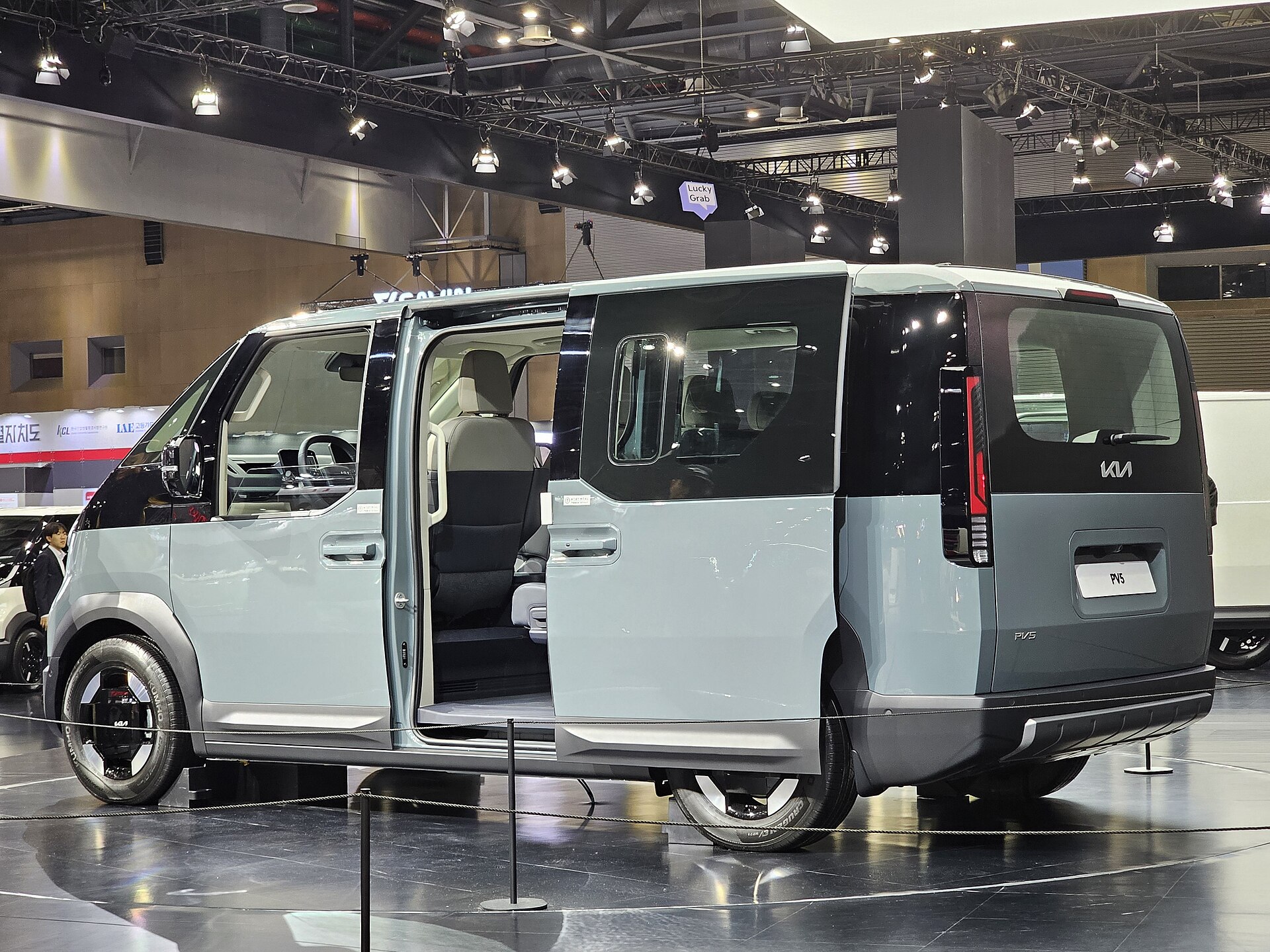
The Kia PV5 is a battery-electric van sold as a Passenger people carrier, a Cargo panel van and a range of converted bodies. Kia revealed the production version at its EV Day in Spain on 24 February 2025 and builds it at the Hwaseong EVO plant in South Korea. It is the first model on the E-GMP.S platform and was named 2026 International Van of the Year.
In short
- One generation (code SW1) since 2025, front-wheel drive, one front motor with 89 kW (122 PS) or 120 kW (163 PS) and 250 Nm.
- Batteries of 43.3 kWh (LFP, Cargo, Europe only), 51.5 kWh and 71.2 kWh; up to 412 km WLTP for the Passenger and 416 km for the Cargo Long.
- 4,695 mm (184.8 in) long on a 2,995 mm wheelbase; the Passenger holds 1,330 to 3,615 litres, the Cargo 4.0 to 5.2 m³.
- German list prices from EUR 38,390 at the October 2025 launch; four Euro NCAP stars in 2025.
Size at a glance
| Dimensions | Kia PV5 SW1 |
|---|---|
| Length | 4,695 mm184.8 in |
| Width | 1,895 mm74.6 in |
| Height | 1,899 mm74.8 in |
| Wheelbase | 2,995 mm117.9 in |
| Boot | 1,330 L47.0 cu ft |
Specs by version
Engines
| Version | Engine | Power | Torque | Gearbox | Drive | Production years |
|---|---|---|---|---|---|---|
| Passenger 51.5 kWh 89 kW | Electric | 89 kW 121 PS119 hp | 250 Nm184 lb-ft | 1-sp Single-speed | Front-wheel drive | 2025 |
| Passenger 71.2 kWh 120 kW | Electric | 120 kW 163 PS161 hp | 250 Nm184 lb-ft | 1-sp Single-speed | Front-wheel drive | 2025 |
| Cargo Long 71.2 kWh 120 kW | Electric | 120 kW 163 PS161 hp | 250 Nm184 lb-ft | 1-sp Single-speed | Front-wheel drive | 2025 |
Performance
Show all 3 versions
| Version | 0–100 km/h | Top speed | Fuel consumption | Range |
|---|---|---|---|---|
| Passenger 51.5 kWh 89 kW | 12.8 s 0–62 mph | 135 km/h84 mph | 19.2 kWh/100 km30.9 kWh/100 mi | 295 km183 mi |
| Passenger 71.2 kWh 120 kW | 10.6 s 0–62 mph | 135 km/h84 mph | 19.3 kWh/100 km31.1 kWh/100 mi | 412 km256 mi |
| Cargo Long 71.2 kWh 120 kW | - | - | - | 416 km258 mi |
Dimensions and weight
Show all 3 versions
| Version | Length | Width | Height | Wheelbase | Kerb weight | Boot | Battery |
|---|---|---|---|---|---|---|---|
| Passenger 51.5 kWh 89 kW | 4,695 mm184.8 in | 1,895 mm74.6 in | 1,899 mm74.8 in | 2,995 mm117.9 in | 2,065 kg4,553 lb | 1,330 l47.0 cu ft | 52 kWh |
| Passenger 71.2 kWh 120 kW | 4,695 mm184.8 in | 1,895 mm74.6 in | 1,899 mm74.8 in | 2,995 mm117.9 in | 2,145 kg4,729 lb | 1,330 l47.0 cu ft | 71 kWh |
| Cargo Long 71.2 kWh 120 kW | 4,695 mm184.8 in | - | - | 2,995 mm117.9 in | - | - | 71 kWh |
Verified Manufacturer and type-approval data from our catalog · Sources and methodology
Kia PV5 at a glance
| Specification | Kia PV5 |
|---|---|
| Body and segment | electric van: Passenger (5, 6 or 7 seats), WAV, Cargo, chassis cab |
| Production | since 2025, Hwaseong (Autoland Hwasung), South Korea |
| Platform | E-GMP.S, 400-volt CATL batteries |
| Drive | front-wheel drive, permanent-magnet front motor |
| Power and torque | 89 kW (122 PS) or 120 kW (163 PS), 250 Nm |
| Batteries | 43.3 kWh LFP; 51.5 or 71.2 kWh NCM |
| WLTP range | 295 km (51.5 kWh Passenger) to 416 km (71.2 kWh Cargo Long) |
| Charging | up to 150 kW DC, 10-80% in about 30 minutes; 11 kW AC |
| Length / wheelbase | 4,695 mm / 2,995 mm; longest body 4,890 mm |
| Load space | 1,330-3,615 l (Passenger); 4.0-5.2 m³ (Cargo) |
| Euro NCAP | 4 stars (Passenger 120 kW, tested 2025) |
| Price from | EUR 38,390 in Germany (ADAC, October 2025) |
One platform for a family of vans
The PV5 is the first model of Kia's PV series of purpose-built electric vans. Kia previewed the PV concepts in January 2024, showed a production-ready PV5 at CES 2025 and then presented it in full in Spain alongside the EV2 and EV4. Mass production of the Passenger and the Cargo Long began at Hwaseong in 2025; Korea came first, and European sales followed in late 2025.
The E-GMP.S platform is a derivative of the E-GMP architecture that Hyundai and Kia introduced in 2021, with the motor on the front axle. One structure carries a five-door Passenger, a wheelchair-accessible WAV with a side boarding system and a tip-up third-row seat, a six-door Cargo in Compact, Long and High Roof form, and a two-door chassis cab. Converters add a Light Camper, refrigerated and frozen-goods boxes and, for Europe only, a Crew version. Inside, the AdGear accessory system lets owners clip holders and hooks to the cabin, and the 12.9-inch central screen runs Android Automotive.
The van found buyers quickly: Kia sold 15,853 PV5s worldwide in 2025, and European registrations passed 10,000 by June 2026, about six months after sales began. A jury of commercial vehicle journalists from 26 countries then voted it 2026 International Van of the Year, Kia's first win in that category.
Batteries, motors and WLTP range
| Version | Battery | Power | WLTP range | 0-100 km/h |
|---|---|---|---|---|
| Passenger 51.5 kWh | 51.5 kWh NCM | 89 kW (122 PS) | 295 km (183 miles) | 12.8 s |
| Passenger 71.2 kWh | 71.2 kWh NCM | 120 kW (163 PS) | 412 km (256 miles) | 10.6 s |
| Cargo Long 71.2 kWh | 71.2 kWh NCM | 120 kW (163 PS) | 416 km (258 miles) | - |
Every PV5 has 250 Nm and, according to ADAC, a top speed of 135 km/h (84 mph). Combined WLTP consumption is 19.2 kWh/100 km for the 51.5 kWh Passenger and 19.3 kWh/100 km with 71.2 kWh, so the gap of 117 km between the two comes almost entirely from battery size. A 43.3 kWh lithium iron phosphate pack is offered only for the Cargo in Europe. Some Asian launches, such as Thailand in August 2026, offer the Cargo only with the Standard Range battery.
Charging, V2L and the payload record
All three batteries charge from 10 to 80 percent in about 30 minutes on a DC charger; ADAC lists a peak of 150 kW through the CCS socket. On a three-phase 11 kW wallbox a full charge takes 285 minutes with 51.5 kWh and 390 minutes with 71.2 kWh. European cars can power outside equipment through vehicle-to-load at up to 3.68 kW.
Charging hardware changes by market. Canadian vans get a NACS port and an 11 kW on-board charger, with 22 kW promised later, while Japanese cars use CHAdeMO and support bidirectional V2X. Less than a month after launch, a PV5 Cargo set a Guinness World Record for the greatest distance driven by a light-duty electric van carrying its maximum payload on one charge: 693.38 km (430.85 miles).
Space, payload and towing
The Passenger has sliding side doors with a step height of 399 mm. Behind the second row ADAC measures 1,330 litres; with the rear bench folded and the space filled to the roof, the figure rises to 3,615 litres. Five-seat versions came first, and six- and seven-seat layouts joined the German price list in July 2026. Kerb weight is 2,065 kg with 51.5 kWh and 2,145 kg with 71.2 kWh, leaving payloads of 535 kg and 455 kg. Only the larger battery is rated to tow 1,500 kg (3,307 lb) braked; the 51.5 kWh van is limited to 750 kg.
The Cargo offers 4.0 m³ in the L1H1 body and up to 5.2 m³ in the L2H2 High Roof, with a rear load sill 419 mm off the ground and L-track rails for securing loads. Kia quotes a payload of up to 790 kg. Kia gives the same 4,695 mm length for the Passenger and the Cargo Long; the longest body listed by Wikipedia measures 4,890 mm (192.5 in), and the high roof lifts the van from 1,905 mm to 2,200 mm (86.6 in). Width is 1,895 mm without mirrors and 2,255 mm with them.

Euro NCAP and ANCAP results
Euro NCAP tested the PV5 Passenger with the 120 kW motor in 2025 and awarded four stars. It scored 83 percent for adult occupants, 85 percent for children, 64 percent for vulnerable road users and 65 percent for safety assistance; the last two scores held it below five stars. The Cargo went through Euro NCAP's separate van assessment with 75 percent for safe driving, 80 percent for crash avoidance and 80 percent for post-crash measures. In Australia, ANCAP gave the PV5 Cargo 91 percent and a Platinum rating.
Prices in Germany and the main rival
| Version (Germany) | Battery | List price | Valid from |
|---|---|---|---|
| Passenger Essential, 5 seats | 51.5 kWh | EUR 38,390 | 10/2025 |
| Passenger Essential, 5 seats | 71.2 kWh | EUR 42,390 | 10/2025 |
| Passenger Elite, 5 seats | 71.2 kWh | EUR 45,440 | 10/2025 |
| Passenger Essential, 7 seats | 71.2 kWh | EUR 44,190 | 07/2026 |
| Passenger Elite WAV | 71.2 kWh | EUR 51,470 | 08/2026 |
These are the list prices in the ADAC catalogue; by late 2026 its data pages showed both five-seat Essential versions EUR 300 higher, at EUR 38,690 and EUR 42,690 in 2026. The obvious rival is the Volkswagen ID. Buzz, built in Hanover since June 2022. The short-wheelbase ID. Buzz is 4,712 mm long, 17 mm longer than the PV5, and drives its rear wheels with 150 kW from a 77 kWh usable battery. Its Cargo version holds 3,900 litres and carries 592 to 607 kg, against 4.0 to 5.2 m³ and up to 790 kg for the Kia van. Within the same group, Hyundai sells the larger Hyundai Staria MPV.
Photo gallery


Kia PV5 in our rankings
More powerful than 35% of ranked vans and minibuses in the 1CARS catalog (No. 12 of 20).
FAQ
What is the range of the Kia PV5?
The PV5 Passenger reaches 412 km (256 miles) WLTP with the 71.2 kWh battery and 295 km with 51.5 kWh. The Cargo Long with 71.2 kWh is rated at 416 km (258 miles), the highest figure in the range.
How fast does the PV5 charge?
A 10 to 80 percent DC charge takes about 30 minutes for every battery, with a peak of 150 kW according to ADAC. On an 11 kW home wallbox a full charge takes 285 minutes for the 51.5 kWh pack and 390 minutes for 71.2 kWh.
How much can the PV5 Cargo carry?
Kia quotes a payload of up to 790 kg for the Cargo and a load volume from 4.0 m³ in the standard body to 5.2 m³ in the L2H2 High Roof. The Passenger with 71.2 kWh carries 455 kg.
Where is the Kia PV5 built?
At Kia's Hwaseong EVO plant (Autoland Hwasung) in South Korea, where mass production of the Passenger and Cargo Long began in 2025. European deliveries started in late 2025.
Data sources
Data checked by an editor against the sources below.
- Wikipedia - Kia PV5
- ADAC
- Automotiveworld - Kia Pv5 Redefines Mobility Through Customer Centric Modular Design


