 Volkswagen Passat B3
Specs, engines and history
Published Report an error
By Felix Hartmann, Automotive Technology & EV Contributor
Which Passat B3 to choose
Our verdict · Felix Hartmann
- For simple daily use: a 2.0 (2E) or 1.8 petrol with the five-speed manual, without the supercharger or the extra cylinders of the top versions.
- For long-distance driving: one of the turbodiesels: the intercooled 1.6 TD with 59 kW (80 PS) or the 1.9 TD (AAZ) of 1991–1993.
- For enthusiasts and collectors: the 2.8 VR6, the first car with this engine, or the rare G60 Syncro with its supercharger and four-wheel drive.
- For load space: the Variant, the only body offered with most Syncro versions.
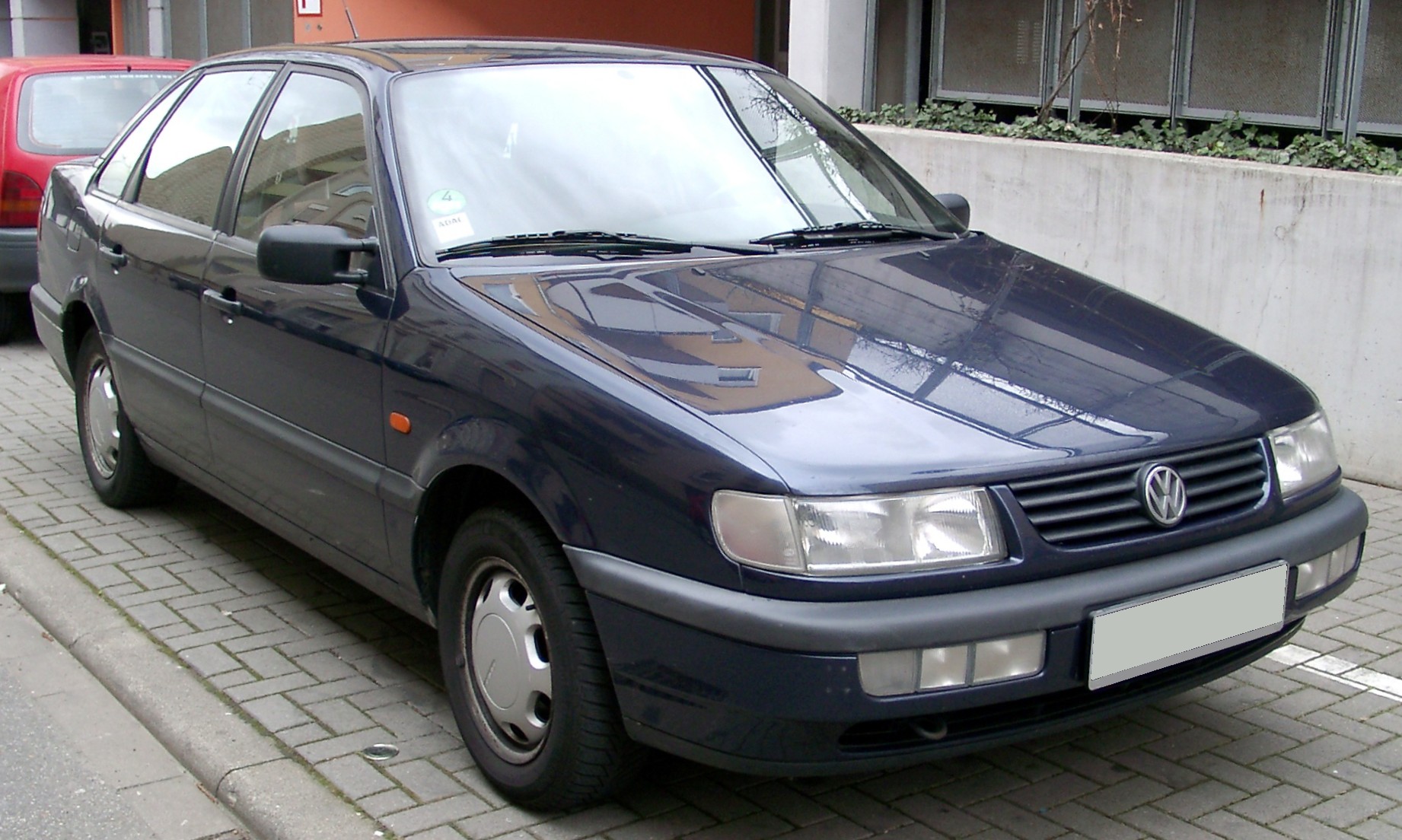
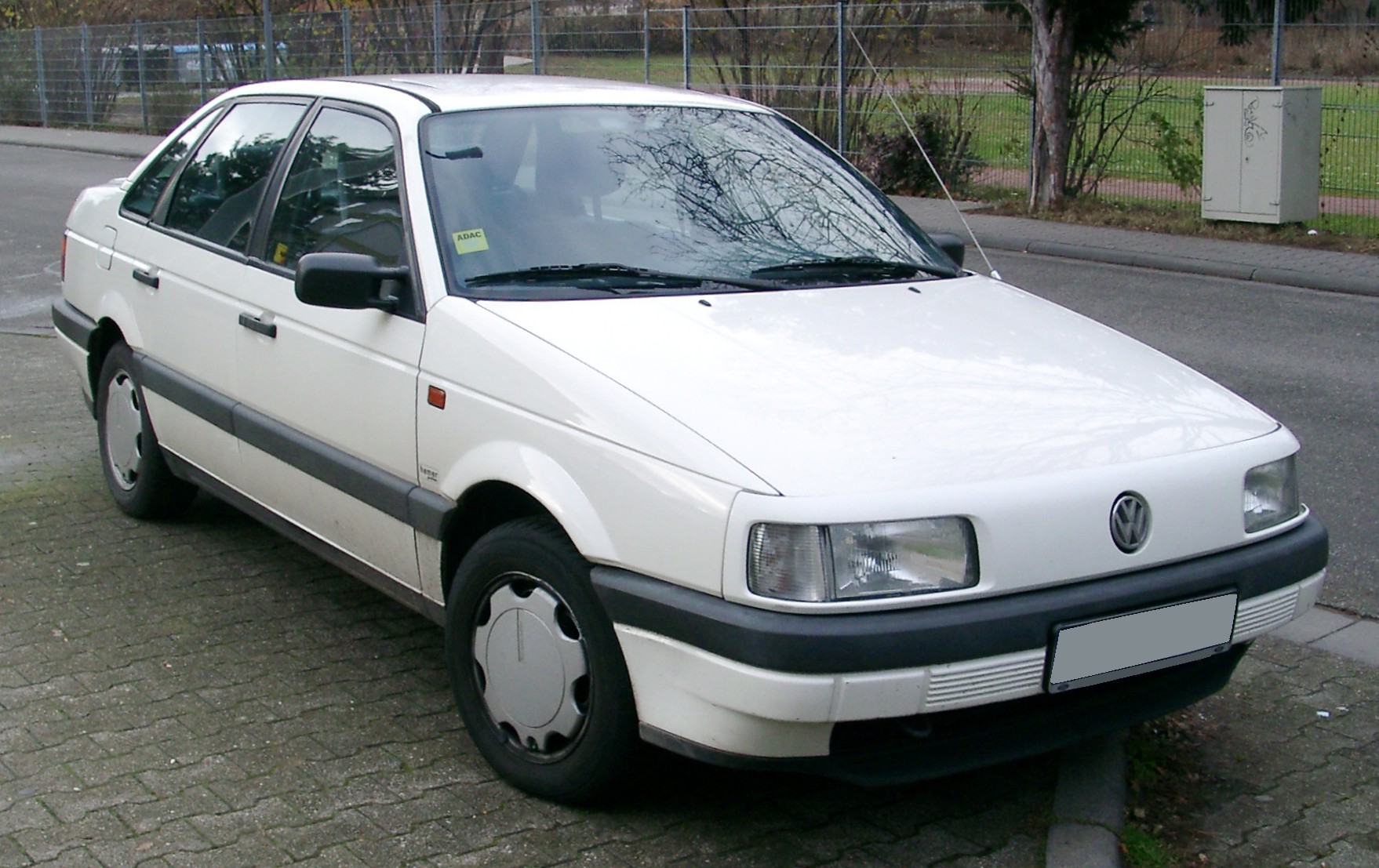
The Volkswagen Passat B3, also known by its type code 35i, is the third-generation Passat, built from 1988 to 1993 as a saloon and a Variant estate. It was the first Passat on a platform designed by Volkswagen itself rather than shared with an Audi, and the first with a transverse engine. Its smooth, grille-less nose made it one of the most recognisable family cars of its time, and it was the first car to receive the VR6 engine.
In short
- Built in Emden (Germany) and Bratislava (Slovakia) from 1988 to 1993; introduced in Europe in March 1988.
- Four-door saloon and five-door Variant only, with front-wheel drive or Syncro four-wheel drive.
- Engines from the 50 kW (68 PS) 1.9 diesel to the 128 kW (174 PS) 2.8 VR6.
- Replaced in October 1993 by the Passat B4, a heavy facelift of the same car.
Passat B3 at a glance
| Specification | Volkswagen Passat B3 (35i) |
|---|---|
| Production | 1988–1993 |
| Plants | Emden, Germany; Bratislava, Slovakia (VWBA) |
| Class | large family car (D-segment) |
| Body styles | 4-door saloon, 5-door estate (Variant) |
| Layout | transverse front engine, front-wheel drive or Syncro four-wheel drive |
| Platform | Volkswagen Group B3, derived from the Golf Mk2 (A2) platform |
| Power range | 50–128 kW (68–174 PS) |
| Gearboxes | 5-speed manual, 4-speed automatic |
| Predecessor / successor | Passat B2 / Passat B4 |
The B3 sits in our Volkswagen catalogue between the B2 and the B4. The current car is covered in our guide to the Passat B8 engines and versions, and the story of the company behind it is told in the history of Volkswagen.
A Passat of its own: platform and development
The first two Passat generations were closely related to the Audi 80 and used longitudinal engines. The B3 broke that link. Volkswagen built it on its own B3 platform, which was largely the A platform of the Golf Mk2, stretched for a longer wheelbase. The engine now sat across the car, as in the Golf, which freed space in the cabin.
The design was led by Volkswagen's design chief Herbert Schäfer. Its shape came from Volkswagen's Auto 2000 research car of 1981, which had a drag coefficient of 0.25. The production car followed the rounded "jelly mould" trend that Ford had started with the Sierra and the Taurus, and it had no conventional grille: air entered below the bumper, a solution that recalled rear-engined Volkswagens such as the 411. German press reports called it the first real "Hahn" car, after Carl Hahn, who had led the group since 1982.
Unlike the B2, the B3 had no fastback. Buyers could choose only the four-door saloon or the five-door Variant, and later Passats kept that choice.


Design, body styles and equipment
The saloon was 4,575 mm long and 1,705 mm wide, on a wheelbase of 2,625 mm (2,630 mm for the Syncro). Height ranged from 1,430 to 1,500 mm, depending on body and suspension. The Variant was the body most often combined with four-wheel drive.
In Europe the options list included features that were rare in a family car of the late 1980s: self-levelling rear air suspension and Climatronic, an electronically regulated air conditioning system.

Passat B3 engines and performance
The B3 had one of the widest engine ranges of any Passat. Carburettor petrol engines sat at the bottom, fuel-injected 16-valve engines in the middle, and two special units at the top: the supercharged G60 and the VR6.
| Engine | Code | Years | Power | Torque | 0–100 km/h |
|---|---|---|---|---|---|
| 1.6 petrol | RF | 1988–1989 | 53 kW (72 PS) | 120 Nm | - |
| 1.6 petrol | EZ / ABN | to 1993 | 55 kW (75 PS) | 125 Nm | 15.7–16.0 s |
| 1.8 petrol | RP / ABS | 1988–1993 | 66 kW (90 PS) | 142–145 Nm | - |
| 2.0 petrol | 2E | 1989–1993 | 85 kW (115 PS) | 166 Nm | - |
| 1.8 16V | KR | 1988–1993 | 100 kW (136 PS) | 162 Nm | 10.4–10.6 s |
| 2.0 16V | 9A | 1988–1993 | 100 kW (136 PS) | 180 Nm | 10.2–11.0 s |
| 1.8 G60 (supercharged, AWD) | PG | 1989–1993 | 118 kW (160 PS) | 225 Nm | 9.6–9.8 s |
| 2.8 VR6 | AAA | 1991–1993 | 128 kW (174 PS) | 235 Nm | 8.2–8.3 s |
| 1.6 turbodiesel | RA / SB | from 1988 | 59 kW (80 PS) | 152–155 Nm | - |
| 1.9 diesel | 1Y | 1989–1993 | 50 kW (68 PS) | 127 Nm | - |
| 1.9 turbodiesel | AAZ | 1991–1993 | 55 kW (75 PS) | 140 Nm | - |
Other outputs existed as well, such as 1.8-litre engines of 55 kW (75 PS), 79 kW (107 PS) and 82 kW (112 PS). All engines drove through a five-speed manual or a four-speed automatic.
The supercharged G60 was paired with Syncro four-wheel drive and reached 210–215 km/h. The VR6, introduced in April 1991, was a narrow-angle six-cylinder that fitted crosswise in the engine bay. In the Passat it gave a top speed of 214–220 km/h. By our calculation the VR6 had 28% more power than the 2.0 16V (128 against 100 kW) and roughly 2.4 times the output of the 1.6 carburettor engine.
Syncro four-wheel drive
Syncro used a viscous coupling between the axles. In normal driving the car was front-wheel drive, and power went to the rear axle only when the front wheels started to slip. The system was offered mostly on the Variant and was standard with the G60 engine. In Canada, about 200 G60 Syncro cars were sold.

Key specifications: Passat B3 VR6
| Parameter | Metric | Imperial |
|---|---|---|
| Engine | 2.8-litre VR6 petrol (AAA) | 2.8-litre VR6 |
| Power | 128 kW (174 PS) at 5,800 rpm | 128 kW (172 hp) |
| Torque | 235 Nm at 4,200 rpm | 173 lb-ft |
| 0–100 km/h | 8.2–8.3 s | - |
| Top speed | 214–220 km/h | 133–137 mph |
| Length | 4,575 mm | 180.1 in |
| Width | 1,705 mm | 67.1 in |
| Wheelbase | 2,625 mm | 103.3 in |
| Height | 1,430–1,500 mm | 56.3–59.1 in |
The Passat B3 in North America
The B3 reached North America in 1989 as a 1990 model, and it was the first generation sold there under the Passat name. The launch model was the GL with the 2.0 16V, rated at 100 kW (134 hp). A CL saloon followed for 1992 and a four-cylinder GLS for 1993. The GLX received the VR6 in 1993 and stayed for 1994. In Canada the VR6 version was sold as the GLS, and a 1.9 turbodiesel rated at 56 kW (75 hp) was also offered in 1992–1993.
In Australia the B3 hardly existed: the importer sold only a handful of 1991 cars before the release was cancelled.
From B3 to B4
The B3 was not replaced by an all-new car. Its successor, the Passat B4 of October 1993, kept the roof and glasshouse but changed every other outer panel, and it brought back a grille in the style of the Golf Mk3. Dual front airbags and seat belt pretensioners were added, while the dashboard design stayed the same. The B4 saloon was 35 mm longer than the B3 (4,610 against 4,575 mm) on practically the same wheelbase. It remained on sale until 1997, when the B5 took over. To convert the outputs in this article between kW, PS and hp, use our power converter.
Photo gallery

Volkswagen Passat B3 in our rankings
In production longer than 23% of ranked nameplates in the 1CARS catalog (No. 761 of 1082).
FAQ
What years was the Passat B3 made?
From 1988 to 1993. It was introduced in Europe in March 1988 and replaced by the Passat B4 in October 1993.
Why does the Passat B3 have no grille?
Its front end was developed from Volkswagen's Auto 2000 research car of 1981, built for low air resistance. Cooling air enters below the bumper, like on some earlier rear-engined Volkswagens.
Which was the most powerful Passat B3?
The 2.8 VR6 with 128 kW (174 PS) and 235 Nm, introduced in April 1991.
Was the Passat B3 available with four-wheel drive?
Yes. The Syncro system with a viscous coupling was offered mainly on the Variant and came with the supercharged 1.8 G60 engine.
Is the Passat B3 related to the Golf?
Yes. Its B3 platform was based largely on the A platform of the Golf Mk2, stretched for a longer wheelbase.