 Opel Karl
Specs, engines and history
Published Sources (3) Report an error
By Felix Hartmann, Automotive Technology & EV Contributor
- Built
- 2015–2019
- Top power
- 55 kW (75 PS)
Which Karl to buy
Our verdict · Felix Hartmann
- Best all-rounder: a 55 kW (75 PS) manual in Active, Excite or Innovation trim, which have more of the comfort equipment.
- For lower fuel bills: the LPG ecoFLEX, if autogas is easy to find where you live.
- For rough roads: the Karl Rocks with its extra 18 mm of ground clearance.
- For city traffic: the Easytronic 3.0, accepting the automated manual's slower shifts.
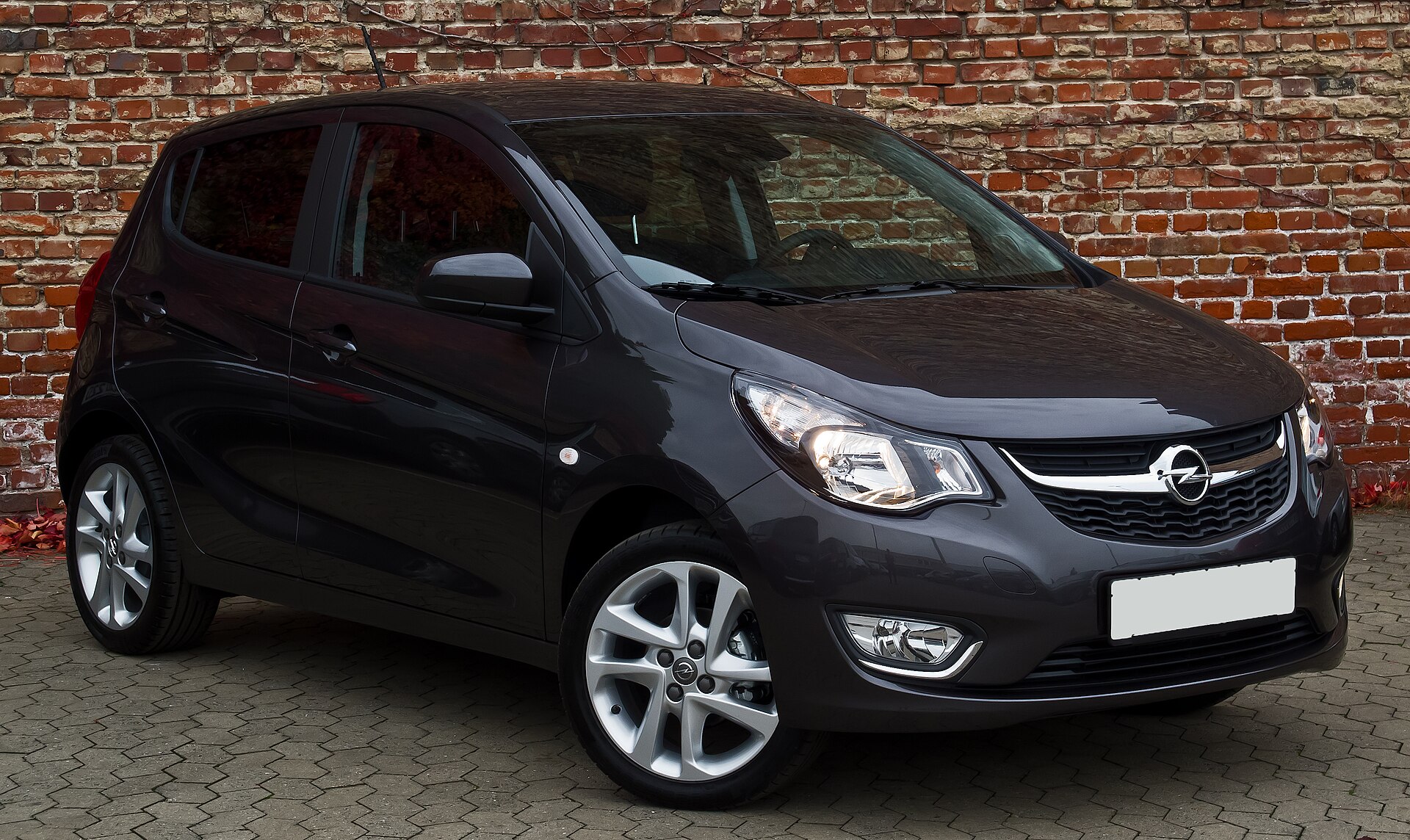
The Opel Karl is a five-door city car that Opel sold from June 2015 to mid-2019, and Vauxhall sold in the UK as the Viva. It was built by GM Korea in Changwon, South Korea, as a reworked, Opel-badged version of the fourth-generation Chevrolet Spark (M400), and every car used the same 1.0-litre three-cylinder petrol engine with about 55 kW (75 PS). Opel dropped it after the company was sold to PSA.
In short
- One generation, 2015-2019, five-door hatchback only; a raised Karl Rocks version followed in 2017.
- Engine: 1.0-litre three-cylinder, 55 kW (75 PS) and 95 Nm, later 54 kW (73 PS); LPG versions were also sold.
- 3,675 mm long, 939 kg, 206-litre boot; German prices started at EUR 9,560 (2015).
- Euro NCAP awarded four stars in October 2015.
Size at a glance
| Dimensions | Opel Karl I |
|---|---|
| Length | 3,675 mm144.7 in |
| Width | 1,595 mm62.8 in |
| Height | 1,485 mm58.5 in |
| Wheelbase | 2,385 mm93.9 in |
| Boot | 206 L7.3 cu ft |
Running cost
Fuel · Karl 1.0 75
about 1,200 EUR fuel a year at 15,000 km
4.5 l/100 km · petrol at 1.75 EUR/l · change mileage, fuel price or version
Specs by version
Engines
| Version | Engine | Power | Torque | Gearbox | Drive | Production years |
|---|---|---|---|---|---|---|
| 1.0 75 | 1.0 l · 3 cyl · Petrol B10XE | 55 kW 75 PS74 hp | 95 Nm70 lb-ft | 5-sp Manual | Front-wheel drive | 2015–2018 |
| 1.0 75 Easytronic | 1.0 l · 3 cyl · Petrol B10XE | 55 kW 75 PS74 hp | 95 Nm70 lb-ft | 5-sp Automated manual | Front-wheel drive | 2015–2019 |
Performance
Show all 1 versions
| Version | 0–100 km/h | Top speed | Fuel consumption | CO₂ |
|---|---|---|---|---|
| 1.0 75 | 13.9 s 0–62 mph | 170 km/h106 mph | 4.5 l/100 km52.3 mpg US · 62.8 mpg UK | 104 g/km |
Dimensions and weight
Verified Manufacturer and type-approval data from our catalog · Sources and methodology
Opel Karl at a glance
| Specification | Opel Karl |
|---|---|
| Segment | A-segment city car |
| Body | Five-door hatchback |
| Production | 2015-2019, GM Korea, Changwon (South Korea) |
| Platform | GM Gamma II, front engine, front-wheel drive |
| Twins | Vauxhall Viva (UK), Chevrolet Spark (M400) |
| Engine | 1.0 three-cylinder petrol (999 cc), also LPG |
| Power | 54-55 kW (73-75 PS) |
| Predecessor | Opel Agila |
The name honours Carl (Karl) Opel, the eldest son of the company founder Adam Opel. The Karl is part of our Opel catalogue.
Versions and model history
The Karl had a single generation with no facelift, so the table lists its main versions.
| Version | Code | Years | Body styles | Engines | Power (kW / hp) |
|---|---|---|---|---|---|
| Karl | Gamma II (Spark M400 basis) | 2015-2019 | 5-door hatchback | 1.0 petrol | 55 kW (75 PS); 54 kW (73 PS) from 2018 |
| Karl LPG ecoFLEX | Gamma II | within 2015-2019 | 5-door hatchback | 1.0 petrol/LPG bi-fuel | 54 kW (73 PS) on LPG, 55 kW (75 PS) on petrol |
| Karl Rocks | Gamma II | 2017-2019 | 5-door hatchback, crossover look | 1.0 petrol, 1.0 LPG | 55 kW (75 PS); 54 kW (73 PS) on LPG |
| Vauxhall Viva | Gamma II | 2015-2019 | 5-door hatchback | 1.0 petrol | 55 kW (75 PS) |
The Karl replaced the Agila as Opel's smallest car and sat below the Corsa. In the UK, Vauxhall revived the Viva name, last used from 1963 to 1979, and sold the car in SE, SE A/C and SL trims. ADAC dates the German series from June 2015 to June 2019. In October 2018 Opel announced that production would end by the close of 2019, following the sale of Opel to the PSA Group.
The Karl Rocks was shown at the Paris Motor Show in 2016 and went on sale in Germany in spring 2017, priced from EUR 12,600 (2017). It has 18 mm more ground clearance, black plastic protection on the wheel arches and sills, and silver roof rails. With the Easytronic 3.0 gearbox it cost EUR 13,350.
The Karl's engineering lived on outside Europe: VinFast in Vietnam built the Fadil on the same basis, selling 18,316 in 2020 and 24,128 in 2021.


Engine, gearboxes and performance
| Version | Power | Torque | Gearbox | 0-100 km/h | Top speed |
|---|---|---|---|---|---|
| 1.0 (2015-2018) | 55 kW (75 PS) | 95 Nm at 4,500 rpm | 5-speed manual | 13.9 s | 170 km/h |
| 1.0 (from 2018) | 54 kW (73 PS) | - | 5-speed manual | - | - |
| 1.0 LPG, gas mode | 54 kW (73 PS) | - | 5-speed manual | - | - |
| 1.0 Easytronic | 55 kW (75 PS) | 95 Nm | 5-speed automated manual | - | - |
The engine is GM's B10XE, a 999 cc three-cylinder. Apart from the fuel system of the LPG model, there was nothing else under the bonnet. The automated manual was called Easytronic 3.0; on the Karl Rocks it added EUR 750 to the price (2017). Opel never offered a diesel, turbo or electric Karl.

Dimensions, space and boot
| Parameter | Metric | Imperial |
|---|---|---|
| Length | 3,675 mm | 144.7 in |
| Width (without mirrors) | 1,595 mm | 62.8 in |
| Height | 1,485 mm | 58.5 in |
| Wheelbase | 2,385 mm | 93.9 in |
| Kerb weight (EU) | 939 kg | 2,070 lb |
| Boot | 206 l | 7.3 cu ft |
| Boot, rear seat folded (to the roof) | 1,013 l | 35.8 cu ft |
| Fuel tank | 32 l | 8.5 US gal |
Figures are ADAC data for the 1.0 Selection. At 3,675 mm the Karl was 75 mm longer than a Volkswagen up! and about the same length as a Hyundai i10, but its boot was smaller than both. Our size comparison tool puts it next to other city cars.
Fuel economy and running costs
ADAC lists the 1.0 Selection at 4.5 l/100 km combined on the NEDC cycle (about 52 mpg US), with 5.6 l/100 km in town and 3.9 l/100 km out of town, and 104 g/km of CO2. Wikipedia quotes 4.3 l/100 km for the most economical version. The LPG model could run on cheaper autogas in markets where it is widely sold.
German list prices ran from EUR 9,560 for the Selection (2015) to EUR 15,605 for the LPG Innovation with the ECO pack. The Easytronic started at EUR 11,650. Opel gave a two-year warranty and 12 years against rust perforation.
Trims and equipment
German trims included Selection, Edition, Active, Excite and Innovation, plus ECO packs that improved economy. In the UK, air conditioning was standard only from the SE A/C trim upwards. The Rocks used the R 300 radio with Aux-In, and Apple CarPlay was available with the optional Opel OnStar system.

Safety
Euro NCAP tested the Karl and the Vauxhall Viva in 2015 and announced four stars on 7 October 2015. Autonomous emergency braking was not available on the Karl. Ratings of other city cars are on our safety page.
Reliability and known issues
The Karl uses a simple naturally aspirated engine and either a conventional manual or a single-clutch automated manual. The sources used for this article contain no breakdown statistics or defect pattern for the Karl, so we do not list any. As with any used city car, check for completed recall work and a full service history.
Sales
Opel and Vauxhall sold 28,638 Karl and Viva models in Europe in 2015, 57,458 in 2016, 49,516 in 2017, 48,292 in 2018 and 47,504 in 2019, its final year.
Rivals
| Model | Engines | Power (kW / hp) | Boot (l) | Price from (EUR) |
|---|---|---|---|---|
| Opel Karl | 1.0 petrol, 1.0 LPG | 54-55 kW (73-75 PS) | 206 | 9,560 (Germany, 2015) |
| Volkswagen up! (2016 facelift) | 1.0 petrol, 1.0 TSI, CNG | 44-66 kW (60-90 PS) | 251 | 9,975 (Germany, 2016) |
| Hyundai i10 (2017 facelift) | 1.0, 1.0 LPG, 1.2 petrol | 49-64 kW (67-87 PS) | 252 | 9,990 (Germany, 2017) |
| Kia Picanto (JA) | 1.0, 1.2, 1.0 T-GDI petrol | 49-74 kW (67-100 PS) | 255 | 9,990 (Germany, 2017) |
All four cost about EUR 10,000 in base form, and the Karl was the cheapest by a small margin. The Kia and Hyundai offered stronger engines, the up! a turbocharged option, and all three rivals had bigger boots.
Photo gallery

Opel Karl in our rankings
- No. 8 of 76 · Lightest hatchbacks (939 kg)
- No. 20 of 531 · Smallest cars (3,675 mm · top 4%)
- No. 20 of 391 · Lightest cars (939 kg · top 6%)
- No. 35 of 297 · Most economical cars (4.5 l/100 km · top 13%)
- No. 18 of 93 · Smallest hatchbacks (3,675 mm · top 20%)
- No. 23 of 54 · Most economical hatchbacks (4.5 l/100 km · top 43%)
Shorter than 96% of ranked cars in the 1CARS catalog (No. 20 of 531).
FAQ
Who made the Opel Karl?
GM Korea built it in Changwon, South Korea. It is based on the Chevrolet Spark (M400) with its own Opel styling and was sold in the UK as the Vauxhall Viva.
What engine does the Opel Karl have?
A 1.0-litre three-cylinder petrol engine with 55 kW (75 PS) and 95 Nm, later 54 kW (73 PS); there was also an LPG bi-fuel version.
Why was the Opel Karl discontinued?
Opel ended production in 2019 after the company was sold to the PSA Group; the plan was announced in October 2018.
How big is the Opel Karl's boot?
206 litres with the rear seats up and 1,013 litres with them folded, according to ADAC.
Data sources
Data checked by an editor against the sources below.
- Wikipedia - Opel Karl
- ADAC
- ADAC - 1generation