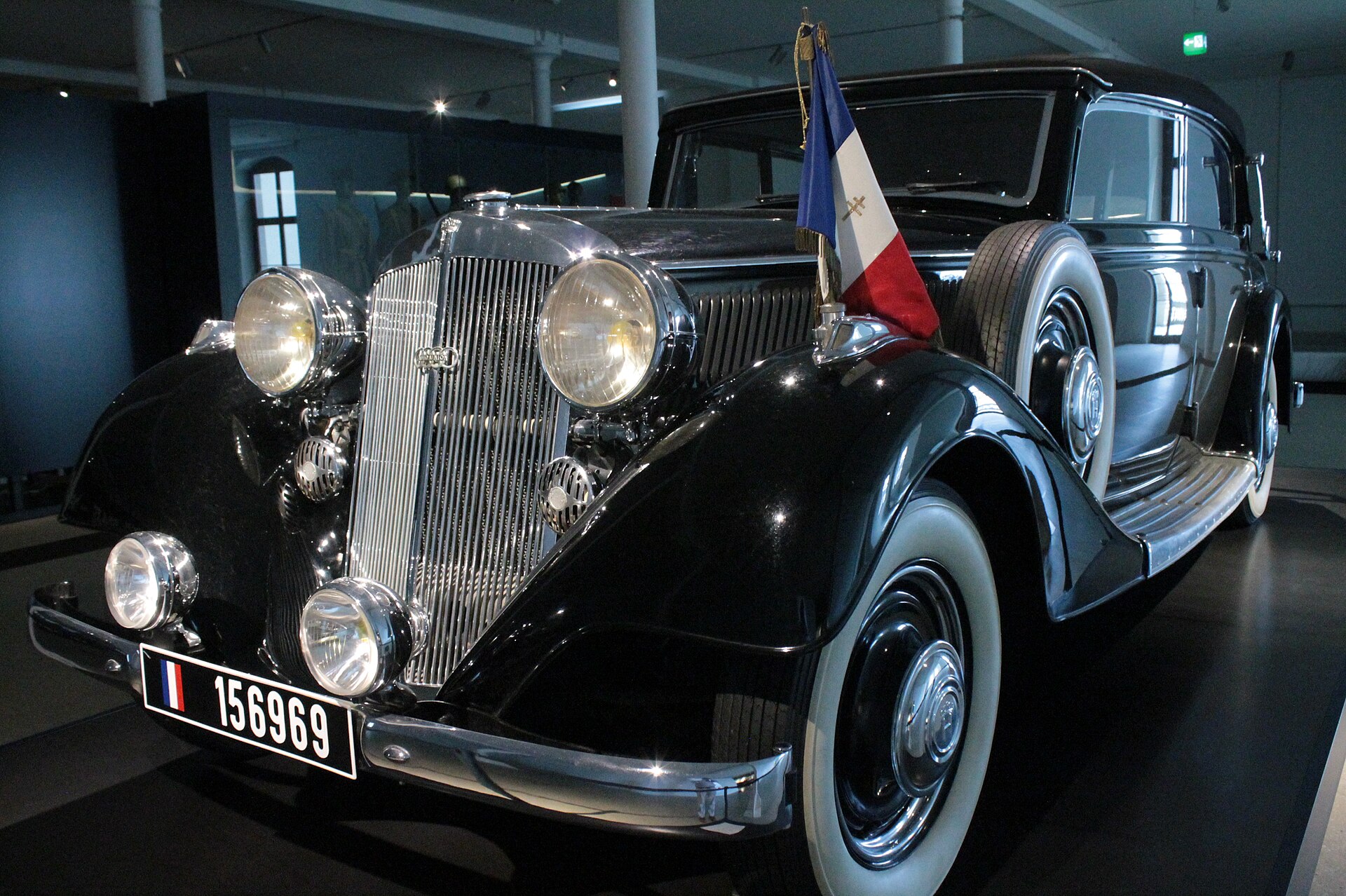
Horch — August Horch's luxury cars from Zwickau, 1899 to 1958
Horch was a German luxury car brand founded in 1899 by August Horch, one of the early engineers of the German motor industry. After a dispute with the board in 1909, August Horch left and founded a second company, Audi, whose name is the Latin form of his own. In the 1920s and 1930s Horch became known for its eight- and twelve-cylinder cars, and in 1932 it joined Audi, DKW and Wanderer in Auto Union, the group behind the four rings. The last car with the Horch name was built in Zwickau in 1958. Since 2021 Audi has used the name again for its top A8 in China.
Key takeaways
- August Horch and Salli Herz founded the company in Ehrenfeld, Cologne, on 14 November 1899; it moved to Zwickau in 1904.
- Paul Daimler joined as chief engineer on 1 July 1923 and developed the eight-cylinder Horch 8.
- Horch became the luxury brand of Auto Union, formed on 29 June 1932, and presented its 25,000th eight-cylinder car in 1936.
- The Horch 830 V8 family alone reached at least 11,000 cars at Zwickau before the Second World War.
Horch at a glance
| Fact | Value |
|---|---|
| Founded | 14 November 1899, Ehrenfeld, Cologne |
| Founders | August Horch, Salli Herz |
| Main plant | Zwickau, Saxony (from 1904) |
| Chief engineers | August Horch; Paul Daimler (1923–1928) |
| Group | Auto Union (from 1932), with Audi, DKW and Wanderer |
| Best-known models | Horch 8, 670 V12, 830, 850, 853 |
| Last car | P240 (1955–1958), renamed Sachsenring P240 |
| Brand rights | Audi (from the mid-1980s) |
August Horch: from Cologne to Zwickau
August Horch was born on 12 October 1868 in Winningen, in the Rhine Province. On 14 November 1899 the engineer and Salli Herz founded the company in Ehrenfeld, Cologne. Production of twin-cylinder cars began near Cologne in 1901.
In 1902 the business moved to Reichenbach im Vogtland, and in March that year the firm produced a 15 kW (20 hp) four-cylinder car with shaft drive. On 10 May 1904 Horch & Cie. Motorwagenwerke AG was founded as a joint-stock company in Zwickau, Saxony. The first six-cylinder engine followed in 1904 and reached production in 1907. In 1906 a Horch driven by Dr Rudolf Stöss won the Herkomer Competition.

The quarrel and the birth of Audi
In 1909 the supervisory board forced the founder out. On 16 July 1909 he founded a rival firm, also in Zwickau, called August Horch Automobilwerke GmbH. The former partners held the Horch name as a registered trademark, and a court ruled in their favour. The founder then chose a new name: "Audi", the Latin form of the German imperative "horch!" ("listen!"). The name Audi Automobilwerke was entered in the Zwickau register on 25 April 1910.
From then on, two car makers in the same town carried the founder's name in two languages. The founder left Audi in 1920 and moved to Berlin. In 1937 his autobiography, titled "I built cars" in English, was published.
Paul Daimler and the eight-cylinder Horch
In the 1920s the Zwickau company moved firmly into the luxury class. On 1 July 1923 Paul Daimler, eldest son of Gottlieb Daimler and the former technical director of Daimler-Motoren-Gesellschaft, became chief engineer in Zwickau. Daimler stayed until 1928 and developed the eight-cylinder Horch 8, which according to the Paul Daimler article "successfully challenged Mercedes-Benz". The brand's Wikipedia article says it was the first maker to put eight-cylinder engines into series production, a claim it marks as unconfirmed.
In 1928 Jørgen Skafte Rasmussen, the owner of DKW, bought the company. The model range of the late 1920s and early 1930s was wide:
| Model | Years | Engine |
|---|---|---|
| Horch 8 (Typ 350, 375, 400, 405) | 1928–1931 | Eight-cylinder |
| Horch 8 Typ 500 | 1931–1935 | 5.0-litre eight |
| Horch 12 (Typ 600, 670) | 1931–1934 | 6.0-litre V12 |
| Horch 830 | 1933–1934 | 3.0-litre V8, 51 kW (70 PS) |
| Horch 850 / 850 Sport | 1935–1937 | Eight-cylinder |
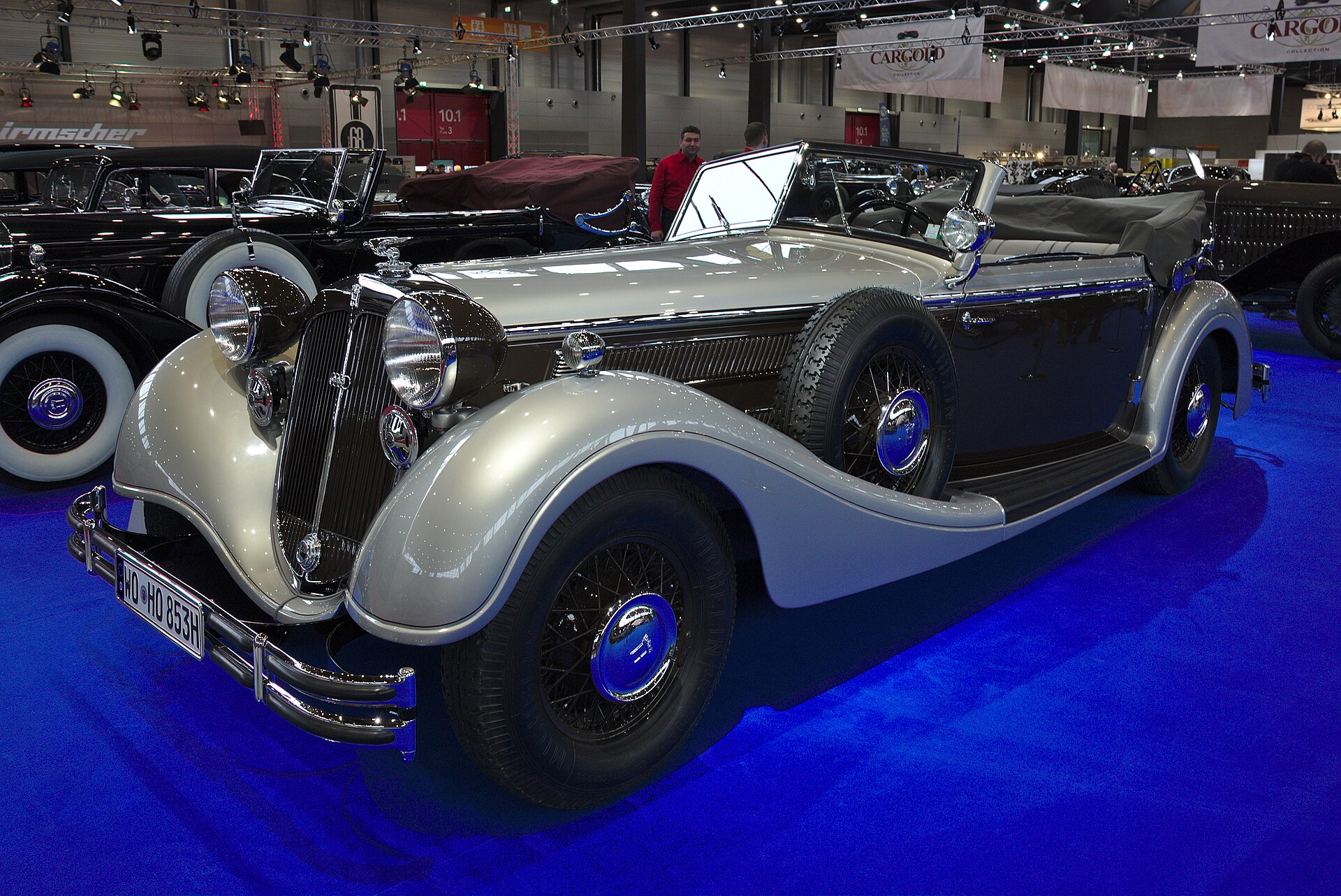
| Horch 851, 853, 855, 951 | 1937–1940 | Eight-cylinder |

Auto Union: the luxury brand of the four rings
On 29 June 1932 Horch, Audi, DKW and Wanderer merged to form Auto Union AG, based in Chemnitz. The four overlapping rings stood for the four brands. Inside the group, the Zwickau brand covered the luxury segment, with straight-eight, V8 and V12 engines.
The V8 Horch 830 family became the volume model. It was built from 1933 to 1940 as a saloon, roadster and cabriolet, and at least 11,000 were made at Zwickau before the war:
| Horch 830 family | Years | Engine | Power |
|---|---|---|---|
| 830 | 1933–1934 | 3.0-litre V8 | 51 kW (70 PS) |
| 830 B | 1935 | 3.25-litre V8 | — |
| 830 BL | 1935–1936 | 3.5-litre V8 | 55 kW (75 PS) |
| 930 V | 1938–1940 | 3.8-litre V8 | 68 kW (92 PS) |
In 1936 the 25,000th eight-cylinder luxury car left the Zwickau works. Auto Union also went racing. It bought the P-Wagen project of Ferdinand Porsche, and the racing department in Zwickau built the Grand Prix types A to D from 1934 to 1939. Auto Union cars won 25 races from 1935 to 1937.
In the late 1930s Auto Union supplied the armed forces with vehicles such as the Horch 108 and the 901. Civilian production stopped in March 1940.

After the war: Zwickau and the last Horch
The Zwickau factories were heavily bombed during the war. In 1945 the group's plants in Saxony were dismantled as war reparations and the company's assets were liquidated without compensation. Zwickau became part of East Germany. The reformed company, Auto Union GmbH, was set up in Ingolstadt, Bavaria, on 3 September 1949, and August Horch remained an honorary executive there until his death on 3 February 1951.
The old works in Zwickau built one more car under the name: the six-cylinder P240, with a 2,407 cc engine. About 1,382 were made between 1955 and 1959. In 1958 the former Horch and Audi plants in Zwickau were combined, the new brand Sachsenring was created within the IFA group, and the car became the Sachsenring P240. After that the name went dormant.

The name returns with Audi
Ownership of the new company in the West changed several times: Daimler-Benz bought 87 per cent in April 1958, and Volkswagen took over the factory in Ingolstadt and the trademark rights in 1964. Auto Union merged with NSU in 1969, and the company was renamed Audi AG in 1985. In the mid-1980s Daimler-Benz transferred the Horch brand rights to Audi. In 1991 Volkswagen also acquired the Zwickau site.
In 2021 Audi brought the name back as a flagship version of the A8 for China, aimed at the Mercedes-Maybach S-Class. Pre-war cars of the brand are now collector's items: a 1937 Horch 853A Sport Cabriolet sold at auction in Cortland, New York, on 24 June 2006 for US$299,000.
The Horch models listed on 1cars are in the Horch catalogue, and the V8 car has its own page on the Horch 830 and its Zwickau V8. The later history of the four rings is told in the history of Audi, with the post-war Auto Union 1000 and the DKW Junior. More pre-war cars are in the classic cars section.
Horch timeline
| Year | Event |
|---|---|
| 1899 | August Horch & Cie founded in Cologne (14 November) |
| 1902 | Move to Reichenbach im Vogtland |
| 1904 | Horch & Cie. Motorwagenwerke AG founded in Zwickau (10 May) |
| 1909 | August Horch forced out; new company founded (16 July) |
| 1910 | Audi Automobilwerke registered (25 April) |
| 1923 | Paul Daimler becomes chief engineer (1 July) |
| 1928 | DKW owner Rasmussen buys Horch |
| 1932 | Auto Union formed (29 June) |
| 1933 | Horch 830 V8 introduced |
| 1936 | 25,000th eight-cylinder Horch |
| 1940 | Civilian production stops (March) |
| 1955 | Horch P240 production begins in Zwickau |
| 1958 | Car renamed Sachsenring P240; Horch name ends |
| 2021 | Audi A8 Horch for China |
Landmark Horch models
| Model | Years | Why it matters |
|---|---|---|
| Horch 8 | 1928–1931 | Paul Daimler's eight-cylinder luxury car |
| Horch 670 | 1931–1934 | V12 flagship of the early 1930s |
| Horch 830 | 1933–1940 | V8 family; at least 11,000 built |
| Horch 853 | 1937–1940 | Eight-cylinder sports cabriolet |
| P240 | 1955–1959 | Last Horch, later sold as the Sachsenring P240 |
Photo gallery


FAQ
Who founded Horch?
August Horch, together with Salli Herz, in Cologne on 14 November 1899.
What is the connection between Horch and Audi?
After leaving Horch in 1909, August Horch could not use his name for a new company, so he chose "Audi", the Latin form of "horch" ("listen"). Both brands later joined Auto Union, and Audi now owns the Horch name.
What were the four rings of Auto Union?
They stood for Audi, DKW, Horch and Wanderer, which merged on 29 June 1932.
What happened to Horch after the Second World War?
The Zwickau plants were dismantled, and the town became part of East Germany. The P240 was the last Horch; it was renamed Sachsenring P240 in 1958.
Does Audi still use the Horch name?
Yes. Since 2021 Audi sells a flagship A8 Horch in China.
Sources
- Wikipedia — Horch (accessed 24 Oct 2026)
- Wikipedia — August Horch (accessed 24 Oct 2026)
- Wikipedia — Auto Union (accessed 24 Oct 2026)
- Wikipedia — Horch 830 (accessed 24 Oct 2026)
- Wikipedia — Paul Daimler (accessed 24 Oct 2026)
- Wikipedia — Sachsenring P240 (accessed 24 Oct 2026)
Found a mistake? Report an error