Auto Union — the Four-Ring Group That Became Audi
Auto Union was a German car group formed in Saxony in 1932 from four brands, Audi, DKW, Horch and Wanderer, whose four interlocking rings are still the Audi badge. Before the Second World War it built everything from small two-stroke DKWs to Horch luxury cars, and its mid-engined Grand Prix cars, designed from a Ferdinand Porsche concept, fought Mercedes-Benz for the European championship. After the war the Saxon company was dissolved, and the company was founded again in Ingolstadt in 1949. Daimler-Benz and then Volkswagen owned it, and in 1969 it merged with NSU to form the company now called Audi AG.
Key takeaways
- Auto Union AG was formed on 29 June 1932 as a holding company for DKW, Audi, Horch and the car division of Wanderer.
- Its Type A to Type D racing cars of 1934–1939 won 25 races from 1935 to 1937, and Bernd Rosemeyer won the 1936 European Championship.
- Auto Union AG of Chemnitz was struck from the commercial register on 17 August 1948; Auto Union GmbH was launched in Ingolstadt on 3 September 1949.
- Daimler-Benz bought 87% in April 1958, Volkswagen took over in 1964, and the 1969 merger with NSU created Audi NSU Auto Union AG.
Auto Union at a glance
| Fact | Value |
|---|---|
| Founded | 29 June 1932, Saxony |
| Brands | Audi, DKW, Horch, Wanderer (cars) |
| Head office | Zschopau (1932–1936), Chemnitz (1936–1948), Ingolstadt (from 1949) |
| Key people | Jørgen Skafte Rasmussen, Richard Bruhn, Ferdinand Porsche |
| Racing | Types A–D, 1934–1939; European champion 1936 |
| Post-war plants | Ingolstadt, Düsseldorf |
| Owners | Daimler-Benz (1958–1964), Volkswagen (from 1964) |
| Successor | Audi NSU Auto Union AG (1969), Audi AG (1985) |
Four brands in Saxony
Each of the four brands had its own past. August Horch founded Horch in Zwickau in 1904 and built cars with engines up to V8s and V12s. After a dispute with his own company's finance chief he founded Audi in 1909, also in Zwickau. Wanderer, based in Siegmar, added cars in 1911. DKW was founded in 1916 by the Danish engineer Jørgen Skafte Rasmussen and later built front-wheel-drive two-stroke cars in the Audi works. Rasmussen took majority control of Audi in August 1928 and in the same year bought engine tooling from the failed American maker Rickenbacker.
The money came from a state bank. The Saxony Regional Bank, which financed Rasmussen, placed Richard Bruhn on the Audi board in 1930, and severe cost-cutting followed. In summer 1932 the bank's solution was a single holding company, Auto Union AG. The four brands kept their names and their places in the market, but engineering was centralised. The four rings stood for the four members.

The Silver Arrows from Zwickau
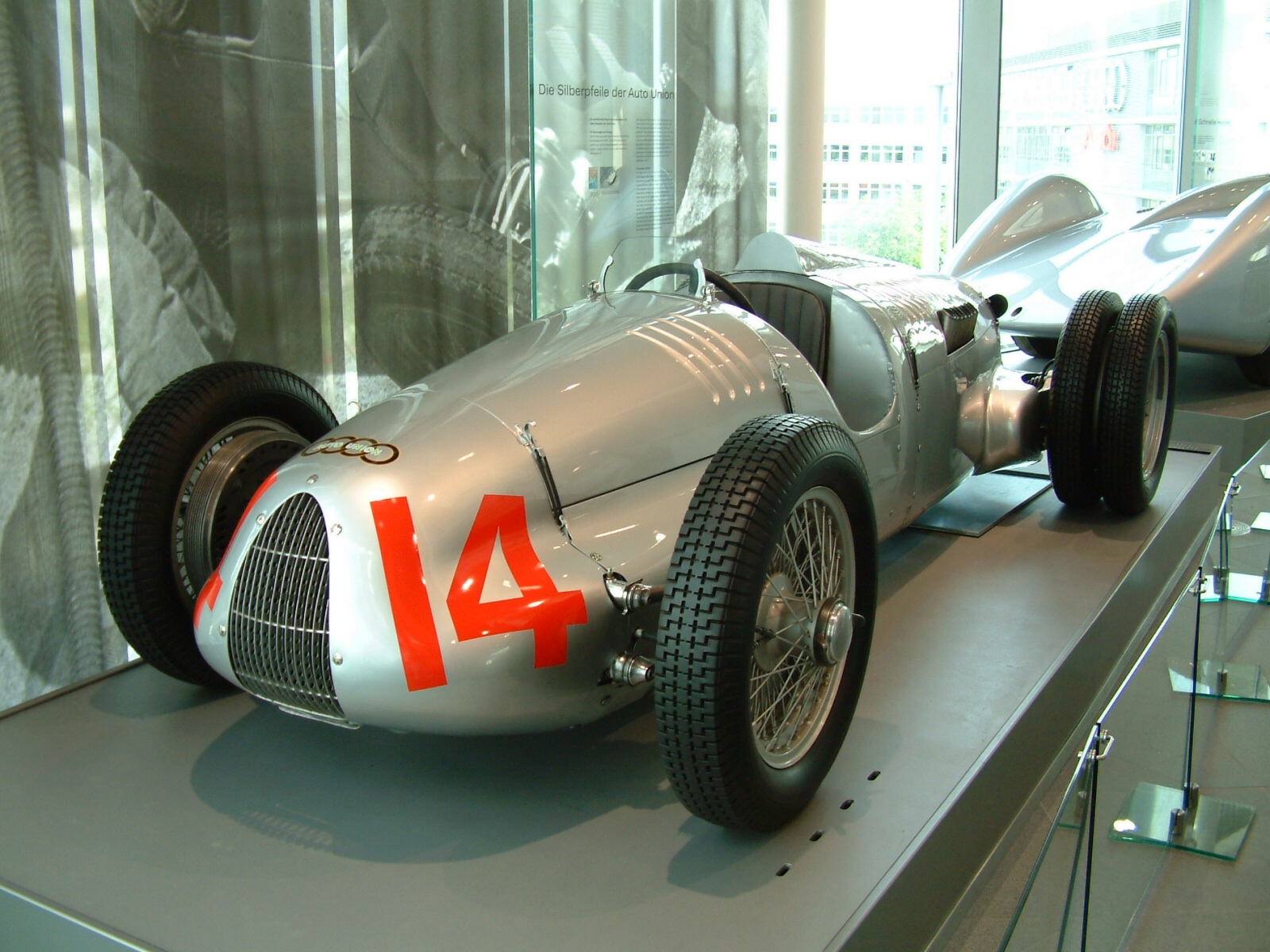
Racing gave the young group a national profile. At the Berlin Motor Show of 1933 Adolf Hitler announced a state racing programme, and Mercedes-Benz and Auto Union each received a yearly grant of 250,000 Reichsmarks. Auto Union bought Ferdinand Porsche's design for a Grand Prix car, the P-Wagen, for 75,000 Reichsmarks and set up a racing department at the Horch works in Zwickau. Ferdinand Porsche placed the supercharged V16 behind the driver, with the fuel tank between, so the balance stayed the same as the fuel burned.
The formula the cars were built for limited weight to 750 kg. The Type A of 1934 had a 4,360 cc V16 of 217 kW (295 PS). Engines grew to about 5 litres for 1935 and 6 litres for the Type C of 1936–1937, with 388 kW (520 bhp), 171 kW more than the Type A. In 1934 Hans Stuck won the Grands Prix of Germany, Switzerland and Czechoslovakia. On 15 February 1935 he averaged about 320 km/h over a flying mile near Lucca, Italy. The cars were tail-heavy and oversteered, and wheelspin was possible above 160 km/h.
Bernd Rosemeyer and the record runs
The team's star had raced motorcycles before he joined in 1935. Bernd Rosemeyer, born in Lingen on 14 October 1909, won his first Grand Prix at Brno in 1935. In 1936 he won the Grands Prix of Germany, Switzerland and Italy and the European Championship, the only drivers' title Auto Union ever won. In 1937 he won four of the team's five victories, including the Vanderbilt Cup in the United States and the Donington Grand Prix, and he reached 380 km/h on the AVUS track in Berlin.
On 28 January 1938 he died during a record attempt on the autobahn between Frankfurt and Darmstadt. Earlier that day he had set a class record of 432 km/h in his streamliner. On the third run the car was caught by a gust of wind, left the road and hit a bridge embankment. Tazio Nuvolari joined the team that year. For 1938 the rules changed to 3-litre supercharged engines, and Robert Eberan von Eberhorst designed the V12 Type D. Nuvolari won the Italian and Donington Grands Prix in 1938 and the Yugoslav Grand Prix in 1939, and Hermann Paul Müller won the 1939 French Grand Prix.
War, dismantling and the move west
From 1935 a subsidiary, Mitteldeutsche Motorenwerke, built Junkers aero engines under licence at Taucha. Civilian car production stopped in May 1940, and Auto Union became a major supplier of military vehicles, among them the chassis of the Sd.Kfz. 222 armoured car. It used forced labour, and a study commissioned by the company in 2014 found that it bore "moral responsibility" for 4,500 deaths at Leitmeritz.
Bombing hit the plants from 1944. American troops occupied Zwickau on 17 April 1945 and left on 30 June, after which the Soviet army took over the Saxon factories. They were dismantled as reparations, about 18 racing cars hidden in a colliery were removed as reparations, and Auto Union AG was struck from the register on 17 August 1948. In Zwickau, the old Audi plant restarted pre-war DKW designs as the IFA F8 and F9.
A new start came in the west. With Bavarian state loans and Marshall Plan aid, Auto Union GmbH was launched in Ingolstadt on 3 September 1949, in a depot that had handled spare parts since 1945. Only the DKW brand returned, first with the RT 125 W motorcycle and the Schnellaster van.
Ingolstadt, Daimler-Benz and Volkswagen
A second plant opened in Düsseldorf-Derendorf in 1950, building the DKW Meisterklasse F 89 P. The DKW 3=6 Sonderklasse followed in March 1953. From October 1956 to December 1968 Auto Union built 46,750 DKW Munga off-road vehicles, mainly for the new Bundeswehr. Studebaker-Packard sold the cars in the United States from 1956 to 1964.
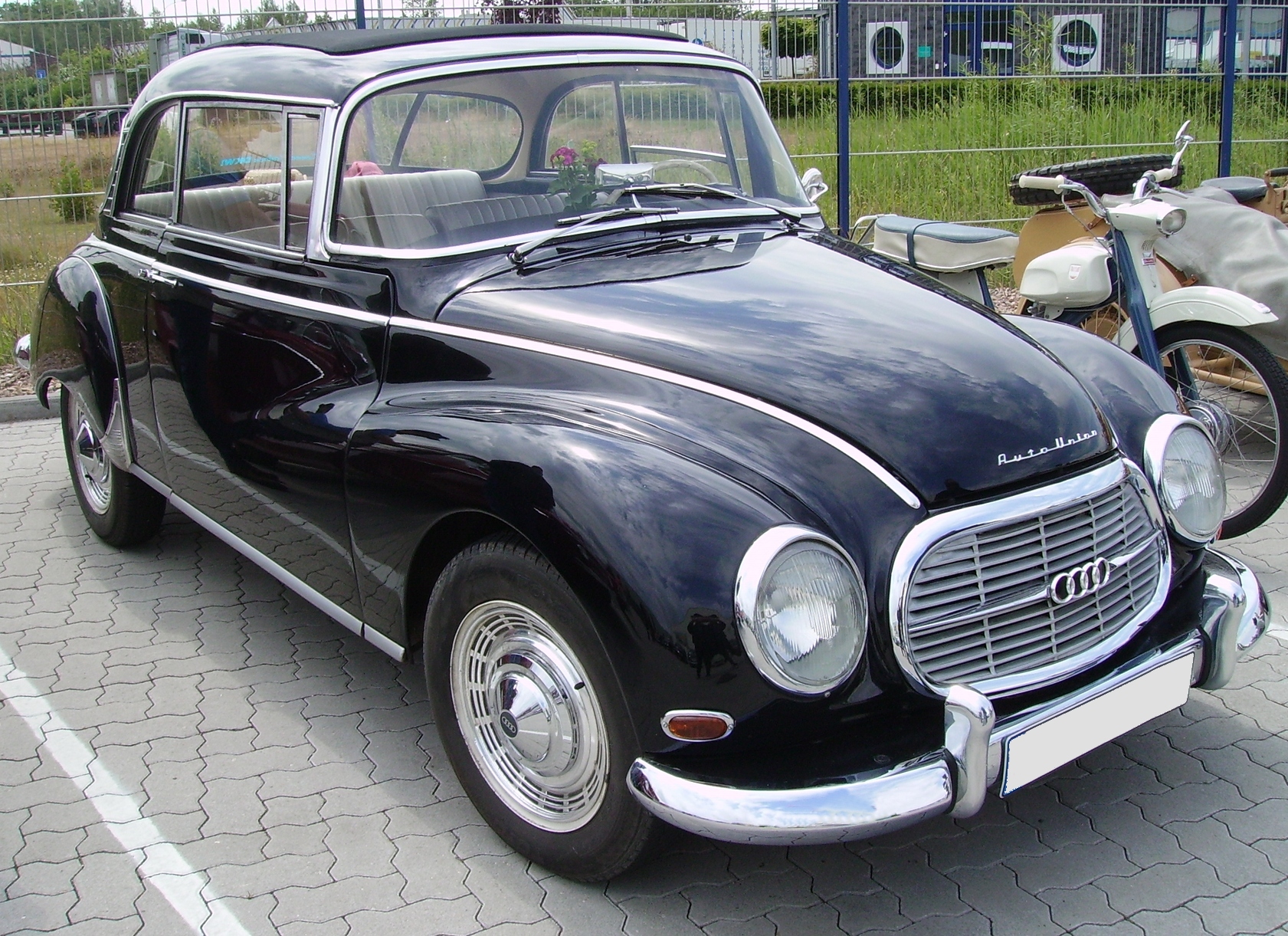
In April 1958 Daimler-Benz bought 87% of Auto Union under pressure from its main shareholder Friedrich Flick, and took full control in 1959. The group's name returned on a car, Auto Union 1000, with a 981 cc three-cylinder two-stroke of 32 kW (44 PS), or 37 kW (50 PS) in the 1000 S. It was built from 1958 to 1965, and 171,008 saloons and estates were made, mostly in Düsseldorf. In 1960 a 1000 S coupé cost £1,259 in Britain including taxes. About 6,640 of the 1000 SP coupé and roadster were built, with 40 kW (55 PS). The 1000 is covered in Auto Union 1000 history and specifications.
Volkswagen bought the Ingolstadt factory and all Auto Union trademarks in 1964; Daimler-Benz kept the dormant Horch name. The new owner replaced the two-stroke. The F103 of September 1965, based on the DKW F102 but with a four-stroke engine, was sold simply as the "Audi".
From Auto Union to Audi
In 1969 Auto Union merged with NSU Motorenwerke of Neckarsulm to form Audi NSU Auto Union AG. In 1985 the name was shortened to Audi AG, the head office returned to Ingolstadt, and a subsidiary called Auto Union GmbH was created to hold the historic trademarks. The brands of the old group are in the Audi catalogue, the DKW catalogue and the Horch catalogue; surviving models of the group itself are in Auto Union's catalogue.
Of the racing cars, no Type A or Type B is believed to survive. One Type C, three Type Ds and one Type C/D hill-climb car exist. The power converter translates the period PS and bhp figures into kW.
Auto Union timeline
| Year | Event |
|---|---|
| 1932 | Auto Union AG formed (29 June) |
| 1934 | Type A racing car; Stuck wins three Grands Prix |
| 1936 | Rosemeyer European champion; head office moves to Chemnitz |
| 1938 | Rosemeyer killed in a record attempt (28 January) |
| 1940 | Civilian production stops (May) |
| 1948 | Auto Union AG struck from the register (17 August) |
| 1949 | Auto Union GmbH launched in Ingolstadt (3 September) |
| 1958 | Daimler-Benz buys 87%; Auto Union 1000 |
| 1964 | Volkswagen takes over |
| 1965 | F103 "Audi" with a four-stroke engine |
| 1969 | Merger with NSU |
| 1985 | Company renamed Audi AG |
Landmark Auto Union models
| Model | Years | Why it matters |
|---|---|---|
| Type A | 1934 | First mid-engined V16 Grand Prix car, 217 kW (295 PS) |
| Type C | 1936–1937 | 388 kW (520 bhp); Rosemeyer's championship car |
| Type D | 1938–1939 | 3-litre V12 for the new formula |
| DKW Munga | 1956–1968 | Military off-roader; 46,750 built |
| Auto Union 1000 | 1958–1965 | Last car named Auto Union; 171,008 saloons and estates |
Photo gallery


FAQ
What do the four rings of Audi mean?
They stand for the four brands joined in Auto Union in 1932: Audi, DKW, Horch and Wanderer.
Who designed Auto Union's racing cars?
Ferdinand Porsche's design office created the first car, the P-Wagen. Robert Eberan von Eberhorst designed the V12 Type D of 1938.
What happened to Auto Union after 1945?
The Saxon company was dismantled and dissolved. Auto Union GmbH was founded in Ingolstadt in 1949.
Is Auto Union the same as Audi?
Audi AG is its direct successor: Auto Union merged with NSU in 1969 and the company was renamed Audi AG in 1985.
Sources
- Wikipedia — Auto Union (accessed 24 Oct 2026)
- Wikipedia — Auto Union racing car (accessed 24 Oct 2026)
- Wikipedia — Bernd Rosemeyer (accessed 24 Oct 2026)
- Wikipedia — Auto Union 1000 (accessed 24 Oct 2026)
- Wikipedia — DKW Munga (accessed 24 Oct 2026)
Found a mistake? Report an error