 DKW Junior
Specs, engines and history
Published Sources (1) Report an error
By Felix Hartmann, Automotive Technology & EV Contributor
- Built
- 1959–1965
- Top power
- 33 kW (45 PS)
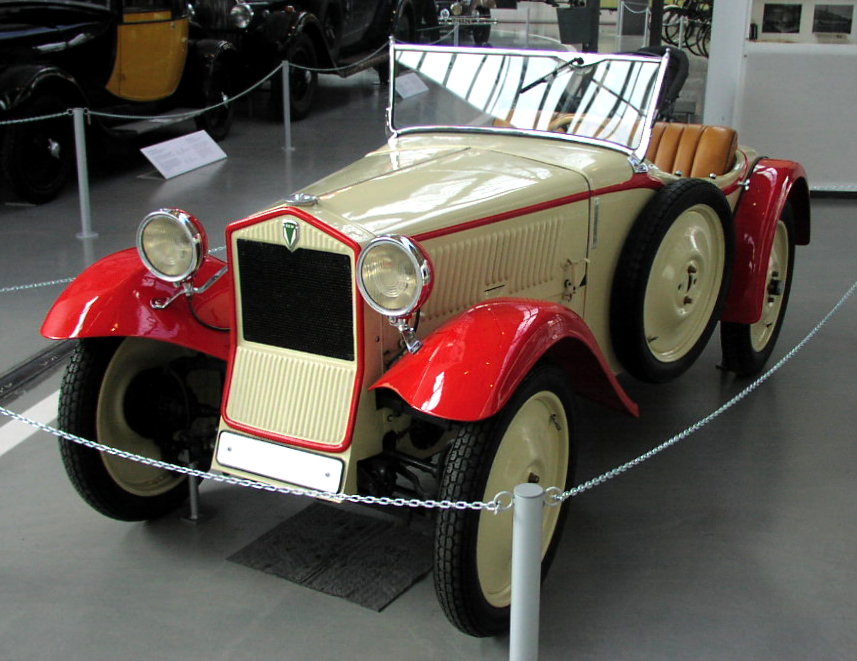
DKW, the brand behind the DKW Junior, was founded in 1916 in Zschopau, Saxony, by the Danish engineer Jørgen Skafte Rasmussen, first to make steam fittings. The name comes from Dampfkraftwagen ("steam-powered car"), a failed steam-car project of 1916; later readings were des Knaben Wunsch ("the boy's wish") and das kleine Wunder ("the little wonder"). DKW grew with small two-stroke engines and by the late 1920s was the world's largest motorcycle maker. Its first car, the Typ P, appeared on 7 May 1928, and the F1 of 1931 was among Europe's first volume-produced front-wheel-drive cars. In 1932 DKW joined Audi, Horch and Wanderer in Auto Union; after the war DKW cars were built in West Germany, and the last German-built DKW car was the F102 of 1963–1966.
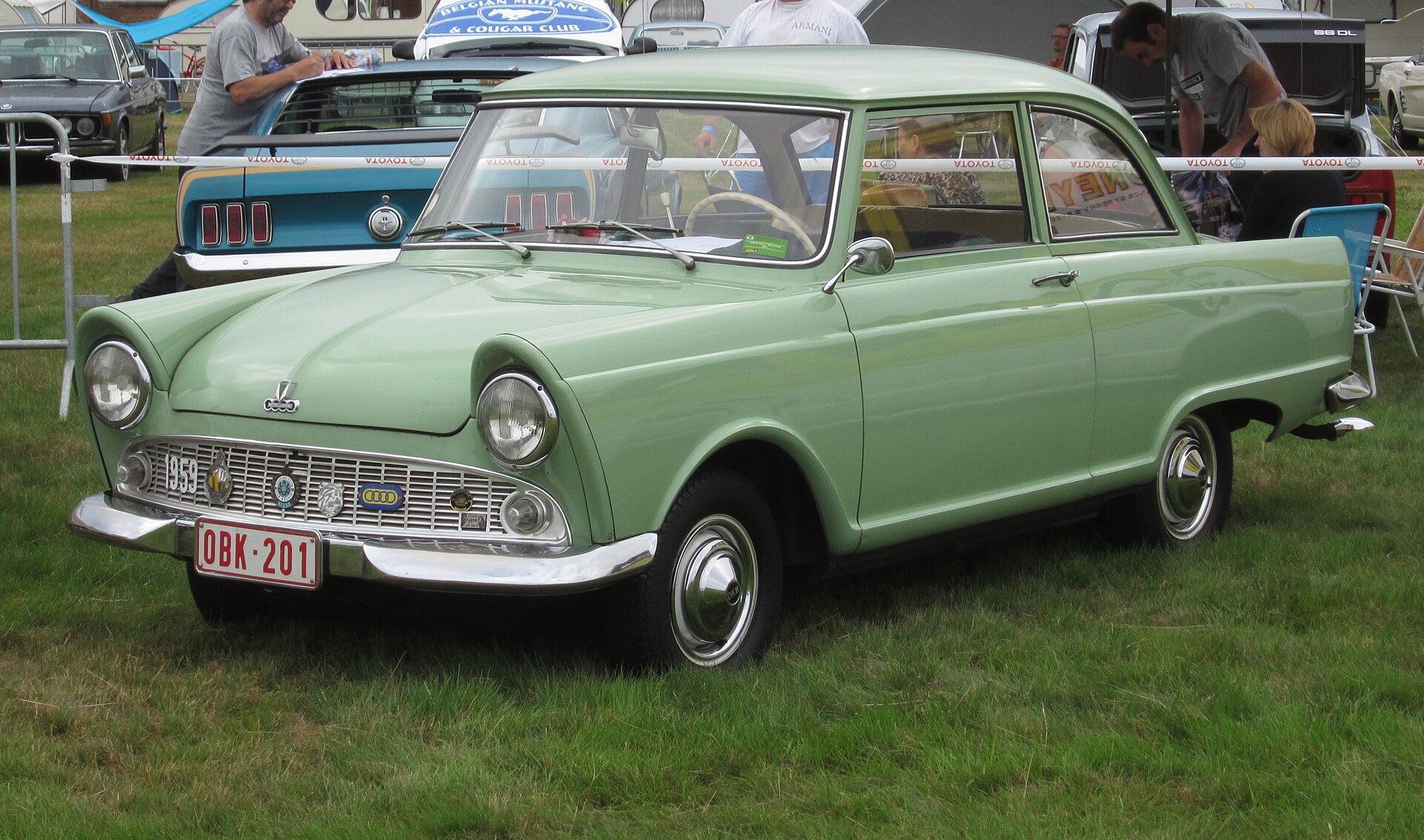
The DKW Junior was the brand's last new small car. Shown as a prototype in March 1957 and in volume production from 1959, it was a compact two-door saloon with a three-cylinder two-stroke and front-wheel drive, built in a new plant in Ingolstadt. The Junior, the Junior de Luxe, the F11 and the F12 followed each other until 1965, and the F12 was the first car in its class with front disc brakes. Volkswagen's takeover of Auto Union in 1965 ended the two-stroke cars almost at once.
Specs by version
| Version | Engine | Power | Gearbox | Drive | Production years |
|---|---|---|---|---|---|
| Junior 741 cc | 0.7 l · 3 cyl · Petrol 741 cc | 25 kW 34 PS34 hp | 4-sp Manual | Front-wheel drive | 1959–1962 |
| F12 889 cc | 0.9 l · 3 cyl · Petrol 889 cc | 29 kW 39 PS39 hp | 4-sp Manual | Front-wheel drive | 1963–1965 |
Verified Manufacturer and type-approval data from our catalog · Sources and methodology
In short
- Built 1959–1965 in Ingolstadt as Junior, Junior de Luxe, F11 and F12, plus the F12 Roadster.
- Three-cylinder two-stroke, water-cooled: 741 cc with 25 kW (34 bhp) at first, 889 cc with 30 kW (40 bhp) in the F12 and 34 kW (45 bhp) in the Roadster.
- Front-wheel drive, four-speed column gearbox; F12 with front disc brakes.
- Price in Germany in 1961: 4,790 marks, plus 160 marks for the optional heater.
DKW Junior at a glance: maker, production years (1959–1965), purpose
| Parameter | Value |
|---|---|
| Maker | Auto Union GmbH (DKW brand), Ingolstadt, West Germany |
| Production | 1959 – 1965 |
| Purpose | small family car |
| Body | two-door saloon; F12 Roadster (cabriolet) |
| Layout | front engine, front-wheel drive |
| Engines | three-cylinder two-stroke, 741, 796 and 889 cc, water-cooled |
| Power | 25 kW (34 bhp) to 34 kW (45 bhp) |
| Torque | 63.8 Nm (741 cc) to 78.5 Nm (889 cc) at 2,250–2,500 rpm |
| Gearbox | four-speed manual, column change by cable |
| Wheelbase | 2,175 mm (Junior); 2,250 mm (F11, F12) |
| Length × width | 3,965–3,968 × 1,575 mm |
| Dry weight | 700 kg (Junior) to 970 kg (F12 with 34 kW) |
| Successor | NSU Typ 110 (listed in English Wikipedia) |
Development and production history
DKW showed a prototype at the Frankfurt Motor Show in March 1957. It was first badged DKW 600 and had a 660 cc two-cylinder two-stroke. When the car entered volume production in 1959, it had a three-cylinder engine and the name Junior. Earlier DKW cars had been assembled in Düsseldorf; for the Junior, Auto Union built a new plant in Ingolstadt.
The Junior de Luxe of 1961 brought a larger engine, and the Junior itself was withdrawn in 1962. In January 1963 the F12 replaced the Junior de Luxe, and in August 1963 the F11 arrived as a simpler F12. The F12 Roadster followed in 1964, and a 34 kW (45 PS) F12 saloon was offered for a few months from February 1965. In early summer 1965 Volkswagen bought Auto Union from Daimler-Benz, and two-stroke DKW production ended almost immediately. By the end of 1965 the plant was building Audi cars with four-stroke engines developed with Mercedes-Benz. The background is told in the history of Audi.

Design and engineering
The Junior is a compact two-door saloon, 3,965 mm long and 1,575 mm wide, on a 2,175 mm wheelbase. The F11 and F12 have a 75 mm longer wheelbase and look similar, but their rear roof pillar is more angular. Height ranges from 1,430 mm for the Junior to 1,453 mm for the F11 and the 34 kW (45 PS) F12; the Roadster is 1,375 mm high.
The Junior ran on 5.20-12 tyres, the later models on 5.50-13 tyres; the de Luxe moved to 13-inch wheels. The track grew from 1,180 mm front and 1,210 mm rear on the Junior to 1,200 and 1,280 mm on the F11. The F12 was the first car in its class with front disc brakes.

Engine and drivetrain: the three-cylinder two-stroke
All engines are inline three-cylinder two-strokes, mounted at the front, water-cooled and without valve gear, with 6-volt electrics. The 741 cc unit (68 × 68 mm) of the Junior gives 25 kW (34 bhp) and 63.8 Nm at 2,500 rpm. The 796 cc engine (70.5 × 68 mm) of the Junior de Luxe and the F11 keeps 25 kW (34 bhp) but has 71.1 Nm. The 889 cc engine (74.5 × 68 mm) of the F12 gives 29–30 kW (40 bhp) and 78.5 Nm at 2,250–2,500 rpm; English Wikipedia gives 30 kW in its text and 29 kW in its table. The Roadster and the last F12 saloon had 33–34 kW (45 bhp); English Wikipedia gives 34 kW in the text and 33 kW in the table.
Power goes to the front wheels through a four-speed manual gearbox with a column-mounted lever linked by cable. With 25 kW and 700 kg, the first Junior has about 36 kW per tonne; the power-to-weight calculator compares that with a modern small car.
DKW Junior specifications
| Version | Years | Engine | Power | Compression |
|---|---|---|---|---|
| Junior | 1959–1962 | 741 cc | 25 kW (34 bhp) | 7:1 |
| Junior de Luxe | 1961–1963 | 796 cc | 25 kW (34 bhp) | 8:1 |
| F11 | 1963–1965 | 796 cc | 25 kW (34 bhp) | 7.25:1 |
| F12 | 1963–1965 | 889 cc | 29–30 kW (40 bhp) | 7:1 |
| F12 Roadster | 1964 | 889 cc | 33–34 kW (45 bhp) | 7.25:1 |
| F12 saloon, 1965 version | 1965 | 889 cc | 33–34 kW (45 bhp) | 7.25:1 |
| Data | Value |
|---|---|
| Top speed | 114 km/h (Junior); 116 km/h (Junior de Luxe) |
| Dry weight | 700 kg (Junior); 940 kg (Roadster); 970 kg (F12 with 34 kW) |
| Loaded weight | 1,020–1,140 kg |
| Tyres | 5.20-12 (Junior); 5.50-13 (later models) |
Variants and derivatives: de Luxe, F11, F12 and Roadster
- Junior (1959–1962): the original car with the 741 cc engine.
- Junior de Luxe (1961–1963): 796 cc engine with 8:1 compression and 13-inch wheels; top speed up from 114 to 116 km/h.
- F11 (1963–1965): a simpler F12 with the 796 cc engine, introduced in August 1963.
- F12 (1963–1965): 889 cc engine, longer wheelbase, angular rear pillar and front disc brakes.
- F12 Roadster (1964): the open version with 33–34 kW (45 bhp), built in limited numbers.
- F12 with 34 kW (45 PS), 1965: the saloon with the Roadster's engine, offered for a few months.

In service: operation and legacy
The Junior range sold in large numbers, as English Wikipedia notes, but by the mid-1960s the two-stroke had reached its development limits. When Volkswagen took over Auto Union in 1965, it replaced the DKW range with the four-stroke Audi, and the DKW car brand ended with the F102 and the Munga off-roader. The DKW trademark is now owned by Auto Union GmbH, a subsidiary of Audi AG. Prices outside Germany were higher: in July 1965 an F11 cost £998 and an F12 £1,198 in New Zealand. The larger two-stroke of the same years, Auto Union's 1000, was built in Düsseldorf; its models are in the Auto Union catalogue.
Preservation and collecting today
The Junior is a small and simple classic. The F12 Roadster was built only in limited numbers, the 34 kW (45 PS) saloon only for a few months in 1965, and the F12 has the advantage of front disc brakes. No reliable public price data in euros was found for this article, so no market values are given.
Which DKW Junior to choose:
- For originality: an early Junior with the 741 cc engine.
- For better brakes: an F12 with front discs.
- For open-air driving: the F12 Roadster.
- For more power: the 34 kW (45 PS) F12 saloon of 1965.
More German cars of the time are in the 1950s classics, the 1960s classics and the classic cars section; every model of the brand is in the DKW catalogue.
Photo gallery


DKW Junior in our rankings
- No. 551 of 912 · Longest-running car nameplates (6 years · top 69%)
- No. 145 of 149 · Most powerful sedans (33 kW · top 98%)
- No. 121 of 124 · Most powerful German cars (33 kW · top 98%)
- No. 93 of 94 · Most powerful cars of the 1960s (29 kW · top 99%)
- No. 846 of 859 · Most powerful cars (33 kW · top 99%)
- No. 130 of 131 · Biggest engines: sedans (889 cc)
In production longer than 31% of ranked nameplates in the 1CARS catalog (No. 551 of 912).
FAQ
What engine does the DKW Junior have?
A water-cooled three-cylinder two-stroke: 741 cc with 25 kW (34 bhp) in the Junior, 796 cc in the de Luxe and F11, and 889 cc with 29–30 kW (40 bhp) in the F12.
What is the difference between the DKW F11 and F12?
The F11 of August 1963 was a simpler F12 with the 796 cc engine; the F12 had the 889 cc engine and front disc brakes.
How much did a DKW Junior cost?
In 1961 it cost 4,790 marks in Germany, and the optional heater 160 marks more.
Where was the DKW Junior built?
In a new plant which Auto Union built for it in Ingolstadt; earlier DKW cars were assembled in Düsseldorf.
Why did DKW stop making the Junior?
Volkswagen bought Auto Union in 1965 and ended two-stroke DKW production almost at once, replacing it with four-stroke Audi cars.
Data sources
Data checked by an editor against the sources below.