DKW — Rasmussen's Two-Stroke Motorcycles and Front-Drive Cars
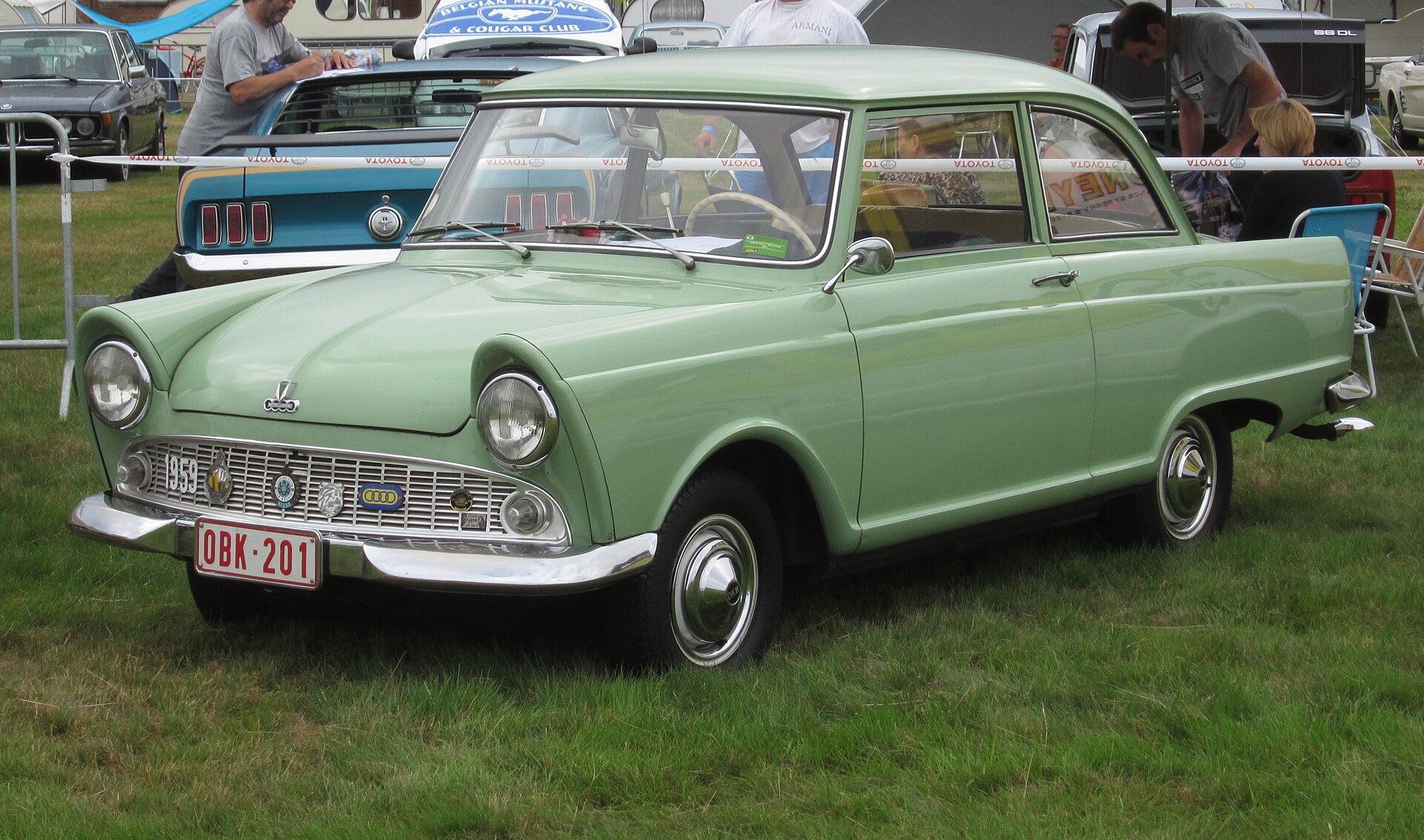
DKW was the German maker of two-stroke motorcycles and small cars founded in Zschopau, Saxony, by the Danish engineer Jørgen Skafte Rasmussen. By the late 1920s it was the largest motorcycle maker in the world, and its F1 of 1931 began the first volume-produced line of front-wheel-drive cars in Europe. DKW became one of the four brands of Auto Union in 1932, carried the group after the war, and built its last German car, the F102, in 1966. Licensed DKWs were made in Brazil until 1967 and in Argentina until 1969.
Key takeaways
- Rasmussen started in Zschopau in 1916 with steam fittings; the DKW name comes from his failed steam car, the Dampfkraftwagen.
- The F-series of 1931–1942 had two-cylinder two-strokes of 584 or 692 cc; about 218,000 were built in Zwickau, and DKW was second in German sales behind Opel from 1933 to 1938.
- After the war DKW built the F89, the three-cylinder 3=6, the Junior and the Munga in Ingolstadt and Düsseldorf; 46,750 Mungas were made from 1956 to 1968.
- Every DKW car used a two-stroke engine; the four-stroke successor of 1965 was sold as an Audi.
DKW at a glance
| Fact | Value |
|---|---|
| Founded | 1916, Zschopau, Saxony |
| Founder | Jørgen Skafte Rasmussen (1878–1964) |
| Name | Dampfkraftwagen (steam-powered car) |
| Products | Motorcycles, cars, vans, the Munga off-roader |
| Engines | Two-stroke only: two-, three- and V4 cylinders |
| Group | Auto Union from 1932 |
| Post-war plants | Ingolstadt, Düsseldorf |
| Last German car | F102, production ended in 1966 |
| Trademark today | Auto Union GmbH, owned by Audi AG |
Rasmussen, steam and the "little wonder"
Jørgen Skafte Rasmussen was born in Nakskov, Denmark, on 30 July 1878. He moved to Germany in 1898 to study engineering at Mittweida in Saxony and took his exams at the new technical college in Zwickau in 1902. In 1916 he set up a business in Zschopau to make steam fittings and tried to build a steam car. The car failed, but its name, Dampfkraftwagen, gave the company its initials. Later readings of DKW include "des Knaben Wunsch" (the boy's wish) and "das kleine Wunder" (the little wonder).
The two-stroke engine came next. In 1919 Rasmussen built a small toy two-stroke, then fitted an enlarged version to bicycles and motorcycles. The 10,000th DKW engine was finished in autumn 1921 and the 50,000th in February 1924. The Rasmussen article dates the motorcycle factory, Zschopauer Motorenwerke, to 1921. In September 1924 DKW bought Slaby-Beringer, a firm hit by inflation, and its founder Rudolf Slaby became DKW's chief engineer. By the late 1920s DKW was the largest motorcycle maker in the world.
The first cars and the front-wheel-drive F1
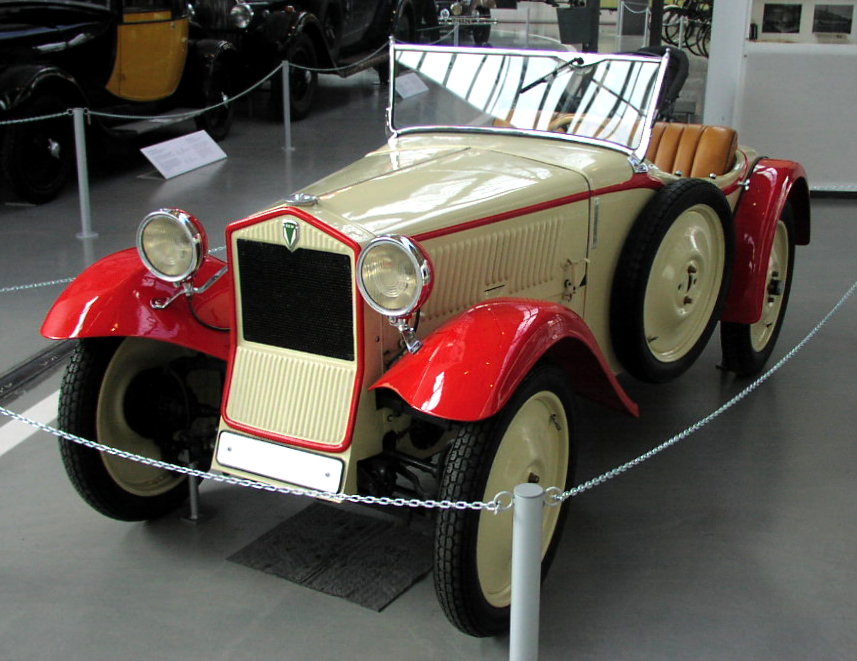
The first DKW car, the rear-driven Typ P, appeared on 7 May 1928 and was built in Spandau, Berlin, until 1931. The same year Rasmussen bought a majority of the Audi car company. A larger rear-drive range, the Schwebeklasse and Sonderklasse of 1929–1940, used a V4 two-stroke of 1.0 and later 1.1 litres, in which two cylinders acted as charging pumps.
The car that mattered was the F1. Design work started in October 1930, three running prototypes were built in six weeks, and it appeared at the Berlin Motor Show in February 1931. It had a 584 cc two-cylinder two-stroke of 11 kW (15 PS) driving the front wheels through a three-speed gearbox. Bodies came from Spandau and assembly was in Zwickau. The car weighed only 450 kg, about 24 kW per tonne on these figures, and cost about 1,700 Reichsmarks in 1931. About 4,000 were sold up to 1932, roughly 8% of a depressed market.
Auto Union and the F-series years
The Saxony Regional Bank, which had financed Rasmussen, put Richard Bruhn on the Audi board in 1930. In summer 1932 DKW, Audi, Horch and the car division of Wanderer were merged into Auto Union. Rasmussen was removed from the board in 1934 after disagreements with other directors.
Inside the group, DKW was the volume brand. The F-series ran from the F1 to the F8, built from 1931 to 1942, with 584 or 692 cc engines and a Dynastart combined starter and generator. About 218,000 were built in Zwickau. In 1933 DKW made about 16,000 cars, and from 1931 to 1938 it sold 189,369 F-series cars, over 16% of the German market. DKW was second only to Opel in German sales every year from 1933 to 1938. Total pre-war and wartime civilian output was almost 250,000 cars. A 1939 prototype already had a 900 cc three-cylinder of 22 kW (30 hp).
Motorcycles kept their lead. DKW pioneered split-single racing engines from 1931, and its RT 125 was a key model before and after the war. After 1945 its drawings went abroad as reparations: Harley-Davidson and BSA received the RT 125 design, and Yamaha also built similar two-strokes.

Division after 1945
The war split the company. The Zschopau factory stayed in the Soviet zone and became MZ, which built two-stroke motorcycles into the 1990s. In Zwickau the F9 prototype went into production as the IFA F9, and a lawsuit later stopped East German makers from using the DKW name. Rasmussen fled to Flensburg in 1945 and returned to Denmark in 1947. In the 1950s he built motorcycles under the DISA name, and he died in Copenhagen on 12 August 1964.
In the west, Auto Union GmbH was registered in 1949 and DKW was the only brand it revived. The F89 of 1950–1954 combined the pre-war F9 body with the two-cylinder engine of the last F8. The three-cylinder F91 of 1953–1955 had 25 kW (34 hp), and the F93 of 1956–1959 had 28 kW (38 hp), both from 900 cc. Saab used the DKW three-cylinder as the model for the two-stroke of its first car, the Saab 92. DKW was among Europe's most successful rally brands for several years in the 1950s.

Junior, Munga and the last DKWs
The Munga off-roader, named from the German for "multi-purpose universal off-road car with all-wheel drive", was built in Ingolstadt from October 1956 to December 1968 for the Bundeswehr, the German Border Police and other NATO armies; 46,750 were made. The Royal Netherlands Army alone received about 2,000. The small Monza coupé of 1956–1958 set FIA class records at Monza in December 1956; about 75 were built.
The Junior and F12 range of 1959–1965 was a popular small car, described in DKW Junior history and specifications. The F102 entered production in 1964 but sold poorly. Ownership had changed: Daimler-Benz controlled Auto Union from the late 1950s, and Volkswagen took over in 1964–1965 and bought the remaining shares in 1967. Volkswagen replaced the two-stroke with a four-stroke, and the result, the F103, was sold as an Audi. The F102 was the last DKW built in Germany, and production ended in 1966. A two-stroke V6 of 1.3 litres and 62 kW (83 hp) was tested in 13 F102s and some Mungas, but about 100 engines were built only for trials.

DKW around the world
Licence production lasted longer. Vemag in Brazil built DKWs from 1957 to 1967, including the Belcar saloon, the Vemaguet estate, the Fissore coupé and the Candango version of the Munga; it made 109,343 cars and 117,191 vehicles in total. The Malzoni GT coupé led to the Brazilian Puma brand. IASF in Sauce Viejo, Argentina, built 32,628 vehicles from 1960 to 1969, and its pick-up continued under IME until 1979. Hart, Nibbrig & Greve assembled about 13,500 cars at Sassenheim in the Netherlands from 1956 to 1961, and IMV in Novo Mesto, Yugoslavia, assembled DKW vans from 1955.

Collecting a DKW today
For collectors DKW offers wide variety in small sizes. The pre-war F-series cars are very light: the F1 weighed 450 kg. Compared with it, the post-war F93 had 28 kW, 17 kW more than the F1's 11 kW. The Munga was also used by farmers and foresters, and many former Dutch army cars went to Britain in the late 1970s. The power converter translates the PS and hp ratings of different years. The brands of the old group are in Auto Union's catalogue and the Audi catalogue, DKW's own model is in the DKW catalogue, and more cars of the period are in 1950s classics.
DKW timeline
| Year | Event |
|---|---|
| 1916 | Rasmussen's steam-fitting business in Zschopau; steam car project |
| 1919 | Toy two-stroke engine |
| 1928 | First DKW car, the Typ P (7 May); Rasmussen buys a majority of Audi |
| 1931 | F1 front-wheel-drive car at the Berlin show (February) |
| 1932 | DKW joins Auto Union |
| 1942 | End of F-series production |
| 1949 | Auto Union GmbH registered in the west |
| 1953 | Three-cylinder F91 |
| 1956 | Munga production starts (October) |
| 1959 | DKW Junior |
| 1966 | Last German DKW, the F102 |
| 1969 | End of Argentine production |
Landmark DKW models
| Model | Years | Why it matters |
|---|---|---|
| F1 | 1931–1932 | Start of Europe's first volume front-wheel-drive car line |
| F8 | to 1942 | Last pre-war F-series car |
| F91 / F93 (3=6) | 1953–1959 | Three-cylinder two-stroke family |
| Munga | 1956–1968 | Military off-roader; 46,750 built |
| Junior | 1959–1965 | Popular small car of the Auto Union era |
| F102 | 1964–1966 | Last DKW car built in Germany |
FAQ
What does DKW stand for?
Dampfkraftwagen, after Rasmussen's 1916 steam car. Later readings include "das kleine Wunder", the little wonder.
Who founded DKW?
The Danish engineer Jørgen Skafte Rasmussen, in Zschopau, Saxony.
Did DKW make front-wheel-drive cars?
Yes. The F1 of 1931 began the F-series, the first volume-produced front-wheel-drive car line in Europe.
Why did DKW disappear?
The F102 sold poorly, and Volkswagen replaced the two-stroke with a four-stroke engine. The F103 that followed in 1965 was sold as an Audi.
Sources
- Wikipedia — DKW (accessed 24 Oct 2026)
- Wikipedia — Jørgen Skafte Rasmussen (accessed 24 Oct 2026)
- Wikipedia — DKW F1 (accessed 24 Oct 2026)
- Wikipedia — DKW Munga (accessed 24 Oct 2026)
- Wikipedia — Auto Union (accessed 24 Oct 2026)
Found a mistake? Report an error