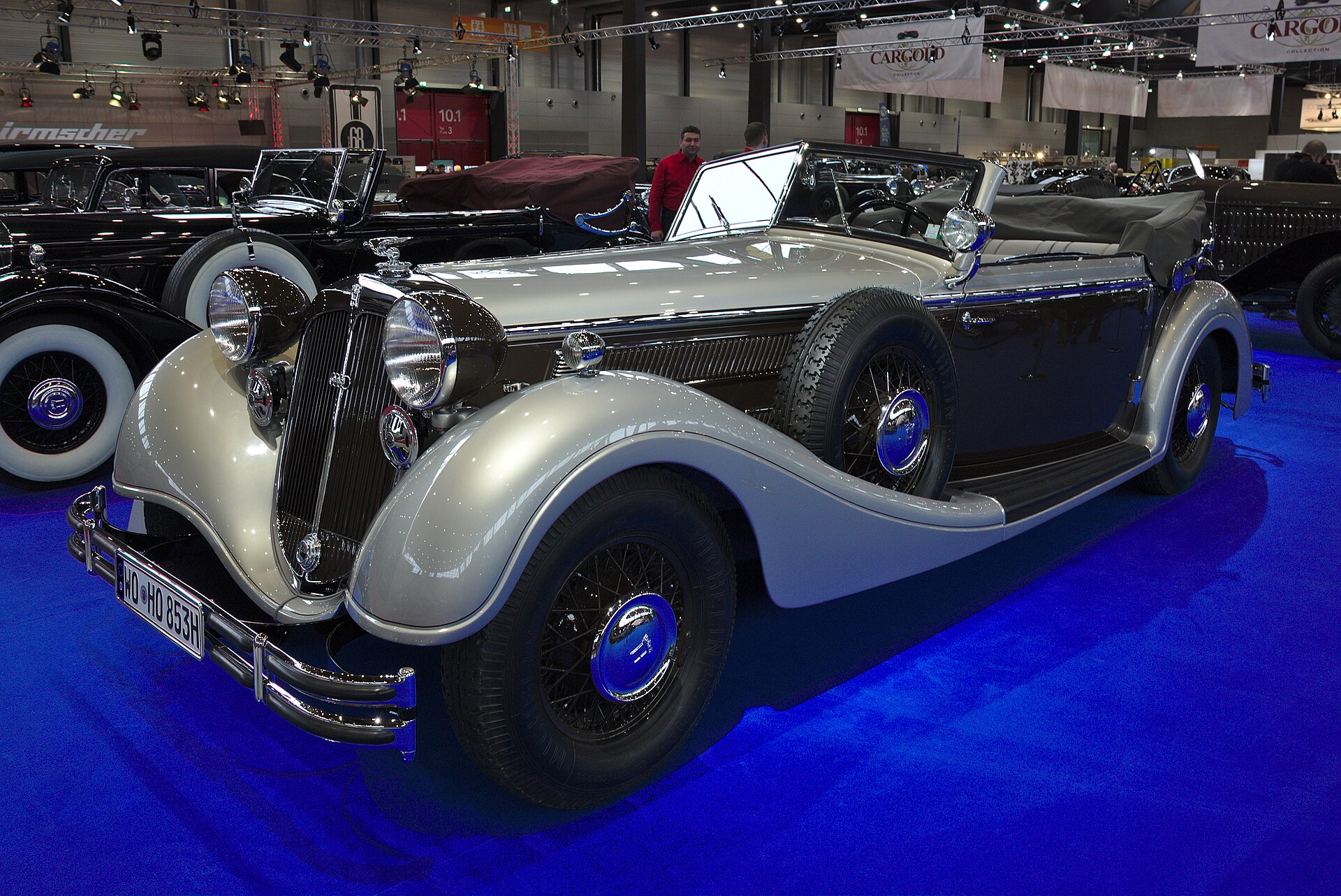
 Horch 830
Specs, engines and history
Published Sources (1) Report an error
By Felix Hartmann, Automotive Technology & EV Contributor
- Built
- 1933–1940
- Top power
- 68 kW (92 PS)
Horch was a German maker of luxury cars. August Horch, who had worked as production manager for Karl Benz, founded the company with Salli Herz on 14 November 1899 in Ehrenfeld, Cologne. It moved to Reichenbach in 1902 and to Zwickau in 1904. In 1909 the supervisory board forced Horch out, and he founded a second company, which became Audi. Under chief engineer Paul Daimler, who joined in 1923, Horch built large eight-cylinder cars, and in 1936 it celebrated its 25,000th eight-cylinder luxury car. On 29 June 1932 Horch merged with Audi, DKW and Wanderer into Auto Union, whose four rings live on in the Audi badge. Audi revived the Horch name in 2021 for a flagship version of the A8.
The Horch 830 is the V8 family that carried the brand through the 1930s. Presented at the Berlin motor show in February 1933 and built in Zwickau until spring 1940, it was the first Horch with a V8 instead of an in-line eight or a V12. German Wikipedia counts 11,625 civilian 830 and 930 cars. The side-valve V8 grew from 3.0 to 3.8 litres and from 51 kW (70 PS) to 68 kW (92 PS), and the cars were offered as saloons, cabriolets, tourers, Pullman limousines and roadsters.
Specs by version
Verified Manufacturer and type-approval data from our catalog · Sources and methodology
In short
- Built in Zwickau from autumn 1933 to spring 1940; 11,625 civilian 830/930 cars (German Wikipedia), at least 11,000 according to English Wikipedia.
- 66-degree side-valve V8: 3.0 l with 51 kW (70 PS) at first, 3.8 l with 68 kW (92 PS) from 1938.
- Four-speed ZF "Aphon" gearbox; from 1938 fully synchronised, with an overdrive.
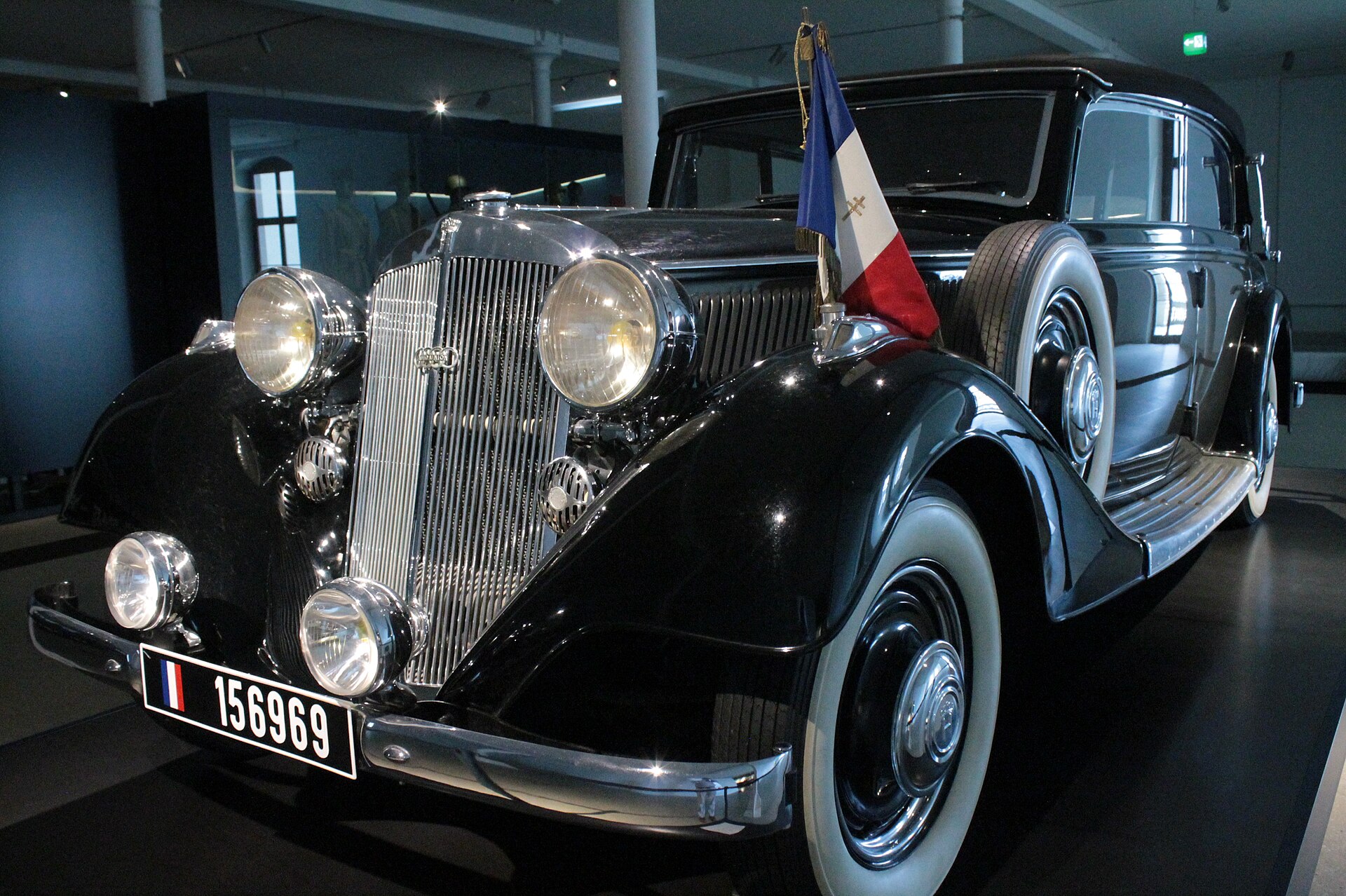
- Charles de Gaulle used a Horch 830 BL cabriolet for official occasions until 1959; the car is now in the Military History Museum in Dresden.
Horch 830 at a glance: maker, production years (1933–1940), purpose
| Parameter | Value |
|---|---|
| Maker | Horch (Auto Union AG), Zwickau, Germany |
| Production | autumn 1933 – spring 1940 |
| Built | 11,625 civilian 830/930 cars (German Wikipedia) |
| Purpose | full-size luxury car |
| Body | four-door saloon, two- and four-door cabriolet, six-seat tourer, Pullman saloon and cabriolet, phaeton, roadster |
| Layout | front engine, rear-wheel drive |
| Engine | side-valve V8, 66-degree bank angle, 3.0 to 3.8 l |
| Power | 51 kW (70 PS) to 68 kW (92 PS) |
| Gearbox | ZF Aphon four-speed manual; overdrive from 1938 |
| Frame | ladder frame of box sections |
| Wheelbase | 3,200 mm (830), 3,350 mm (830 BL), 3,100 mm (930 V) |
| Weight | 1,650 kg (830) to 1,960 kg (930 V 3.8) |
| Predecessor | Horch 8 (type 430) |
Development and production history
Horch presented the 830 at the Berlin show in February 1933 as the successor of the Horch 430, one of the Horch 8 series. First deliveries followed in autumn 1933. It was developed under Auto Union, and German Wikipedia explains the choice of a V8: it was cheaper to build and shorter than the in-line eight, and about 80 kg lighter. The 830 itself weighed 1,650 kg, about 200 kg less than the 430.
The family then grew in steps. The 830 B of 1935 had a 3.25-litre engine and hydraulic drum brakes. In the same year the long-wheelbase 830 BL arrived, and the shorter car was renamed 830 Bk. In January 1937 the Bk gave way to the 930 V, with a shorter wheelbase and more aerodynamic bodies. In September 1938 a longer stroke took the engine to 3.8 litres. Civilian production stopped in spring 1940. A 930 L and a streamlined 930 S had been planned to follow in 1940, but the war prevented it; four 930 S cars were built in Zwickau in 1948. Auto Union's story is in the history of Audi.

Design and engineering
The chassis is a ladder frame made of box sections instead of open U-profiles. The first 830 had rigid axles front and rear. The 830 B and the Pullman models got independent front suspension with double wishbones, and English Wikipedia describes the 830 as the first Horch with a transverse leaf spring. The 830 BL and the four-door cabriolet had a De Dion rear axle. Brakes were drums, first operated by cable and later hydraulically.
Bodies came in many styles, from the four-door limousine to the two-door roadster, and some had streamlined tails. The 830 BL is the largest, 5,050 mm long on a 3,350 mm wheelbase, while the 930 V is 4,920 mm long on 3,100 mm.
Engine and drivetrain: the side-valve V8
The V8 has its cylinder banks at 66 degrees. A single camshaft sits between the banks, driven by a triple roller chain, and operates horizontal valves through rocker arms. The crankshaft runs in three main bearings; the earlier in-line eight had ten. The engine grew over the years:
| Engine | Version | Power |
|---|---|---|
| 3,004 cc (75 × 85 mm) | 830, 1933–1934 | 51 kW (70 PS) |
| 3,250 cc (78 × 85 mm) | 830 B, 1935 | 51 kW (70 PS) |
| 3,517 cc (78 × 92 mm) | 830 Bk / BL, from 1935 | 55 kW (75 PS) at 3,600 rpm |
| 3.5 l, two carburettors | 930 V, 1937 | 60 kW (82 PS) |
| 3,823 cc (78 × 100 mm) | 830 BL and 930 V, from 1938 | 68 kW (92 PS) at 3,200 rpm |
Power went to the rear wheels through a ZF "Aphon" four-speed gearbox with helical gears. At first second to fourth gears were synchronised; from 1938 all four were, and an overdrive, engaged with a second lever, became standard. With 68 kW and 1,960 kg, the 3.8-litre 930 V has about 35 kW per tonne, which the power-to-weight calculator puts in context.
Horch 830 specifications
| Version | Years | Top speed | Weight | Length / wheelbase |
|---|---|---|---|---|
| 830 | 1933–1934 | 110–115 km/h | 1,650–1,730 kg | 4,750 / 3,200 mm |
| 830 B | 1935 | 115 km/h | 1,650 kg | - |
| 830 BL | 1935–1940 | 120 km/h | 1,950 kg | 5,050 / 3,350 mm |
| 830 Bk | 1936 | 120 km/h | 1,840 kg | 4,750 / 3,200 mm |
| 930 V | 1937–1938 | 125 km/h | 1,900 kg | 4,920 / 3,100 mm |
| 930 V 3.8 | 1938–1940 | 130 km/h | 1,960 kg | 4,920 / 3,100 mm |
Figures are from English Wikipedia. Its table also lists later weights of 2,030 kg for the 830 BL and 2,100 kg for a long-wheelbase 930 V, and a later top speed of 125 km/h for the 830 BL. Turning circles range from 11.5 m (930 V) to 13.5 m (830 BL).
Variants and derivatives
- 830 (1933–1934): the original 3.0-litre car.
- 830 B (1935): 3.25-litre engine, hydraulic brakes, independent front suspension.
- 830 BL (1935–1940): the long-wheelbase lang version with De Dion rear axle, also as Pullman saloon and cabriolet.
- 830 Bk (1936): the short kurz version.
- 930 V (1937–1940): verkürzt, with a shorter wheelbase and more aerodynamic bodies, including a phaeton.
- 830 R: a military utility version with rigid axles, of which 4,536 were delivered from 1934 to 1937.

In service: the de Gaulle car and the legacy
The best-known surviving 830 is a 1936 830 BL cabriolet. After the Second World War, Charles de Gaulle used it for official occasions for more than ten years, until he became president in 1959. The car had belonged to the fleet of General Dietrich von Choltitz, the last German commandant of Paris, and it is now on display, with a French flag, at the Bundeswehr Military History Museum in Dresden.
The V8 engines also had a long life beyond the cars: the 3.5- and 3.8-litre units were used in several military vehicles of the period. After the war a one-off Bruhn-Horch was built in 1953 on an 830 BL Pullman chassis; it weighed 2.1 tonnes and reached 125 km/h.
Preservation and collecting today
The Horch 830 is a pre-war luxury car, and the best-documented survivor is the de Gaulle cabriolet in Dresden. With more than 11,000 civilian cars and many body styles, the family offers a wide choice, from the saloons to the cabriolets and the 930 V phaeton. No reliable public price data was found for this article, so no market values are given.
Which Horch 830 to choose:
- For the original design: an early 3.0-litre 830 of 1933–1934.
- For comfort and power: a 3.8-litre 830 BL or 930 V from 1938 with the overdrive gearbox.
- For style: a cabriolet or the 930 V phaeton.
More pre-war cars are in the 1930s classics and the classic cars section; every model of the brand is in the Horch catalogue.

Photo gallery

Horch 830 in our rankings
- No. 200 of 557 · Biggest engines: cars (3,823 cc · top 36%)
- No. 479 of 912 · Longest-running car nameplates (7 years · top 60%)
- No. 800 of 859 · Most powerful cars (68 kW · top 94%)
- No. 117 of 124 · Most powerful German cars (68 kW · top 95%)
- No. 154 of 154 · Most powerful V8 cars (68 kW)
Bigger engine than 64% of ranked cars in the 1CARS catalog (No. 200 of 557).
FAQ
How many Horch 830s were built?
German Wikipedia counts 11,625 civilian 830 and 930 cars built in Zwickau until spring 1940; English Wikipedia says at least 11,000.
What engine does the Horch 830 have?
A side-valve V8 with a 66-degree bank angle, growing from 3.0 litres and 51 kW (70 PS) to 3.8 litres and 68 kW (92 PS).
Why did Horch switch to a V8?
According to German Wikipedia, the V8 was cheaper to build, shorter and about 80 kg lighter than the in-line eight.
Which Horch did Charles de Gaulle drive?
A 1936 Horch 830 BL cabriolet, used for official occasions until 1959 and now shown in the Military History Museum in Dresden.
What is the difference between the 830 BL and the 930 V?
The 830 BL has the long 3,350 mm wheelbase and a De Dion rear axle; the 930 V of 1937 has a shorter 3,100 mm wheelbase and more aerodynamic bodies.
Data sources
Data checked by an editor against the sources below.