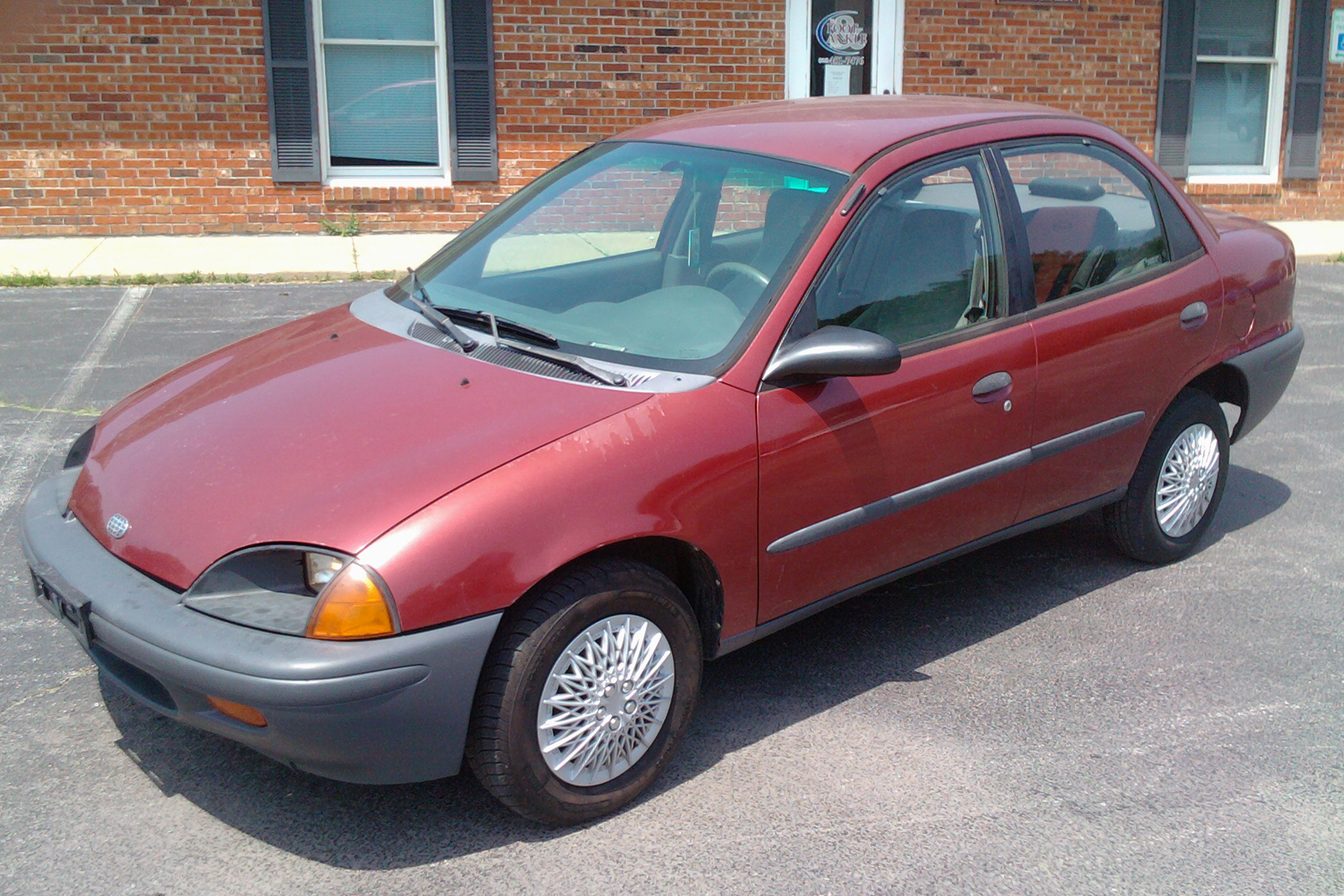
Geo — General Motors' Japanese-built small cars, 1989 to 1997
Geo was a small-car brand of General Motors, sold through Chevrolet dealers in the United States and Canada from 1989 to 1997. GM did not design Geo cars itself. They came from its Japanese partners: Suzuki built the Metro and the Tracker, Isuzu the Spectrum and the Storm, and Toyota the Prizm through the NUMMI joint venture. The idea was to win back buyers who had moved to cheap, economical imports in the mid-1980s. The brand was dropped in 1997, and its cars carried Chevrolet badges until the last Tracker in 2004.
Key takeaways
- Geo was introduced on 16 August 1989 as a Chevrolet sub-brand; its first slogan was "Get to know Geo".
- All Geo models were rebadged Japanese designs, built in Japan, in Fremont, California, or in Ingersoll, Ontario.
- The Metro XFi was rated at 53 mpg (US) in the city and 58 mpg on the highway, the brand's best-known figure.
- GM discontinued the Geo name after the 1997 model year; the Metro, Prizm and Tracker became Chevrolets for 1998.
Geo at a glance
| Fact | Value |
|---|---|
| Owner | General Motors, as a sub-brand of Chevrolet |
| Years | 1989 to 1997 model years |
| Markets | United States and Canada |
| Partners | Suzuki, Isuzu, Toyota |
| Plants | NUMMI (Fremont, California); CAMI (Ingersoll, Ontario); Suzuki and Isuzu plants in Japan |
| Models | Metro, Prizm, Spectrum, Storm, Tracker |
| Slogan | "Get to know Geo" |
| Successor | The same cars sold as Chevrolets from 1998 |
Why General Motors created Geo
In the mid-1980s small imported cars took a growing share of the North American market. GM already had partners in Japan. It ran the CAMI plant in Canada with Suzuki as a 50–50 joint venture and built cars with Toyota at NUMMI in California. Isuzu supplied small cars from Japan. Instead of designing its own small cars, GM gathered the partners' models under one new name.
Geo was launched on 16 August 1989. Its logo was based on the Chevrolet globe-and-bowtie design, and the cars were sold by Chevrolet dealers. Low prices and low running costs were the main selling points of the whole range. In Canada, where Pontiac-Buick-GMC dealers also wanted similar cars, GM added a sister brand, Asüna, in 1992.
The Metro: Suzuki's small car
The Metro was the North American version of the Suzuki Cultus, also sold as the Swift. The first cars came from Suzuki's Hamamatsu plant in Japan at the end of 1988. From 1990 North American models were built at CAMI in Ingersoll, Ontario, although CAMI never reached its planned Metro capacity.
Over three generations the Metro was sold as a three-door and five-door hatchback, a four-door saloon and a two-door convertible. The convertible was added in 1990 and dropped after 1993. The base engine was a 1.0-litre three-cylinder with throttle-body injection. It was the last engine on sale in the US to use that system. The fuel-saving XFi version was rated at 53 mpg (US) in the city and 58 mpg on the highway.
The 1995 redesign added a 1.3-litre four-cylinder with 52 kW (70 hp), later 59 kW (79 hp) in post-1997 LSi models. Sales were 88,700 in 1996 and 55,600 in 1997. The Metro became a Chevrolet in 1998. The three-cylinder and the hatchback ended with the 2000 model year, and in 2001 only fleet saloons were made. CAMI built the last Metro on 26 April 2001.
The Prizm: a Corolla from California
The Prizm was a rebadged Toyota Sprinter, a close relative of the Corolla. All Prizms were built at NUMMI in Fremont, California. It replaced the Chevrolet Nova and was sold as a Geo from 1990 to 1997.
The first generation (E90) used Toyota's 1.6-litre 4A-FE engine. The GSi version of 1990–1992 had the twin-cam 4A-GE with 97 kW (130 hp). A five-door hatchback was offered until 1991. The second generation (E100) of 1993–1997 added a 1.8-litre 7A-FE. The third generation became a Chevrolet in 1998. Its 1ZZ-FE engine gained variable valve timing in 2000, rising from 89 to 93 kW (120 to 125 hp). The Prizm was never sold in Canada, and the Pontiac Vibe replaced it in 2003.

Spectrum and Storm: the Isuzu cars
The Spectrum, based on the Isuzu Gemini, had been sold as a Chevrolet from 1985 to 1988. It became a Geo for the 1989 model year only.
Its replacement was the Storm, a rebadged second-generation Isuzu Impulse built at Isuzu's main plant in Fujisawa, Japan. It lacked the Impulse's Lotus-tuned suspension, turbocharger and all-wheel drive. The base 1.6-litre engine had 71 kW (95 hp), reduced to 67 kW (90 hp) for 1993. The sporty GSi had a 1.6-litre twin-cam with 97 kW (130 hp) in 1990–1991 and a 1.8-litre with 104 kW (140 hp) in 1992–1993. Most cars were liftback coupés; a hatchback "wagonback" was sold only in 1991 and 1992.
In its first year the Storm outsold GM's own small cars, including the Cavalier, Sunbird, Corsica and Beretta. It ended after 1993, when Isuzu stopped building passenger cars to concentrate on trucks and SUVs.

The Tracker and the end of Geo
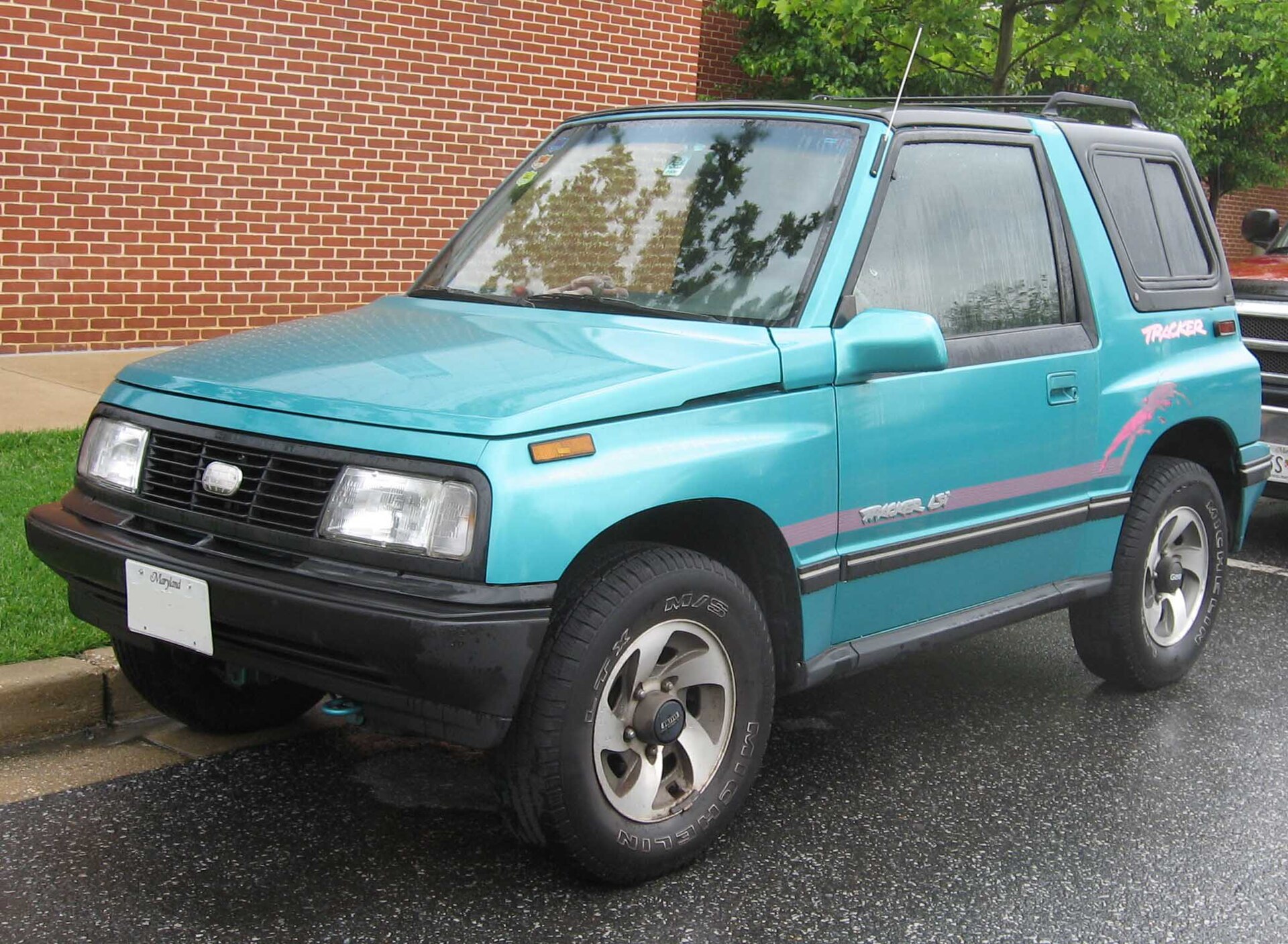
The Tracker was the twin of the Suzuki Sidekick, called Escudo in Japan. Launched at the end of 1988 as a 1989 model, it had a 1.6-litre four-cylinder with 60 kW (80 hp). Early cars came from Japan, and CAMI production started at the end of 1989. All Trackers had four-wheel drive with a two-speed transfer case until a two-wheel-drive convertible arrived in 1992. A four-door model came in 1996 with a 16-valve 1.6-litre engine of 72 kW (96 hp).
On 16 June 1997 GM confirmed that the Geo name would end with the 1997 model year. For 1998 the Metro, Prizm and Tracker were sold as Chevrolets. The redesigned Tracker of 1999 offered 2.0- and 2.5-litre engines and, from 2002, a V6 in the US. The last one was built at CAMI on 27 January 2004, and that ended the last line of cars launched under the Geo name.
The Geo models listed on 1cars are in the Geo catalogue. The partners behind the brand are covered in the history of Suzuki and the history of Toyota, and the parent brand in the history of Chevrolet. For today's economical small cars, see the best small city cars.
Geo timeline
| Year | Event |
|---|---|
| 1985 | Chevrolet Spectrum (Isuzu Gemini) goes on sale |
| 1988 | Metro production starts at Suzuki in Japan; Tracker launched |
| 1989 | Geo introduced on 16 August |
| 1990 | Storm replaces the Spectrum; Metro built at CAMI |
| 1992 | Asüna brand added in Canada; two-wheel-drive Tracker |
| 1993 | Last Storm; second-generation Prizm |
| 1995 | Redesigned Metro with a 1.3-litre option |
| 1996 | Four-door Tracker |
| 1997 | Geo name dropped after the model year |
| 1998 | Metro, Prizm and Tracker sold as Chevrolets |
| 2001 | Last Metro built (26 April) |
| 2004 | Last Tracker built (27 January) |
Landmark Geo models
| Model | Geo years | Why it matters |
|---|---|---|
| Metro | 1989–1997 | Suzuki-built economy car; XFi rated at 58 mpg on the highway |
| Prizm | 1990–1997 | Corolla twin built at NUMMI in California |
| Storm | 1990–1993 | Isuzu Impulse coupé; GSi with up to 104 kW (140 hp) |
| Tracker | 1989–1997 | Small four-wheel-drive SUV built with Suzuki in Canada |
FAQ
What was Geo?
A Chevrolet sub-brand of General Motors from 1989 to 1997 for small cars made by its Japanese partners Suzuki, Isuzu and Toyota.
Who built Geo cars?
Suzuki (Metro, Tracker), Isuzu (Spectrum, Storm) and Toyota through NUMMI (Prizm). North American cars were built at NUMMI in California and CAMI in Ontario.
Why was Geo discontinued?
GM dropped the name after the 1997 model year and sold the same cars as Chevrolets. The Storm had already ended in 1993, when Isuzu stopped making passenger cars.
What replaced the Geo Metro?
The Metro became a Chevrolet in 1998 and was built until April 2001. The Chevrolet Aveo of 2004 effectively replaced it.
Sources
- Wikipedia — Geo (automobile) (accessed 24 Oct 2026)
- Wikipedia — Geo Metro (accessed 24 Oct 2026)
- Wikipedia — Geo Tracker (accessed 24 Oct 2026)
- Wikipedia — Geo Storm (accessed 24 Oct 2026)
- Wikipedia — Geo Prizm (accessed 24 Oct 2026)
Found a mistake? Report an error