 Geo Metro
All generations, specs and history
Published Sources (3) Report an error
By Sarah Whitmore, Senior Automotive Writer
- Built
- 1989–2001
- Generations
- 2
- Top power
- 59 kW (80 PS)
Timeline
Geo Metro generations
Click a generation for its own page
- Metro 1989–1994 · Sedan, Hatchback · 37–45 kW (50–61 PS)
- Metro 1995–2001 · Sedan, Hatchback · 41–59 kW (56–80 PS)
Newest first · 2 generations since 1989
- 1995 Metro 1995–2001 · Sedan, Hatchback · 41–59 kW (56–80 PS)
- 1989 Metro 1989–1994 · Sedan, Hatchback · 37–45 kW (50–61 PS)
All generations by year: Metro (1995–2001) · Metro (1989–1994)
Which one is mine?
Pick the year of first registration to see which generation it is.
Check by VINWhich Geo Metro to choose
Our verdict · Sarah Whitmore
- XFi (1990–1994): the most economical version, with a detuned 37 kW engine and a taller final drive; under 10 % of sales.
- First-generation 1.0 (1989–1994): the 45 kW three-cylinder in hatchback or convertible form.
- Second-generation 1.3 (1995–2001): more power and the sedan body; 1998-on cars have the 59 kW 16-valve engine.
- Second-generation 1.0: the economical three-cylinder with the newer body and dual airbags.
Geo was a General Motors brand of small cars, sold through Chevrolet dealers as a sub-brand of Chevrolet. It was introduced on 16 August 1989 with the slogan "Get to know Geo", and its badge was a globe outline with the Chevrolet bow tie in the middle. Every Geo came from a joint venture or a partner. The Metro and Tracker came from Suzuki and the CAMI plant in Ontario, the Prizm from Toyota and NUMMI in California, and the Spectrum and Storm from Isuzu in Japan. GM dropped the Geo name in mid-1997, and from the 1998 model year the Metro, Prizm and Tracker were sold as Chevrolets.
The Metro was Geo's smallest and best-known car. It was the North American version of the Suzuki Cultus, sold from 1989 to 1997 as the Geo Metro and from 1998 to 2001 as the Chevrolet Metro. Its 1.0-litre three-cylinder made it one of the most economical petrol cars in America. The XFi version of 1990–1994 was rated at 43 mpg city and 51 mpg highway on the revised EPA scale.
Specs by version
| Version | Engine | Power | Drive | Production years |
|---|---|---|---|---|
| Metro · 1.0 XFi | 1.0 l · 3 cyl · Petrol 993 cc | 37 kW 50 PS50 hp | Front-wheel drive | 1990–1994 |
| Metro · 1.0 (G10) | 1.0 l · 3 cyl · Petrol 993 cc | 45 kW 61 PS60 hp | Front-wheel drive | 1989–1994 |
| Metro · 1.0 three-cylinder | 3 cyl · Petrol | 41 kW 56 PS55 hp | Front-wheel drive | 1995–2001 |
| Metro · 1.3 8V | 4 cyl · Petrol | 52 kW 71 PS70 hp | Front-wheel drive | 1995–1997 |
| Metro · 1.3 16V | 4 cyl · Petrol | 59 kW 80 PS79 hp | Front-wheel drive | 1998–2001 |
Verified Manufacturer and type-approval data from our catalog · Sources and methodology
In short
- Built from 1989 to 2001, first by Suzuki in Japan and from 1990 by CAMI Automotive, the 50–50 GM–Suzuki joint venture in Ingersoll, Ontario; the last car was a red sedan built on 26 April 2001.
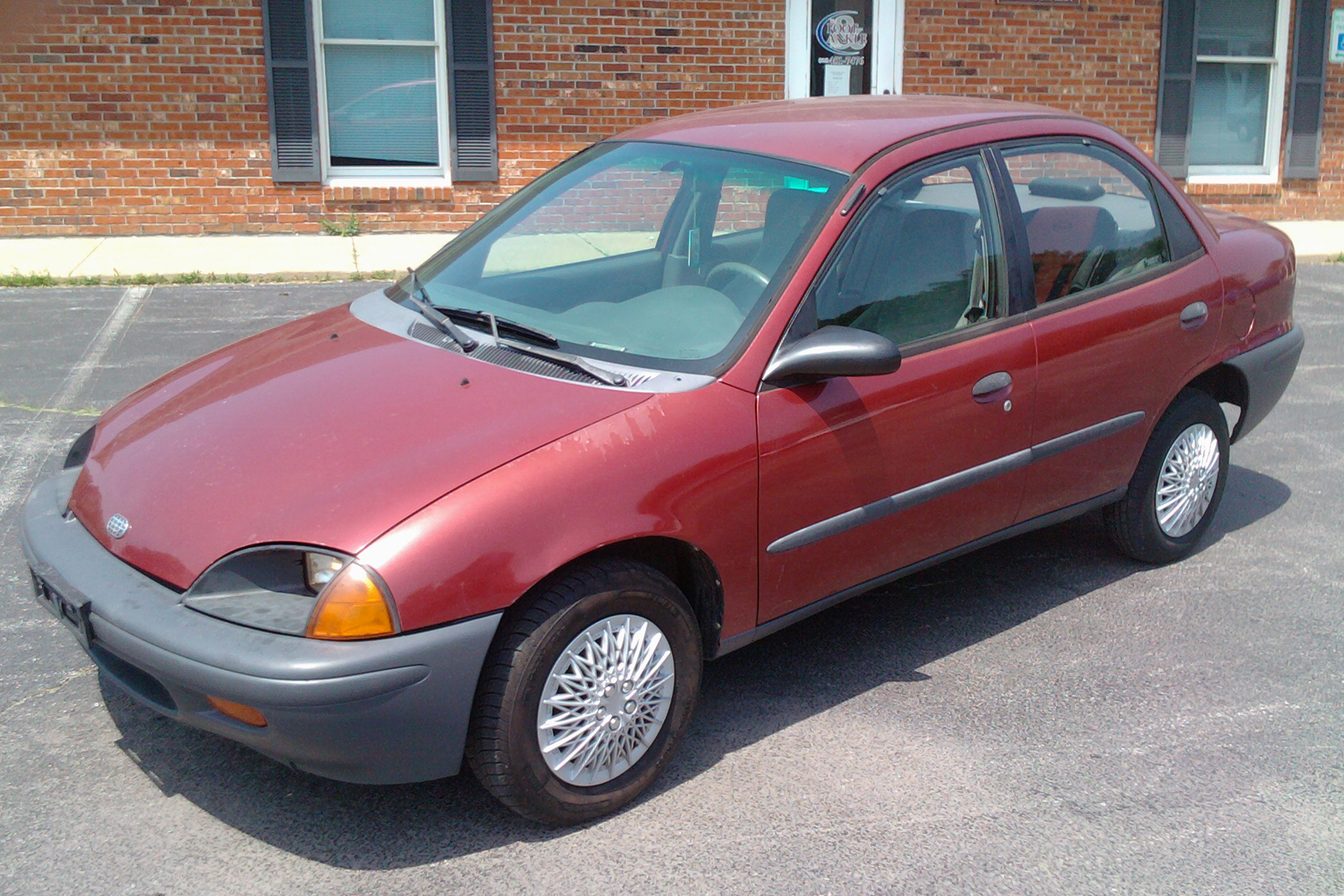
- Two generations: 1989–1994 (three- and five-door hatchback, convertible) and 1995–2001 (three-door hatchback and four-door sedan).
- Engines: 993 cc three-cylinder with 45 kW (60 hp), 37 kW (49 hp) in the XFi; 1.3-litre four with 52 kW (70 hp), later 59 kW (79 hp).
- In a July 2009 Car and Driver test a 1998 Metro tied the Toyota Prius at 42 mpg (5.6 l/100 km).
Geo Metro at a glance
| Specification | Value |
|---|---|
| Makers | General Motors and Suzuki |
| Production | 1989–2001 (Geo 1989–1997, Chevrolet 1998–2001) |
| Plants | Suzuki, Japan (first cars and convertibles); CAMI, Ingersoll, Ontario, from 1990 |
| Platform | GM M platform with Suzuki chassis, engines and drivetrains |
| Bodies | three-door and five-door hatchback, convertible, four-door sedan |
| Layout | front engine, front-wheel drive |
| Engines | 993 cc G10 three-cylinder; 1.3 l G13 four-cylinder |
| Power | 37 kW (49 hp) XFi to 59 kW (79 hp) 1.3 16-valve |
| Twins | Suzuki Swift, Pontiac Firefly |
| Predecessor | Chevrolet Sprint (Metro name from 1987) |
| Successor | Chevrolet Aveo (2004 model year) |
Geo Metro generations
| Generation | Years | Bodies | Engines | Notes |
|---|---|---|---|---|
| First | 1989–1994 | three- and five-door hatchback, convertible (sedan in Canada) | 1.0 l I3; 1.3 l I4 in Canada | XFi economy model 1990–1994 |
| Second | 1995–2001 | three-door hatchback, four-door sedan | 1.0 l I3, 1.3 l I4 | Geo to 1997, Chevrolet 1998–2001 |
First generation (1989–1994). Suzuki started building the first Metro at its Hamamatsu plant in late 1988, and the car went on sale in 1989. The Suzuki Cultus article names Suzuki's Kosai plant as the Japanese source. CAMI began production in late 1989 and made 660 cars in its first year; from 1990 all North American M-cars came from Ingersoll. Japan still supplied the convertibles and the Canadian sedans, and CAMI never reached its planned capacity.
Second generation (1995–2001). The new car used an adapted version of the longer-wheelbase Cultus platform. In the United States the sedan replaced the five-door hatchback. The sedan and coupé bodies were 20 % and 5 % stiffer than the previous five-door and coupé. The drag coefficient was 0.32. At its launch the Metro was the smallest car in the world to meet the 1997 North American side-impact standard. It was also the second GM car in the US to offer daytime running lights, after the 1995 Chevrolet Corsica.

Engines, transmissions and performance
| Engine | Years | Power | Notes |
|---|---|---|---|
| 1.0 l (993 cc) G10 I3, throttle-body injection | 1989–1994 | 45 kW (60 hp) | US engine of the first generation |
| 1.0 l G10 I3, XFi | 1990–1994 | 37 kW (49 hp) | shorter-duration cam, leaner mixture, two-ring pistons, taller final drive |
| 1.0 l G10 turbo | 1989–1991 | - | Canadian Pontiac Firefly only |
| 1.3 l G13 SOHC 8-valve I4 | Canada from 1993; US from 1995 | 52 kW (70 hp) | same engine as the Suzuki Swift of earlier years |
| 1.3 l SOHC 16-valve I4, MPFI | 1998–2001 | 59 kW (79 hp) | about 12 % more power, electronic ignition |
| 1.0 l I3 (six-valve) | 1995–2001 | 41 kW (55 hp), 79 Nm | Hagerty figures for a 2000 Chevrolet Metro |
The 1.0-litre engine with throttle-body injection was the last engine of its kind sold in the United States. OBD-II diagnostics arrived in 1996 at some cost in economy. Hagerty lists a five-speed manual as standard and an automatic as an option for the 2000 car. Its figure of 58 lb-ft equals about 79 Nm.
Fuel economy and running costs
| Version | City | Highway | Basis |
|---|---|---|---|
| 1989–1994 1.0 l | 38 mpg (6.2 l/100 km) | 45 mpg (5.2 l/100 km) | revised 2007 EPA scale |
| XFi | 43 mpg (5.5 l/100 km) | 51 mpg (4.6 l/100 km) | revised 2007 EPA scale |
| 2000 Chevrolet Metro 1.0 l | 39 mpg (6.0 l/100 km) | 46 mpg (5.1 l/100 km) | Hagerty |
| 1998 Metro hatchback, Car and Driver test (2009) | 42 mpg (5.6 l/100 km) overall | - | tied with the Toyota Prius |
The XFi made up less than 10 % of Metro sales and was dropped in 1994. The American Council for an Energy-Efficient Economy ranked the Metro and Swift as the two greenest petrol vehicles in its 1998 and 1999 lists. When fuel prices rose in 2008, used Metros were suddenly in demand. In Car and Driver's July 2009 test of economy cars, a base 1998 Metro hatchback matched the Toyota Prius at 42 mpg. It finished third overall behind the Honda Insight and the Prius, losing seven points for its lack of equipment. The Prius story is in our article on the Toyota Prius generations. Use the fuel cost calculator to turn these figures into a running cost.
Dimensions and interior space
| Dimension | Three-door / convertible | Five-door / sedan |
|---|---|---|
| Wheelbase | 2,265 mm | 2,365 mm |
| Length | 3,745 mm | 3,845 mm (five-door); 4,095 mm (sedan) |
| Width | 1,575 mm; 1,590 mm (convertible) | 1,575 mm; 1,590 mm (sedan) |
| Height | 1,350 mm; 1,340 mm (convertible) | 1,380 mm |
These figures from the Suzuki Cultus article apply to the second-generation Cultus family. The Geo Metro article lists 4,166 mm for the US sedan without further detail. In the three-door hatchback, the second generation gained rear legroom, from 29.8 in to 32.8 in (757 to 833 mm), and front headroom, from 37.8 in to 39.1 in (960 to 993 mm). Front legroom stayed at 42.5 in (1,080 mm). The size comparison tool shows how small that is next to a current supermini.
Safety
The second-generation Metro had dual front airbags, a safety cage with front and rear crumple zones, five structural crossbars, steel side-impact beams in the doors and optional anti-lock brakes. English Wikipedia lists NHTSA crash-test headings for the car but gives no star ratings, so none are quoted here.
Sales, twins and buyers
The Metro was sold under several names. The Suzuki Swift was its three-door twin in North America from 1995 to 2000. The Pontiac Firefly was the Canadian version in three-door and four-door form from 1995 to 2000. Canadian production of the Swift, Metro and Firefly peaked at more than 100,000 cars a year and fell to 32,000 in 2000. Chevrolet and Geo sold 88,700 Metros in the US in 1996 and 55,600 in 1997.
At the 1995 launch, 41 % of buyers were buying their first car, 62 % were women and the median buyer was 37. In 2000 the window sticker of a Chevrolet Metro at a Torrance, California, dealer read US$11,140, according to Hagerty. Suzuki's side of the story is in our history of Suzuki.
The end of the Metro and its legacy
For 2001 only the four-door LSi sedan was sold in the US, and GM said the Metro would not return for 2002. CAMI built the last one, a red sedan, on 26 April 2001. The Chevrolet Aveo replaced it from the 2004 model year, alongside the Pontiac Wave and the Suzuki Swift+.
The Metro has had a long second life. Solectria of Massachusetts converted about 500 Metros of 1996–1997 into electric cars, the Solectria Force and EV, using bodies supplied by GM. Cornell's 100+ MPG team used one in 2007, and Clay Pitkin turned another into a salt-flat racer in 2012. In 2010 the artist Cai Guo-Qiang hung nine Chevrolet Metros in the air for the Biennale of Sydney. The rest of the brand is in the Geo catalogue.

Photo gallery


Geo Metro: first vs latest generation
| Spec | Metro | Metro | Change |
|---|---|---|---|
| Years | 1989–1994 | 1995–2001 | 6 years apart |
| Most powerful version | 45 kW (61 PS) | 59 kW (80 PS) | +14 kW (+31%) |
Oldest and newest generation in the 1cars catalog. Power is the strongest version of each; other rows are shown only when both generations have the figure.
Geo Metro in our rankings
- No. 299 of 912 · Longest-running car nameplates (12 years · top 35%)
- No. 134 of 149 · Most powerful sedans (59 kW · top 90%)
- No. 86 of 91 · Most powerful cars of the 1990s (59 kW · top 95%)
- No. 147 of 154 · Most powerful American cars (59 kW · top 96%)
- No. 818 of 859 · Most powerful cars (59 kW · top 96%)
- No. 551 of 557 · Biggest engines: cars (993 cc · top 99%)
In production longer than 65% of ranked nameplates in the 1CARS catalog (No. 299 of 912).
FAQ
What engine is in a Geo Metro?
Most Metros have Suzuki's 993 cc G10 three-cylinder, with 45 kW (60 hp) in the first generation and 37 kW (49 hp) in the XFi. Some cars have a 1.3-litre four with 52 kW (70 hp) or, from 1998, 59 kW (79 hp).
What is the Geo Metro XFi?
The XFi was an economy version sold from 1990 to 1994, with a detuned engine, a shorter-duration cam, a leaner fuel map, two-ring pistons and a taller final drive; it was rated at 43 mpg city and 51 mpg highway.
Who made the Geo Metro?
General Motors and Suzuki. The first cars came from Suzuki in Japan, and from 1990 the CAMI joint venture in Ingersoll, Ontario, built the North American cars except the convertibles.
What replaced the Geo Metro?
The Metro became a Chevrolet from 1998 and ended in 2001; the Chevrolet Aveo replaced it from the 2004 model year.
How good is the Geo Metro's fuel economy?
On the revised EPA scale the first-generation 1.0 is rated at 38 mpg city and 45 mpg highway. In a 2009 Car and Driver test a 1998 Metro averaged 42 mpg (5.6 l/100 km), tying the Toyota Prius.
Data sources
Data checked by an editor against the sources below.
- Wikipedia - Geo Metro
- Wikipedia - Suzuki Cultus
- Hagerty - Media