 Chevrolet 490
Specs, engines and history
Published Sources (1) Report an error
By Sarah Whitmore, Senior Automotive Writer
- Built
- 1915–1922
- Top power
- 18 kW (24 PS)
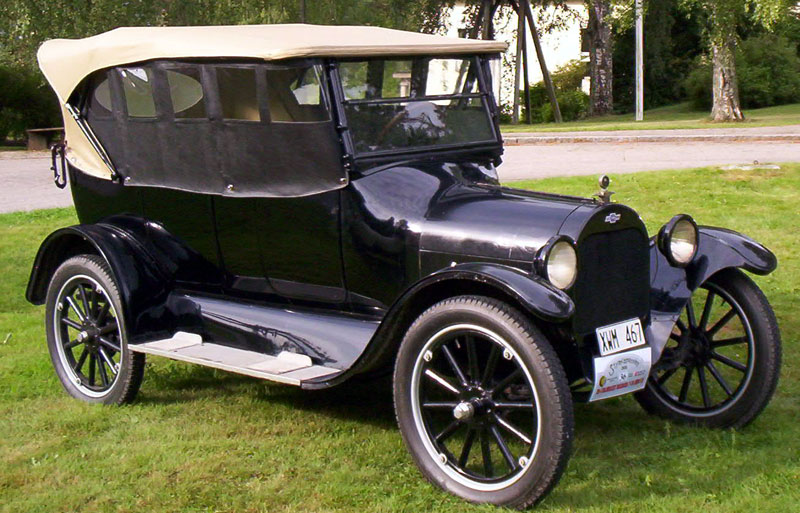
The Chevrolet Series 490, usually called the "Four-Ninety", is the low-priced car with which Chevrolet took on the Ford Model T. Introduced in June 1915 at US$490 (1915), which gave it its name, it was built until 1922 with a single 2.8-litre overhead-valve four-cylinder engine. Its profits allowed William C. Durant to buy back control of General Motors, and Chevrolet became a GM division. By 1922 production had reached about 243,479 cars a year.
In short
- Built 1915–1922; launched in June 1915 at US$490 (1915), against US$495 for the cheapest Ford Model T at the time.
- 171 cu in (2.8-litre) OHV inline-four with 18 kW (24 hp); three-speed selective-sliding gearbox and cone clutch.
- Touring car and roadster, from 1918 also coupé, sedan and the half-ton Light Delivery.
- Production: about 70,701 in 1916, 149,833 in 1919 and 243,479 in 1922.
Specs by version
Engines
| Version | Engine | Power | Gearbox | Drive | Production years |
|---|---|---|---|---|---|
| 2.8 OHV (171 cu in) | 2.8 l · 4 cyl · Petrol 2,802 cc | 18 kW 24 PS24 hp | 3-sp Manual | Rear-wheel drive | 1915–1922 |
Dimensions and weight
Show all 1 versions
| Version | Wheelbase |
|---|---|
| 2.8 OHV (171 cu in) | 2,591 mm102.0 in |
Verified Manufacturer and type-approval data from our catalog · Sources and methodology
Chevrolet Series 490 at a glance
| Parameter | Value |
|---|---|
| Maker | Chevrolet Motor Company |
| Production | June 1915 – 1922 |
| Plants | Flint (Michigan), North Tarrytown (New York), Oakland (California), Norwood (Ohio), St. Louis (Missouri); Oshawa (Ontario, Canada) |
| Body styles | touring car, roadster; coupé, sedan and Light Delivery from 1918 |
| Engine | 171 cu in (2.8 l) OHV inline-four |
| Power | 18 kW (24 hp) |
| Gearbox | three-speed selective-sliding manual, cone clutch |
| Wheelbase | 102 in (2,591 mm) |
| Successor | Chevrolet Superior |
Development and production history
Chevrolet was founded on 3 November 1911 by Louis Chevrolet, his brother Arthur and William C. Durant, who had earlier lost control of General Motors; the first factory was in Flint, Michigan. Its first car, the Series C Classic Six designed by Etienne Planche, was expensive, and Louis Chevrolet, who had differences with Durant over design, sold his share to Durant in 1914. The much cheaper Series 490 that followed became the company's first big success.
The car appeared in June 1915 at US$490 (1915), US$5 below the Ford Model T, which then started at US$495 (1915). It was successful at once: English Wikipedia gives about 70,701 cars for 1916. The profits made it possible for Durant to buy GM shares and regain control of General Motors. The English article on the 490 dates the merger of Chevrolet into GM to 1917. The article on Chevrolet says that the deal was completed in 1918, when Durant became GM president and Chevrolet became a division.
After the First World War prices rose quickly, and by 1921 the average price of a 490 was US$820 (1921), far from the figure in its name. Prices then fell sharply in 1922, when production reached its peak of about 243,479 cars. The 490 was then replaced by the Chevrolet Superior.
| Year | Built | Price range (US$) | Event |
|---|---|---|---|
| 1915 | - | 490 | Introduced in June |
| 1916 | about 70,701 | 550–750 | - |
| 1917 | - | - | Merger with GM according to the 490 article |
| 1918 | 95,660 | 660–1,060 | Coupé, sedan and Light Delivery added; merger completed according to the Chevrolet article |
| 1919 | about 149,833 | 715–1,185 | - |
| 1920 | about 150,226 | 795–1,285 | - |
| 1921 | about 76,370 | 795–1,375 | Average price US$820 |
| 1922 | about 243,479 | 510–875 | Last and best year |

Design and engineering
The 490 is a simple front-engined, rear-wheel-drive car on a 102 in (2,591 mm) wheelbase, with a four-door touring body as the original version. Its four-cylinder engine has overhead valves and drives through a cone clutch and a three-speed selective-sliding gearbox. Weight varied with the body: 1,820–2,500 lb (826–1,134 kg) in 1916, 1,820–2,160 lb (826–980 kg) in 1918–1921 and 1,435–2,150 lb (651–975 kg) in 1922.
Electric horns were standard. By 1921 standard equipment included a speedometer, an ammeter, headlamp dimmers and, on closed cars, dome lights.
Engine and drivetrain
| Parameter | Value |
|---|---|
| Engine | 171 cu in (2.8 l) overhead-valve inline-four, the only engine offered |
| Power | 18 kW (24 hp) |
| Clutch | cone |
| Gearbox | three-speed selective-sliding manual |
| Drive | rear wheels |
With one engine for all versions, the 490 relied on low price, not choice. Our power converter gives the 18 kW (24 hp) rating in PS as well.
Chevrolet 490 specifications
| Parameter | Metric | Imperial |
|---|---|---|
| Engine | 2,802 cc OHV I4 | 171 cu in |
| Power | 18 kW | 24 hp |
| Wheelbase | 2,591 mm | 102 in |
| Weight (1916) | 826–1,134 kg | 1,820–2,500 lb |
| Weight (1922) | 651–975 kg | 1,435–2,150 lb |
| Gearbox | three-speed | - |
Variants and derivatives
| Variant | Years | Body / purpose | Notes |
|---|---|---|---|
| Touring | 1915–1922 | four-door open car | launch model |
| Roadster | 1915–1922 | two-door open car | - |
| Coupé | 1918–1922 | two-door closed car | - |
| Sedan | 1918–1922 | three-door closed car | dome light by 1921 |
| Light Delivery | 1918–1922 | half-ton commercial on a cowl chassis | Chevrolet's early truck |

Chevrolet before and beside the 490
The 490 arrived when Chevrolet was barely four years old. The company was incorporated on 8 November 1911, and its first production cars were 1913 models; the first, the Series C Classic Six, was described as costly. The cheaper 490 sold successfully and became the basis of the company's growth.
Chevrolet also tried a larger car alongside it. The Series D, a V8 model, was introduced for the 1918 model year, but it sold poorly and was dropped in 1919. In the same year GMC's commercial trucks were rebranded as Chevrolets. The 490's own Light Delivery, added in 1918 on a cowl chassis and rated at half a ton, was already part of the range. From 1918 the 490 could thus be bought as an open car, a closed car or a small commercial vehicle, all with the same engine.
The production network grew with the sales. English Wikipedia lists five US assembly plants for the 490 - Flint, North Tarrytown, Oakland, Norwood and St. Louis - and Oshawa, Ontario, in Canada, from the Pacific coast to the Atlantic.

Rival to the Ford Model T
The 490 was aimed squarely at the Ford Model T, and English Wikipedia says that it took a share of Ford's market. Its launch price was US$5 (1915) below the cheapest Model T of the time, and it offered an overhead-valve engine and a three-speed selective gearbox. The story of Ford's car is told in our Ford Model T article. Above all, the 490 turned Chevrolet into a large-scale producer and gave Durant the means to retake General Motors, whose history is in our history of General Motors.
The 490 in numbers
From about 70,701 cars in 1916 to about 243,479 in 1922, production rose almost three and a half times. The 1921 drop is clearly visible: output halved from about 150,226 in 1920 to about 76,370, and then more than tripled in 1922 when prices were cut. In 1922 the cheapest 490 cost US$510 (1922), only US$20 more than the 1915 launch price, but more than US$300 below the 1921 average of US$820 (1921). With 18 kW and weights of 651–975 kg in 1922, the car had about 36–54 kg per kilowatt.
The price table also shows how the range widened. In 1916 the dearest 490 cost US$200 (1916) more than the cheapest; by 1921, with closed bodies in the range, the spread was US$580, from US$795 to US$1,375 (1921). In 1922 the whole range was cheaper again, between US$510 and US$875 (1922), and that year became the most successful of the model's life. The figures suggest how sensitive buyers in this class were to price: the year with the lowest prices since 1916 was also the year with by far the highest production.
Which 490 to look for
- For the original idea: an early touring car or roadster of 1915–1917.
- For comfort: a 1921–1922 car with the fuller standard equipment, or a closed coupé or sedan.
- For work: a Light Delivery from 1918, an early Chevrolet commercial vehicle.
- For the best-documented year: a 1922 car, from the largest production year and with the widest choice of bodies and equipment.
Because the 490 used one engine throughout, the body style and the equipment are the clearest guide to a car's year.
The brand's story is told in our history of Chevrolet. Today's models are in the Chevrolet catalogue, and more early cars in classic cars.
Chevrolet 490 in our rankings
- No. 296 of 557 · Biggest engines: cars (2,802 cc · top 54%)
- No. 478 of 912 · Longest-running car nameplates (7 years · top 60%)
- No. 35 of 49 · Biggest engines: convertibles and roadsters (2,802 cc · top 72%)
- No. 77 of 79 · Most powerful convertibles and roadsters (18 kW · top 98%)
- No. 152 of 154 · Most powerful American cars (18 kW · top 99%)
- No. 854 of 859 · Most powerful cars (18 kW)
Bigger engine than 46% of ranked cars in the 1CARS catalog (No. 296 of 557).
FAQ
Why is it called the Chevrolet 490?
It was introduced in June 1915 at a price of US$490 (1915), which became its name.
When was the Chevrolet 490 produced?
From June 1915 to 1922, when it was replaced by the Chevrolet Superior.
What engine does the Chevrolet 490 have?
A 171 cu in (2.8-litre) overhead-valve four-cylinder with 18 kW (24 hp), the only engine offered.
How many Chevrolet 490 were built?
English Wikipedia gives yearly figures, from about 70,701 in 1916 to about 243,479 in 1922, but no total.
Was the Chevrolet 490 cheaper than the Ford Model T?
At launch, yes: US$490 against US$495 for the Model T at that time.
Data sources
Data checked by an editor against the sources below.