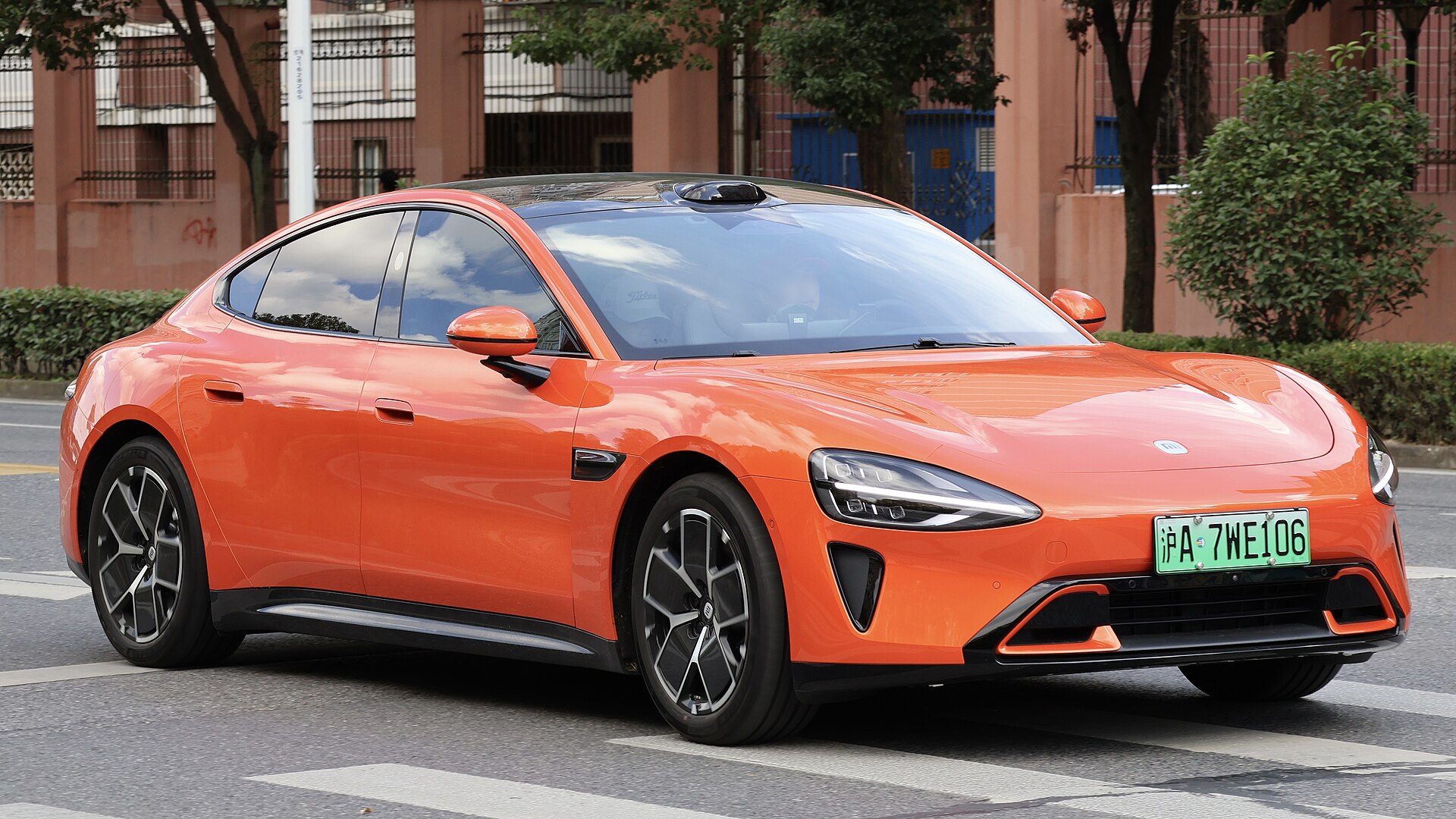
 Xiaomi SU7
Specs, engines and history
Published Sources (1) Report an error
By Felix Hartmann, Automotive Technology & EV Contributor
- Built
- 2023–present
- Top power
- 1,138 kW (1,547 PS)
Which SU7 to choose
Our verdict · Felix Hartmann
For drivers in China the Pro offers the longest range with rear-wheel drive and 220 kW, while the Max is the version for performance, with 800 volts and 2.78 seconds to 100 km/h. The Ultra is a track car with a number plate. Wikipedia EN mentions no European sales, so there is no official dealer or service network for the SU7 in the EU. Comparable electric saloons sold in Europe include the Tesla Model 3 and the Porsche Taycan; more are in the electric car hub.
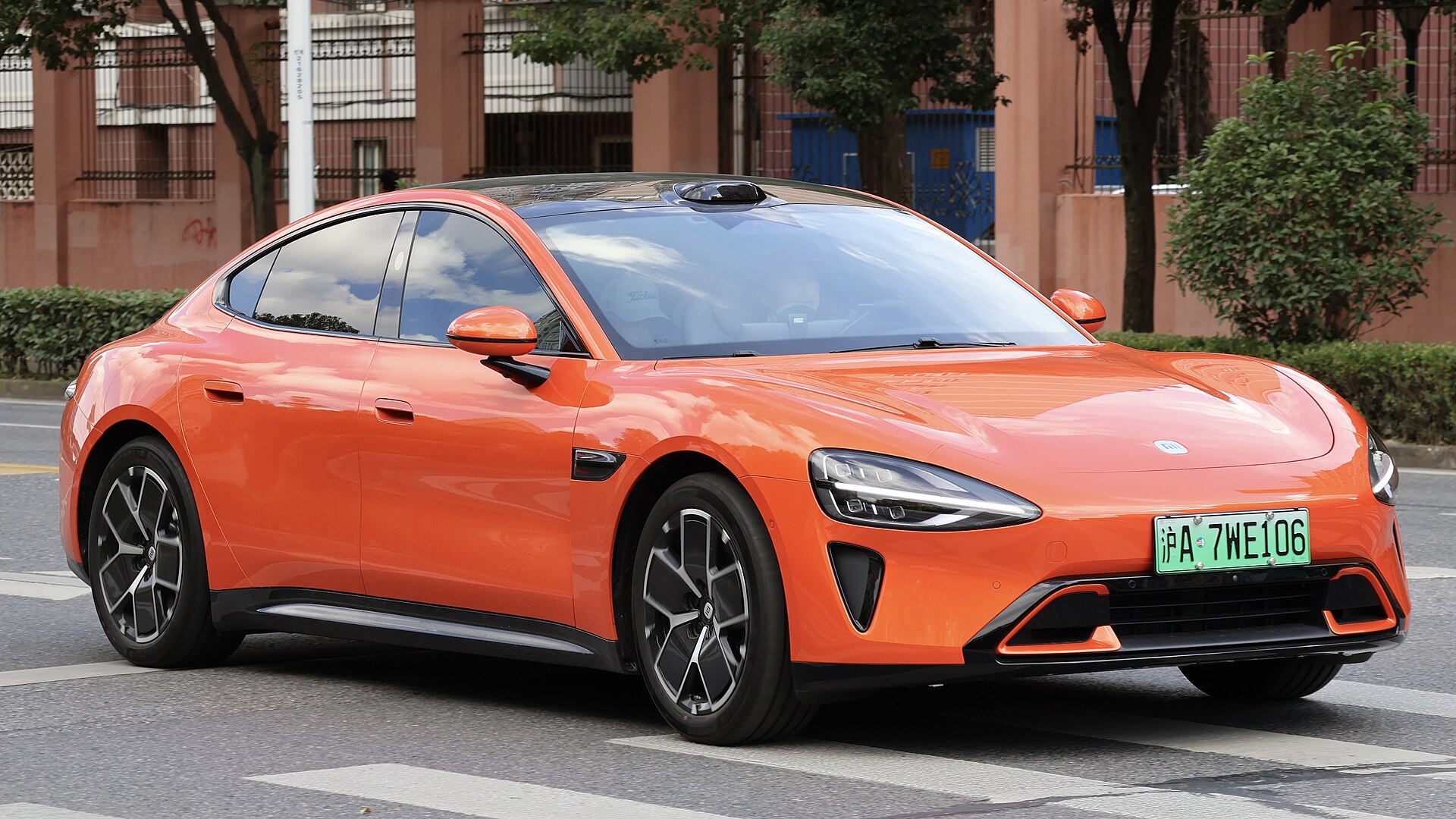
The Xiaomi SU7 is a large electric saloon of 4,997 mm, the first car from the consumer electronics company Xiaomi. It was unveiled on 28 December 2023, launched in Beijing on 28 March 2024 and built in Xiaomi's own factory in the Beijing Economic and Technological Development Zone. Versions range from the 220 kW rear-wheel-drive SU7 to the three-motor SU7 Ultra with about 1,138 kW, which set a Nürburgring record for production electric cars in 2025. A facelifted SU7 went on sale in March 2026. The car is sold in China and has no European price list.
Xiaomi announced its move into cars on 30 March 2021, with an initial investment of 10 billion yuan and a plan to spend about US$10 billion over ten years. Xiaomi Auto was formally established on 1 September 2021, with Lei Jun as chief executive. Its Beijing plant was planned in two phases of 150,000 cars a year each. The second model, the YU7 SUV, was revealed in May 2025, and in 2025 the company sold 411,837 cars in China.
Specs by version
Engines
Dimensions and weight
Show all 2 versions
| Version | Battery |
|---|---|
| SU7 RWD | 74 kWh |
| SU7 Ultra | 94 kWh |
Verified Manufacturer and type-approval data from our catalog · Sources and methodology
In short
- Built in Beijing since 2024; drag coefficient 0.195, which Xiaomi claims as the world's lowest.
- SU7: 73.6 kWh LFP, 220 kW, 700 km CLTC; SU7 Max: 101 kWh, 800 volts, 495 kW, 0–100 km/h in 2.78 seconds.
- SU7 Ultra: three motors, about 1,138 kW and 1,770 Nm; 7:04.957 on the Nürburgring Nordschleife in April 2025.
- More than 258,000 SU7s delivered by May 2025; no Euro NCAP test and no EU sales so far.
Xiaomi SU7 at a glance
| Parameter | Xiaomi SU7 |
|---|---|
| Production | since 2024, Beijing (China) |
| Code name | MS11; Xiaomi says "SU" stands for "Speed Ultra" |
| Body | four-door saloon |
| Length / width / height | 4,997 / 1,963 / 1,440–1,455 mm |
| Wheelbase | 3,000 mm |
| Power | 220 kW (RWD) to about 1,138 kW (Ultra) |
| Batteries | 73.6 kWh LFP, 94.3 kWh LFP, 101 kWh NMC, 93.7 kWh NMC (Ultra) |
| Kerb weight | 1,980–2,360 kg |
| Luggage | 571 l boot plus 105 l front compartment |
| Chief designer | Sawyer Li, formerly of BMW |
From consumer electronics to cars
Xiaomi received its vehicle production permit from China's National Development and Reform Commission in August 2023. Xiaomi benchmarked the SU7 against the Porsche Taycan and the Tesla Model S. The design team was led by Sawyer Li, with James Qiu responsible for the exterior and Chris Bangle as a consultant.
Demand was high from the start. Xiaomi reported 70,000 orders by April 2024, the 100,000th car came off the line 230 days after launch in November 2024, and the 200,000th followed on 18 March 2025. China sales reached 139,487 in 2024 and 242,291 in 2025, plus 15,728 SU7 Ultras.
Versions and performance
| Version | Battery | Voltage | Power | Torque | 0–100 km/h | Top speed | CLTC range |
|---|---|---|---|---|---|---|---|
| SU7 (RWD) | 73.6 kWh LFP (FinDreams) | 400 V | 220 kW (299 PS) | 400 Nm | 5.28 s | 210 km/h | 700 km |
| SU7 Pro (RWD) | 94.3 kWh LFP (CATL) | 400 V | 220 kW (299 PS) | 400 Nm | 5.7 s | 210 km/h | 830 km |
| SU7 Max (AWD) | 101 kWh NMC (CATL Qilin) | 800 V | 495 kW (673 PS) | 838 Nm | 2.78 s | 265 km/h | 800 km |
| SU7 Ultra (AWD, 3 motors) | 93.7 kWh NMC (CATL Qilin 2.0) | 897 V | about 1,138 kW | 1,770 Nm | 1.98 s | over 350 km/h | 620 km |
The CLTC figures come from the Chinese test cycle, which gives noticeably higher ranges than the European WLTP; the sources used here give no WLTP figures for the SU7. The Max uses a 220 kW front induction motor and a 275 kW rear motor. Charging peaks at 170 kW for the SU7 and Pro, 300 kW for the Max and 490 kW for the Ultra, which charges from 10 to 80 % in 11 minutes. AC charging runs at 11 kW. Output figures on this scale are easier to compare with the power converter, which turns kW into PS and hp.

SU7 Ultra and the Nordschleife record
The Ultra was unveiled on 29 October 2024 and launched on 27 February 2025, with deliveries from 3 March. Xiaomi gives 0–100 km/h in 1.98 seconds, 0–200 km/h in 5.96 seconds and 0–300 km/h in 15 seconds; the prototype reached 359.71 km/h at a Chinese proving ground.
On 1 April 2025 Vincent Radermecker lapped the Nürburgring Nordschleife in an unmodified SU7 Ultra in 7:04.957, a record for a production electric car and a road-legal four-door. It beat the Rimac Nevera, the hypercar described in the story of the Rimac Concept Two, and the Porsche Taycan Turbo GT. On 7 May 2026 Porsche took the record back with a Taycan Turbo GT with the Weissach package and a Manthey kit, at 6:55.553. A non-road-legal Ultra prototype on slick tyres had lapped in 6:46.874 in October 2024 and in 6:22.091 in 2025.

Interior and technology
The cabin has a 16.1-inch 3K touchscreen running Xiaomi HyperOS on a Snapdragon 8295 chip, a 7.1-inch instrument display and a 56-inch augmented-reality head-up display; a 4.7-litre fridge is optional. Basic cars use the camera-based Xiaomi Pilot system with one Nvidia Orin X chip, while higher trims add a lidar, three radars, 11 cameras and two Orin X chips.


Safety, crash and recall
In China's C-NCAP test, published in March 2025, the SU7 Max scored 93.5 % and five stars. The car has not been tested by Euro NCAP.
On 29 March 2025 an SU7 hit a guardrail on the Dezhou–Shangrao expressway in Anhui province and caught fire, and three people died. Xiaomi said the driver-assistance function had been engaged at 116 km/h shortly before the crash. On 19 September 2025 Xiaomi filed a recall for 116,887 standard SU7s built between February 2024 and August 2025, because the level 2 highway assistance could fail to handle some extreme situations.
The 2026 facelift
Pre-sales of the revised SU7 began on 7 January 2026, and it was launched on 19 March 2026; production of the original car ended in February. The facelift uses the V6s Plus motor from the YU7, and the CLTC ranges rose to 713 km for the Standard, 901 km for the Pro and 835 km for the Max. The Standard and Pro now run at 752 volts, the Max at 897 volts. Other changes include wider 265 mm rear tyres, four-piston front brake calipers as standard, semi-hidden door handles, backup power for the door locks and a new steering wheel.
Photo gallery


Xiaomi SU7 in our rankings
- No. 1 of 149 · Most powerful sedans (1,138 kW)
- No. 3 of 97 · Most powerful electric cars (1,138 kW)
- No. 10 of 239 · Most powerful cars of the 2020s (1,138 kW)
- No. 11 of 859 · Most powerful cars (1,138 kW · top 2%)
- No. 17 of 78 · Biggest batteries: electric cars (94 kWh · top 22%)
- No. 809 of 912 · Longest-running car nameplates (3 years · top 89%)
More powerful than 99% of ranked sedans in the 1CARS catalog (No. 1 of 149).
FAQ
Is the Xiaomi SU7 sold in Europe?
Not officially. The SU7 is sold in China, and Wikipedia EN gives no European launch date.
How fast is the Xiaomi SU7 Ultra?
Xiaomi gives 0–100 km/h in 1.98 seconds and a top speed of over 350 km/h. An unmodified Ultra lapped the Nürburgring Nordschleife in 7:04.957 in April 2025.
What is the range of the Xiaomi SU7?
On the Chinese CLTC cycle, 700 km for the SU7, 830 km for the Pro and 800 km for the Max at launch; after the 2026 facelift 713, 901 and 835 km.
Who designed the Xiaomi SU7?
Chief designer Sawyer Li, formerly at BMW, with James Qiu for the exterior and Chris Bangle as a consultant.
What happened in the SU7 crash of March 2025?
An SU7 hit a guardrail on an expressway in Anhui and caught fire; three people died. Xiaomi said driver assistance had been engaged at 116 km/h, and in September 2025 it recalled 116,887 cars over limits of the highway assistance system.
Data sources
Data checked by an editor against the sources below.