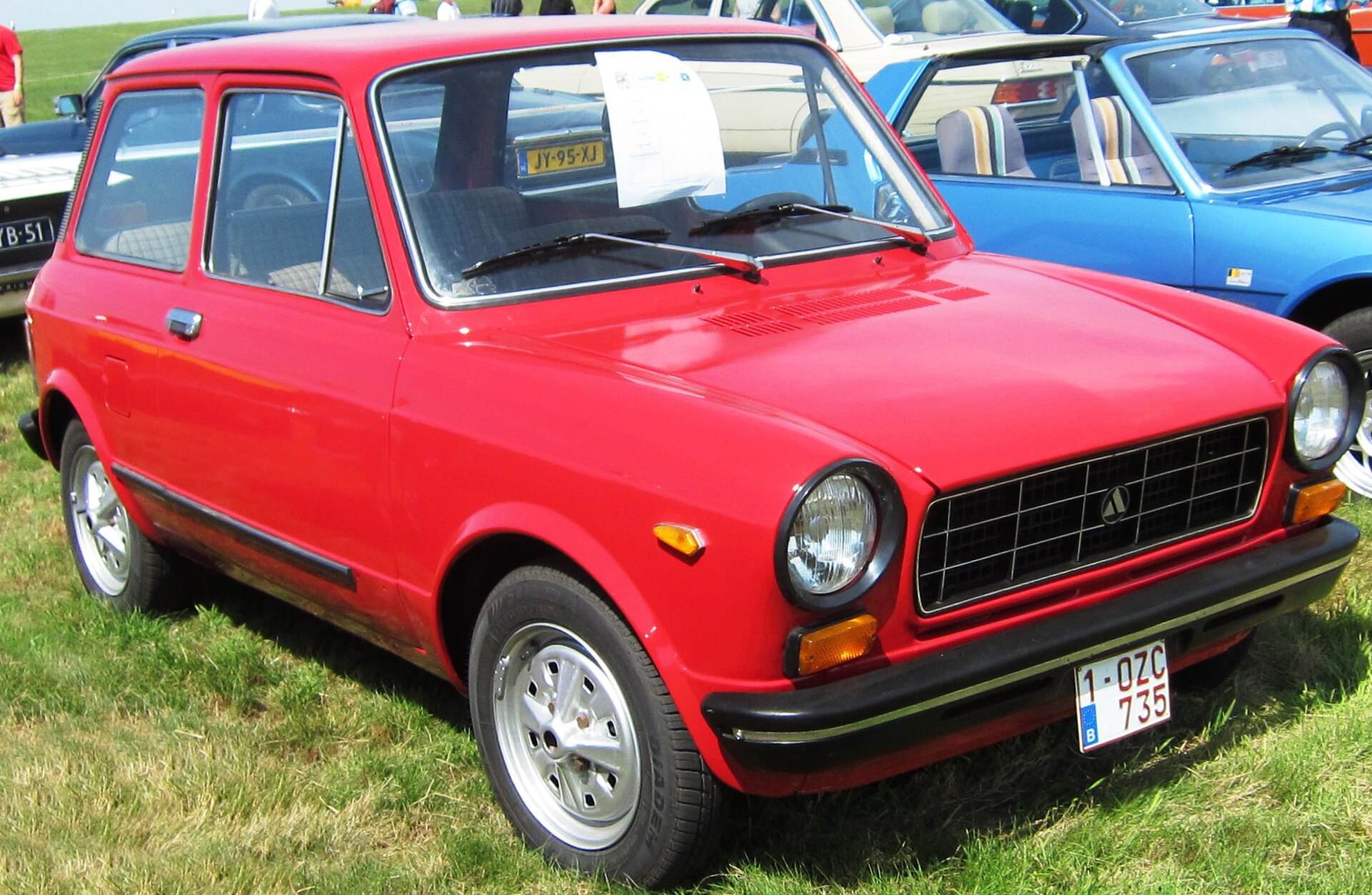
 Autobianchi A112
Specs, engines and history
Published Sources (1) Report an error
By Felix Hartmann, Automotive Technology & EV Contributor
- Built
- 1969–1986
- Top power
- 51 kW (69 PS)
Autobianchi was an Italian car maker set up on 11 January 1955 by Bianchi, Pirelli and Fiat. Bianchi, founded by Edoardo Bianchi in 1885, had built cars since 1899; in the new company Fiat supplied the technical base, Pirelli the tyres and Bianchi the bodies and assembly, in a purpose-built plant of 140,000 square metres at Desio. The brand became Fiat's testing ground for new ideas. The 1963 Stellina had a fibreglass body, and the 1964 Primula was Fiat's first car with front-wheel drive and a transverse engine. Fiat took full control in 1968 and placed Autobianchi under Lancia in 1969. The brand ended in the mid-1990s; English Wikipedia gives both 1995 and 1996.
The A112 is the Autobianchi most people remember. Built from 1969 to 1986, this three-door supermini reached 1,254,178 cars. Marcello Gandini at Bertone designed it on a shortened Fiat 128 platform, and it arrived about 18 months before the Fiat 127, which later used its mechanicals. English Wikipedia calls it the first modern three-door supermini hatchback built in Europe. The A112 Abarth, with up to 51 kW (70 PS), became the basis of an Italian one-make rally series that ran from 1977 to 1984.
Specs by version
| Version | Engine | Power | Gearbox | Drive | Production years |
|---|---|---|---|---|---|
| 903 cc | 0.9 l · 4 cyl · Petrol 903 cc | 31 kW 42 PS42 hp | 4-sp Manual | Front-wheel drive | - |
| Abarth 1050 cc | 1.1 l · 4 cyl · Petrol 1,050 cc | 51 kW 69 PS68 hp | - | Front-wheel drive | 1975 |
Verified Manufacturer and type-approval data from our catalog · Sources and methodology
In short
- Built 1969–1986 in eight series; 1,254,178 cars, the last in May 1986.
- Transverse front engine, front-wheel drive, three-door hatchback only, designed by Marcello Gandini at Bertone.
- Engines of 903–1,050 cc: 31 kW (42 PS) in the basic car, up to 51 kW (70 PS) in the A112 Abarth 70 HP.
- Sold as the Lancia A112 in many export markets from 1977; replaced by the Autobianchi Y10 in 1985.
Autobianchi A112 at a glance: maker, production years (1969–1986), purpose
| Parameter | Value |
|---|---|
| Maker | Autobianchi (Fiat group); badged Lancia A112 in some export markets |
| Production | October 1969 – May 1986 |
| Built | 1,254,178 |
| Purpose | small car (supermini, B segment) for city and family use |
| Body | three-door hatchback |
| Layout | transverse front engine, front-wheel drive |
| Designer | Marcello Gandini (Bertone) |
| Engines | 903, 965, 982 and 1,050 cc pushrod four-cylinders |
| Power | 31 kW (42 PS) to 51 kW (70 PS) |
| Gearbox | four-speed manual; five-speed from 1975 (Abarth) and more widely from 1979 |
| Wheelbase | 2,038 mm |
| Length × width | 3,230 × 1,480 mm |
| Kerb weight | 670 kg (Abarth 700 kg) |
| Predecessor / successor | Bianchina and Primula / Autobianchi Y10 |
Development and production history
Italian Wikipedia dates the presentation to the 1969 Turin Motor Show, and sales began in October 1969. The car replaced both the Bianchina and the Primula. The A112 was developed from a shrunken version of the Fiat 128 platform, and its mechanicals were later used in the Fiat 127. In the 1970 European Car of the Year vote it finished second, behind the Fiat 128. Italian Wikipedia notes that some buyers waited more than twelve months for a car.
The A112 then changed in steps over eight series. Production passed about 1,115,000 cars by the seventh series in 1984. From late 1977 the car was badged as a Lancia in some markets outside Italy; by 1984 only France, Italy and Israel still used the Autobianchi badge. The Autobianchi Y10 took over in 1985, but the A112 stayed in production until May 1986. It was never sold officially in Britain.
The A112 was a small car with a broad audience. In 1984, 35% of owners were women, and about a third were aged 18–24. More about the company behind it is in the history of Fiat.
Design and engineering
Marcello Gandini drew the A112 at Bertone as a short three-door hatchback. Gandini and Bertone also built the A112 Runabout show car of 1969, a wedge-shaped concept that led to the Fiat X1/9; its story is told in the A112 Runabout article.
The production car is 3,230 mm long on a 2,038 mm wheelbase. Italian Wikipedia gives a track of 1,250 mm at the front and 1,220 mm at the rear, a ground clearance of 120 mm, a 30-litre tank and a boot of 180 litres at launch. The car ran on 135 SR13 radial tyres. It was approved for four people until the second series and for five from the third series of 1975, when the rear seat was reworked.

Engine and drivetrain
All A112 engines are pushrod four-cylinders derived from the Fiat 100 series engine of the Fiat 600, mounted across the front and driving the front wheels.
- 903 cc: the Fiat 850 unit. It gave 31 kW (42 PS) at launch, a claimed 35 kW (47 PS) from 1971 without mechanical changes, and 31 kW (42 PS) again in the Normale from July 1975.
- 965 cc: from November 1977 in the Elegant, later in the Elite and LX, with 35 kW (48 PS) and more torque.
- 982 cc: the first Abarth engine, made by lengthening the stroke, with 43 kW (58 PS).
- 1,050 cc: the Abarth engine from 1975 (Italian Wikipedia: December 1974), with 51 kW (70 PS) at 6,600 rpm.
The standard gearbox was a four-speed manual. A five-speed came first on the Abarth in 1975 and was offered on more versions from 1979, with fifth gear as an overdrive. In the seventh series every model except the Junior had five speeds. Italian Wikipedia records 0–100 km/h in 13.7 seconds and an average of 6.9 l/100 km for the first 903 cc car, and a measured top speed of about 144 km/h against a claimed "over 135 km/h". With 51 kW and 700 kg, the Abarth 70 HP has about 73 kW per tonne; the power-to-weight calculator puts that next to modern small cars.

Autobianchi A112 specifications
| Version | Engine | Power | Years |
|---|---|---|---|
| Normale / Junior | 903 cc | 31–35 kW (42–47 PS) | 1969–1986 |
| E / Elegant | 903 cc, then 965 cc | 33–35 kW (45–48 PS) | 1971–1982 |
| Elite | 965 cc | 35 kW (48 PS) | 1979–1985 |
| LX | 965 cc | 35 kW (48 PS) | 1982–1985 |
| Abarth 58 HP | 982 cc | 43 kW (58 PS) | 1971–1976 |
| Abarth 70 HP | 1,050 cc | 51 kW (70 PS) | 1975–1985 |
| Data | Value |
|---|---|
| Kerb weight | 670 kg; Abarth 700 kg |
| Top speed | over 135 km/h claimed (903 cc); about 160 km/h for the Abarth 70 HP |
| 0–100 km/h | 13.7 s (903 cc, Italian Wikipedia) |
| Fuel use | 6.2 l/100 km at 80 km/h, 9.2 l/100 km at 120 km/h (903 cc) |
| Boot | 180 litres at launch |
Variants and derivatives: the eight series
| Series | Years | Main changes |
|---|---|---|
| 1 | 1969–1973 | launch as Normale; Elegant (E) and Abarth from September 1971 |
| 2 | 1973–1975 | larger grille, rubber bumpers with chrome inserts, new seats |
| 3 | 1975–1977 | five seats, larger C-pillar vents, new rear lights; Abarth 1,050 cc |
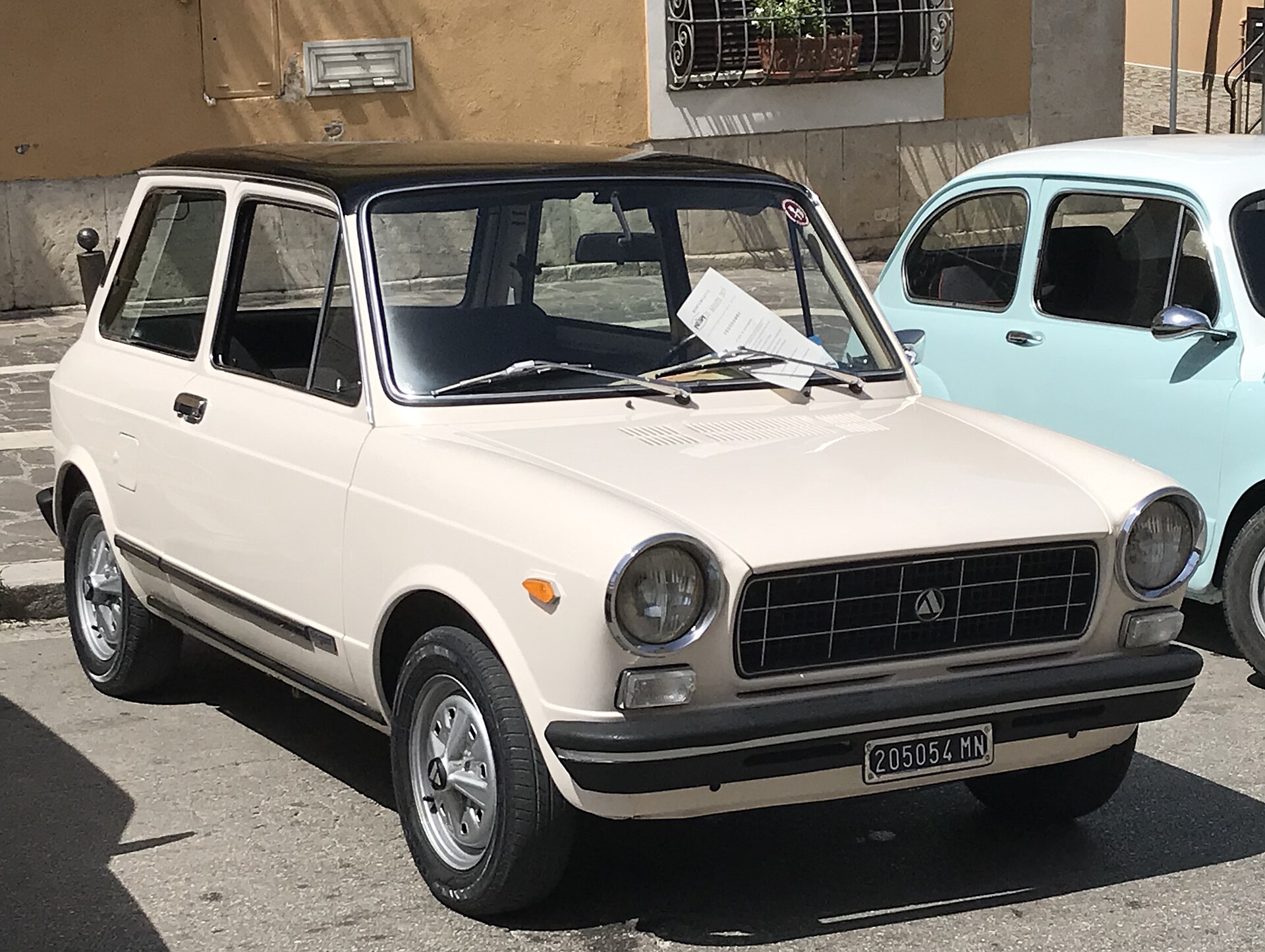
| 4 | 1977–1979 | "Nuova A112": taller roof for more headroom; Elegant gets the 965 cc |
| 5 | 1979–1982 | black plastic cladding; Normale renamed Junior; Elite added; canvas sunroof |
| 6 | 1982–1984 | smoother bumpers, new interior; LX added, Elegant dropped |
| 7 | 1984–1985 | new rear lights, rear plate on the bumper; Abarth gets fog lights |
| 8 | 1985–1986 | only the basic car, sold as "Autobianchi A112" |
The 1976 Elegant lost power to 33 kW (45 PS) because of emissions rules. Several show cars used the A112 base: the Pininfarina Giovani of the 1973 Geneva Motor Show, a targa with the 43 kW (58 PS) Abarth engine, and the Rayton Fissore "Gold Shadow" of 1978.

In service: the A112 Abarth and rallying
The A112 Abarth arrived in September 1971, prepared by the Fiat group's motorsport division with a sports exhaust, a twin-choke carburettor and a different camshaft. The 982 cc car was built alongside the 1,050 cc Abarth until late 1976. Abarth's own story is in the history of Abarth.
The car became the basis of a national one-make series. The Campionato A112 Abarth ran for eight seasons from 1977 to 1984 under Group 1 rules, and its winners included Attilio Bettega, Fabrizio Tabaton and Gianfranco Cunico. A Trofeo A112 Abarth for historic rallies and hill climbs returned in 2010. English Wikipedia also notes that Formula One driver Olivier Panis was among the drivers who crashed one.


Preservation and collecting today
The A112 is still raced: the Trofeo A112 Abarth for historic rallies and hill climbs has run again since 2010. Even the show cars survive; the Pininfarina Giovani is owned by the collector Corrado Lopresto. The Abarth 58 HP, built only from 1971 to 1976, and the first-series cars of 1969–1973 were made for the shortest time; the 903 cc Junior is the simplest version. No reliable public price data was found for this article, so no market values are given.
Which A112 to choose:
- For driving fun: an Abarth 70 HP with the 1,050 cc engine and five-speed gearbox.
- For originality: a first-series car (1969–1973) with metal bumpers.
- For comfort: an Elite or LX with the 965 cc engine and five speeds.
- For simplicity: a late 903 cc Junior.
More cars of the time are in the 1970s classics and the classic cars section; every Autobianchi model is listed in the Autobianchi catalogue.
Photo gallery

Autobianchi A112 in our rankings
- No. 208 of 912 · Longest-running car nameplates (17 years · top 25%)
- No. 100 of 106 · Most powerful hatchbacks (51 kW · top 95%)
- No. 83 of 88 · Most powerful cars of the 1970s (51 kW · top 95%)
- No. 66 of 70 · Biggest engines: hatchbacks (1,050 cc · top 95%)
- No. 828 of 859 · Most powerful cars (51 kW · top 97%)
- No. 123 of 127 · Most powerful Italian cars (51 kW · top 98%)
In production longer than 75% of ranked nameplates in the 1CARS catalog (No. 208 of 912).
FAQ
Who designed the Autobianchi A112?
Marcello Gandini at Bertone. The car used a shortened version of the Fiat 128 platform, and its mechanicals later went into the Fiat 127.
How many Autobianchi A112s were built?
1,254,178 between October 1969 and May 1986, in eight series; about 1,115,000 had been built by the start of the seventh series in 1984.
How powerful is the A112 Abarth?
The first Abarth had a 982 cc engine with 43 kW (58 PS); from 1975 the 1,050 cc engine gave 51 kW (70 PS) at 6,600 rpm.
Why is the A112 sometimes called a Lancia?
From late 1977 it was badged as the Lancia A112 in some export markets; by 1984 only France, Italy and Israel kept the Autobianchi name.
What replaced the A112?
The Autobianchi Y10, sold as the Lancia Y10 in most export markets, from 1985.
Data sources
Data checked by an editor against the sources below.