
 Bertone A112 Runabout
Specs, engines and history
Updated Published Sources (2) Report an error
By Felix Hartmann, Automotive Technology & EV Contributor Reviewed by Oleksandr Hnatiuk

- Built
- 1969
- Top power
- 40 kW (54 PS)
Verdict: who should care about the Runabout
Our verdict · Felix Hartmann
For design students and fans of Italian cars, the Runabout is a key car of the late 1960s: it links the Miura's engine layout to an affordable sports car and shows how Bertone used show cars to win production contracts. For buyers, the lesson is practical: the concept itself is a museum piece, while the Fiat X1/9 that grew out of it is a cheap, light, mid-engined classic. A later 1500 with the five-speed gearbox is the easier X1/9 to live with. For a modern Fiat roadster, see the Fiat 124 Spider of 2016, and put it next to other small sports cars in the 1cars comparison tool.
The Autobianchi A112 Runabout is a one-off concept car that Bertone showed at the Turin Motor Show in late October 1969. Designed by Marcello Gandini, it put a Fiat 128 engine behind the two seats and borrowed its shape from racing speedboats. Fiat turned the idea into the Fiat X1/9, launched in November 1972.
In short
- One running prototype, chassis number 41258, styled by Marcello Gandini at Bertone.
- A 1,116 cc Fiat 128 four-cylinder of about 40 kW (55 PS), mounted transversely ahead of the rear axle.
- No doors, a forward-leaning roll bar and headlamps placed behind the occupants.
- The direct ancestor of the Fiat X1/9, of which about 160,000 were built from 1972 to 1989.

Autobianchi A112 Runabout at a glance
The Runabout was Bertone's answer to a business problem. The coachbuilder assembled the Fiat 850 Spider at its Grugliasco plant near Turin, that car was ageing, and proposed US rollover rules threatened open cars of the traditional kind. Bertone needed a new small sports car to build, and the Runabout was its pitch.

The name came from the Autobianchi A112, the small front-wheel-drive hatchback that Autobianchi, a Fiat-controlled brand, launched in the same autumn of 1969. Gandini styled both. In English a runabout is a small motorboat, and the car was meant to look like one.
| Fact | Value |
|---|---|
| Debut | Turin Motor Show, 29 October to 9 November 1969 |
| Builder | Carrozzeria Bertone, Grugliasco |
| Designer | Marcello Gandini |
| Body | Two-seat open barchetta with roll bar, no doors |
| Engine | Fiat 128 SOHC inline-four, 1,116 cc |
| Layout | Transverse mid-engine, rear-wheel drive |
| Built | 1 (chassis 41258) |
| Owner today | Automotoclub Storico Italiano (since 2015) |
Speedboat design: waterline, roll bar and hidden lamps
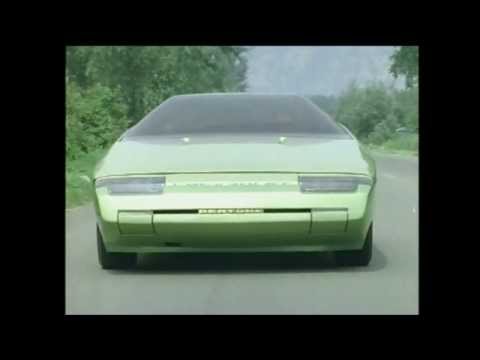
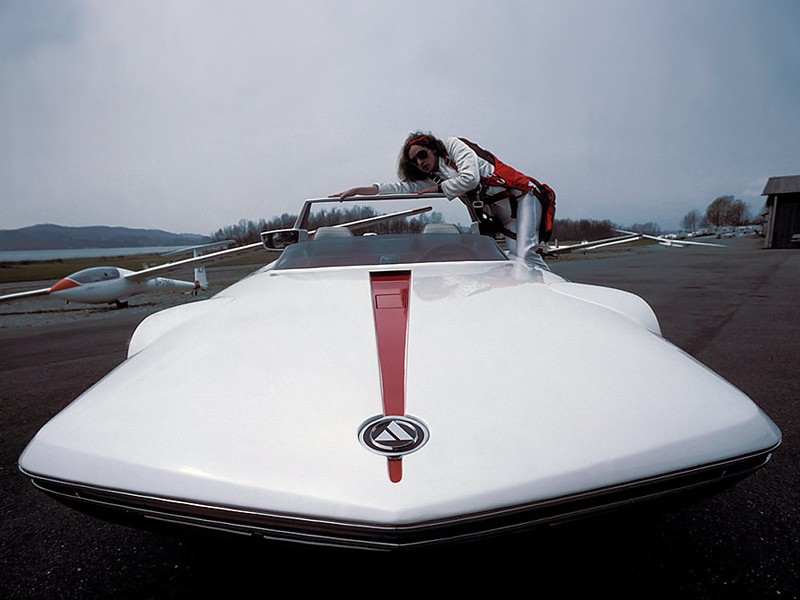
The body has a long, flat nose with a central indentation and an inset Autobianchi badge, and almost no rear overhang. A sharp crease runs along the whole flank like a boat's waterline, with white paint above it and a metallic finish below. The tail is cut off square, like a boat's transom, with the black engine cover on top.

The most unusual feature is the roll bar. It leans forward over the cabin like the radar arch on a racing boat and carries the headlamps in its lower legs, behind the seats rather than in the nose. A low wind deflector replaces a full windscreen, and there are no doors: the occupants step over the sill.
Gandini drew round, slightly flared wheel arches over wide, low tyres and deep-dish wheels, but none of the cut rear arches he used on many other designs. The hexagonal seat shapes recall his Lamborghini Marzal of 1967. The dashboard is tiny, with a single central speedometer styled like a ship's compass.
The Fiat 128 engine behind the seats
Despite the Autobianchi name, the mechanical parts did not come from the A112, which used a 903 cc overhead-valve engine of 31 kW (42 PS) at the front. The Runabout used the newer 1,116 cc single-overhead-camshaft engine of the Fiat 128, designed by Aurelio Lampredi, who had joined Fiat from Ferrari. With an aluminium cylinder head and a belt-driven camshaft, it was a modern unit for 1969, producing about 40 kW (55 PS).

| Parameter | Runabout (1969) | Autobianchi A112 (1969) |
|---|---|---|
| Engine | 1,116 cc SOHC inline-four | 903 cc OHV inline-four |
| Power | about 40 kW (55 PS) | 31 kW (42 PS) |
| Position | transverse, ahead of the rear axle | transverse, front |
| Driven wheels | rear | front |
| Gearbox | manual (sources give four or five speeds) | 4-speed manual |
Bertone placed the engine transversely just ahead of the rear axle, the layout Lamborghini had used for the Miura. The fuel tank and the spare wheel sat behind the cabin on either side of the engine, which balanced the weight and left room for luggage at both ends. Published accounts disagree about the gearbox: some list a four-speed manual, others a five-speed.
Bertone built its show cars as drivable prototypes rather than clay models, and the Runabout was no exception. The old 1cars text claimed a 1.3-litre engine; that size belongs to the production X1/9, not to the concept.
From concept to the Fiat X1/9
Gianni Agnelli saw the Runabout and approved a production car based on it. Bertone's design team, again led by Gandini, adapted the idea into a mid-engined targa with a removable roof panel, and the Fiat X1/9 was presented to the press in Sicily in late November 1972. Its launch had been moved away from the Turin show so that it would not overshadow the new Fiat 126.

| Year | Event |
|---|---|
| 1969 | Runabout shown at Turin; Autobianchi A112 launched |
| 1972 | Fiat X1/9 launched with a 1,290 cc engine of 55 kW (75 PS) |
| 1979 | X1/9 1500: 1,498 cc, 63 kW (85 PS), five-speed gearbox |
| 1982 | Bertone takes over production as the Bertone X1/9 |
| 1989 | X1/9 production ends after about 160,000 cars |
| 2015 | ASI acquires the Bertone collection, Runabout included |
| 2022 | Runabout shown at Pebble Beach, Gran Turismo award |
The X1/9 kept the Runabout's main ideas: the transverse Fiat engine ahead of the rear axle, a fuel tank and spare wheel between cabin and engine, and luggage space at both ends. Fiat built about 140,500 cars until 1982 and Bertone about 19,500 more until 1989; roughly two-thirds went to North America. The X1/9 weighed about 880 kg dry with the 1.3-litre engine and 920 kg with the 1.5. By our calculation that is 16 kg per kW for the first car and about 14.6 kg per kW for the 1500, figures you can set against modern roadsters in the power-to-weight calculator. Bertone's later work is covered in the history of Bertone, and Fiat's in the history of Fiat.
Some historians also point to Fiat's own G31 prototype of 1969 and to the strikingly similar De Tomaso 1600 Spider of 1971 as part of the X1/9 story, but the Runabout is the car most often named as its starting point.
Influence on the Lancia Stratos
The Runabout's wedge proportions and its pointed, low nose fed into Gandini's later work for Lancia. Design historians see a strong influence on the Lancia Stratos HF of the early 1970s, from the prototype to the production rally car. There is a human link too: Mike Parkes, who built the first racing X1/9 for Scuderia Filipinetti, later worked on the development of the Stratos.

Where the Runabout is today
The car survived in Bertone's own collection. When the Bertone company collapsed, the Automotoclub Storico Italiano (ASI) bought the collection in September 2015, and the Runabout has belonged to the club since then. In August 2022 it was shown in the Postwar Preservation class at the Pebble Beach Concours d'Elegance, where it received the Gran Turismo award chosen by Kazunori Yamauchi, the creator of the video game series.

The original is not for sale, and no price can be given for it. A production X1/9 is the realistic way to own the idea; you can browse other cars of the period in the classic cars section and the best classic cars of the 1960s.
The Bertone Runabout revival
The Bertone name returned in the 2020s as a maker of limited-series cars, and it chose the Runabout as the first model of its Bertone Classic range. The new car is a neo-retro reading of the 1969 shape, offered as a barchetta and as a targa, limited to 25 cars. It uses a mid-mounted supercharged 3.5-litre V6 from Toyota with 349 kW (468 bhp), a six-speed manual gearbox, a claimed 0–100 km/h time of 3.1 seconds and a top speed of almost 170 mph (about 270 km/h). The engine sits in the same place as in the original, but with more than eight times the power.

Bertone A112 Runabout in our rankings
- No. 75 of 81 · Most powerful convertibles and roadsters (40 kW · top 93%)
- No. 991 of 1011 · Most powerful cars (40 kW · top 99%)
- No. 146 of 146 · Most powerful Italian cars (40 kW)
More powerful than 7% of ranked convertibles and roadsters in the 1CARS catalog (No. 75 of 81).
Bertone A112 Runabout photos 13


FAQ
Who designed the Autobianchi A112 Runabout?
Marcello Gandini, chief designer at Bertone, styled it in 1969. He also designed the Autobianchi A112 hatchback, the Lamborghini Miura and Countach, the Lancia Stratos and the Fiat X1/9 that grew out of the Runabout.
What engine does the A112 Runabout have?
It uses the 1,116 cc single-overhead-camshaft four-cylinder of the Fiat 128, with about 40 kW (55 PS). The engine sits transversely ahead of the rear axle and drives the rear wheels, unlike the front-engined A112 hatchback.
Was the Autobianchi Runabout ever produced?
Not as shown. Only one prototype was built, but Fiat approved a production car based on it, and Bertone developed it into the Fiat X1/9, built from 1972 to 1989 in about 160,000 examples.
Why is it called the Runabout?
A runabout is a small open motorboat. Gandini based the body on late-1960s racing speedboats, with a waterline crease along the sides, a square transom-style tail and a roll bar shaped like a boat's radar arch.
Where is the Autobianchi A112 Runabout now?
It belongs to the Automotoclub Storico Italiano, which bought the Bertone collection in 2015. It was shown at the Pebble Beach Concours d'Elegance in August 2022.
Data sources
Data checked by an editor against the sources below.
- Wikipedia - Autobianchi A112 Runabout
- Cardesignnews


