Autobianchi: The Desio Brand Where Fiat Tested New Ideas
Autobianchi was an Italian car maker from Desio, near Milan, founded on 11 January 1955 by the bicycle maker Bianchi, Fiat and the tyre company Pirelli. For four decades it served as Fiat's laboratory: the Bianchina tried out a dressed-up Fiat 500, the Primula of 1964 introduced the transverse-engine, front-wheel-drive layout later used across the Fiat group, and the A112 became one of the first modern European superminis. After coming under Lancia's control in 1969, the brand ended with the Y10 in the mid-1990s.
Key takeaways
- Bianchi, Fiat and Pirelli signed the agreement creating Autobianchi on 11 January 1955; the Bianchi family held 33%.
- The Bianchina, presented on 16 September 1957, sold about 275,000 on Fiat 500 mechanicals.
- The Primula of 1964, designed by Dante Giacosa, was Fiat's test of transverse front-wheel drive with an end-on gearbox.
- The A112 of 1969–1986 sold 1,254,178; the Desio plant closed in 1992, and the Y10 was the last Autobianchi.
Autobianchi at a glance
| Fact | Value |
|---|---|
| Founded | 11 January 1955 |
| Founders | Bianchi, Fiat and Pirelli |
| Home | Desio, near Milan, Italy |
| Owners | Fiat fully from 1968; under Lancia control from 1969 |
| Best-known models | Bianchina, Stellina, Primula, A111, A112, Y10 |
| Plant | Desio, 140,000 m², closed 1992 |
| End | Y10 production ended in 1995 (some sources give 1996 for the brand) |
| Brand rights today | Registro Autobianchi, the Italian club for the marque |
Bianchi: bicycles, cars and the war
The name came from Edoardo Bianchi, who founded his company in 1885. Bianchi is best known for bicycles, but from 1899 it also built passenger cars. In the Second World War bombing destroyed the company's factory, and in 1946 Edoardo Bianchi died in a car accident. His son Giuseppe inherited the business and built a new plant in Desio, but post-war conditions led him to concentrate on bicycles, motorcycles and commercial vehicles rather than cars.
Bianchi's general manager, Ferruccio Quintavalle, still wanted to return to car production. Bianchi alone was too small for that, so it looked for larger partners.
Founding with Fiat and Pirelli
On 11 January 1955 Bianchi, Fiat and Pirelli signed the agreement creating Autobianchi, with a share capital of 3 million lire, of which the Bianchi family held 33%. Each partner had its role. Fiat supplied the technical base and the mechanical components, Pirelli supplied tyres and gained a foothold in the original-equipment market, and Bianchi built the bodies and did the final assembly. A purpose-built factory of 140,000 m² went up in Desio.
Bianchina and Stellina
The first car took the name of Edoardo Bianchi's car of 1899. The Bianchina used the chassis and rear engine of the Fiat 500 under a body designed by Luigi Rapi. It was presented on 16 September 1957 at the Museum of Science and Technology in Milan, and the first car, a two-door Trasformabile with a fabric roof, left the line in September 1957. The air-cooled twin had 479 cc and 11 kW (15 PS) at first, rising to 499 cc and up to 15 kW (21 PS) in the Special versions.
From 1960 a Cabriolet, the Panoramica estate, a Berlina saloon and the Furgoncino van followed. The Panoramica was the best-selling version, with about 160,000 across two series, and about 275,000 Bianchinas were built up to 1970. The car became part of Italian popular culture: Audrey Hepburn drove a red Bianchina cabriolet in How to Steal a Million (1966), and Paolo Villaggio's character Ugo Fantozzi drove a much-damaged white Bianchina in his stories and films.
Autobianchi also tried glass-fibre bodies. The Stellina, a two-door spider on the mechanicals of the Fiat 600D with a fibreglass body by Tom Tjaarda, appeared at the 1963 Turin Motor Show; only 502 were built in 1964 and 1965.

Primula: Fiat's front-wheel-drive test
The most important Autobianchi was the Primula, a three-door hatchback introduced for 1964 and built in Desio until 1970. Fiat had started the project in 1961 as "Project 109" and launched it under the Autobianchi name to test how the market would react. Dante Giacosa mounted the engine transversely and moved the gearbox out of the engine's oil sump, placing it end-on beside the engine above the differential. This made the drive easier to service and quieter than the arrangement of the Mini, and Ettore Cordiano's concentric clutch release made it compact. The resulting unequal-length driveshafts are now common on front-wheel-drive cars.
The Primula was also Fiat's first car with rack-and-pinion steering, and it had disc brakes on all four wheels. It finished second in the 1965 European Car of the Year award. The first engine was the 1,221 cc unit from the Fiat 1100 D; from 1968 Fiat 124 engines were used, with 1,197 cc and 44 kW (60 hp) for the saloon and 1,438 cc and 52 kW (70 hp) for the Touring-styled coupé. About 75,000 were built.

Fiat, Lancia, the A111 and A112
Bianchi sold its share in 1968 amid problems in the motorcycle market, and Autobianchi became part of Fiat S.p.A. In 1969 it was placed under the control of Lancia, another brand of the Fiat group. The same year the Bianchina ended, and two new cars replaced the Primula. The larger A111, based on Primula mechanicals, sold poorly, and about 50,000 were built up to 1972.
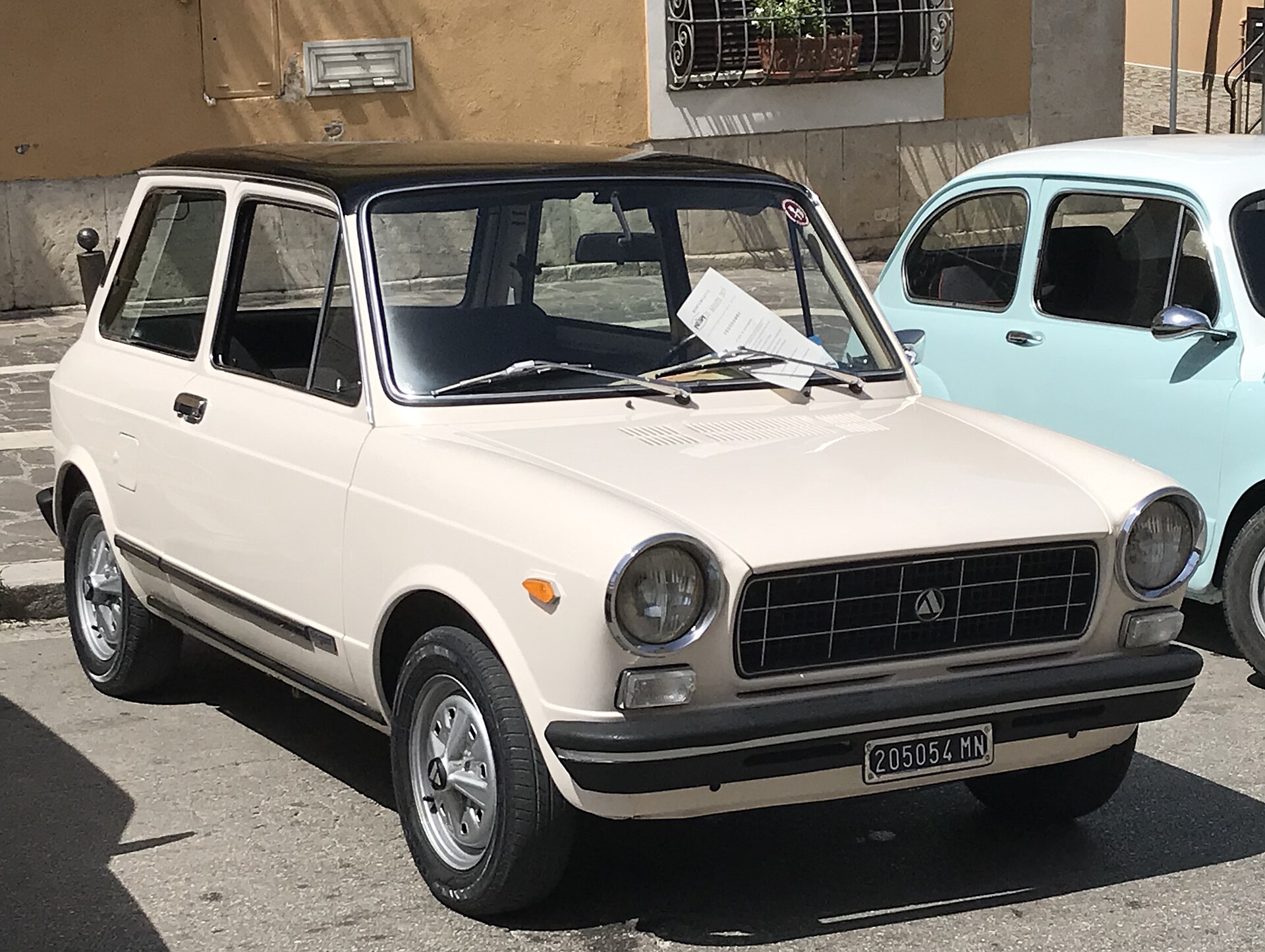
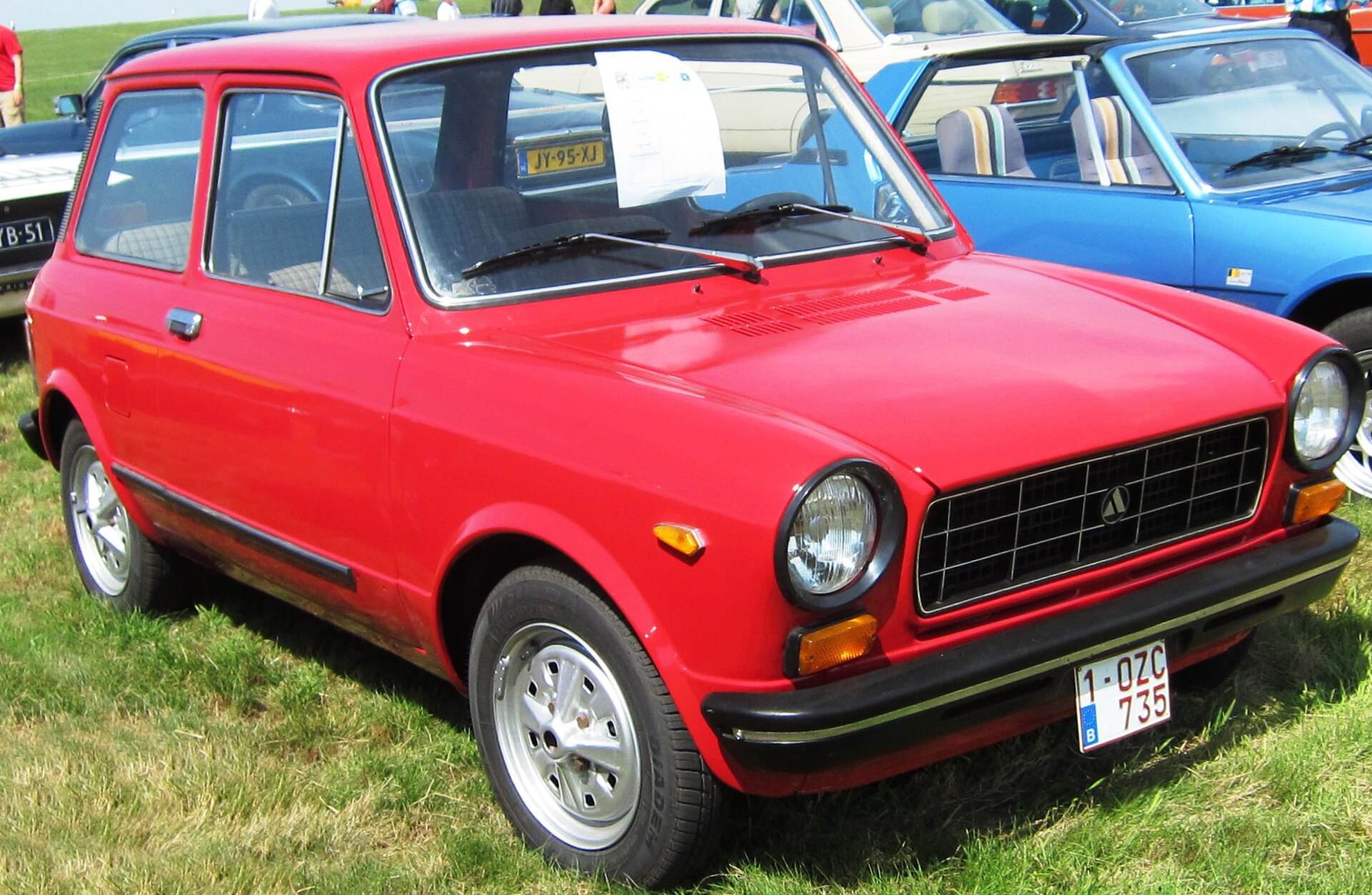
The smaller A112 was a success. Launched in November 1969 with a body by Marcello Gandini at Bertone, it is described as the first modern three-door supermini hatchback built in Europe, about 18 months before the Fiat 127. Its 903 cc engine first had 31 kW (42 PS); the Abarth versions had 982 cc and 43 kW (58 PS), then 1,050 cc and 51 kW (70 PS). The car went through eight series. From 1977 to 1984 the Campionato A112 Abarth one-make rally series ran for eight seasons; its winners included Attilio Bettega, Fabrizio Tabaton and Gianfranco Cunico. From the mid-1970s the A112 was sold as a Lancia in most export markets except Italy, France and Israel. By the time the last one was built in May 1986, 1,254,178 had been made. Its full story is in the Autobianchi A112 history, and Bertone's concept based on it is described in the A112 Runabout article.

Y10 and the end of the brand
The last Autobianchi was the Y10, shown at the Geneva Motor Show in March 1985. Based on the Fiat Panda, it was sold as the Autobianchi Y10 in Italy, France, Portugal and Japan and as the Lancia Y10 elsewhere, including Britain. It was the first car with Fiat's FIRE engine, a 999 cc four with 33 kW (45 hp), and later versions included a 62 kW (84 hp) Turbo and a four-wheel-drive model. Its drag coefficient of 0.31 was very low for a small car of the time, and higher trims offered Alcantara upholstery. More than 942,000 were built.
The Desio factory closed in 1992, and production of the Y10 moved to Arese and Pomigliano d'Arco. When the Y10 ended, the Autobianchi name ended with it; Wikipedia gives 1995 in its infobox and 1996 in the text. Its small-car role passed to the Lancia Ypsilon. Fiat had used Autobianchi to test fibreglass bodies and front-wheel drive before both spread to mainstream Fiats. The rights to the brand are now held by Registro Autobianchi, the Italian owners' club. Autobianchi models on 1cars are listed in the Autobianchi catalogue, and the designer of the A112 is profiled on the Marcello Gandini page.

Autobianchi timeline
| Year | Event |
|---|---|
| 1885 | Edoardo Bianchi founds Bianchi |
| 1899 | First Bianchi car |
| 1955 | Autobianchi founded by Bianchi, Fiat and Pirelli (11 January) |
| 1957 | Bianchina presented in Milan (16 September) |
| 1963 | Stellina at the Turin show |
| 1964 | Primula with transverse front-wheel drive |
| 1968 | Bianchi sells its stake; Autobianchi fully part of Fiat |
| 1969 | Lancia takes control; A111 and A112 launched |
| 1977 | Campionato A112 Abarth begins |
| 1985 | Y10 shown in Geneva (March) |
| 1986 | Last A112 (May) |
| 1992 | Desio plant closes |
| 1995 | Y10 production ends; brand retired |
Landmark Autobianchi models
| Model | Years | Why it matters |
|---|---|---|
| Bianchina | 1957–1970 | First Autobianchi, about 275,000 built |
| Stellina | 1964–1965 | Glass-fibre spider, 502 built |
| Primula | 1964–1970 | Fiat's first transverse front-wheel-drive car |
| A112 | 1969–1986 | Early European supermini, 1,254,178 built |
| Y10 | 1985–1995 | First car with the FIRE engine, the last Autobianchi |
Photo gallery

FAQ
Who owned Autobianchi?
It was founded by Bianchi, Fiat and Pirelli in 1955. Fiat became the sole owner in 1968 and put the brand under Lancia in 1969.
Why was Autobianchi important to Fiat?
Fiat used it to test new ideas. The Primula of 1964 introduced the transverse engine with an end-on gearbox that became standard in later front-wheel-drive Fiats.
Is the Autobianchi Y10 the same as the Lancia Y10?
Yes. It was sold as an Autobianchi in Italy, France, Portugal and Japan and as a Lancia in other markets.
When did Autobianchi stop making cars?
The Desio plant closed in 1992, and the name ended with the Y10 in the mid-1990s; sources give 1995 or 1996.
Sources
- Wikipedia - Autobianchi (accessed 24 Oct 2026)
- Wikipedia - Autobianchi Bianchina (accessed 24 Oct 2026)
- Wikipedia - Autobianchi Primula (accessed 24 Oct 2026)
- Wikipedia - Autobianchi A112 (accessed 24 Oct 2026)
- Wikipedia - Lancia Y10 (accessed 24 Oct 2026)
Found a mistake? Report an error