 Mazda BT-50
All generations, specs and history
Published Sources (3) Report an error
By Sarah Whitmore, Senior Automotive Writer
- Built
- 2006–present
- Generations
- 3
- Top power
- 147 kW (200 PS)
Timeline
BT-50 generations
Click a generation for its own page


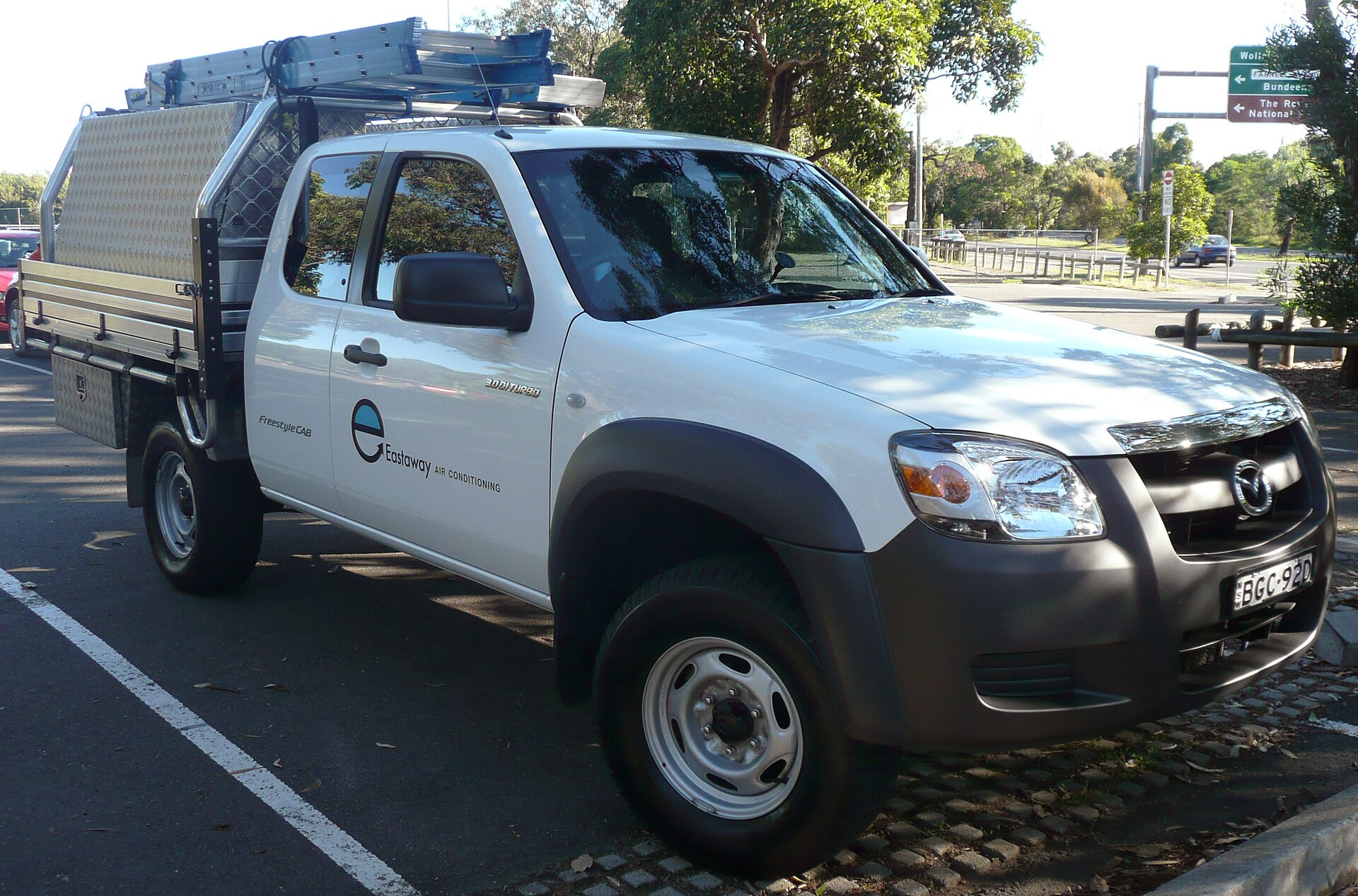
- BT-50 I 2006–2011 · Pickup · 105 kW (143 PS)
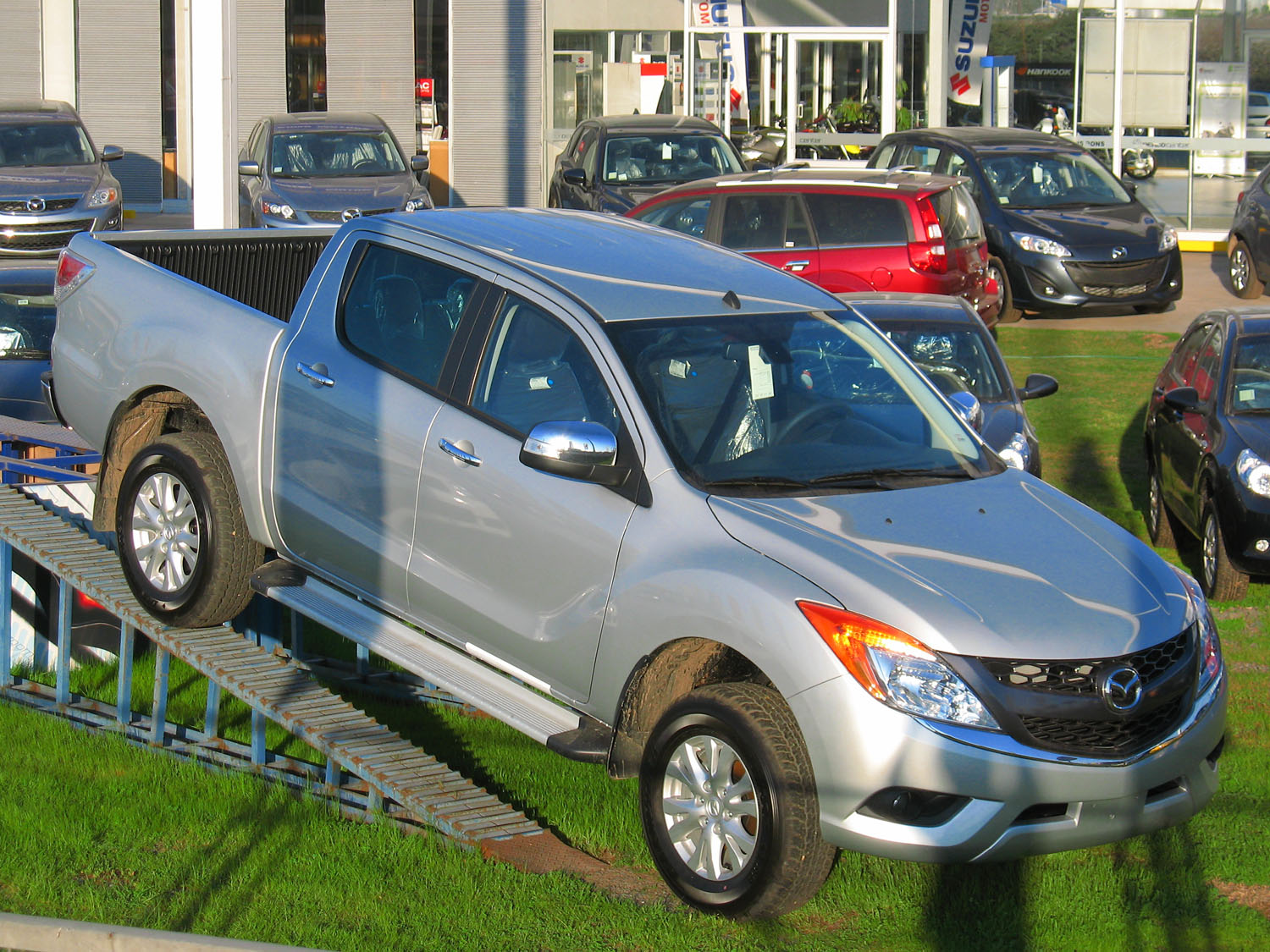
- BT-50 II 2011–2020 · Pickup · 110–147 kW (150–200 PS)
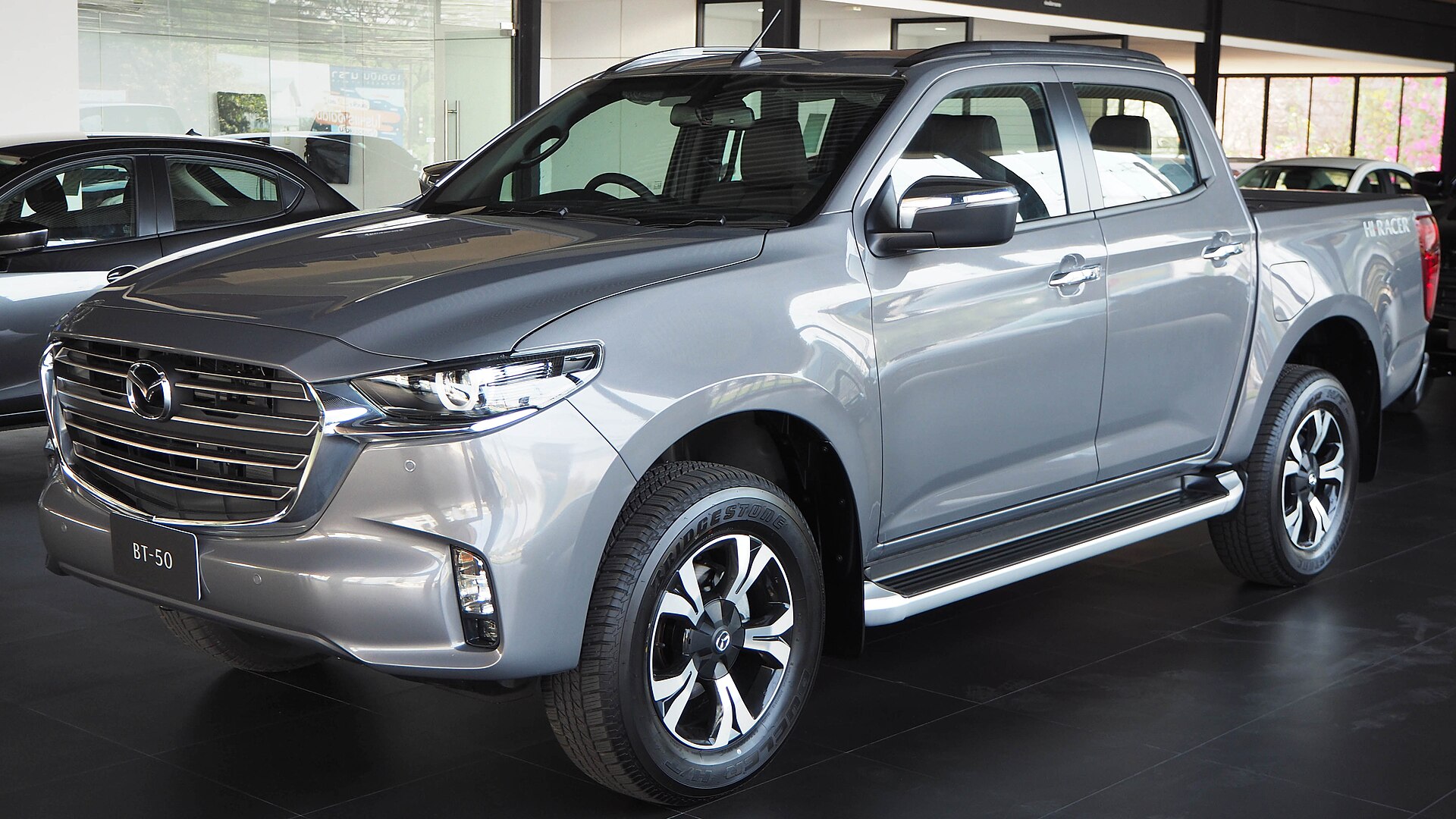
- BT-50 III Current 2020–now · Pickup · 110–140 kW (150–190 PS)
Newest first · 3 generations since 2006
-
2020
-
2011
-
2006
All generations by year: BT-50 III (2020–now) · BT-50 II (2011–2020) · BT-50 I (2006–2011)
Which one is mine?
Pick the year of first registration to see which generation it is.
Check by VINWhich BT-50 to choose
Our verdict · Sarah Whitmore
- For heavy towing: a third-generation 3.0 with 140 kW and 450 Nm, rated at 3,500 kg.
- For a cheaper work truck: the 1.9 XS or the 2026 2.2 with the eight-speed automatic.
- For a used bargain: a second-generation 3.2 five-cylinder, mechanically a Ford Ranger T6 with 147 kW.
- For safety: a 2020-or-later truck with the camera-based driver aids and a centre airbag.
Its current twin is the Isuzu D-Max, and a key rival is covered in the Toyota Hilux article. The garage-fit tool helps to check whether a double cab fits, and Mazda's background is in our history of Mazda. The Mazda catalogue lists every model.
The Mazda BT-50 is a pickup truck built in Thailand since 2006 and sold in Australia, South-East Asia, Africa and Latin America. The first two generations were developed with Ford as twins of the Ranger, and the third, launched in 2020, is based on the Isuzu D-Max. Diesel engines range from 105 to 147 kW, and the current truck tows up to 3,500 kg. The first generation was also sold in Europe; the second was not offered there.
In short
- First generation 2006–2011: Thai-built Ranger twin with 2.5 and 3.0 MZR-CD diesels, also sold in Europe.
- Second generation 2011–2020: developed with the Ranger T6, 2.2 and 3.2 Duratorq diesels with up to 147 kW and 470 Nm.
- Third generation since 2020: built by Isuzu at Samrong, Thailand, with the 3.0 4JJ3-TCX of 140 kW and 450 Nm.
- Australia is the main market: 17,526 sold there in 2023, the best year since 2019.
Specs by version
Engines
| Version | Engine | Power | Torque | Gearbox | Production years |
|---|---|---|---|---|---|
| BT-50 I · 2.5 MZR-CD 2WD | 4 cyl · Diesel | 105 kW 143 PS141 hp | 330 Nm243 lb-ft | — | 2006 |
| BT-50 I · 2.5 MZR-CD 4WD | 4 cyl · Diesel | 105 kW 143 PS141 hp | 330 Nm243 lb-ft | — | 2006 |
| BT-50 II · 2.2 Duratorq TDCi | 4 cyl · Diesel | 110 kW 150 PS148 hp | 375 Nm277 lb-ft | 6-sp Manual | 2011 |
| BT-50 II · 3.2 Duratorq TDCi | 5 cyl · Diesel | 147 kW 200 PS197 hp | 470 Nm347 lb-ft | 6-sp | 2011 |
| BT-50 III · 1.9 RZ4E-TC | 4 cyl · Diesel RZ4E-TC | 110 kW 150 PS148 hp | 350 Nm258 lb-ft | 6-sp | 2021 |
| BT-50 III · 3.0 4JJ3-TCX | 4 cyl · Diesel 4JJ3-TCX | 140 kW 190 PS188 hp | 450 Nm332 lb-ft | 6-sp | 2020 |
Performance
Show all 2 versions
| Version | 0–100 km/h | Top speed |
|---|---|---|
| BT-50 I · 2.5 MZR-CD 2WD | 10.4 s 0–62 mph | 170 km/h106 mph |
| BT-50 I · 2.5 MZR-CD 4WD | 12.5 s 0–62 mph | 158 km/h98 mph |
Verified Manufacturer and type-approval data from our catalog · Sources and methodology
Mazda BT-50 at a glance
| Parameter | First generation | Second generation | Third generation |
|---|---|---|---|
| Years | 2006–2011/2012 | 2011–2020 | since 2020 |
| Partner model | Ford Ranger | Ford Ranger (T6) | Isuzu D-Max |
| Main plant | Thailand | Rayong (Thailand), Silverton (South Africa) | Isuzu, Samrong (Thailand) |
| Cabs | regular, Freestyle, double | single, Freestyle, double | single, Freestyle, double |
| Diesel engines | 2.5 and 3.0 MZR-CD | 2.2 and 3.2 Duratorq | 1.9, 2.2 and 3.0 |
| Power | 105 kW (2.5) | 110–147 kW | 110–140 kW |
| Sold in Europe | yes | no | – |
First generation (2006–2011): the Ranger twin
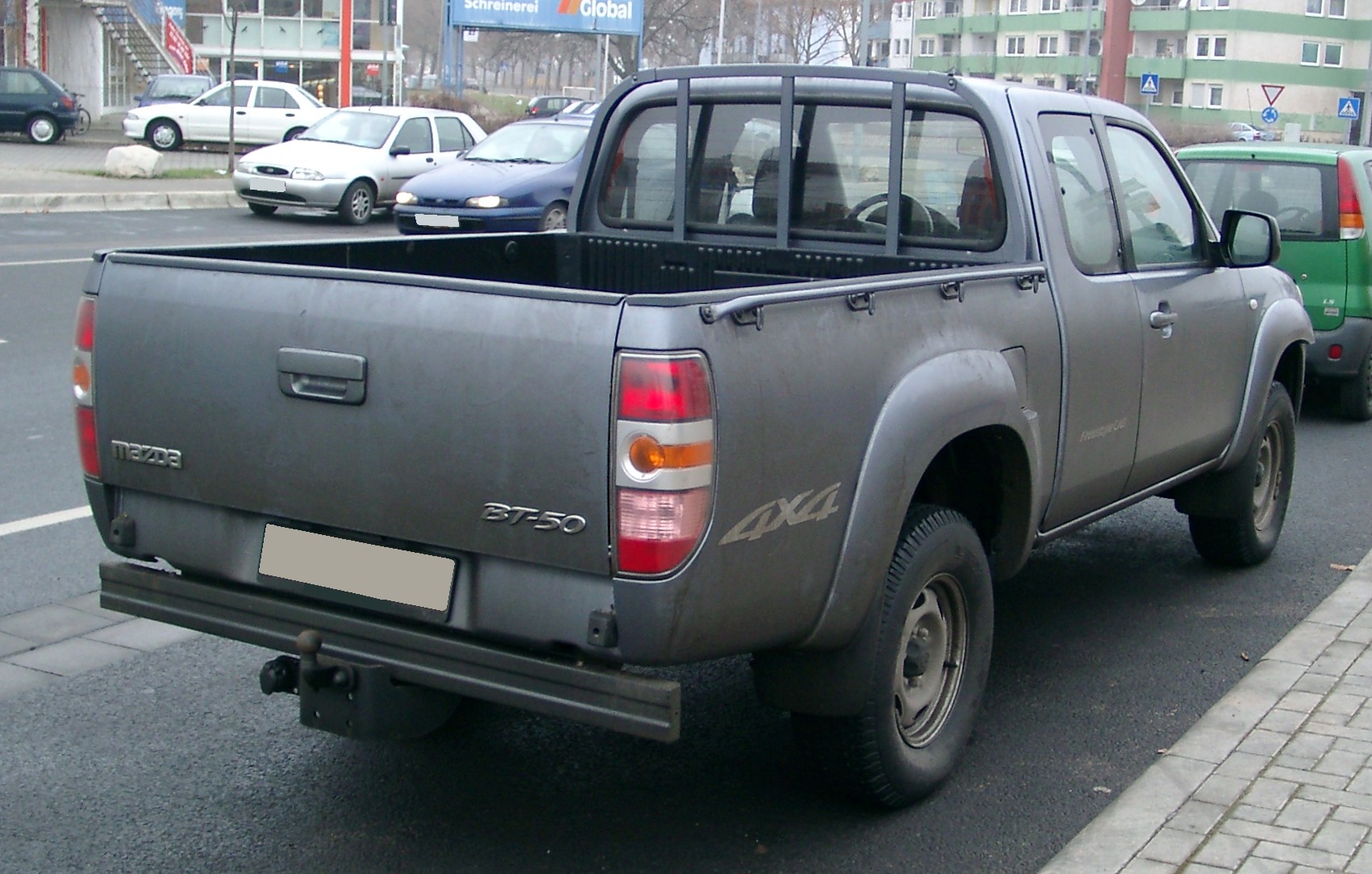
Mazda launched the BT-50 at the Bangkok International Motor Show on 22 March 2006. It was a twin of the Ford Ranger of the time and shared its 2.5- and 3.0-litre MZR-CD common-rail diesels. Both trucks were built in Thailand for the Thai and European markets. Further assembly took place in Pretoria, South Africa, in Colombia for Latin America and, from 2007 to 2010, in Zimbabwe.
In November 2006 a five-speed automatic with a Borg Warner transfer case and side airbags joined the range. A minor update with a revised interior followed in 2008, and in autumn 2008 the grille was redesigned. Latin American markets also received 2.2- and 2.6-litre petrol engines.
| Version | Power | Torque | Top speed | 0–100 km/h |
|---|---|---|---|---|
| 2.5 MZR-CD, 2WD | 105 kW (143 PS) | 330 Nm | 170 km/h | 10.4 s |
| 2.5 MZR-CD, 4WD | 105 kW (143 PS) | 330 Nm | 158 km/h | 12.5 s |
The European truck used about 8.9 l/100 km, held 70 litres of diesel and weighed about two tonnes. German buyers could choose the long cab or the double cab; the short cab was not offered there. In the 2008 ANCAP test, the DX dual cab 4x4 scored only 6.46 of 16 in the frontal offset test but scored full marks for side impact. Stability control was not available.

Second generation (2011–2020): co-developed with the T6
The second BT-50 was revealed in October 2010 and developed in tandem with the T6 Ranger. Mechanically the two are identical, but they share almost no body panels apart from the roof and the window glass. Production took place at Rayong in Thailand and at Silverton near Pretoria. Body styles were a two-door single cab, a Freestyle cab with rear-hinged back doors and a four-door double cab.
| Engine | Power | Torque | Gearbox |
|---|---|---|---|
| 2.2 Duratorq TDCi, four-cylinder | 88–118 kW (118–158 hp), main version 110 kW (150 hp) | 285–400 Nm, main version 375 Nm | 6-speed manual or automatic |
| 3.2 Duratorq TDCi, five-cylinder | 147 kW (197 hp) | 470 Nm | 6-speed |
The Ranger platform allowed a braked towing capacity of 3,500 kg. A single cab tested by ANCAP in 2011 reached 15.72 of 16 points for the offset crash and a perfect side-impact score, with stability control fitted as standard. A cosmetic facelift for the 2016 model year was shown in July 2015, and an Australian update in 2018 added Apple CarPlay and Android Auto. Mazda did not offer this generation in Europe.

Third generation (since 2020): based on the Isuzu D-Max
Mazda unveiled the third BT-50 on 17 June 2020. Under a 2016 agreement Isuzu supplies the truck, which is heavily based on the third-generation D-Max. It is built alongside the D-Max at Isuzu's plant in Samrong, Samut Prakan, Thailand. An Isuzu executive said that Mazda had no part in the D-Max's development.
The 3.0-litre four-cylinder replaced the old 3.2-litre five-cylinder, with 7 kW less power and 450 Nm of torque compared with 470 Nm. A 1.9-litre entry engine arrived in Australia in November 2021 with the XS trim. Thai trucks use a six-speed Aisin manual, a six-speed Aisin automatic and, from 2024, an eight-speed automatic. CarsGuide lists a 2.2-litre diesel with the eight-speed automatic for the 2026 Australian XS models.
| Engine | Code | Power | Torque | Gearbox |
|---|---|---|---|---|
| 1.9 turbo diesel | RZ4E-TC | 110 kW (150 PS) | 350 Nm | 6-speed manual or automatic |
| 3.0 turbo diesel | 4JJ3-TCX | 140 kW (190 PS) | 450 Nm | 6-speed manual or automatic |
| 2.2 turbo diesel | – | not published in the source | – | 8-speed automatic (2026, Australia) |
The 3.0 has 30 kW more than the 1.9 and 100 Nm more torque. The power converter gives these figures in PS and hp.
Every 2026 Australian BT-50 is rated to tow 3,500 kg braked, according to CarsGuide. Instead of a grille radar, adaptive cruise control uses two cameras behind the windscreen. Autonomous emergency braking, blind-spot warning, rear cross-traffic alert, lane-keeping assist and a centre airbag are available on selected trims.
In the 2020 ANCAP assessment, aligned with Euro NCAP, the BT-50 scored 83 % for adult occupants, 89 % for children, 67 % for pedestrian protection and 84 % for safety assistance. A 2022 update raised the adult score to 86 %. Its twin, the D-Max, was the first pickup to earn five stars under Euro NCAP's protocol.


Facelift and recent changes
Mazda presented a revised BT-50 on 18 October 2024. It went on sale in Thailand on 28 November 2024, in the Philippines on 23 April 2025 and in Malaysia on 5 November 2025. Changes include:
- new front and rear styling;
- a 7-inch digital instrument display and a 9-inch touchscreen;
- wireless Android Auto;
- front stereo cameras for the driver aids.
In March 2026 the Boss and Thunder versions joined the Australian range, both with the 3.0-litre diesel.
Sales and prices
| Year | Australia | Thailand |
|---|---|---|
| 2019 | 11,357 | 5,664 |
| 2020 | 9,588 | 2,711 |
| 2021 | 15,662 | 1,441 |
| 2022 | 12,937 | 1,506 |
| 2023 | 17,526 | 834 |
| 2024 | 15,164 | 486 |
Australian sales were far higher than Thai sales in every year shown. In January 2021 Thai prices for the 1.9 and 3.0 double cab ran from 771,000 to 1,153,000 baht, about €21,000–31,600 at 2021 rates.
Photo gallery

Mazda BT-50 evolution in numbers
Did you know?
- The Mazda BT-50 has been around for 20 years: 3 generations in our catalog since 2006.
- The longest-running generation is the BT-50 II (2011–2020): 9 years.
- The biggest jump in power came with the BT-50 II: up to 147 kW (200 PS), 42 kW more than the BT-50 I.
- The most powerful Mazda BT-50 is not the newest: the BT-50 II (2011–2020) offered up to 147 kW (200 PS), the BT-50 III up to 140 kW (190 PS).
Most powerful version, kW
Figures from the 1cars catalog: power is the strongest version of each generation; generations without the figure are left out.
Mazda BT-50: first vs latest generation
| Spec | BT-50 I | BT-50 III | Change |
|---|---|---|---|
| Years | 2006–2011 | 2020–present | 14 years apart |
| Most powerful version | 105 kW (143 PS) | 140 kW (190 PS) | +35 kW (+33%) |
Oldest and newest generation in the 1cars catalog. Power is the strongest version of each; other rows are shown only when both generations have the figure.
Mazda BT-50 in our rankings
More powerful than 20% of ranked pickup trucks in the 1CARS catalog (No. 16 of 20).
FAQ
Is the Mazda BT-50 the same as the Ford Ranger?
The first two generations were Ranger twins; the 2011–2020 truck was mechanically identical to the Ranger T6. Since 2020 the BT-50 is based on the Isuzu D-Max.
Who builds the Mazda BT-50?
Since 2020, Isuzu at its Samrong plant in Thailand. Earlier trucks were built in Thailand, mainly at Rayong, and in South Africa.
What engine does the Mazda BT-50 have?
The current truck uses Isuzu diesels: a 1.9 with 110 kW, a 3.0 with 140 kW and 450 Nm and, in the 2026 Australian range, a 2.2.
How much can a Mazda BT-50 tow?
Up to 3,500 kg braked, both for the 2011–2020 truck and for the current range.
Is the Mazda BT-50 sold in Europe?
The first generation (2006–2011) was sold in Europe, including Germany. Mazda did not offer the second generation there.
Data sources
Data checked by an editor against the sources below.
- Wikipedia — Mazda BT 50
- Wikipedia — Ford Ranger (T6)
- Wikipedia — Isuzu D Max