 Kia K4
Specs, engines and history
Published Sources (7) Report an error
By Sarah Whitmore, Senior Automotive Writer
- Built
- 2024–present
- Top power
- 142 kW (193 PS)
Which K4 to choose
Our verdict · Sarah Whitmore
- For low running costs in Europe: the 1.0 T-GDi GT-Line, which Auto Express rates as the best buy.
- For more pace: the 1.6 T-GDi with up to 133 kW in Europe or 142 kW in the US GT-Line Turbo.
- For the biggest boot: the Sportswagon estate with 604 litres.
- To line it up against a Golf or Civic: open our comparison tool.
- For a cheaper, smaller Kia: the subcompact K3 sold in Latin America and the Middle East.
More models are listed in our Kia catalogue, and the brand's past is told in our history of Kia.
The Kia K4 is a compact family car launched in 2024 to replace the Kia Forte, Cerato and K3 in most markets and, in Britain, the Ceed hatchback as well. It is built in Mexico on the platform of the Hyundai Elantra and comes as a fastback saloon, a hatchback and, from 2026, a Sportswagon estate. Petrol engines range from a 1.0-litre turbo with 84 kW to a 1.6-litre turbo with 142 kW.
In short
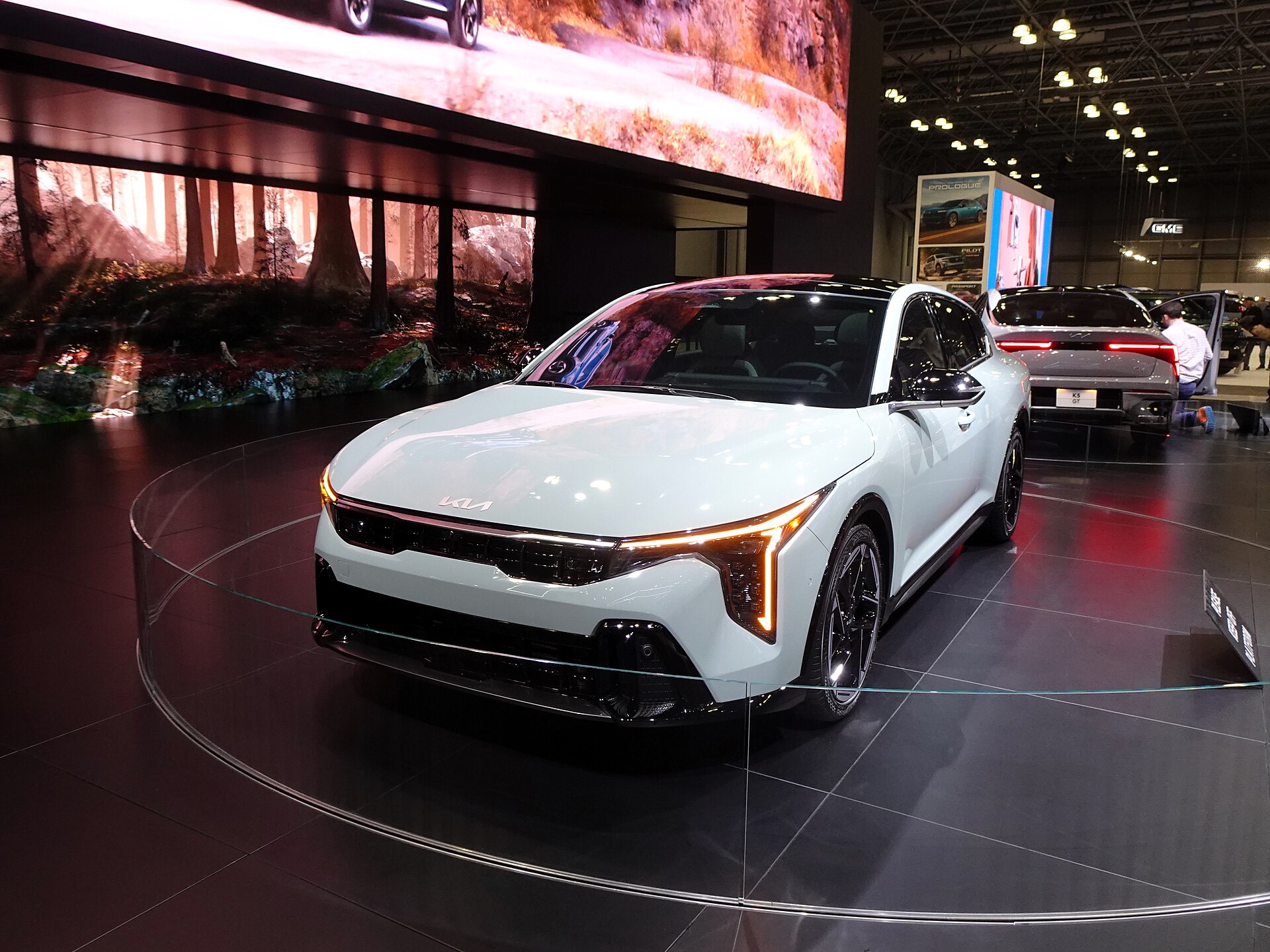
- Code CL4; revealed on 21 March 2024 and shown at the New York motor show six days later.
- Engines: 1.0 T-GDi 84 kW (114 PS), 1.6 MPi 90 kW, 2.0 MPi 112 kW, 1.6 T-GDi 110–142 kW.
- Euro NCAP 2025: five stars with the Safety Pack; IIHS Top Safety Pick in the US.
- US sales: 139,778 in 2024 and 140,514 in 2025; prices from US$23,165 (about €21,400).
Size at a glance
| Dimensions | Kia K4 CL4 |
|---|---|
| Length | 4,710 mm185.4 in |
| Width | 1,850 mm72.8 in |
| Height | 1,420 mm55.9 in |
| Wheelbase | 2,720 mm107.1 in |
Running cost
Fuel · K4 CL4 1.6 T-GDi 150 PS
about 1,700 EUR fuel a year at 15,000 km
6.5 l/100 km · petrol at 1.75 EUR/l · change mileage, fuel price or version
Specs by version
Engines
| Version | Engine | Power | Gearbox | Drive | Production years |
|---|---|---|---|---|---|
| 1.6 L 4 cyl Automatic (S8) · 2026 (EPA) | 1.6 l · 4 cyl 1,600 cc | - | 8-sp Automatic | Front-wheel drive | 2026 |
| 1.6 L 4 cyl Automatic (S8) · 2025 (EPA) | 1.6 l · 4 cyl 1,600 cc | - | 8-sp Automatic | Front-wheel drive | 2025 |
| 2 L 4 cyl Automatic (AV-S1) · 2025 (EPA) | 2.0 l · 4 cyl 2,000 cc | - | CVT | Front-wheel drive | 2025 |
| 2 L 4 cyl Automatic (AV-S1) · 2025 (EPA) | 2.0 l · 4 cyl 2,000 cc | - | CVT | Front-wheel drive | 2025 |
| 1.0 T-GDi | 3 cyl · Petrol | 84 kW 114 PS113 hp | - | Front-wheel drive | 2025 |
| 1.6 MPi | 4 cyl · Petrol | 90 kW 122 PS121 hp | - | Front-wheel drive | 2024 |
| 1.6 T-GDi 150 PS | 4 cyl · Petrol | 110 kW 150 PS148 hp | Dual-clutch | Front-wheel drive | 2025 |
| 2.0 MPi | 4 cyl · Petrol | 112 kW 152 PS150 hp | CVT | Front-wheel drive | 2024 |
| 1.6 T-GDi 180 PS | 4 cyl · Petrol | 133 kW 181 PS178 hp | Dual-clutch | Front-wheel drive | 2025 |
| 1.6 T-GDi GT-Line Turbo | 4 cyl · Petrol | 142 kW 193 PS190 hp | 8-sp Automatic | Front-wheel drive | 2024 |
Performance
Show all 7 versions
| Version | Fuel consumption | CO₂ |
|---|---|---|
| 1.6 L 4 cyl Automatic (S8) · 2026 (EPA) | 8.4 l/100 km28.0 mpg US · 33.6 mpg UK | - |
| 1.6 L 4 cyl Automatic (S8) · 2025 (EPA) | 8.1 l/100 km29.0 mpg US · 34.9 mpg UK | - |
| 2 L 4 cyl Automatic (AV-S1) · 2025 (EPA) | 7.1 l/100 km33.1 mpg US · 39.8 mpg UK | - |
| 2 L 4 cyl Automatic (AV-S1) · 2025 (EPA) | 6.9 l/100 km34.1 mpg US · 40.9 mpg UK | - |
| 1.6 T-GDi 150 PS | 6.5 l/100 km36.2 mpg US · 43.5 mpg UK | 148 g/km |
| 2.0 MPi | 6.5 l/100 km36.2 mpg US · 43.5 mpg UK | 148 g/km |
| 1.6 T-GDi 180 PS | 6.6 l/100 km35.6 mpg US · 42.8 mpg UK | 151 g/km |
Dimensions and weight
Show all 6 versions
| Version | Length | Width | Wheelbase | Kerb weight |
|---|---|---|---|---|
| 1.0 T-GDi | - | 1,850 mm72.8 in | 2,720 mm107.1 in | - |
| 1.6 MPi | 4,710 mm185.4 in | 1,850 mm72.8 in | 2,720 mm107.1 in | - |
| 1.6 T-GDi 150 PS | - | 1,850 mm72.8 in | 2,720 mm107.1 in | 1,487 kg3,278 lb |
| 2.0 MPi | 4,710 mm185.4 in | 1,850 mm72.8 in | 2,720 mm107.1 in | 1,487 kg3,278 lb |
| 1.6 T-GDi 180 PS | - | 1,850 mm72.8 in | 2,720 mm107.1 in | 1,500 kg3,307 lb |
| 1.6 T-GDi GT-Line Turbo | 4,710 mm185.4 in | 1,850 mm72.8 in | 2,720 mm107.1 in | 1,489 kg3,283 lb |
Verified Manufacturer and type-approval data from our catalog · Sources and methodology
Safety
-
NHTSA 2025
US NCAP (NHTSA)
Stars from different years and organisations are not directly comparable: test protocols change every few years.
Kia K4 at a glance
| Parameter | Value |
|---|---|
| Production | since 2024 (model year 2025 onwards) |
| Code and platform | CL4; Hyundai-Kia K3 platform, related to the Hyundai Elantra (CN7) |
| Plant | Nuevo León, Mexico |
| Bodies | saloon, five-door hatchback, Sportswagon estate (from 2026) |
| Engines | 1.0 turbo three-cylinder; 1.6 and 2.0 petrol; 1.6 turbo petrol |
| Power | 84–142 kW (114–193 PS) |
| Gearboxes | 6-speed manual, 6- and 8-speed automatic, 7-speed DCT, CVT |
| Drive | front wheels |
| Wheelbase | 2,720 mm |
| Kerb weight | 1,330–1,434 kg |
| Predecessors | Kia Forte / Cerato / K3; Kia Ceed in the UK |
One car instead of three names
For years Kia sold its compact saloon as the Cerato in most markets, as the Forte in North America and as the K3 in Korea and China. The K4 brings these under a single name. The K3 name did not disappear: it moved to a smaller subcompact model built since 2023. The four earlier generations of the Cerato family are described in our Kia Cerato article.
Measured against the last Mexican-market Forte saloon (4,640 mm long, 2,700 mm wheelbase, 502-litre boot), the K4 saloon is 70 mm longer and has 20 mm more wheelbase. Its boot, however, is 89 litres smaller.
In Europe the K4 also takes over from the Kia Ceed hatchback. The car shares its platform with the seventh-generation Hyundai Elantra, but its body and cabin are Kia's own.
Three bodies: saloon, hatchback and Sportswagon
| Body | Length | Boot |
|---|---|---|
| Saloon | 4,710 mm | 413 l |
| Hatchback | 4,430–4,440 mm | 438 l (Auto Express) or 629 l (Wikipedia figure) |
| Sportswagon | 4,695 mm | 604 l |
All three are 1,850 mm wide and share the 2,720 mm wheelbase. The saloon has a fastback profile with a thick rear pillar, and the hatchback is styled almost like a shooting brake. Vertical headlights and tail lamps and hidden rear door handles follow Kia's "Opposites United" design language.
The Sportswagon estate was unveiled on 13 January 2026. It is 15 mm shorter than the saloon but 265 mm longer than the hatchback. Its 604-litre boot is 166 litres larger than the hatchback's 438 litres in Auto Express's data. Among hatchbacks of its class, Auto Express found that only the Skoda Octavia offers more boot space than the K4.

Engines and gearboxes
| Engine | Power | Notes |
|---|---|---|
| 1.0 T-GDi three-cylinder (mild hybrid available) | 84 kW (114 PS) | Europe; 6-speed manual or DCT |
| 1.6 MPi | 90 kW (122 PS) | entry engine in some markets |
| 2.0 MPi | 112 kW (152 PS) | standard on most US trims |
| 1.6 T-GDi (Europe) | 110–133 kW (150–181 PS) | DCT |
| 1.6 T-GDi (North America) | 142 kW (193 PS), 264 Nm | 8-speed automatic, GT-Line Turbo |
Every K4 is front-wheel drive. In the UK, Auto Express measured 0–62 mph in 12.3 s for the 1.0 DCT, 9.1 s for the 110 kW turbo and 8.4 s for the most powerful version. The 1.6 turbo models can tow up to 1,410 kg. A US K4 GT-Line Turbo weighs about 1,489 kg and is rated at 29 mpg combined.
Interior and technology
The dashboard carries Kia's Connected Car Navigation Cockpit, first seen in the EV9. Two 12.3-inch displays sit under one glass panel almost 30 inches (760 mm) wide. Kia kept two rows of physical buttons for the climate and audio controls, which reviewers welcomed.
Other features of the K4:
- the first Kia voice assistant activated by "Hey Kia";
- Digital Key 2.0, which uses ultra-wideband with a phone or an NFC card;
- a T-shaped gear lever on automatic versions;
- driver assistance systems, standard in the UK as part of the Safety Pack.
Critics point to dull handling, noticeable wind and road noise on the motorway and fuel use above the official figures. Space in the back and the boot are the main strengths.

Safety
| Test | Result |
|---|---|
| Euro NCAP 2025 (with Safety Pack) | 5 stars; adult 80 %, child 86 %, vulnerable road users 77 %, safety assist 75 % |
| ANCAP (saloon, Safety Pack) | adult 83 %, child 80 %, pedestrian 77 %, safety assist 77 % |
| IIHS (2025 model year) | Top Safety Pick |
Markets, sales and prices
The K4 went on sale in Mexico on 1 August 2024 and in North America the same month. Australia followed on 16 January 2025, the Middle East on 8 May 2025. Kia unveiled the European hatchback on 17 September 2025.
| Market | Price |
|---|---|
| US, 2025 model year, K4 LX | US$23,165 (about €21,400) |
| US, 2025, GT-Line Turbo | US$29,265 |
| UK, September 2026 | £26,550–36,265 (about €30,500–41,700) |
The car sells strongly in America: 139,778 units in the US in 2024 and 140,514 in 2025, plus 13,984 in Canada in 2025. In Britain Kia gives a seven-year warranty.
Kia K4 in our rankings
- No. 7 of 67 · Longest hatchbacks (4,710 mm)
- No. 7 of 66 · Widest hatchbacks (1,850 mm)
- No. 88 of 256 · Most economical cars (6.5 l/100 km · top 36%)
- No. 17 of 49 · Most economical sedans (6.5 l/100 km · top 37%)
- No. 152 of 420 · Longest cars (4,710 mm · top 37%)
- No. 33 of 80 · Widest sedans (1,850 mm · top 42%)
Longer than 89% of ranked hatchbacks in the 1CARS catalog (No. 7 of 67).
FAQ
Is the Kia K4 the same as the Forte?
The K4 is the successor of the Forte, Cerato and Korean-market K3. It is a new design with its own body and cabin, not a renamed Forte.
Where is the Kia K4 built?
In Nuevo León, Mexico.
What engines does the Kia K4 have?
Only petrol engines are offered. Outputs run from 84 kW for the small three-cylinder turbo to 142 kW for the North American 1.6 turbo, with 90–112 kW for the non-turbo 1.6 and 2.0.
How big is the Kia K4 boot?
413 litres in the saloon and 604 litres in the Sportswagon. Figures for the hatchback differ by source: 438 litres in Auto Express's data and 629 litres in Wikipedia's.
Is the Kia K4 safe?
Euro NCAP gave it five stars in 2025 with the Safety Pack, and the IIHS named the 2025 model a Top Safety Pick.
Data sources
Data checked by an editor against the sources below.
- Wikipedia - Kia K4
- Motor1 - Kia K4 Review Pros Cons
- US EPA fueleconomy.gov - 50059.shtml
- US EPA fueleconomy.gov - 48179.shtml
- US EPA fueleconomy.gov - 48180.shtml
- EEA CO₂ monitoring (European Environment Agency, CC BY 4.0)
- NHTSA 5-Star Safety Ratings (US NCAP) — U.S. Government work, public domain