Hyundai Elantra: Generations, Engines and History
The Hyundai Elantra is a front-wheel-drive compact car - a C-segment model in European terms - and one of the most important nameplates in Hyundai Motor Company's global range. It replaced the Stellar in 1990 and was conceived as an affordable alternative to Japanese compact sedans. This article covers the first six generations, up to the sixth car revealed in autumn 2015 and heavily facelifted in 2018; the seventh generation (CN7) followed in 2020. In its home market the second generation was sold as the Avante.
Key takeaways
- Six generations: 1990, 1995, 2000 (XD), 2006 (HD), 2010 (MD) and 2015.
- The first generation used Mitsubishi-licensed engines; later cars use Hyundai's Gamma, Nu and other families.
- Power ranges from 62 kW (84 PS) in the first car to 110 kW (150 PS) in the 1.8 and 2.0 versions.
- Owners value comfort, economy and ergonomics; sound insulation is a recurring weak point.
Hyundai Elantra at a glance
The Elantra has been sold mainly as a four-door sedan, with a wagon in the second generation and a hatchback in the third. Every generation is front-wheel drive with transverse four-cylinder engines and a choice of manual or automatic gearboxes. More Hyundai models are listed in the Hyundai catalogue; the company's own story is in the history of Hyundai.
Hyundai Elantra generations
First generation (1990–1995)
Hyundai's first compact sedan of this kind went on sale in 1990 and received three facelifts before production ended in 1995. It was offered only as a sedan, had good corrosion resistance for its time and 150 mm of ground clearance. The cabin used inexpensive materials but felt comfortable; higher trims even had a manual sunroof, and the roomy boot hid a full-size spare.
Because Hyundai did not yet make its own engines, the Elantra used three Mitsubishi-licensed petrol units:
- 1.5 litre, 8-valve: 62 kW (84 PS), 124 Nm
- 1.6 litre, 16-valve: 84 kW (114 PS), 139 Nm
- 1.8 litre, 16-valve: 93 kW (127 PS), 165 Nm
A five-speed manual or four-speed automatic drove the front wheels. Suspension was fully independent with coil springs and anti-roll bars, the steering had hydraulic assistance, and the brakes were front discs and rear drums.
Second generation (1995–2000)
The second Elantra, sold at home as the Avante, came as a sedan and a wagon and was facelifted in 1998. Its rounded "bio-design" body had no conventional grille. Build quality was solid, the body was galvanised on both sides and the paint was good, though owners report the rear wheel arches as a weak spot. The cabin is roomy and rounded, with sound ergonomics. The sedan's boot holds 390 litres; the wagon offers 360 litres, or 1,260 litres with the rear seats folded.
Engines were naturally aspirated petrol fours: a 1.6 8-valve with 65 kW (88 PS) and 130 Nm, and 16-valve units of 1.6 litres (84 kW / 114 PS, 143 Nm), 1.8 litres (94 kW / 128 PS, 162 Nm) and 2.0 litres (102 kW / 139 PS, 182 Nm). Gearboxes were a five-speed manual or four-speed automatic. Suspension was MacPherson at the front and multi-link at the rear; front discs were now ventilated, with drums at the rear and ABS on higher trims.
Third generation: XD (2000–2006)
The XD arrived in 2000 as a sedan and a hatchback and was facelifted at the Frankfurt motor show in 2003 with styling and interior changes but no new engines. It looked more confident than before, with bigger headlights, a wavy shoulder line, pronounced wheel arches and a body-coloured bumper with fog lamps. Ground clearance is 160 mm.
The interior was simple but used soft-touch plastics on the dashboard, pleasant fabrics and blue instrument lighting. The centre console is angled towards the driver. Front seats are wide and adjustable but lack side support, and road and engine noise are noticeable at speed; panel gaps inside were uneven. The sedan's boot holds 415 litres, though the opening through to the cabin is small; the hatchback's 569-litre boot is more practical.
Five petrol engines from 1.6 to 2.0 litres produced 77–105 kW (105–143 PS) and 143–186 Nm, with five-speed manual or four-speed automatic gearboxes. Depending on version, 0–100 km/h took 9.1–11 seconds, top speed was 170–206 km/h and combined consumption 7.4–8.4 l/100 km. A 2.0-litre turbodiesel with 83 kW (113 PS) and 235 Nm came only with a manual gearbox, reached 190 km/h, needed 11.7 seconds to 100 km/h and used about 6.1 l/100 km. The XD rode on the Hyundai-Kia J3 platform, with MacPherson struts at the front, independent multi-link rear suspension and disc brakes all round (ventilated at the front).
Owners describe the XD as robust, with a comfortable, absorbent suspension, plenty of space, strong brakes and low running costs, but criticise its sound insulation, vague steering, side windows that get dirty quickly in bad weather and weak headlights.
Fourth generation: HD (2006–2010)
The HD, built from 2006 to 2010, was a sedan only. Its wheelbase grew by 40 mm, its front end became wider and more substantial with a larger grille and swept-back headlights, and side mouldings were painted in body colour. Ground clearance stayed at 160 mm.
Inside, the budget feel was gone, with a blue-lit oval display and window switches angled at 45 degrees for easier use. The front seats were mounted 35 mm higher and the steering wheel gained reach as well as height adjustment. Rear space grew, and the boot gained 45 litres to reach 460 litres, with a 60/40 split rear seat; only a space-saver spare is provided.
Two petrol engines were common: a 1.6 with 90 kW (122 PS) and 154 Nm (0–100 km/h in 10–11.6 seconds, 183–190 km/h, 6.2–6.7 l/100 km) and a 2.0 with 105 kW (143 PS) and 190 Nm (190 km/h; 0–100 km/h in 8.9 seconds with the manual or 10.5 seconds with the automatic; 7.1 and 8.3 l/100 km). Gearboxes were a five-speed manual and a four-speed automatic. The platform was Hyundai-Kia J4, with MacPherson struts at the front, multi-link rear suspension with twin-tube gas dampers, discs all round and ABS with EBD. Owners like the equipment, looks, cabin and robust chassis, but mention weak sound insulation and an outdated automatic.
Fifth generation: MD (2010–2015)
The MD, launched in 2010 and facelifted in 2013, adopted Hyundai's "Fluidic Sculpture" design language. The facelift brought new fog lamps, a new grille, new wheels and headlights with LEDs and projector lenses. The long front overhang requires care when parking. Ground clearance dropped to 150 mm.
The cabin is stylish, with a Supervision instrument cluster on the top-spec version and, on better-equipped cars, a 7-inch infotainment screen and dual-zone climate control. It is one of the roomiest in its class: three people fit in the back, although the sloping roof limits headroom. The 485-litre boot has straight sides, a moderate loading height and a full-size spare.
Engines were a 1.6-litre Gamma with 97 kW (132 PS) and 158 Nm - 0–100 km/h in 10.1 seconds with the manual (about 1.5 seconds slower with the automatic) and 200/194 km/h - and a 1.8-litre Nu with an aluminium block, variable valve timing and variable intake geometry, producing 110 kW (150 PS) and 178 Nm (10.2 seconds and 202 km/h with the automatic). Consumption is about 6.4–6.9 l/100 km for the 1.6 and about 7.1 l/100 km for the 1.8. The MD shares its platform with the Hyundai i30, with MacPherson front suspension, a torsion-beam rear axle, electric power steering, discs all round and ABS, ESP and EBD.
Sixth generation (2015–2020)
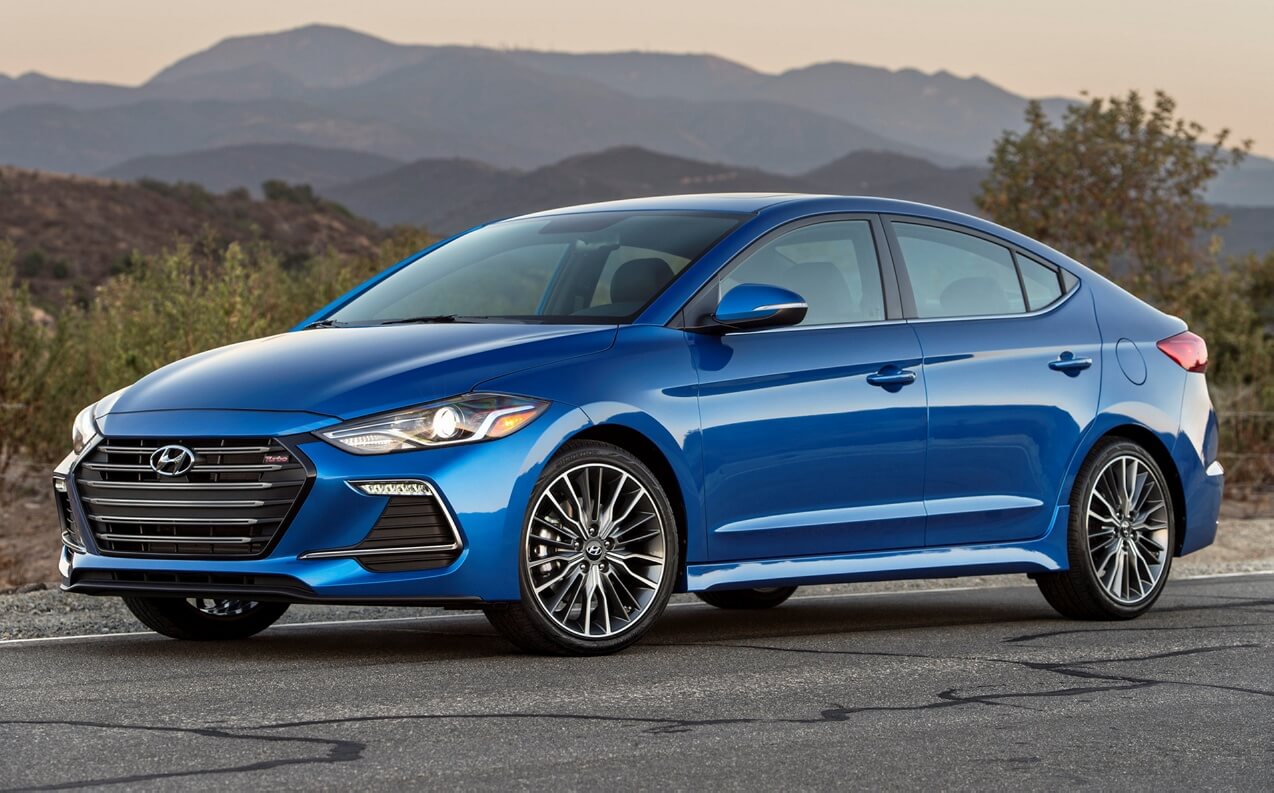
The sixth Elantra was revealed in 2015 and received a far-reaching facelift in 2018. It grew in size and adopted the "Fluidic Sculpture 2.0" theme seen on the larger Sonata, with a big hexagonal grille, slim headlights with LED running lights and boomerang-shaped intakes housing round fog lamps. Wheels range from 15 to 17 inches. Its drag coefficient of 0.27 is among the best in the class, and ground clearance remains 150 mm.
The interior is restrained and ergonomic in a European way, with better and more durable materials than before, a centre console angled towards the driver and Qi wireless phone charging. The front seats have pronounced side bolsters and a wide range of adjustment. Three people fit in the rear, which has its own air vent and a fold-down armrest, though tall passengers may find the roofline low. The boot holds 458 litres and has a full-size spare.
Two naturally aspirated DOHC 16-valve petrol engines with multi-point injection meet Euro 5:
- 1.6 Gamma (aluminium, timing chain): 94 kW (128 PS), 155 Nm; 0–100 km/h in 10.1–11.6 seconds, 195–200 km/h, 6.6–6.9 l/100 km.
- 2.0 (aluminium block and head, variable intake and exhaust timing): 110 kW (150 PS), 192 Nm; 0–100 km/h in 8.8–9.9 seconds, 202–205 km/h, 7.1–7.2 l/100 km.
Both come with a six-speed manual, with a six-speed automatic as an option. The platform is a heavily upgraded version of the previous one, with 53% high-strength steel. Suspension is MacPherson at the front and a torsion beam at the rear; disc brakes measure 280 mm at the front and 262 mm at the rear. Equipment can include front and side airbags, ESP, a rear camera, blind-spot monitoring, lane-change warning, low-speed automatic braking (up to 10 km/h), adaptive headlights, a parking assistant, cruise control and tyre-pressure monitoring.
Engines and power by generation
| Generation | Years | Petrol engines | Power (kW / PS) | Diesel |
|---|---|---|---|---|
| 1st | 1990–1995 | 1.5, 1.6, 1.8 (Mitsubishi licence) | 62–93 kW / 84–127 PS | - |
| 2nd | 1995–2000 | 1.6, 1.8, 2.0 | 65–102 kW / 88–139 PS | - |
| 3rd (XD) | 2000–2006 | 1.6–2.0 | 77–105 kW / 105–143 PS | 2.0 turbodiesel, 83 kW / 113 PS |
| 4th (HD) | 2006–2010 | 1.6, 2.0 | 90–105 kW / 122–143 PS | - |
| 5th (MD) | 2010–2015 | 1.6 Gamma, 1.8 Nu | 97–110 kW / 132–150 PS | - |
| 6th | 2015–2020 | 1.6 Gamma, 2.0 | 94–110 kW / 128–150 PS | - |
Boot space by generation
| Generation | Sedan boot | Other body |
|---|---|---|
| 2nd | 390 l | Wagon 360 l (1,260 l folded) |
| 3rd (XD) | 415 l | Hatchback 569 l |
| 4th (HD) | 460 l | - |
| 5th (MD) | 485 l | - |
| 6th | 458 l | - |
Strengths and weaknesses
Owners of the latest Elantra report precise handling, a smooth ride, low fuel consumption and very good ergonomics, with roughly 7.5 l/100 km in summer city driving with the air conditioning on. Cabin quality and space have improved, and the boot is practical. The automatic is adequate rather than sporty. The usual complaints are insufficient sound insulation and, at times, a lack of engine power. Key rivals include the Kia Cerato, Mazda3, Toyota Corolla, Ford Focus, Volkswagen Jetta, Skoda Octavia, Nissan Sentra and Citroën C4.
FAQ
How many generations of the Hyundai Elantra are there?
Six up to the 2018 facelift - 1990, 1995, 2000 (XD), 2006 (HD), 2010 (MD) and 2015 - followed by the seventh generation (CN7) in 2020.
Did the Hyundai Elantra use Mitsubishi engines?
Yes. The first generation used Mitsubishi-licensed 1.5-, 1.6- and 1.8-litre petrol engines, because Hyundai did not yet build its own engines.
What engines does the sixth-generation Elantra have?
A 1.6-litre Gamma with 94 kW (128 PS) and a 2.0-litre with 110 kW (150 PS), each available with a six-speed manual or six-speed automatic.
Is the Hyundai Elantra the same as the Avante?
The second-generation Elantra was sold in South Korea as the Avante.