 Ford Pinto
Specs, engines and history
Published Sources (1) Report an error
By Sarah Whitmore, Senior Automotive Writer
- Built
- 1971–1980
- Top power
- 76 kW (103 PS)
Which Pinto to choose today
Our verdict · Sarah Whitmore
- For the best driving: a 1975–1979 car with the 2.8-litre V6, the most powerful Pinto.
- For period character: a 1977–1978 Cruising Wagon or a Runabout with the optional all-glass hatch.
- For simplicity: a late 2.3-litre car, which shares many parts with other Fords of the era.
- For any Pinto: check that the 1978 recall shield and filler neck are fitted and the tank area is free of rust.
Other small Fords and their successors are in the Ford catalogue, and more cars of the decade in our 1970s classics guide.
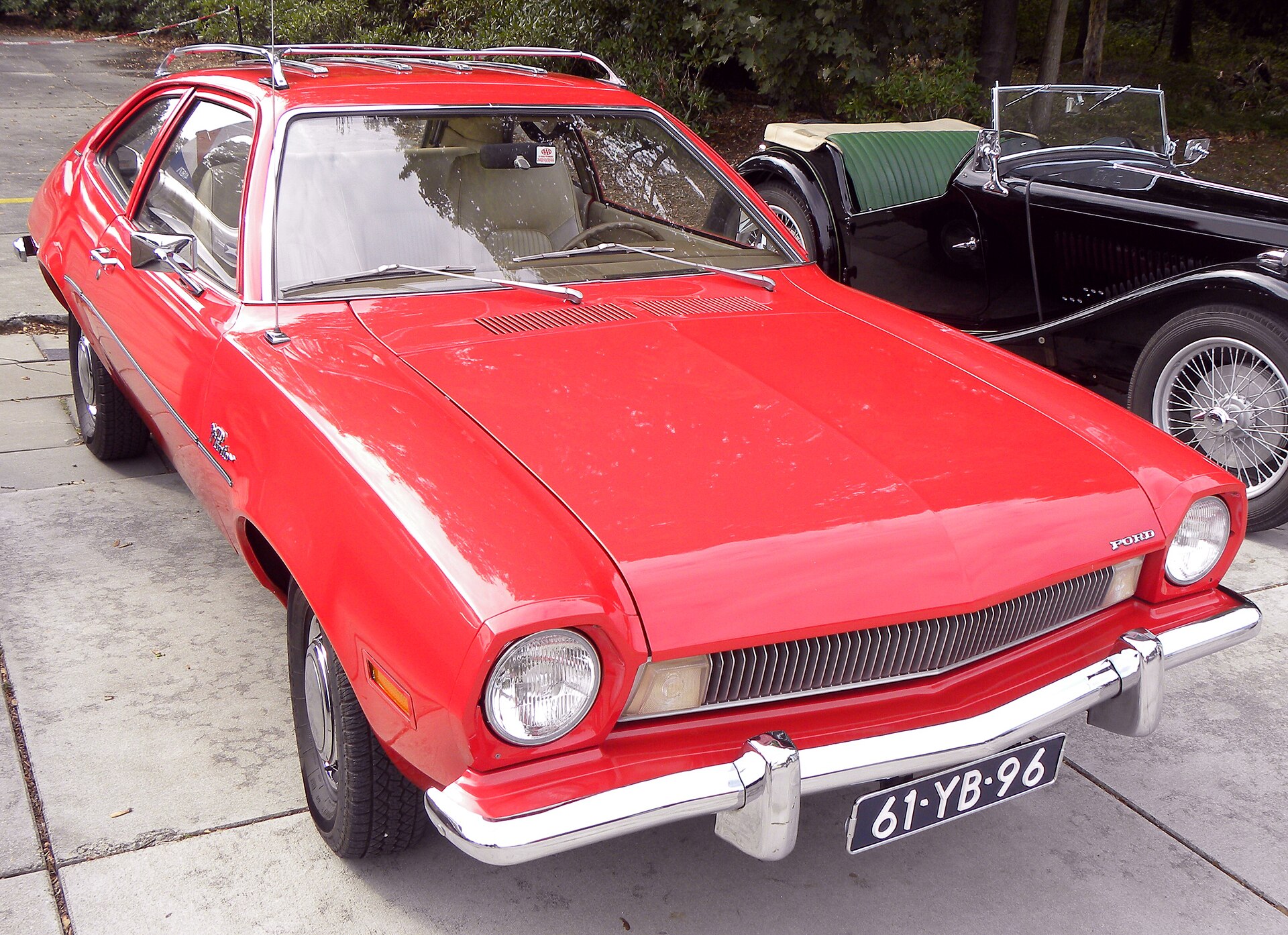
The Ford Pinto was Ford's subcompact for North America from the 1971 to the 1980 model years: a light, rear-wheel-drive car with European-sourced four-cylinder engines, sold as a sedan, a three-door Runabout and a wagon. It sold more than three million cars, but it is remembered above all for the debate over its fuel tank, which led to the largest car recall of its time in 1978 and to landmark court cases. The front-wheel-drive Escort replaced it.
In short
- Launched on 11 September 1970; production ended in July 1980 after about 3.17 million cars (Wikipedia EN table).
- Engines: 1.6-litre Kent and 2.0-litre four from Ford's European plants, later the American 2.3-litre OHC four and a 2.8-litre V6; 40–76 kW (54–102 hp).
- Base price $1,850 in 1971, in line with Lee Iacocca's target of under 2,000 lb and under $2,000.
- In June 1978 Ford recalled 1.5 million Pintos and Mercury Bobcats to shield the fuel tank.
Size at a glance
| Dimensions | Ford Pinto |
|---|---|
| Length | 4,140 mm163.0 in |
| Width | 1,763 mm69.4 in |
| Height | 1,270 mm50.0 in |
| Wheelbase | 2,388 mm94.0 in |
Specs by version
Engines
| Version | Engine | Power | Drive | Production years |
|---|---|---|---|---|
| 1.6 Kent I4 | 1.6 l · 4 cyl · Petrol 1,598 cc | 40 kW 54 PS54 hp | Rear-wheel drive | 1972–1973 |
| 1.6 Kent I4 (gross) | 1.6 l · 4 cyl · Petrol 1,598 cc | 56 kW 76 PS75 hp | Rear-wheel drive | 1971 |
| 2.0 OHC I4 | 2.0 l · 4 cyl · Petrol 1,993 cc | 64 kW 87 PS86 hp | Rear-wheel drive | 1972–1974 |
| 2.3 OHC I4 | 2.3 l · 4 cyl · Petrol 2,301 cc | 66 kW 90 PS89 hp | Rear-wheel drive | 1978–1980 |
| 2.3 OHC I4 | 2.3 l · 4 cyl · Petrol 2,301 cc | 67 kW 91 PS90 hp | Rear-wheel drive | 1974–1977 |
| 2.8 Cologne V6 | 2.8 l · 6 cyl · Petrol 2,786 cc | 72 kW 98 PS97 hp | Rear-wheel drive | 1975–1978 |
| 2.0 OHC I4 (gross) | 2.0 l · 4 cyl · Petrol 1,993 cc | 75 kW 102 PS101 hp | Rear-wheel drive | 1971 |
| 2.8 Cologne V6 | 2.8 l · 6 cyl · Petrol 2,786 cc | 76 kW 103 PS102 hp | Rear-wheel drive | 1979 |
Dimensions and weight
Show all 8 versions
| Version | Length | Width | Height | Wheelbase |
|---|---|---|---|---|
| 1.6 Kent I4 | 4,140 mm163.0 in | 1,763 mm69.4 in | 1,270 mm50.0 in | 2,388 mm94.0 in |
| 1.6 Kent I4 (gross) | 4,140 mm163.0 in | 1,763 mm69.4 in | 1,270 mm50.0 in | 2,388 mm94.0 in |
| 2.0 OHC I4 | - | - | - | 2,388 mm94.0 in |
| 2.3 OHC I4 | - | - | - | 2,388 mm94.0 in |
| 2.3 OHC I4 | - | - | - | 2,388 mm94.0 in |
| 2.8 Cologne V6 | - | - | - | 2,388 mm94.0 in |
| 2.0 OHC I4 (gross) | 4,140 mm163.0 in | 1,763 mm69.4 in | 1,270 mm50.0 in | 2,388 mm94.0 in |
| 2.8 Cologne V6 | - | - | - | 2,388 mm94.0 in |
Verified Manufacturer and type-approval data from our catalog · Sources and methodology
Ford Pinto at a glance
| Parameter | Metric | Imperial |
|---|---|---|
| Production | 1970–1980 (model years 1971–1980) | - |
| Built | 3,173,491 (table) / 3,150,943 (text) | - |
| Bodies | two-door sedan, three-door Runabout, two-door wagon, sedan delivery | - |
| Engines | 1.6, 2.0, 2.3-litre fours; 2.8-litre V6 | 98–170 cu in |
| Power | 40–76 kW | 54–102 hp |
| Gearboxes | four-speed manual, three-speed automatic | - |
| Wheelbase | 2,388 mm | 94.0 in |
| Length | 4,140 mm (wagon 4,387 mm) | 163 in (172.7 in) |
| Width / height | 1,763 mm / 1,270 mm | 69.4 in / 50 in |
| Kerb weight (1971) | 914–1,030 kg | 2,015–2,270 lb |
| Price (1971) | $1,850 sedan, $2,062 Runabout | - |
Development: 25 months to launch
Planning began in the summer of 1967. Ford president Lee Iacocca wanted a car for 1971 that weighed less than 2,000 lb (907 kg) and cost less than $2,000, and inside the company the project was known as "Lee's car". The design by Robert Eidschun dates from 1968; the programme was recommended in December 1968 and approved by the board in January 1969. Development took 25 months against an industry average of 43.
The Pinto went on sale on 11 September 1970 as "The Little Carefree Car", one day after Chevrolet launched the Vega and six months after the AMC Gremlin. It replaced the British-built Cortina that Ford had sold in America as a captive import. Iacocca's career and his role at Ford are covered in our article on Lee Iacocca.
Production and plants
The Pinto was built at Edison (New Jersey), at San Jose Assembly in Milpitas (California) and at St. Thomas Assembly in Southwold (Ontario). Lincoln-Mercury dealers sold a rebadged version, the Mercury Bobcat, from 1974 in Canada and 1975 in the United States; 224,026 Bobcats were made.
| Model year | Pintos built | Model year | Pintos built |
|---|---|---|---|
| 1971 | 352,402 | 1976 | 290,132 |
| 1972 | 480,405 | 1977 | 225,097 |
| 1973 | 484,512 | 1978 | 188,899 |
| 1974 | 544,209 | 1979 | 199,018 |
| 1975 | 223,763 | 1980 | 185,054 |
Output peaked in 1974 and fell by more than half the next year.
Sedan, Runabout, wagon and Cruising Wagon
At launch the Pinto was a two-door fastback sedan with a separate boot. The three-door Runabout hatchback was shown at the Chicago Auto Show on 20 February 1971 at $2,062. A two-door station wagon followed on 24 February 1972 with 1.71 m³ (60.5 cu ft) of cargo space, and the Squire version added imitation wood trim.
Option packages kept the range fresh: the Sprint Decor Group in 1972, Sport Accent and Luxury Decor in 1973, the Stallion and Runabout Squire in 1976, the cheap Pinto Pony from 1976 and the ESS trim in 1979. The 1977 Cruising Wagon was a sedan-delivery package styled like a small conversion van.
German Wikipedia compares the interior with the Volkswagen Beetle, the Pinto's main rival: at a similar wheelbase it gave 150 mm more shoulder room, 75 mm more hip room and 125 mm more knee room. The boot was small but could be enlarged by folding the rear seat.


Engines and gearboxes
| Engine | Years | Displacement | Power | Rating |
|---|---|---|---|---|
| Kent four (Ford of England) | 1971 | 1.6 l (98 cu in) | 56 kW (75 hp) | gross |
| Kent four | 1972–1973 | 1.6 l | 40 kW (54 hp) | net |
| OHC four (Ford of Germany) | 1971 | 2.0 l (122 cu in) | 75 kW (100 hp) | gross |
| OHC four | 1972–1974 | 2.0 l | 64 kW (86 hp) | net |
| OHC four | 1974–1980 | 2.3 l (140 cu in) | 66–67 kW (88–90 hp) | net |
| Cologne V6 | 1975–1979 | 2.8 l (170 cu in) | 72–76 kW (97–102 hp) | net |
The apparent drop in power in 1972 reflects the change from gross to net ratings rather than weaker engines. The 2.0-litre overhead-camshaft four came from Ford's European engine range, where it also powered the Cortina Mk3 and the Taunus. The 2.3-litre OHC four introduced for 1974 was later used in several other Ford vehicles; the V6 was dropped for 1980, leaving the 2.3 as the only engine. Gearboxes were a four-speed manual or a three-speed automatic. To compare these outputs with today's engines, use our power converter.

The fuel-tank controversy
Like many cars of its time, the Pinto had its fuel tank between the rear axle and the rear bumper. From 1973 Ford received reports of Pintos catching fire after low-speed rear-end collisions; its internal recall committee reviewed them and found no defect requiring action. In 1973 an internal cost-benefit paper, later called the "Pinto Memo", compared fixes of about $11 per vehicle (1973 estimate) with the value of avoided deaths and injuries. It used the National Highway Traffic Safety Administration's 1972 figure of $200,000 per life.
In August 1977 the magazine Mother Jones published "Pinto Madness" by Mark Dowie, which claimed 500 to 900 deaths; English Wikipedia describes these numbers as wrong. The NHTSA opened an investigation on 11 August 1977 and on 8 May 1978 declared the fuel system defective. On 9 June 1978 Ford recalled 1.5 million Pintos and Bobcats, excluding the wagon, while disputing the finding. The fix added a polyethylene shield and a longer filler neck. The NHTSA counted 27 deaths in rear-impact fires from 1970 to mid-1977.

Court cases and later analysis
In Grimshaw v. Ford Motor Co., a 1972 Pinto stalled on a California freeway and was hit from behind. The driver, Lily Gray, died and 13-year-old Richard Grimshaw was badly burned. In February 1978 the jury awarded $125 million in punitive damages; it also awarded $2,841,000 (1978) in compensation to Grimshaw and $665,000 to the Gray family in 1978. The judge then cut the 1978 punitive award to $3.5 million.
In Indiana v. Ford Motor Co., a grand jury indicted Ford on three counts of reckless homicide after a 1973 Pinto crash killed three teenage girls on 10 August 1978. In 1980 Ford was found not guilty. About 117 lawsuits were filed over rear-end Pinto crashes in total.
Later research put the record in context. The legal scholar Gary T. Schwartz, writing in the Rutgers Law Review, found that Pintos made up 1.9% of cars on the road and 1.9% of fatal fire accidents in 1975–76. He judged the rear-end fire record somewhat worse than the subcompact average, but overall safety comparable to its class.
Photo gallery

Ford Pinto in our rankings
- No. 8 of 70 · Biggest engines: hatchbacks (2,786 cc)
- No. 9 of 86 · Smallest sedans (4,140 mm)
- No. 66 of 420 · Smallest cars (4,140 mm · top 17%)
- No. 32 of 67 · Smallest hatchbacks (4,140 mm · top 48%)
- No. 398 of 912 · Longest-running car nameplates (9 years · top 49%)
- No. 298 of 557 · Biggest engines: cars (2,786 cc · top 54%)
Shorter than 89% of ranked sedans in the 1CARS catalog (No. 9 of 86).
FAQ
What years was the Ford Pinto made?
For the 1971 to 1980 model years. It was launched on 11 September 1970, and production ended in July 1980.
How many Ford Pintos were made?
The yearly figures in English Wikipedia add up to 3,173,491; the same article also gives 3,150,943. Mercury built another 224,026 Bobcats.
Why was the Ford Pinto recalled?
After an NHTSA finding in May 1978 that the fuel system was defective in rear-end crashes, Ford recalled 1.5 million Pintos and Bobcats in June 1978 and fitted a plastic shield and a longer filler neck.
How many people died in Ford Pinto fires?
The NHTSA counted 27 deaths in rear-impact fire crashes from 1970 to mid-1977. A 1977 magazine article claimed 500 to 900, which English Wikipedia describes as an error.
What engines did the Ford Pinto have?
A 1.6-litre Kent four and a 2.0-litre OHC four from Europe, then a 2.3-litre OHC four and a 2.8-litre Cologne V6, with 40–76 kW (54–102 hp).
Data sources
Data checked by an editor against the sources below.