Chevrolet Corvette C5: the LS1 Corvette That Modernised the Breed
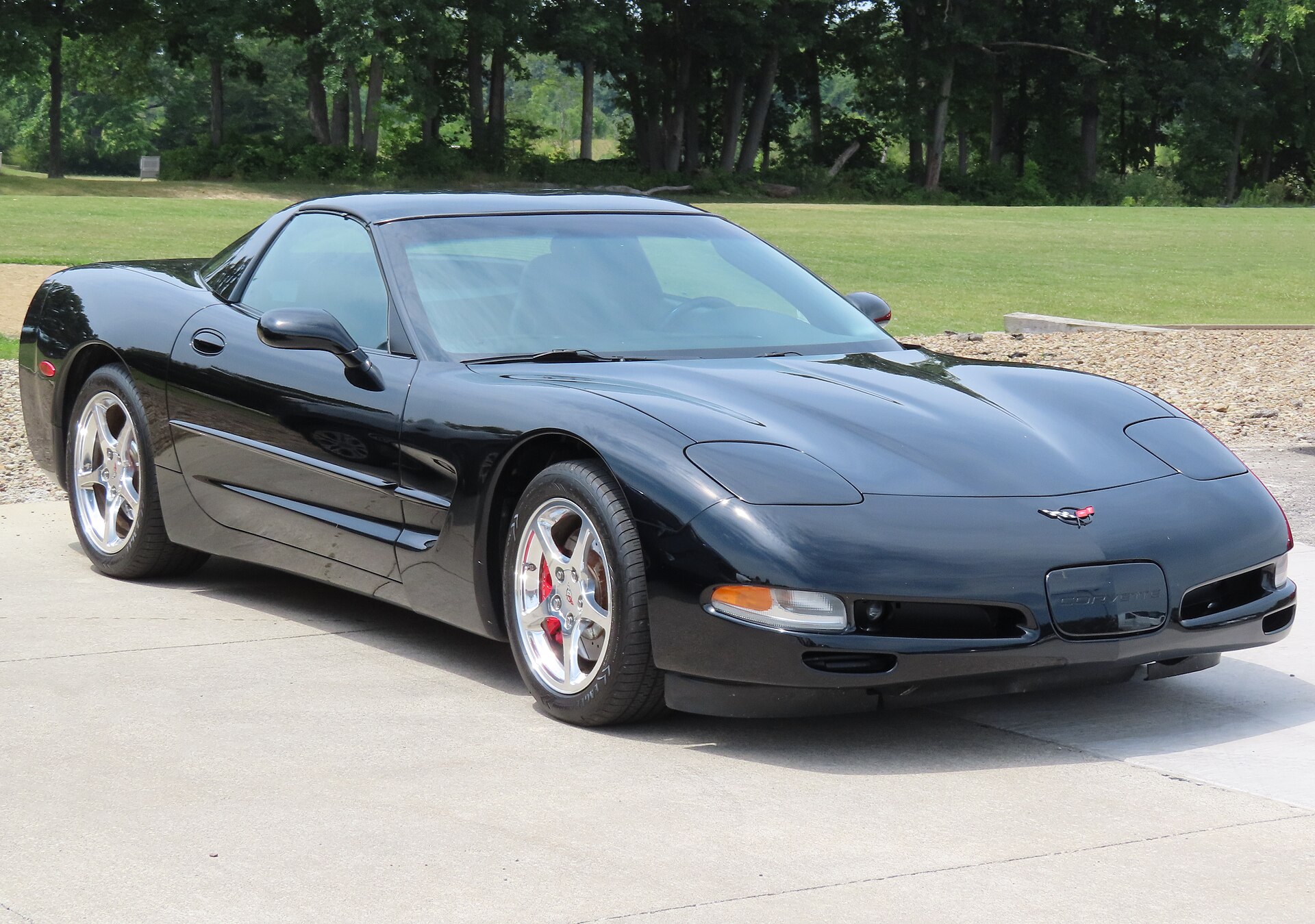
The Chevrolet Corvette C5 is the fifth-generation Corvette, built in Bowling Green, Kentucky, from October 1996 to July 2004 for the 1997–2004 model years. It was a clean-sheet design with a hydroformed steel frame, a rear-mounted gearbox and the all-aluminium LS1 V8, the first of GM's third-generation small blocks. With 248,715 cars built, it also introduced the hardtop that became the Z06, the fastest Corvette of its day.
Key takeaways
- Revealed at the Detroit motor show on 6 January 1997; coupé from 1997, convertible from 1998, fixed-roof hardtop from 1999.
- LS1 5.7-litre V8 with 257 kW (345 hp), from 2001 261 kW (350 hp); Z06 from 2001 using the LS6, first 287 kW (385 hp), then 302 kW (405 hp).
- Rear transaxle linked by a torque tube gives near-even weight distribution; drag coefficient 0.29.
- The last Corvette with pop-up headlamps; Z06 production started in 2001.
Chevrolet Corvette C5 at a glance
| Specification | Chevrolet Corvette C5 |
|---|---|
| Model years | 1997–2004 (production 1 October 1996 – 2 July 2004) |
| Plant | Bowling Green, Kentucky |
| Cars built | 248,715 |
| Design | John Cafaro (1993) |
| Body | targa coupé with glass hatch, convertible, fixed-roof hardtop |
| Engines | 5.7-litre LS1 V8; LS6 V8 in the Z06 |
| Power | 257–302 kW (345–405 hp) |
| Gearboxes | four-speed 4L60-E automatic; six-speed Borg-Warner T-56 manual |
| Drivetrain | front-mid engine, rear-wheel drive (RWD), rear transaxle |
| Wheelbase / length | 2,654 mm / 4,564 mm |
| Width / height | 1,869 mm / 1,212 mm (coupé) |
| Kerb weight | 1,472 kg coupé, 1,439 kg hardtop, 1,414 kg Z06 |
| Predecessor / successor | C4 / C6 |
A clean-sheet design
Chevrolet first wanted the new car for the Corvette's 40th anniversary in 1993, but GM's financial troubles and changes of management delayed it by four model years. When it finally appeared in Detroit in January 1997, almost nothing was carried over from the C4.
Size at a glance
Chevrolet Corvette C7
The Chevrolet Corvette C8 is 137 mm longer and 56 mm wider than the Chevrolet Corvette C7.
| Dimensions | Chevrolet Corvette C8 | Chevrolet Corvette C7 | Difference |
|---|---|---|---|
| Length | 4,630 mm182.3 in | 4,493 mm176.9 in | +137 mm+5.4 in |
| Width | 1,933 mm76.1 in | 1,877 mm73.9 in | +56 mm+2.2 in |
| Height | 1,234 mm48.6 in | 1,234 mm48.6 in | Same |
| Wheelbase | 2,723 mm107.2 in | 2,710 mm106.7 in | +13 mm+0.5 in |
The chassis was built around a hydroformed box frame, which made the structure much stiffer, especially for the later convertible. The gearbox moved to the rear axle and was joined to the engine by a torque tube; English Wikipedia describes the result as a 50:50 weight split, German Wikipedia gives 51.4 % front and 48.6 % rear. Floor panels were a sandwich of composite and balsa wood, chosen for stiffness, low weight and sound damping. The suspension used unequal-length double wishbones with transverse composite leaf springs, as on the C4.
Other Corvette firsts were drive-by-wire throttle control, variable-effort power steering and tandem windscreen wipers. The body had a drag coefficient of 0.29 according to German Wikipedia, against 0.34 for the C4.

Coupé, convertible and hardtop
The C5 range grew in three steps:
- 1997: the targa-roof coupé with a lift-out roof panel and glass hatch.
- 1998: the convertible, the first open Corvette with a proper boot lid since 1962.
- 1999: the fixed-roof hardtop, also called the FRC. It was the lightest body and became the basis of the Z06.
Equipment moved forward too. A head-up display was offered as a high-tech option, Active Handling stability control was an option from 1998 and standard from 2001, and the F55 Magnetic Selective Ride Control dampers arrived for 2003.

LS1 and LS6 engines
The LS1 was the first engine of GM's third-generation small-block family. It kept the traditional pushrod layout and 5.7-litre capacity, but its block and heads were aluminium. Output was 257 kW (345 hp) at launch and 261 kW (350 hp) from 2001. Z06 owners received the LS6, a higher-output version with 287 kW (385 hp) in 2001 and 302 kW (405 hp) with 542 Nm from 2002.
| Version | Years | Engine | Power | Torque | Gearbox |
|---|---|---|---|---|---|
| Coupé, convertible, hardtop | 1997–2000 | LS1 5.7 V8 | 257 kW (345 hp) | - | 4L60-E auto or T-56 manual |
| Coupé, convertible | 2001–2004 | LS1 5.7 V8 | 261 kW (350 hp) | - | as 1997–2000 |
| Z06 | 2001 | LS6 5.7 V8 | 287 kW (385 hp) | - | six-speed manual only |
| Z06 | 2002–2004 | LS6 5.7 V8 | 302 kW (405 hp) | 542 Nm | six-speed manual only |
German Wikipedia gives 0–100 km/h in 4.7 seconds for a manual LS1 car and 5.1 seconds with the automatic (5.0 seconds from 2001), and 4.2 seconds for the Z06. Top speed is about 282 km/h (175 mph) according to English Wikipedia, while German Wikipedia lists up to 297 km/h for the coupé and 275 km/h for the Z06. The EPA rated the original automatic at 18 mpg in the city and 25 mpg on the highway, and the manual at 19 and 28 mpg; by our conversion, 28 mpg equals about 8.4 l/100 km. These figures kept the C5 clear of the US gas-guzzler tax. Running costs today can be estimated with the 1cars fuel cost calculator.

Z06: the lightweight hardtop
The Z06 of 2001 revived an option code first used on the C2 Sting Ray and took over the role of the old ZR-1. It came only as a hardtop and only with the six-speed manual. Chevrolet saved weight with a titanium exhaust and a lighter battery and fitted the stiffer FE4 suspension, larger wheels and tyres, revised gearing and brake cooling ducts.
At 1,414 kg the Z06 was 58 kg lighter than a standard coupé. GM High-Tech Performance measured the 302 kW car at 3.9 seconds to 60 mph and 11.9 seconds over the quarter mile in October 2004, and Wikipedia records a top speed of 275 km/h (171 mph). According to German Wikipedia, the Z06 was never offered officially in Europe.

Production and US prices by model year
| Model year | Cars built | US base price |
|---|---|---|
| 1997 | 9,752 | US$37,495 |
| 1998 | 31,084 | US$38,995 |
| 1999 | 33,270 | US$38,777 |
| 2000 | 33,682 | US$40,900 |
| 2001 | 35,627 | US$41,475 |
| 2002 | 35,767 | US$42,450 |
| 2003 | 35,469 | US$45,895 |
| 2004 | 34,064 | US$46,535 |
Production of the 1997 model began only in October 1996, which explains the low first-year total. From 1998 output stayed between 31,000 and 36,000 a year. By our calculation the C5's sticker climbed only 24 % in eight years, far less than during the C3 and C4 eras.
Special editions and racing
- 1998 Indianapolis 500 Pace Car replica: Radar Blue paint, yellow wheels and Active Handling.
- 2003 50th Anniversary Edition: Anniversary Red Metallic paint, shale leather and a head-up display; a slightly modified example paced the 2002 Indianapolis 500.
- 2004 Le Mans Commemorative Edition: Le Mans Blue paint; on the Z06 (Z16 package) it came with stripes, a carbon-fibre bonnet that saved 5 kg and revised damping. 2,025 Z16 cars were built.
- Z18: a Commemorative Edition for Europe only, of which German Wikipedia counts 46.
On the track, Pratt & Miller built the C5-R for GM Racing with a 7.0-litre V8. In 2001 it won the 24 Hours of Daytona outright, took eight of ten American Le Mans Series races and finished first and second in the GTS class at Le Mans. The 1–2 was repeated in 2002 and again in 2004, when the winning car finished 16 laps ahead of the best Ferrari.

Known problems and what to check
Age has exposed some weak points. Dino's Corvette Salvage, a US parts specialist, published this list in February 2026:
| Issue | Years affected | Note |
|---|---|---|
| ABS/traction control module (EBCM) | 1997–2000 | hard to rebuild; a used unit costs US$1,200–1,800 |
| F55 magnetic dampers leaking | 2003–2004 | US$550–750 each, US$3,000–4,000 for a set fitted |
| Steering column lock message | early cars | warning fault; ask for the repair history |
| Fuel level senders, harmonic balancer wobble | all | common LS-era faults |
| Headlamp motor gears, window regulators, roof seals | all | age-related |
For 2003 cars the F55 system can be reprogrammed to accept ordinary dampers; 2004 cars cannot. Wikipedia adds valve-spring failures on Z06 engines built from late 2002 to mid-2003 and a costly dual fuel tank layout on some 2004 cars. The same dealer calls 2001–2002 the "sweet spot": updated brakes and electronics, lower prices than the last special editions and no F55 dampers. A well-maintained 60,000-mile car is usually a safer buy than a low-mileage car that has stood for years, because seals, tyres and fluids still need service. On a Z06, check the clutch, differential noise and suspension bushings.

Verdict: which C5 to buy
For daily use, a 2001–2002 coupé with the 261 kW LS1 and the six-speed manual suits most buyers. The Z06 is the choice for track days and for keen drivers who accept a harsher ride. The convertible suits relaxed touring, and the 1997–2000 cars make sense only with proof that the brake module has been sorted. To weigh a C5 against its successor or a European rival, use the 1cars comparison tool, and check its power position in the 1cars rankings. The earlier Corvettes are covered in the Corvette C2 Sting Ray guide, the later C7 in the Corvette C7 guide, and the whole family on the Chevrolet Corvette catalogue page.
Photo gallery

FAQ
What engine is in the C5 Corvette?
Every C5 used a 5.7-litre V8. The LS1 gave 257 kW (345 hp) at first and 261 kW (350 hp) from the 2001 model year; Z06 cars had the LS6 with up to 302 kW (405 hp).
How many C5 Corvettes were made?
248,715 for the 1997–2004 model years, all in Bowling Green, Kentucky.
What are the best years for a C5 Corvette?
Many specialists name 2001–2002: they have the updated brake electronics and the 261 kW engine, but not the F55 dampers of 2003–2004.
How fast is a C5 Z06?
German Wikipedia lists 0–100 km/h in 4.2 seconds, and English Wikipedia gives 275 km/h (171 mph) flat out.
Is the C5 the last Corvette with pop-up headlights?
Yes. The C6 of 2005 introduced fixed, exposed headlamps.