Chevrolet Lacetti: Specs, Engines and History
The Chevrolet Lacetti is a compact family car - a C-segment model in European terms - built by the South Korean manufacturer GM Daewoo as the successor to the Daewoo Nubira. It was produced for about eleven years as a sedan, a hatchback and a wagon, and designed with help from two famous Italian studios. Practical and inexpensive, it became a familiar sight in many countries and was eventually replaced by the Chevrolet Cruze.
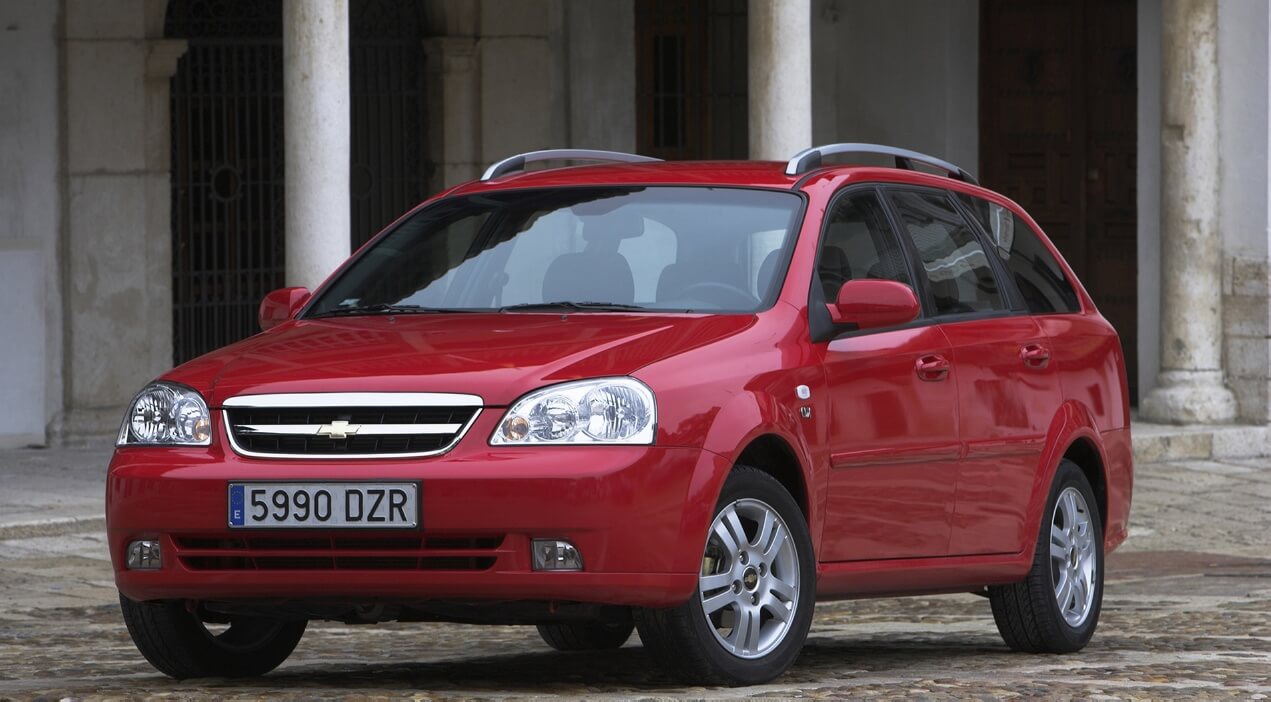
Key takeaways
- Sedan shown in Seoul in 2002; hatchback about 18 months later; wagon from 2004.
- Sedan and wagon styled by Pininfarina, hatchback by Giorgetto Giugiaro's Italdesign.
- 1.4, 1.6 and 1.8 petrol engines with 70–89 kW (95–121 PS); fully independent suspension.
- Famous as the "reasonably priced car" on Top Gear from 2006.
Chevrolet Lacetti at a glance
The Lacetti is a front-wheel-drive car on GM Daewoo's J200 platform. The sedan premiered at the Seoul motor show in 2002, the hatchback followed roughly a year and a half later and the wagon went on sale in 2004. Around five years later GM decided that the Lacetti and the Cobalt should give way to the Cruze. The sedan remained in production in Uzbekistan, sold there as the Lacetti and in other markets as the Daewoo Gentra. Other models of the brand are in our Chevrolet catalogue, and the company's background is told in Chevrolet's history.
Design
The Lacetti does not look like a budget car, and the Italian influence is obvious. The sedan has large headlights, a chrome grille with the badge in the centre and a prominent bumper with fog lamps. Side mouldings, flared wheel arches, a long bonnet and a roofline that slopes towards the tail complete the profile. The rear has large lamps and crisp edges that recall the Cadillac CTS. The hatchback, designed by a different studio, looks almost completely different from the sedan. Ground clearance is 162 mm. The car was developed with Europe in mind, and its simple, clean shapes have aged well.
Interior and practicality
This is a budget car, and the plastics could be better, but the assembly is neat with tight gaps. There are two storage bins on the centre console, an armrest and air conditioning. The four-spoke steering wheel faces a clear analogue instrument panel with a trip computer that is easy to read at night; higher trims have cruise-control buttons on the wheel. A clock sits at the top of the centre console, above the radio and the climate controls; some versions display the selected settings on a screen. Faux-metal inserts on the dashboard look dated.
The seats are average but suit drivers of any size, and both the seat and the steering wheel are adjustable. Three adults can sit in the back without running short of leg- or headroom. The sedan's boot holds 405 litres and has a wide opening and a regular shape for bulky items; folding the rear seat increases the space to 1,225 litres.
Engines and transmissions
The sedan is offered with three naturally aspirated four-cylinder petrol engines:
| Engine | Power (kW / PS) | Torque | 0–100 km/h | Top speed | Combined consumption |
|---|---|---|---|---|---|
| 1.4 | 70 kW / 95 PS | 131 Nm | 11.6 s | 175 km/h | 7.2 l/100 km |
| 1.6 | 80 kW / 109 PS | 150 Nm | 10.7–11.5 s | 175–187 km/h | 7.1–8.1 l/100 km |
| 1.8 | 89 kW / 121 PS | 169 Nm | 9.8–10.9 s | 187–195 km/h | 7.4–8.8 l/100 km |
The 1.4 comes only with a five-speed manual gearbox; the 1.6 and 1.8 can be ordered with the manual or a four-speed automatic. All versions are front-wheel drive.
Chassis
The J200 platform has independent suspension at all four wheels: MacPherson struts at the front and a multi-link system at the rear. Disc brakes are fitted all round, ventilated at the front.
Safety
GM Daewoo designed the Lacetti around a protective safety cell formed by the floor tunnel and reinforced sills, with a B-pillar welded using new methods and a strengthened bulkhead and engine-bay sides. About 40% of the body is high-strength steel. Steel beams under the dashboard and in the doors protect occupants' legs and limit door-frame deformation in a frontal crash. The Siemens airbag system deploys with lower pressure to reduce injuries, while the bags themselves grew to 60 litres for the driver and 120 litres for the passenger.
Base versions have two airbags, ABS, two electric windows, an audio system and heated electric mirrors. The top-spec version adds side airbags, electric windows all round, climate control, fog lamps and a steering wheel adjustable for both height and reach.
A television star
The Lacetti sedan was used as the "Star in a Reasonably Priced Car" on the BBC's Top Gear from the spring 2006 series. In May 2006 presenter Jeremy Clarkson noted that it was more agile on the test track than its predecessor in the role, the Suzuki Liana, and about four seconds a lap quicker.
Strengths and weaknesses
Owners appreciate the low purchase price, cheap maintenance and a roomy cabin and boot. The firm suspension gives reasonably tidy handling, the standard audio and headlights are good, and the 1.6 engine provides lively performance. Complaints centre on poor sound insulation and slow engine warm-up in severe frost. The Lacetti competed with the Ford Focus, Volkswagen Jetta, Kia Spectra, Mazda3, Nissan Almera and Citroën C4.
FAQ
Who made the Chevrolet Lacetti?
It was built by GM Daewoo in South Korea as the successor to the Daewoo Nubira; production of the sedan continued later in Uzbekistan.
Who designed the Chevrolet Lacetti?
The sedan and wagon were styled by Pininfarina, and the hatchback by Giorgetto Giugiaro's Italdesign.
What engines does the Chevrolet Lacetti have?
The sedan uses 1.4-, 1.6- and 1.8-litre petrol engines with 70 kW (95 PS), 80 kW (109 PS) and 89 kW (121 PS).
What replaced the Chevrolet Lacetti?
The Chevrolet Cruze, which took over from both the Lacetti and the Cobalt.
Was the Chevrolet Lacetti on Top Gear?
Yes. It was the "Star in a Reasonably Priced Car" from 2006, replacing the Suzuki Liana.