 Maserati MC12
Specs, engines and history
Published Sources (1) Report an error
By Felix Hartmann, Automotive Technology & EV Contributor
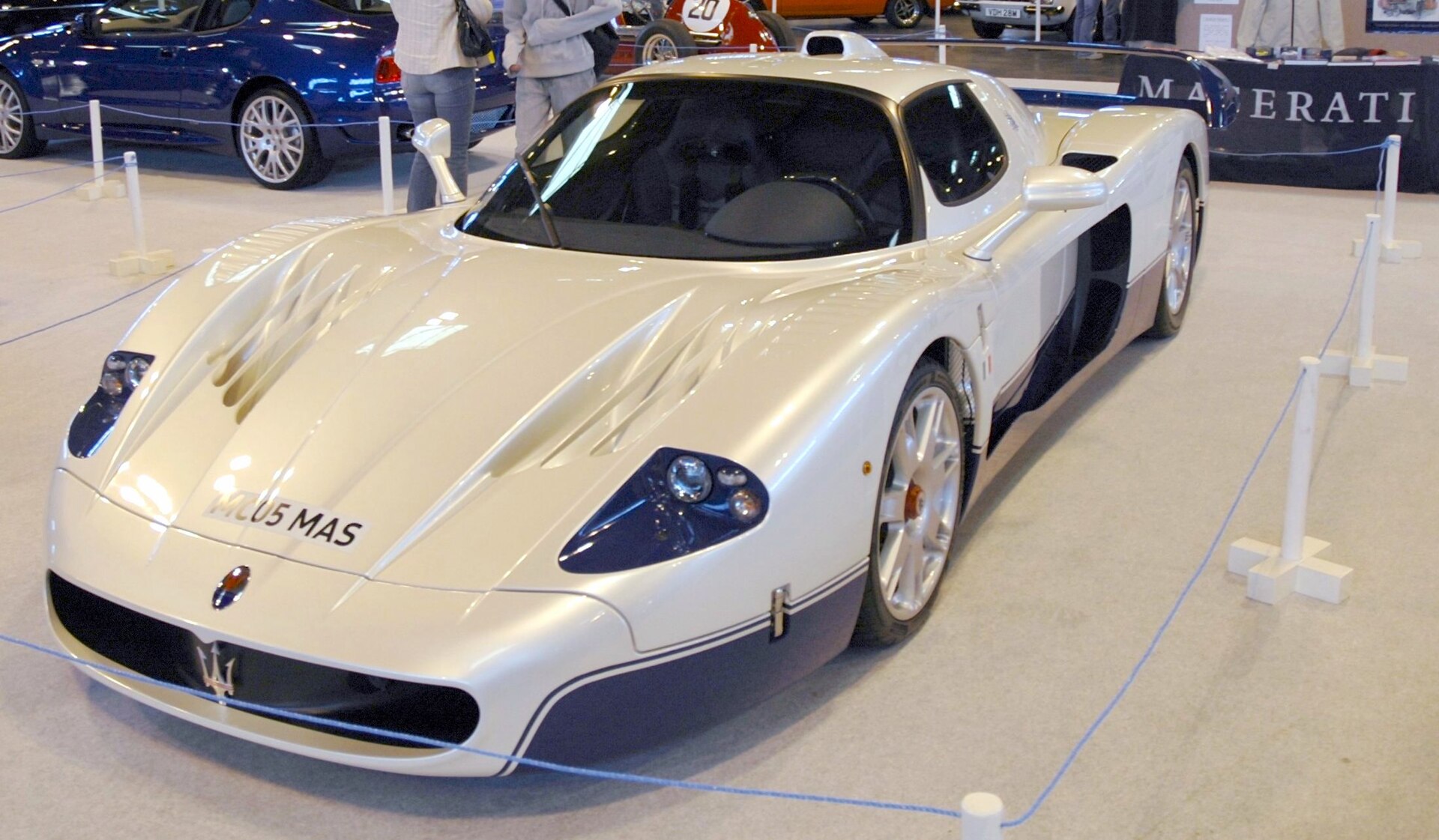
The Maserati MC12 is the mid-engined V12 supercar that Maserati built in Modena in 2004 and 2005 so that it could race in the FIA GT Championship. Only 50 road cars were made. Under its long carbon-fibre body sit the chassis, engine and gearbox of the Ferrari Enzo, but the two cars share only one visible part — the windscreen. On the track the MC12 became one of the most successful GT1 cars of its era, winning team and driver titles every year from 2005 to 2010.
In short
- 50 road cars built in Modena, 25 in 2004 and 25 in 2005; 12 track-only Versione Corse cars followed in 2006.
- 5,998 cc 65° V12 derived from the Ferrari F140: 463 kW (630 PS) at 7,500 rpm and 652 Nm at 5,500 rpm, six-speed Cambiocorsa automated manual.
- Kerb weight 1,500 kg, 0–100 km/h in 3.8 seconds (Motor Trend measured 3.7), top speed 330 km/h.
- Maserati won the FIA GT Manufacturers' Cup in 2005 and 2007; Vitaphone Racing took six consecutive team titles with the MC12.
MC12 at a glance
| Specification | Maserati MC12 |
|---|---|
| Production | 2004–2005, Modena (Italy) |
| Cars built | 50 road cars; 12 Versione Corse for customers (2006) |
| Body | two-door carbon-fibre coupé with removable targa roof |
| Engine | 5,998 cc 65° V12 (Ferrari F140-derived), dry sump |
| Power | 463 kW (630 PS) at 7,500 rpm |
| Torque | 652 Nm at 5,500 rpm |
| Gearbox | six-speed Maserati Cambiocorsa automated manual |
| Kerb weight | 1,500 kg |
| Dimensions | 5,143 mm long, 2,096 mm wide, 1,205 mm high, 2,800 mm wheelbase |
| Related model | Ferrari Enzo |
The MC12 is part of the Maserati catalogue, next to grand tourers such as the Maserati GranTurismo. It shares its technical base with the Ferrari Enzo.
Development on the Enzo base
The MC12 was built on the Ferrari Enzo. It keeps the Enzo's chassis and its track widths, a modified version of its F140 V12 and its gearbox, renamed "Cambiocorsa" for Maserati.
The project was led by Giorgio Ascanelli. During development the racing car was called "MCC" and the road car "MCS". Andrea Bertolini was the chief test driver, and Michael Schumacher also drove the MCC during testing.
The FIA's GT1 rules required a minimum number of road cars for homologation. Maserati built 25 in 2004 and another 25 in 2005. The second batch was 150 mm shorter, because a rule change had reduced the maximum length allowed.
Design and body
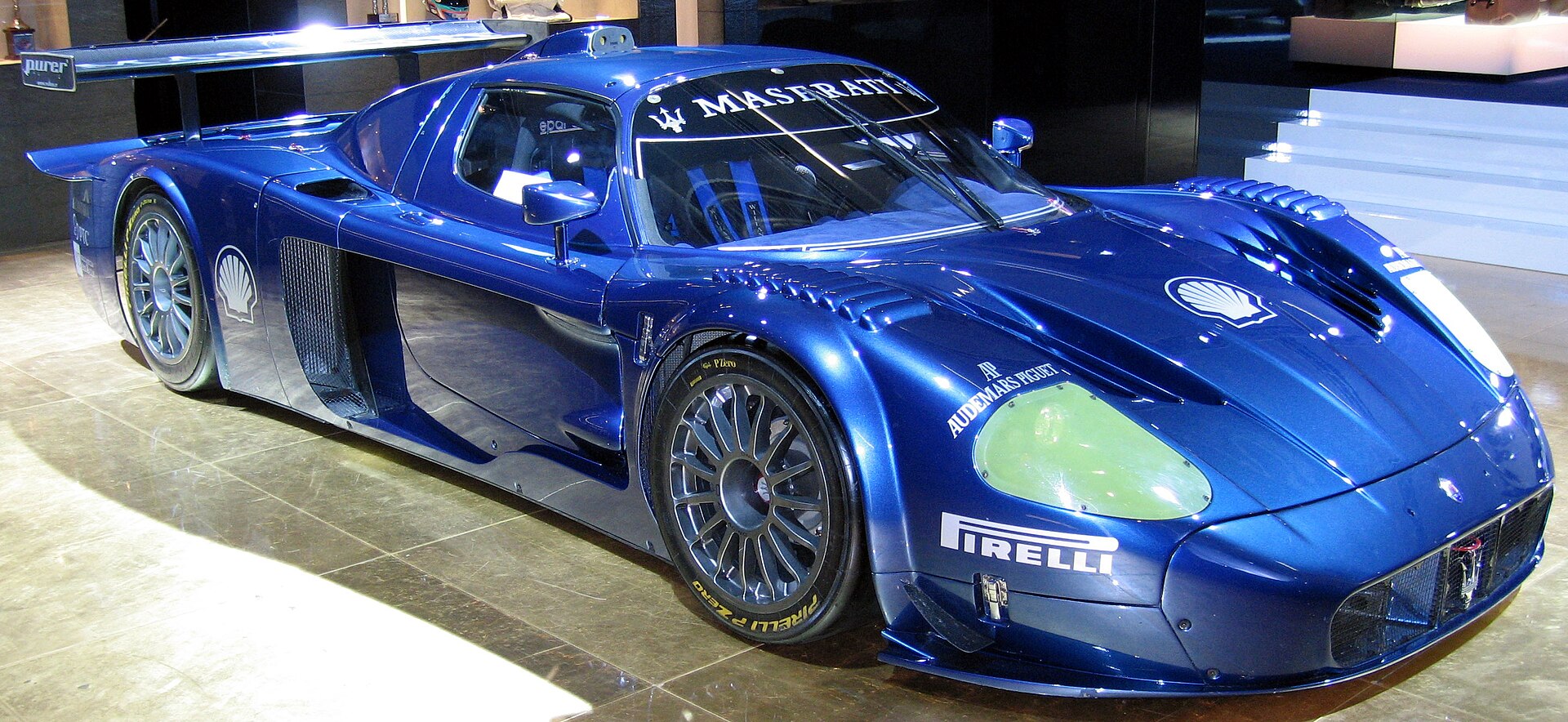
The body was mostly styled by Frank Stephenson, starting from an idea by Giorgetto Giugiaro that was refined in the wind tunnel. It is made entirely of carbon fibre. Compared with the Enzo, the MC12 is longer, wider and taller, with a sharper nose and a lower drag coefficient. At 5,143 mm (2004 cars) it is one of the longest production supercars ever built.
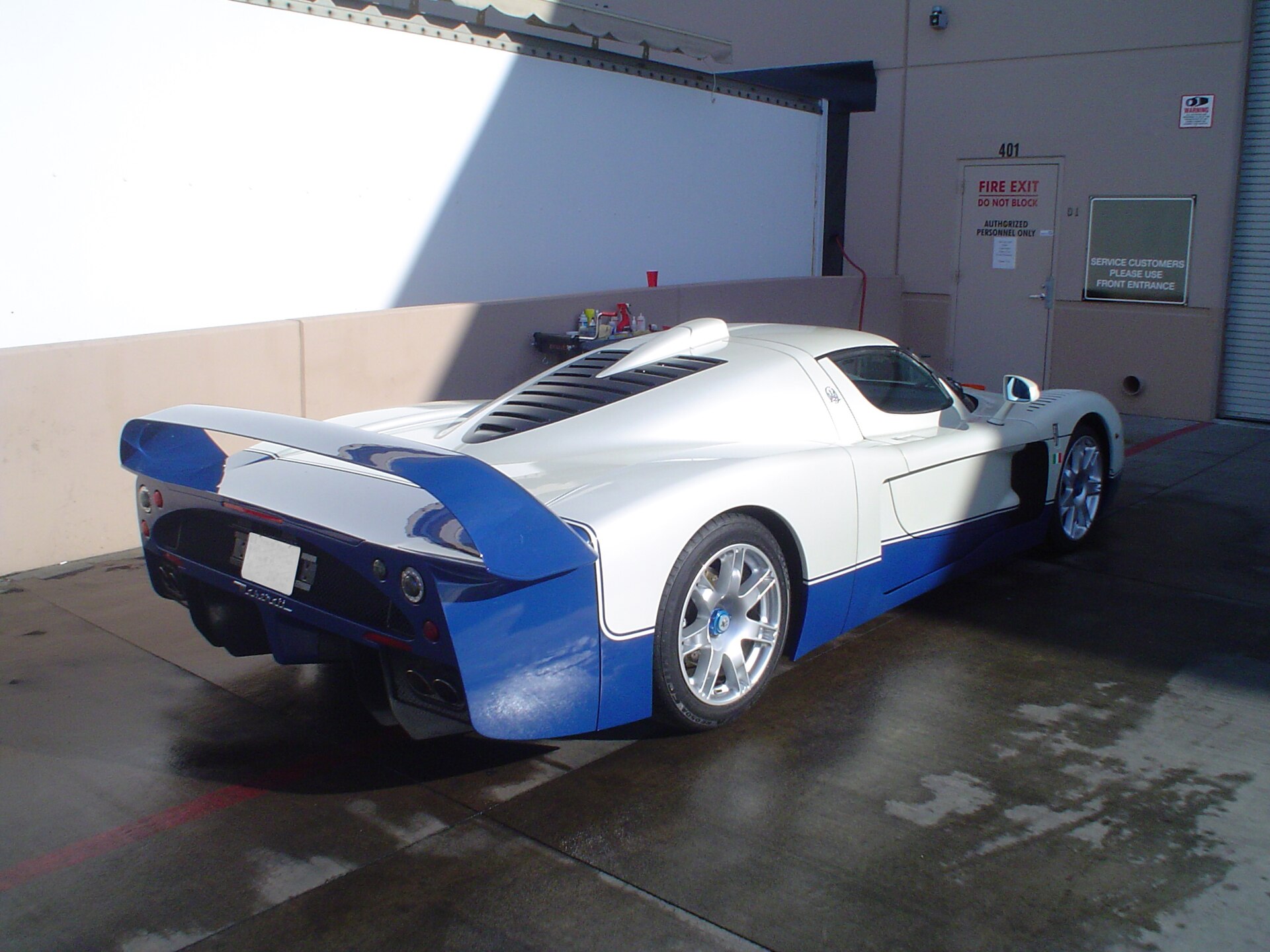
The aerodynamics were shaped for racing. The rear wing is 2 metres wide and 30 mm thick, the underside is smooth and diffusers in the rear bumper create ground effect. An air scoop sits on top of the cabin, which makes the MC12 taller than the Enzo. The weight split is 41% front and 59% rear when the car stands still; at 200 km/h the downforce shifts it to 34% front and 66% rear.
The roof is a removable targa panel, but it cannot be carried in the car. The standard colour scheme was white and blue, a tribute to the America Camoradi racing team; other colours cost extra.

Engine and performance
The engine is a 65° V12 of 5,998 cc, mounted lengthwise behind the cabin. It has four valves per cylinder, dry-sump lubrication and a compression ratio of 11.2:1, and it weighs 232 kg. Unlike the Enzo, whose camshafts are chain-driven, the MC12 engine uses gear-driven camshafts. Output is 463 kW (630 PS) at 7,500 rpm and 652 Nm at 5,500 rpm. The red line is 7,500 rpm (safe to 7,700 rpm), lower than the Enzo's 8,000 rpm.
| Version | Power | Torque | 0–100 km/h | Top speed |
|---|---|---|---|---|
| MC12 (road car) | 463 kW (630 PS) at 7,500 rpm | 652 Nm at 5,500 rpm | 3.8 s (Motor Trend: 3.7 s) | 330 km/h |
| MC12 Versione Corse (track) | 555 kW (755 PS) at 8,000 rpm | not published | not published | not published |
Wikipedia lists 0–200 km/h in 9.9 seconds, a standing quarter mile in 11.3 seconds at 200 km/h and a standing kilometre in 20.1 seconds. The Enzo accelerates and brakes harder and reaches 350 km/h, 20 km/h more than the MC12. On the Top Gear test track the Stig lapped the MC12 in 1:18.9, a tenth of a second faster than the Enzo.
Chassis and cabin
The structure is a carbon and Nomex monocoque with aluminium subframes at the front and rear. The suspension uses double wishbones with pushrod-operated coil springs, and a button raises the nose for ramps and speed bumps. The driver can choose between "Sport" (the default) and "Race" modes; Race reduces the intervention of the Bosch ASR traction control, speeds up the gear changes and stiffens the suspension.
The Cambiocorsa gearbox is a six-speed automated manual with a 150-millisecond shift time and a 215 mm twin-plate dry clutch. The 19-inch wheels carry Pirelli P Zero Corsa tyres (245/35 ZR19 front, 345/35 ZR19 rear). Brakes are by Brembo with Bosch ABS: 380 mm discs with six-piston calipers at the front and 335 mm discs with four-piston calipers at the rear.
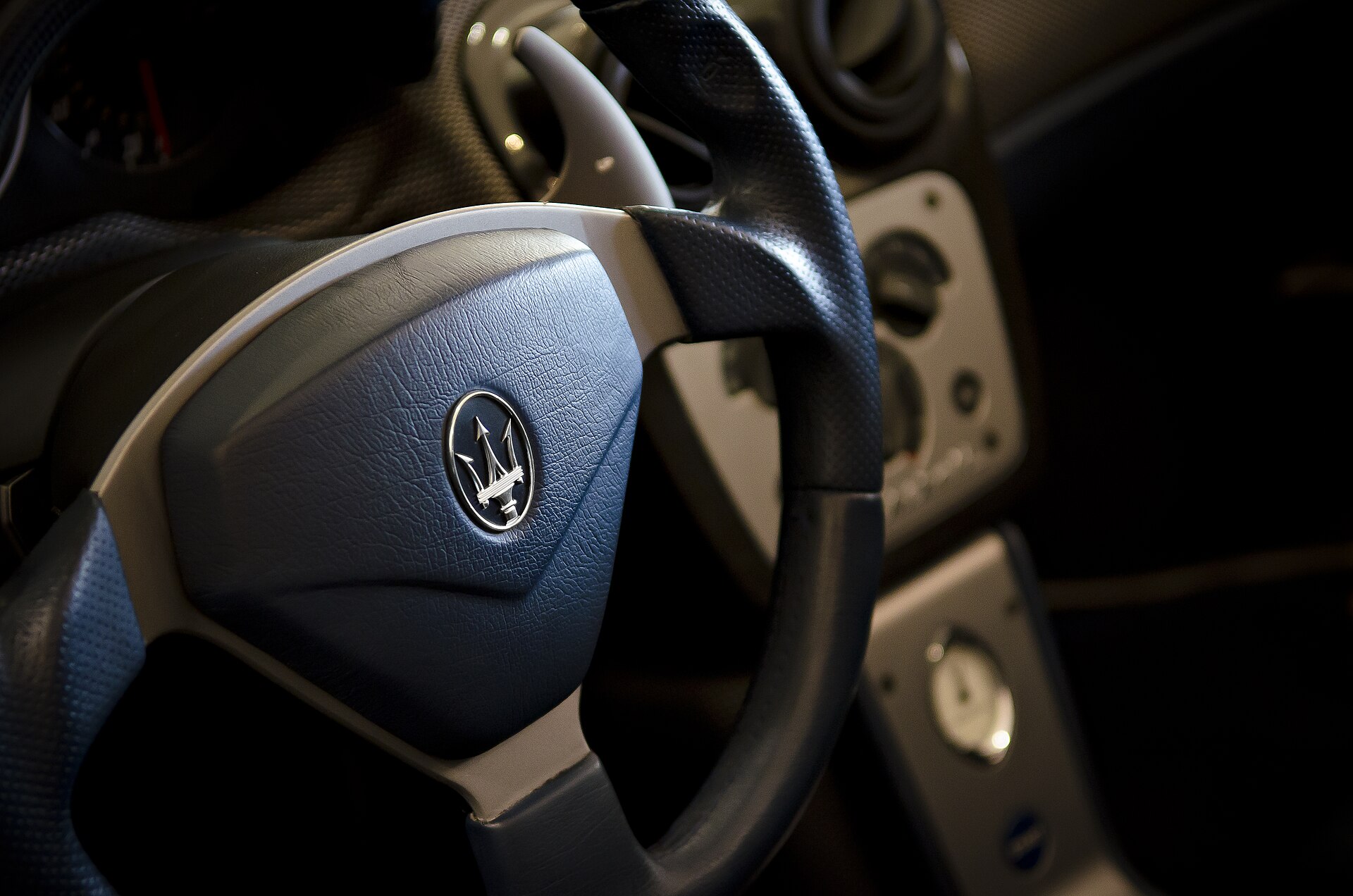
The cabin is strictly functional. There is no rear window, no boot, no spare wheel and no radio. Reviews were mixed: critics called the car hard to drive, too large and too expensive, and Jeremy Clarkson complained about the missing rear window while praising the ride. Motor Trend praised its stability and forgiving handling at the limit, and Automobile Magazine called it "user-friendly".

Racing: the MC12 GT1
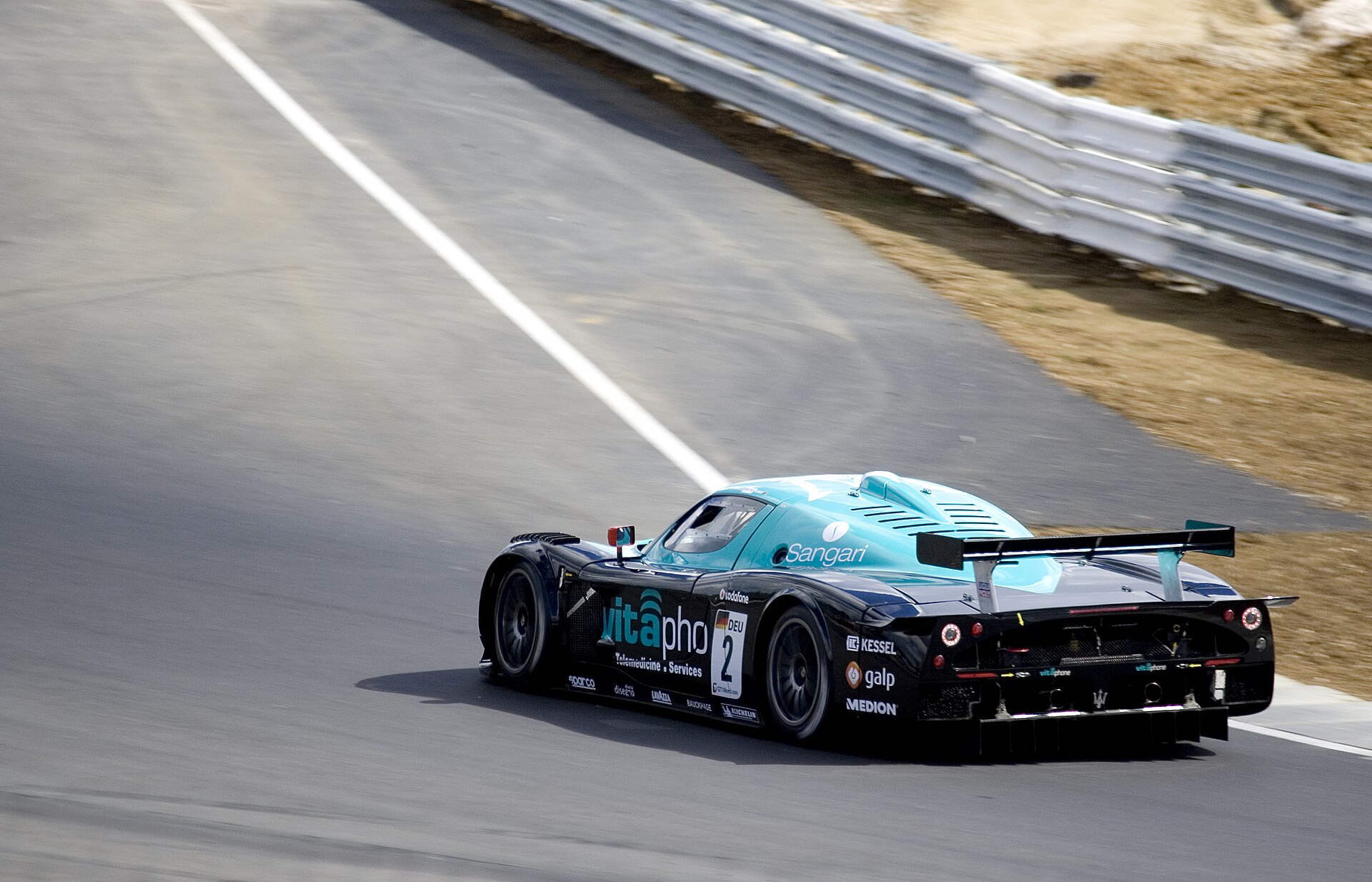
The racing MC12 GT1 made its debut with AF Corse in the 2004 FIA GT Championship. At Imola the FIA withheld points because of homologation questions, although the cars finished second and third. The first win came at Oschersleben, with Andrea Bertolini and Mika Salo, followed by Zhuhai, where the car scored points after full homologation.
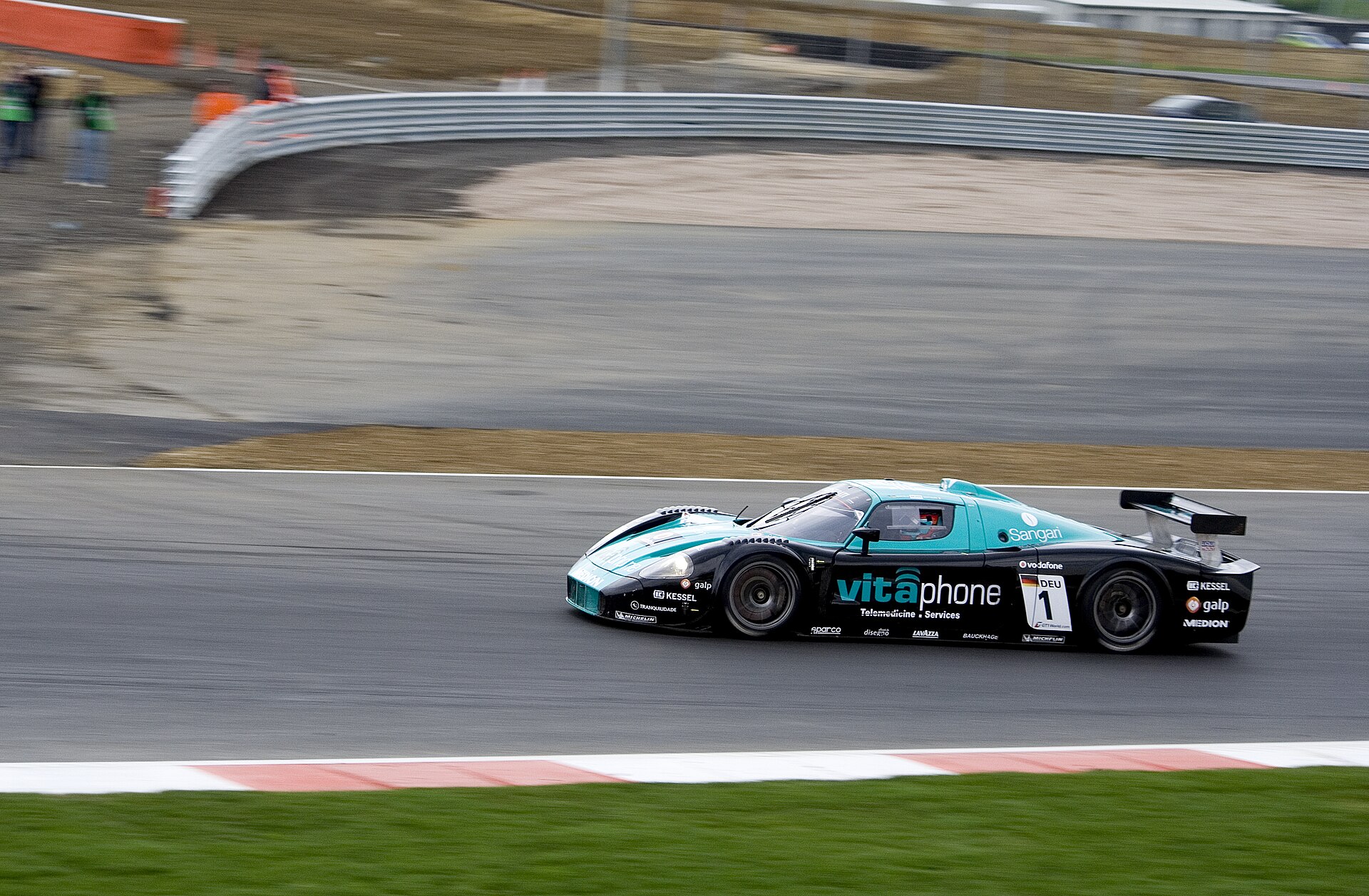
From 2005 the MC12 dominated:
- 2005: Maserati won the Manufacturers' Cup with 239 points to Ferrari's 125; Vitaphone Racing won the teams' title and JMB Racing was second.
- 2006: Vitaphone won the teams' title, and Bertolini and Michael Bartels finished level at the top of the drivers' standings.
- 2007: Vitaphone won the teams' title, Maserati the Manufacturers' Cup and Thomas Biagi the drivers' title.
- 2008 and 2009: Vitaphone took further team titles, and Bertolini and Bartels won the drivers' championship both years.
- 2010: in the new FIA GT1 World Championship, Vitaphone won five races and both the drivers' and the teams' titles.
In Italy, Scuderia Playteam won the Italian GT Championship in 2005 and 2006, and Racing Box won the 6 Hours of Vallelunga in both years.
The car's size kept it out of some series. In 2004 it was longer and wider than the ACO allowed, so it could not race at Le Mans or in the American Le Mans Series. Even with the nose shortened by 201 mm it was still 66 mm too wide. In 2005 IMSA admitted it to the ALMS as a guest without championship points and with a weight penalty; Risi Competizione ran a car that year, and Doran Racing raced a former GT1 car in 2007.


MC12 Versione Corse
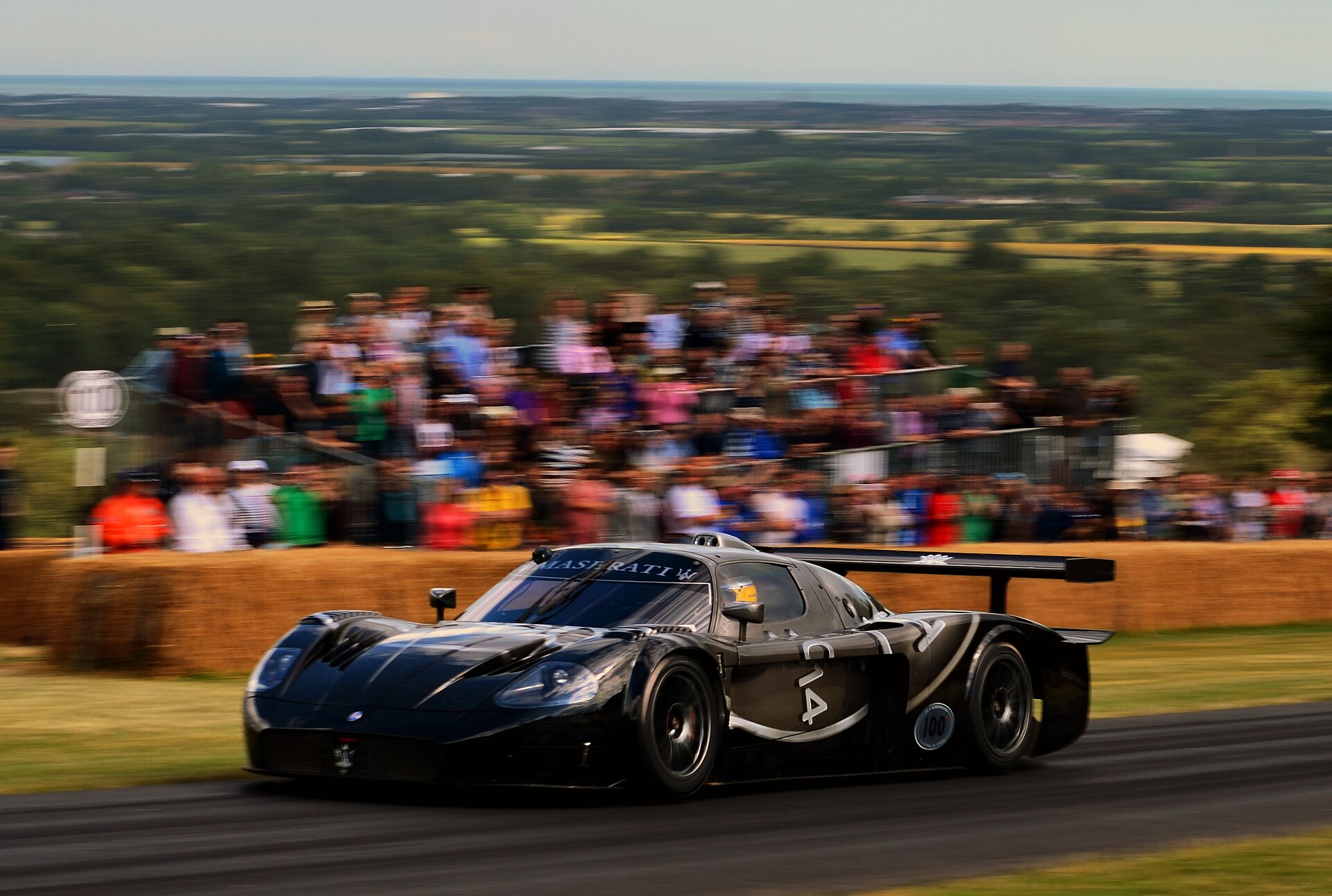
In mid-2006 Maserati released the MC12 Versione Corse, a track-only car developed from the 2005 GT1 racer. Twelve were sold to customers at €1 million each in 2006, and three more were built for testing and publicity. It shares the GT1's shortened nose and its engine, with 555 kW (755 PS) at 8,000 rpm, and uses racing brakes without ABS. The standard colour was "Blue Victory".
The cars belong to private owners, but Maserati looks after their storage, upkeep and maintenance. Three Corse cars were later converted for road use by Edo Competition, with slightly more power and adjustable suspension.

Legacy
The MC12 also gave its chassis to the Maserati Birdcage 75th, a concept car designed by Pininfarina to celebrate its 75th anniversary and shown at the Geneva motor show in 2005; its name recalls the Tipo 61 "Birdcage" racing car of the early 1960s. More of the brand's story is told in our history of Maserati.
Photo gallery


Maserati MC12 in our rankings
Maserati MC12 photos 6
FAQ
How many Maserati MC12s were built?
50 road cars — 25 in 2004 and 25 in 2005 — plus 12 Versione Corse track cars sold to customers and three more for testing and publicity.
Is the MC12 a Ferrari Enzo?
It uses the Enzo's chassis, a modified version of its V12 and its gearbox, but has a different, larger carbon body. The only visible part the two cars share is the windscreen.
How fast is the Maserati MC12?
Its top speed is 330 km/h, and it reaches 100 km/h in 3.8 seconds; Motor Trend measured 3.7 seconds.
Why does the MC12 have no rear window?
There is a large air scoop on the cabin roof and the body was shaped for racing aerodynamics. The road car has no rear window, boot, spare wheel or radio.
What did the MC12 win in racing?
The Manufacturers' Cup of the FIA GT Championship in 2005 and 2007, six consecutive team titles for Vitaphone Racing (2005–2010) and several drivers' titles.
Data sources
Data checked by an editor against the sources below.