 Maserati Mistral
Specs, engines and history
Published Sources (1) Report an error
By Felix Hartmann, Automotive Technology & EV Contributor
- Built
- 1963–1970
- Top power
- 198 kW (269 PS)
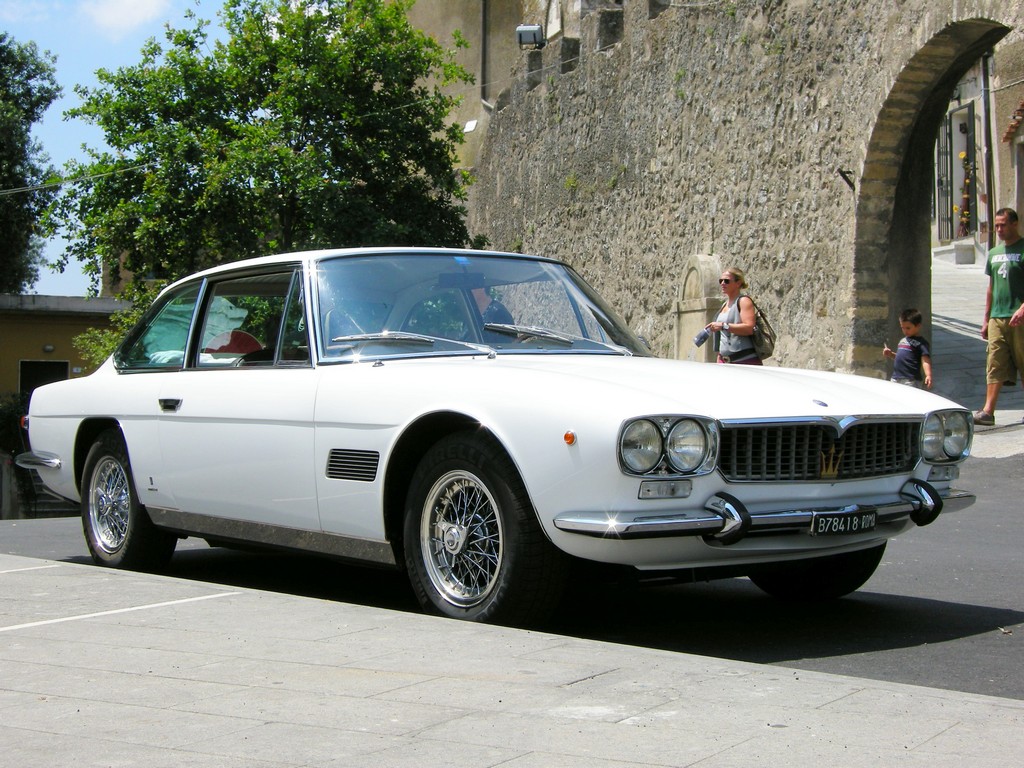
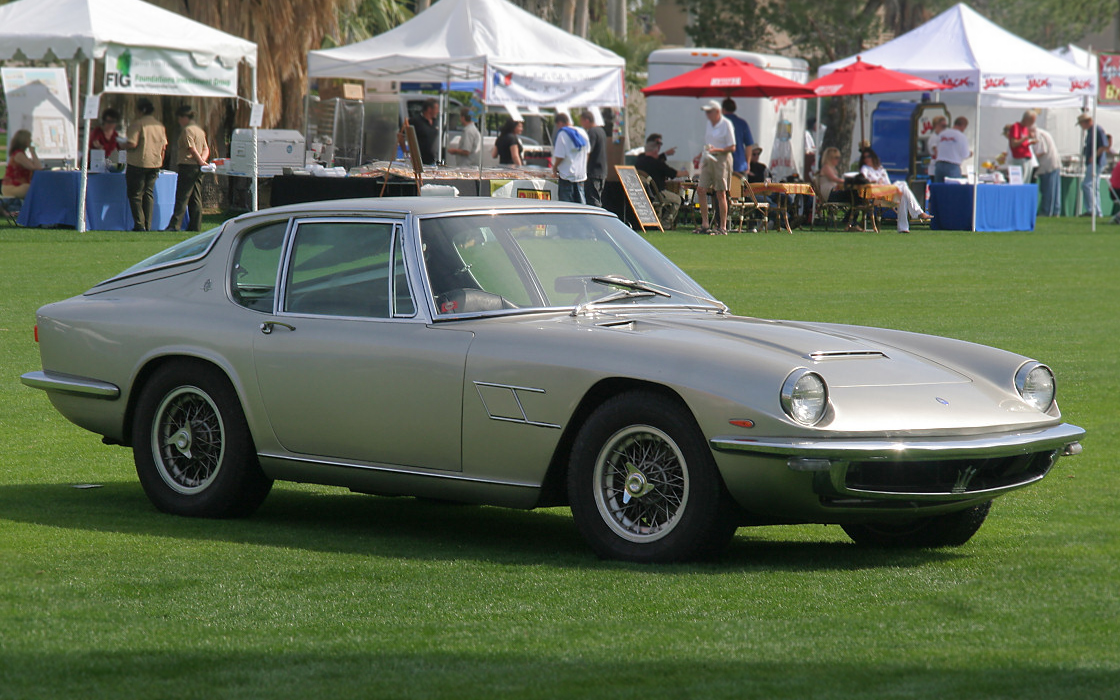
The Maserati Mistral is a two-seat grand tourer that Maserati built from 1963 to 1970 as a coupé and a Spyder. Styled by Pietro Frua, it replaced the 3500 GT and was the last Maserati road car powered by the company's twin-cam straight-six, an engine family that traced its roots to the 250F racing car. It was also the first Maserati of the classic era named after a wind, a tradition that continued with the Ghibli, Bora and Merak. In total 968 cars were built.
In short
- Previewed at the Turin motor show in November 1963; built until 1970; 968 cars (844 coupés and 124 Spyders).
- Twin-spark, twin-cam straight-six with Lucas fuel injection in 3.5, 3.7 and 4.0-litre versions: 175–198 kW (235–265 bhp).
- Five-speed ZF manual gearbox, independent front suspension, live rear axle, disc brakes on all wheels.
- Top speed about 225–233 km/h; dry weight about 1,430 kg.
At a glance: Maserati Mistral
| Specification | Maserati Mistral (Tipo AM109) |
|---|---|
| Production | 1963–1970 |
| Cars built | 968 (844 coupés, 124 Spyders) |
| Body | two-seat coupé and Spyder by Frua, built by Maggiora |
| Engine | twin-spark DOHC straight-six, 3,500, 3,700 or 4,000 cc |
| Power | 175 kW (235 bhp) to 198 kW (265 bhp) |
| Fuel system | Lucas indirect injection |
| Gearbox | five-speed ZF manual |
| Dry weight | about 1,430 kg |
| Dimensions | 4,500 mm long, 1,675 mm wide, 1,300 mm high, 2,400 mm wheelbase |
| Predecessor / successor | 3500 GT / Ghibli |
The Mistral followed the Maserati 3500 GT and is part of the classic range in the Maserati catalogue.
History of the Maserati Mistral
Maserati showed the new car at the Turin motor show in November 1963. Internally it was the Tipo AM109, and it was also known as the "Maserati 2 Posti" (two-seater) or "Maserati 4000 GT". As the successor to the 3500 GT it kept a six-cylinder engine.
The name Mistral refers to the cold northerly wind of southern France. It was the first of the classic Maseratis to be named after a wind. The Mistral stayed in production until 1970, overlapping from 1967 with its successor, the V8-powered Ghibli.
Design by Frua
The body was styled by the Turin designer Pietro Frua and built by the coachbuilder Maggiora, also in Turin. The coupé is a compact fastback two-seater, 4,500 mm long on a short 2,400 mm wheelbase. Bodies were made in aluminium and, from 1967, also in steel; nobody knows exactly how many of each were built.
The Mistral is often confused with the AC 428, another Frua design of the same period. The AC looks very similar but is larger and more powerful.

The twin-spark straight-six
The engine is a straight-six with two overhead camshafts, two spark plugs per cylinder, hemispherical combustion chambers and Lucas indirect fuel injection. Its design was derived from the Maserati 250F racing car, which won eight Grands Prix between 1954 and 1960 and the 1957 Formula 1 World Championship with Juan Manuel Fangio. The Mistral was the last Maserati with this engine; later road cars used V8s.
| Version | Displacement | Power | Coupés | Spyders |
|---|---|---|---|---|
| Mistral 3500 | 3,500 cc | 175 kW (235 bhp) at 5,500 rpm | 3 | 27 |
| Mistral 3700 | 3,700 cc | 183 kW (245 bhp) at 5,500 rpm | 387 | 46 |
| Mistral 4000 | 4,000 cc | 198 kW (265 bhp) at 5,200 rpm | 454 | 51 |
Power goes to the rear wheels through a five-speed ZF manual gearbox. Wikipedia gives a top speed of about 225–233 km/h, depending on the engine.
Chassis
The Mistral has independent front suspension and a solid rear axle, with solid disc brakes at all four wheels. The dry weight is given as about 1,430 kg. The original tyres were Pirelli Cinturato 185VR16, later 205VR15, mounted on Borrani wire wheels.
Coupé and Spyder
Most buyers chose the coupé: 844 were built against 124 Spyders. The open car was offered with all three engine sizes, and 20 Spyders were built with right-hand drive. Over the production run the 3.7-litre and 4.0-litre engines accounted for almost all cars; only 30 were built with the original 3.5-litre engine.

The 3500 GT heritage
The Mistral took over from one of Maserati's most important road cars. The 3500 GT (Tipo 101) of 1957–1964 was the company's first large-series grand tourer: 2,226 coupés and convertibles were built in Modena, with a best year of 500 cars in 1961. Its 3,485 cc twin-cam straight-six, derived from the 350S racing engine, produced 162 kW (220 PS) with three Weber carburettors or 173 kW (235 PS) with Lucas mechanical fuel injection; the fuel-injected GTi of 1961 was the first Italian production car with fuel injection.
The Mistral kept this engine family and its Lucas injection, enlarged it to 3.7 and 4.0 litres, and placed it in a compact two-seat body styled by Frua. Alongside it, the four-seat Sebring used the same mechanical base until 1968.
Legacy
The Mistral closed the chapter of six-cylinder Maserati grand tourers that had started with the 3500 GT. Its successor, the Ghibli, moved to a V8 and to the wind names that later Maseratis also used. For the background of the company, read our history of Maserati.
Photo gallery

Maserati Mistral in our rankings
- No. 489 of 859 · Most powerful cars (198 kW · top 58%)
- No. 485 of 912 · Longest-running car nameplates (7 years · top 60%)
- No. 90 of 127 · Most powerful Italian cars (198 kW · top 71%)
- No. 249 of 313 · Most powerful coupes (198 kW · top 80%)
More powerful than 42% of ranked cars in the 1CARS catalog (No. 489 of 859).
FAQ
How many Maserati Mistrals were built?
968 cars were built between 1963 and 1970: 844 coupés and 124 Spyders, 20 of them with right-hand drive.
What engine does the Mistral have?
A twin-spark, twin-cam straight-six with Lucas fuel injection, offered as a 3.5, 3.7 or 4.0-litre with 175–198 kW (235–265 bhp).
Who designed the Maserati Mistral?
Pietro Frua styled the body, and the coachbuilder Maggiora of Turin built it, first in aluminium and from 1967 also in steel.
Why is it called Mistral?
After the cold northerly wind of southern France. It was the first classic Maserati named after a wind, a custom later continued by the Ghibli.
How fast is the Mistral?
Its top speed is about 225–233 km/h, depending on the engine size.
Data sources
Data checked by an editor against the sources below.